Microfabricated dynamic brain organoid cocultures to assess the effects of surface geometry on assembloid formation

Academic Article

Microfabricated dynamic brain organoid cocultures to assess the effects of surface geometry on assembloid formation

Camille Cassel de Camps, Sabra Rostami, Vanessa Xu, Chen Li, Paula Lépine, Thomas M. Durcan and Christopher Moraes

Organoids have emerged as valuable tools for the study of development and disease. Assembloids are formed by integrating multiple organoid types to create more complex models. However, the process by which organoids integrate to form assembloids remains unclear and may play an important role in the resulting organoid structure. Here, a microfluidic platform is developed that allows separate culture of distinct organoid types and provides the capacity to partially control the geometry of the resulting organoid surfaces. Removal of a microfabricated barrier then allows the shaped and positioned organoids to interact and form an assembloid. When midbrain and unguided brain organoids were allowed to assemble with a defined spacing between them, axonal projections from midbrain organoids and cell migration out of unguided organoids were observed and quantitatively measured as the two types of organoids fused together. Axonal projection directions were statistically biased toward other midbrain organoids, and unguided organoid surface geometry was found to affect cell invasion. This platform provides a tool to observe cellular interactions between organoid surfaces that are spaced apart in a controlled manner, and may ultimately have value in exploring neuronal migration, axon targeting, and assembloid formation mechanisms.

Keywords: Assembloid; brain organoid; co‐culture; organ‐on‐a‐chip.

We kindly thank the researchers at McGrill University for this collaboration and for sharing the results obtained with our CADworks3D system.​

1. Introduction

Organoids have gained popularity as experimental models for developmental and disease studies.[1-11] Grown from stem cells, these 3D tissue-engineered cultures can differentiate toward diverse lineages that capture the complexity of in vivo tissues.[1-9] Multiple organoid types can also be assembled to interact, fuse, and mature[12-14] and these “assembloids” can hence capture some of the additional cellular diversity and architectural complexity of multi-component organ systems, compared to single-type organoids.[12, 13, 15, 16] In the developing brain, for example, complex circuits are established by neuronal projection and migration to create both local and long-distance connections.[13, 17-19] Regionalized organoids can hence be assembled to create in vitro models of the circuits that run throughout the brain. For example, functional synaptic connections can form between cortical and striatal organoids, specific neurons can migrate from ventral to dorsal forebrain organoids,[20, 21] and muscle contraction can be stimulated by brain organoid activity.[22] Assembloids can hence be powerful in vitro models for a wide variety of neurodevelopmental disease processes.[20, 21]

Tissue geometry is now well-established to influence fundamental cellular processes, such as proliferation, differentiation, branching, and invasion.[23-30] Driven by endogenous mechanical cellular stresses that spontaneously arise in three-dimensional tissues,[24, 25, 31] these cellular phenotypes drive feedback loops that govern tissue organization, specification, and maturation.[23, 26, 32] While previous studies have demonstrated that geometric confinement and associated mechanical stresses drive the organization of developing neural structures,[33, 34] whether these geometric features play a role in neural organoid development and assembloid formation remains an open question. Such experiments would require the technical capacity to simultaneously impose a specific geometry on independently cultured organoids, and control their relative positions before allowing them to interact. Moreover, such experiments would require long-term culture in biologically permissive and optically addressable formats. Given the intrinsic challenges associated with precisely manipulating soft living matter, technical innovations are required to better understand assembloid formation.

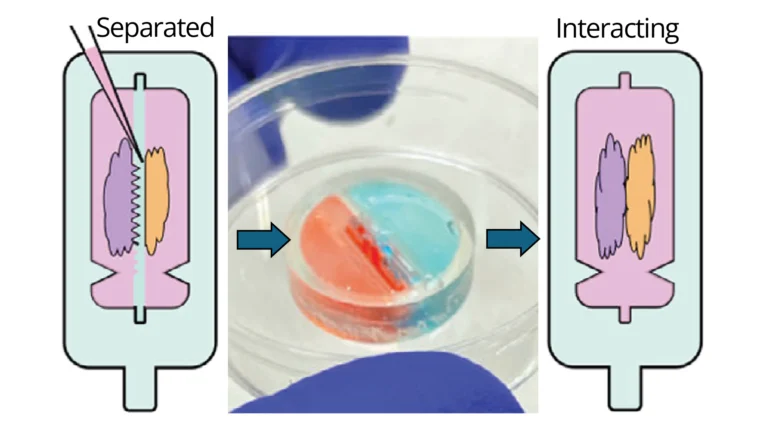
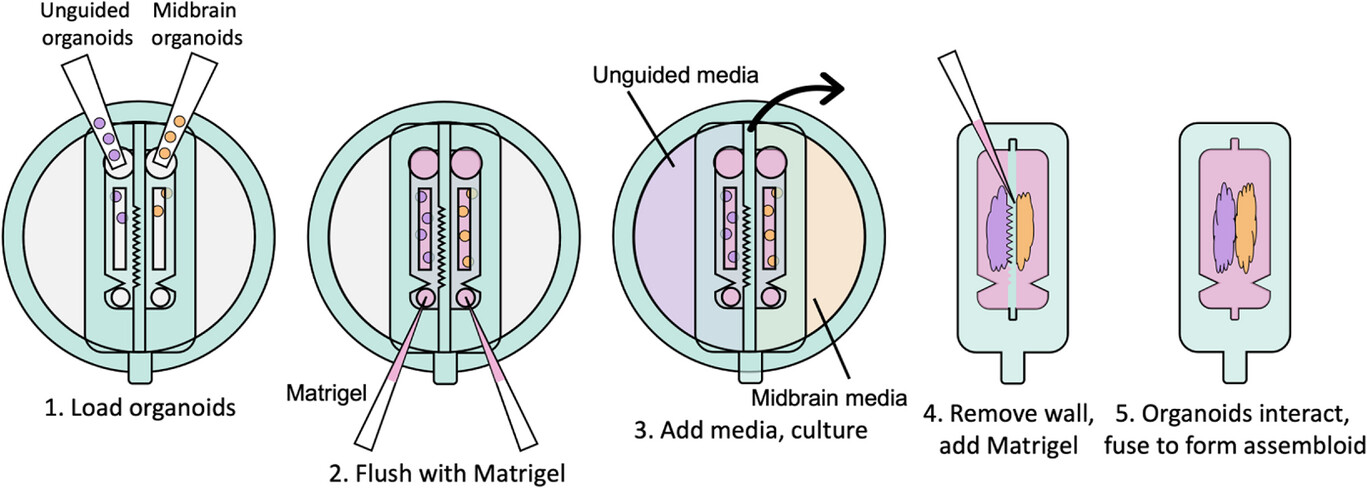
Recent developments in organoid culture models suggest a path to achieve these goals. Park et al. recently developed a microfabricated culture approach in which oxygen-permeable silicone inserts are used to restrict the size and shape of intestinal organoids as they grow into a hydrogel matrix.[35] This approach was successfully used to allow stem cell proliferation and maturation, while controlling the global geometry of mature intestinal organoids, such that diffusive transport of oxygen, nutrients, and waste was sufficient to prevent the formation of a necrotic core that commonly arises in large, dense tissues.[35] Although very promising, this strategy has yet to be demonstrated for other types of organoids. Inspired by this approach, here we develop a strategy to separately culture distinct brain organoid types in adjacent compartments, while shaping the surface geometry of the tissues; and explore this concept using two types of brain organoids. After establishing mature organoids, an insert separating the organoid compartments can be manually removed and replaced with a thin layer of extracellular matrix, allowing the precisely positioned organoids to begin forming an assembloid (Figure 1). To prove this concept, here we use various channel geometries to shape unguided and midbrain organoids. We demonstrate simultaneous axonal projections emanating from the midbrain organoids, and surface geometry-specific cell migration from unguided organoids. We hence propose that this technical innovation allows systematic investigation of the role of interacting surface geometries in assembloid formation.
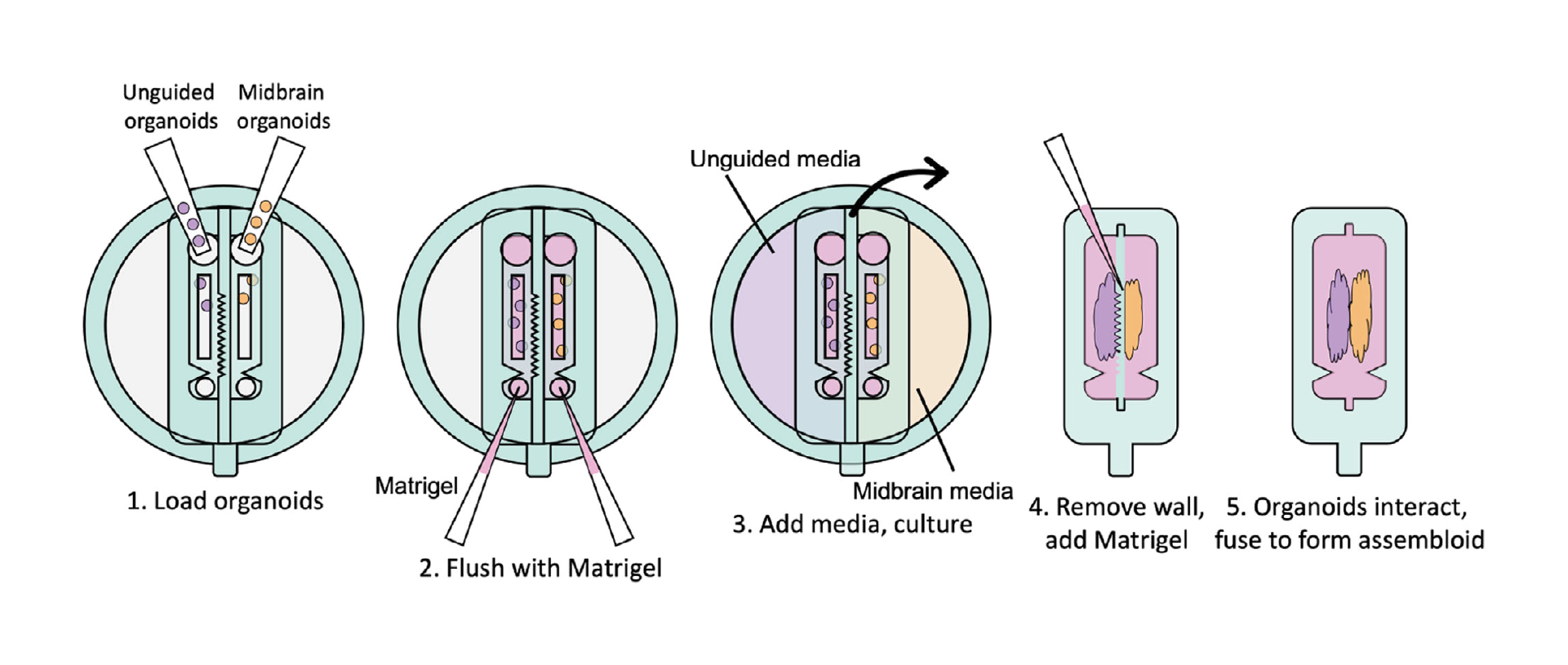
Figure 1. Schematic of device for coculture and assembloid formation. Two different types of organoids are loaded into separate channels and fed by separate media reservoirs. The geometry of the wall separating the channels shapes the organoids as they grow. When mature, the separating wall can be physically removed, allowing the organoids to interact and eventually fuse, while observing their interactions throughout culture.

2. Methods

Unless otherwise stated, all cell culture materials and supplies were purchased from Fisher Scientific (Ottawa, ON) and chemicals were from Sigma-Aldrich (Oakville, ON). The use of induced pluripotent stem cells (iPSCs) in this research was approved by the McGill University Health Centre Research Ethics Board (DURCAN_IPSC/2019-5374).


2.1. Device fabrication process

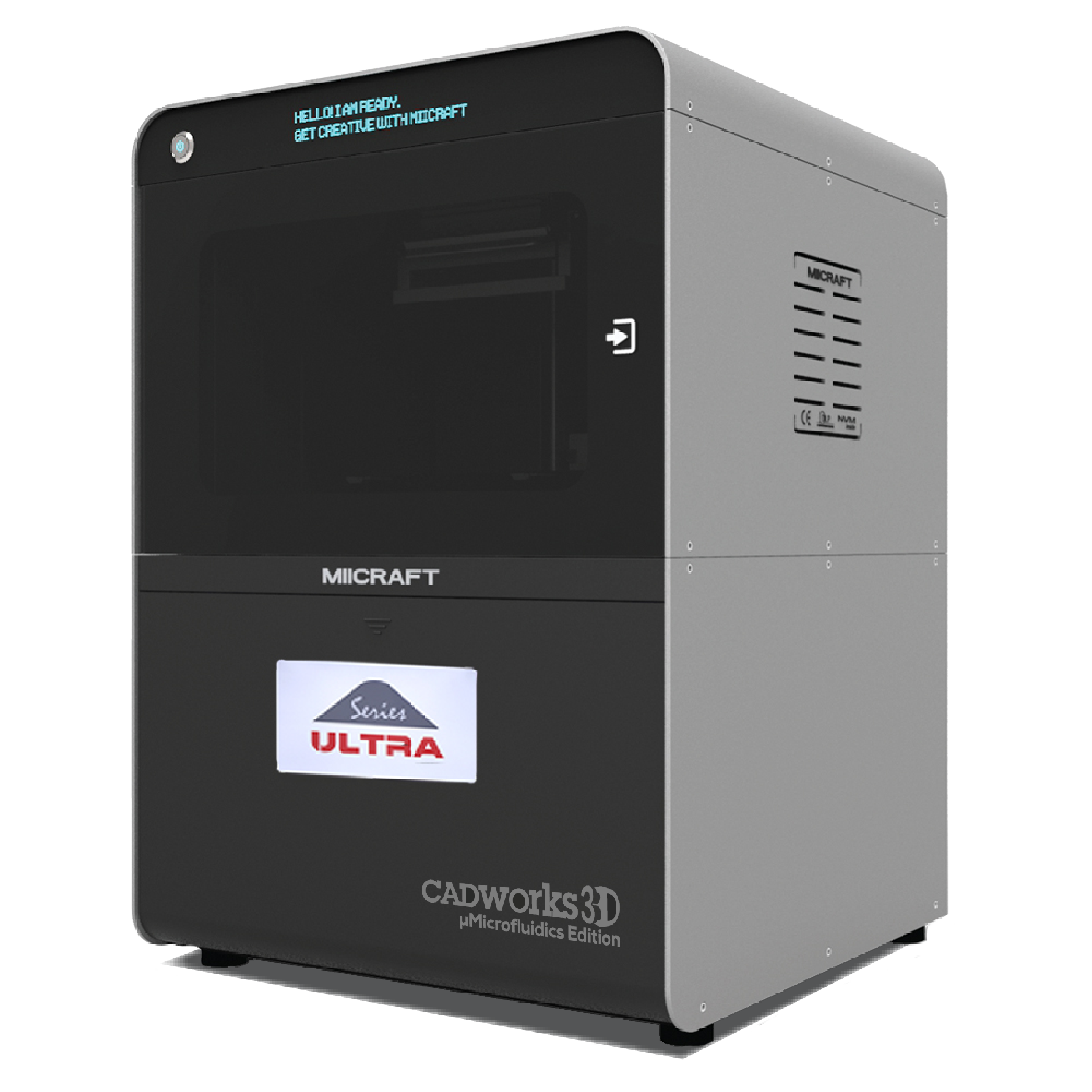
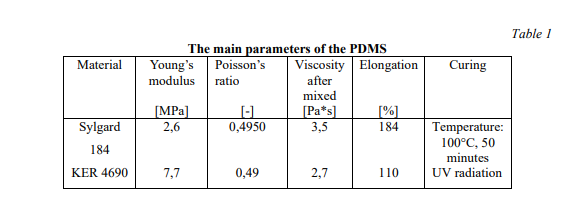
Molds were designed in Fusion 360 (AutoDesk), and printed on a ProFluidics 285D 3D resin printer using Master Mold Resin (CADworks3D) with a layer thickness of 50 µm. After washing with isopropanol, mold pieces were cured in a 36 W ultraviolet (UV) chamber overnight. Molds were designed for assembly into chambers with patterned features on both the base and lid (Figure 2A). Polydimethylsiloxane (PDMS) prepolymer and curing agent were mixed at a ratio of 10:1 w/w, poured into the chamber, and degassed under vacuum. The molded lid was then lowered slowly from one side to avoid trapping air bubbles in the chamber. The lid was then pressed down to displace excess PDMS. Tongue-and-groove convex/concave features in the chamber base and lid contained the PDMS prepolymer after chamber assembly. PDMS was cured overnight in an oven at 40°C to minimize shrinkage[36] and de-molded using 70% ethanol to help release the devices from the 3D printed resin.
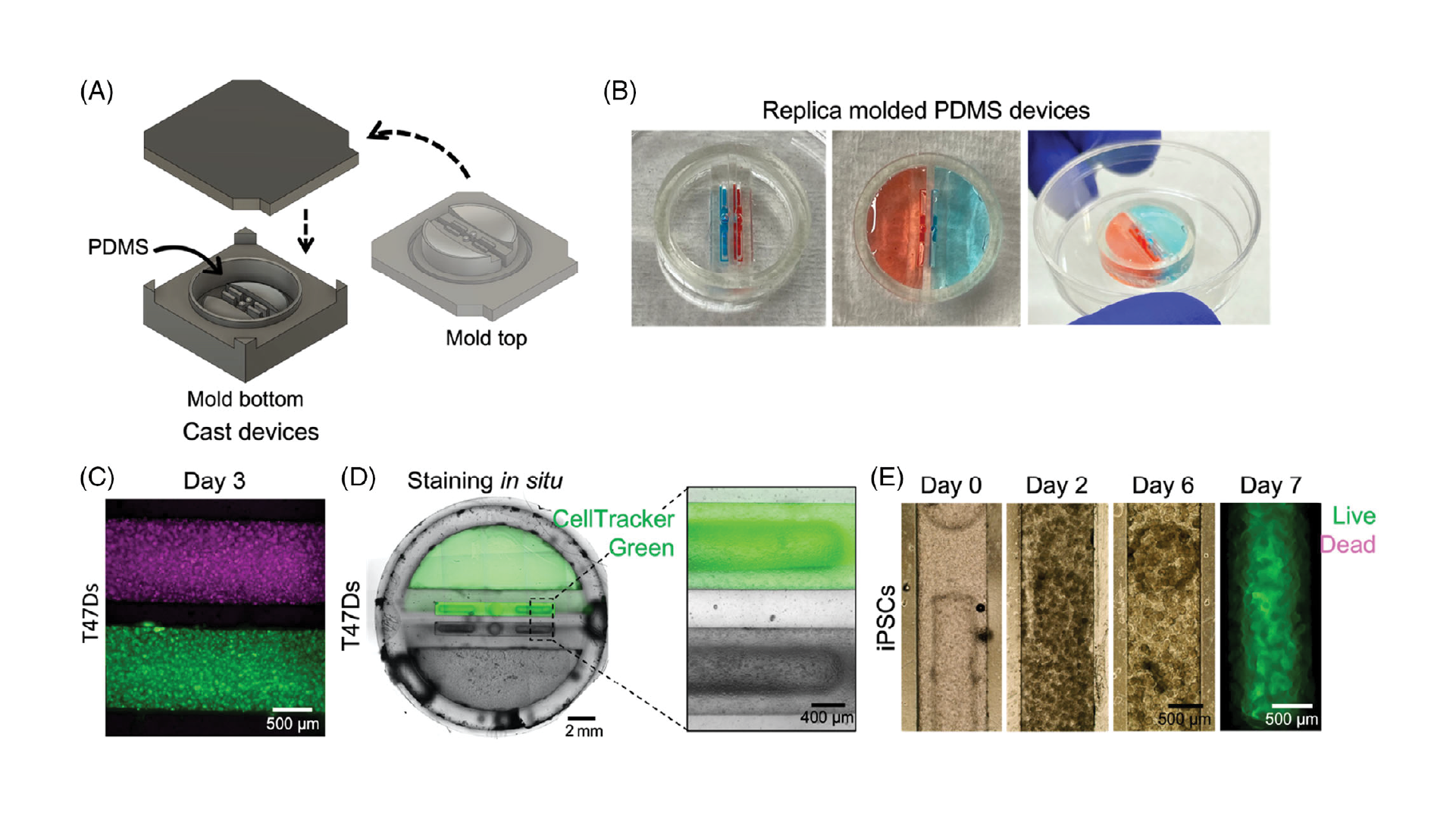
Figure 2. Functional, separate channels and reservoirs. (A) Base and insert parts of displacement mold for casting devices for single cell culture. (B) Replica molded PDMS devices, shown with channels filled with dye, left, and reservoirs filled, middle and right. (C) T47D cells were stained with CellTracker Red or Green, and then loaded into channels with Matrigel. After 3 days of culture, cells remain separated in their respective channels. (D) T47D cells were loaded with Matrigel into both channels of a device, with cells in one channel dyed once inside the channel by adding CellTracker Green to that media reservoir. (E) iPSCs were loaded into channels with Matrigel, and cultured with midbrain organoid media. Live/dead staining shows high viability after 7 days in culture.

Apparatus Used

Master Mold for PDMS

ProFluidics 285D

Apparatus Used

Master Mold for PDMS

ProFluidics 285D

2.2. Device preparation for organoid culture

Base devices were coated with dopamine to improve adhesion to Matrigel.[37] Briefly, dopamine hydrochloride was dissolved in 10 mM Tris buffer (pH 8.5; 2 mg mL−1), pipetted into the devices, and incubated overnight at room temperature. After treatment, devices were rinsed in reverse osmosis water, and dried with a stream of dry compressed air. To facilitate release from the devices and reduce adhesion to tissue cultures, the removable inserts were passivated with Pluronic® F-68 (5% in water) overnight at room temperature.[38, 39] Treated devices were rinsed in water, and dried with compressed air. All components were sterilized for 20 min in a 36 W UV chamber before assembly. Devices were assembled on a coverslip, which formed the bottom of the media reservoirs and allowed the device to be easily manipulated as a unit. For experiments without a removable insert, glass coverslips were used as the base surface, after functionalization with dopamine. Assembled devices were sterilized by UV for 45 min.

2.3. Cell culture

The AIW002-2 iPSC line (male) was used to generate unguided (previously referred to as “cerebral” organoids), and the TD22 iPSC line (male) was used to generate midbrain organoids, following established and characterized protocols[40, 41] with some previously-described modifications.[42] Both lines were obtained from The Neuro’s C-BIG repository and had undergone multistep quality control.[43] T47D human breast cancer cells (ATCC HTB-133) were used for preliminary validation experiments with the microfluidic device.

All cell cultures were maintained at 37°C with 5% CO2. T47D cells were cultured in Dulbecco’s Modified Eagle Medium with 10% fetal bovine serum and 1% antibiotic–antimycotic (complete DMEM). Media was changed every 3–4 days, and cells were passaged using 0.25% trypsin–EDTA at 80% confluence in a 1:5 dilution. The iPSC lines TD22 and AIW002-02 were maintained on Matrigel-coated plates in mTeSR1 complete kit media (Basal medium with supplement; STEMCELL Technologies, Cat No. 85850) with daily media changes. iPSC plated petri dishes were checked every day for spontaneous differentiation using a brightfield microscope. In cases where cells with morphologies different from iPSC colonies were detected, locations were marked and then in the BSC, cells on the marked locations were scraped off using a P200 pipette tip. Then, the media was collected, and the plate was washed with DMEM-F12 media supplemented with 1% antibiotic-antimycotic to ensure the removal of the scraped cells from the culture. iPSC cells were passaged with Gentle Cell Dissociation Reagent (StemCell Technologies) at 70% confluence. A ratio of 1:10 was maintained throughout all passages in which the colony pellet was broken down in such a way that each fragment contained between 10 and 15 cells. The homogeneity of the colony sizes in the sub-culture was assessed the next day by imaging with a brightfield microscope. At this step, colonies that were either too large or too small were scraped off and removed from the culture using the same method mentioned for removal of spontaneous differentiation.

2.4. Organoid culture

When iPSC cultures reached 70% confluence, cells were detached with Accutase (Gibco), resuspended in the appropriate media, seeded at 10,000 cells per well in 96-well round-bottom ultralow attachment plates (Corning Costar), and centrifuged for 10 min at 1200 rpm to aggregate the cells. Organoids were seeded so that they would be ready for Matrigel embedding simultaneously (Day 7 for midbrain, and Day 12 for unguided).


Media was changed every other day according to published protocols.[40, 41] For unguided organoids: human embryonic stem cell (hES) media (low basic fibroblast growth factor (bFGF), with ROCK inhibitor) was used on Day 0 (consisting of 400 mL DMEM-F12 + Glutamax, 100 mL Knockout Serum Replacement, 15 mL hESC-quality FBS (Gibco), 5 mL MEM- non-essential amino acids, 3.5 µL 2-mercaptoethanol, bFGF at 4 ng mL−1 final concentration, and ROCK inhibitor at 50 µM final concentration); hES media (low bFGF, no ROCK inhibitor) on Day 2; hES media (no bFGF, no ROCK inhibitor) on Day 4; neural induction media on Day 7 and 9 (consisting of DMEM-F12 + Glutamax, 1% N2 supplement, 1% MEM-non-essential amino acids (MEM-NEAA), and heparin at 1 µg mL−1 final concentration); cerebral organoid differentiation media without vitamin A on Day 12 and 14 (consisting of 125 mL DMEM-F12 + Glutamax, 125 mL Neurobasal, 1.25 mL N2 supplement, 62.5 µL insulin, 1.25 mL MEM-NEAA, 2.5 mL penicillin-streptomycin, 1.75 µL of 1/10 2-mercaptoethanol dilution in neurobasal, and 2.5 mL B27 supplement without vitamin A); cerebral organoid differentiation media with vitamin A on Day 16 onwards (made using B27 supplement with vitamin A).


For midbrain organoids: neuronal induction media was used on Day 0 (consisting of 25 mL DMEM-F12 + Glutamax + 1% antibiotic-antimycotic, 25 mL neurobasal, 500 µL N2 supplement, 1 mL B27 without vitamin A, 500 mL MEM-NEAA, 1.75 µL of 1/10 2-mercaptoethanol dilution in neurobasal, heparin at 1 µg mL−1 final concentration, SB431542 at 10 µM final concentration, noggin at 200 ng mL−1 final concentration, CHIR99021 at 0.8 µM final concentration, and ROCK inhibitor at 10 µM final concentration); neuronal induction media without ROCK inhibitor was used on Day 2; midbrain patterning media was used on Day 4 (consisting of neuronal induction media without ROCK inhibitor with the addition of Sonic Hedgehog (SHH) at 100 ng mL−1 final concentration, and Fibroblast Growth Factor 8 (FGF8) at 100 ng mL−1 final concentration); tissue induction media was used on Day 7 (consisting of 50 mL neurobasal, 500 µL N2 supplement, 1 mL B27 without vitamin A, 500 mL MEM-NEAA, 1.75 µL of 1/10 2-mercaptoethanol dilution in neurobasal, 12.5 µL insulin, laminin at 200 ng mL−1 final concentration, SHH at 100 ng mL−1 final concentration, FGF8 at 100 ng mL−1 final concentration, and 50 µL penicillin-streptomycin); final differentiation media was used on Day 8 onwards (consisting of 50 mL neurobasal, 500 µL N2 supplement, 1 mL B27 without vitamin A, 500 mL MEM-NEAA, 1.75 µL of 1/10 2-mercaptoethanol dilution in neurobasal, brain-derived neurotrophic factor (BDNF) at 10 ng mL−1 final concentration, glial cell line-derived neurotrophic factor (GDNF) at 10 ng mL−1 final concentration, ascorbic acid at 100 µM final concentration, db-cAMP at 125 µM final concentration, and 50 µL penicillin-streptomycin).


2.5. Device loading

Cell cultures were either loaded as single cells or as pre-formed organoids into the devices. Single cell cultures were obtained by trypsinization (T-47D, breast cancer line) or detachment (TD22 iPSCs, using Accutase as previously described[42]) and resuspended in undiluted Matrigel (Corning 356230) at concentrations of 8 × 10⁶ cells mL−1 for T-47D, or 1 × 10⁶, 3 × 10⁶, or 1 × 10⁷ cells mL−1 for iPSCs. All pipetting steps were performed with chilled pipette tips to prevent premature polymerization of the Matrigel. To load the organoids into the devices, they were pipetted directly into the loading ports in media with cut P200 pipette tips on Day 12 or 13 after seeding cerebral organoids, and on Day 7 or 8 for midbrain organoids. Once in the chamber, they were too big to pass through the channel restriction. Media was aspirated, leaving the organoids in the device, and replaced with undiluted Matrigel. All devices were incubated for 20 min at 37°C to polymerize the Matrigel. The appropriate media was added after polymerization, and replaced every 2 days.[40]


2.6. Insert removal

Once the organoids had grown and adopted the shapes defined by the compartment dimensions, the inserts separating the compartments were removed. One pair of tweezers was used to hold the base device down, while another was used to slowly pull the insert away. Media was gently aspirated from between the organoids, and replaced with Matrigel to fill in the space. Devices were left at room temperature for 5 min to allow the newly added liquid Matrigel to seep into the existing Matrigel, and then incubated for 20 min at 37°C. Final differentiation medium from the midbrain protocol,[40] with the addition of insulin at a concentration of 0.25 µL mL−1, was added to the well for this stage of combined culture. This media formulation was selected based on consultation and comparison of existing organoid and assembloid protocols and the function of each component,[21, 41, 44] and would need to be adjusted if other types of organoids were grown in the coculture device.


2.7. Tissue staining

Live CellTracker Green or Red were loaded into cells at 20 µM in media overnight at 37°C. Live/dead viability assays were performed with calcein AM and ethidium homodimer-1 (Life Technologies), diluted in media to 4 µM each and incubated with devices for 30 min at 37°C.


For immunostaining, Matrigel was first dissolved using Cell Recovery Solution (Corning; at 4°C for 20 min, twice). Devices were washed twice with phosphate buffered saline (PBS), fixed in 4% paraformaldehyde for 1 h at room temperature, and washed three times for 15 min each with PBS before storage at 4°C until staining. Whole mount staining was performed on organoids directly in the devices, using standard protocols.[42] Briefly, organoids were incubated in blocking buffer (0.5% Triton X-100 + 5% donkey serum in PBS) for 5 h at room temperature, then with primary antibodies diluted in blocking buffer overnight at 4°C. Organoids were then washed with PBS, three times for 15 min each, and then incubated with secondary antibodies and Hoechst diluted in blocking buffer overnight at 4°C. Organoids were washed again as before. Antibodies and stains were used as follows: anti-tyrosine hydroxylase (TH) at 1:200 (rabbit polyclonal, Pel Freez P40101-150), anti-β-tubulin III (Tuj1) at 1:300 (chicken polyclonal, Millipore Sigma AB9354), anti-tau-1 clone PC1C6 at 1:200 (mouse monoclonal, Millipore Sigma MAB3420), anti-glial fibrillary acidic protein (GFAP) at 1:250 (rabbit polyclonal, Millipore Sigma AB5804), anti-microtubule-associated protein 2 (MAP2) at 1:400 (chicken polyclonal, EnCor Biotechnology CPCA-MAP2), goat anti-chicken IgY H&L (DyLight® 488) at 1:500 (Abcam ab96947), donkey anti-rabbit IgG H&L (DyLight® 488) at 1:500 (Abcam ab96891), donkey anti-mouse IgG H&L (DyLight® 594) at 1:500 (Abcam ab96877), donkey anti-Rabbit IgG (H+L) Alexa Fluor™ 594 at 1:500 (Invitrogen A-21207), and Hoescht 33342 at 1:5000 (Invitrogen H3570). Immunostains were performed with a negative control (staining without primary antibody) to confirm that under these imaging conditions, any detected signals were not the result of non-specific binding or autofluorescence.


2.8. Microscopy and image analysis

Devices were imaged using an EVOS transmitted light microscope (XL Core) or an EVOS M7000 fluorescent Imaging System. Images were processed and analyzed in Fiji (NIH).[45] Pairwise stitching was performed using the Stitching plugin[46] when needed. Axonal projections were measured from the organoid surface to projection tip to obtain their length and angle. Cell migration distances were measured from the organoid surface to the edge of the migrating cell front, 2–3 days after removal of the separating wall.


2.9. Statistical analysis

Analyses were performed in R statistical software.[47] All data was confirmed to be normally distributed, with equal variances. The measurements of axonal projection lengths toward nearby organoids were normalized by lengths not directed towards a nearby organoid within samples, and then a two-sample, two-tailed t-test was used to compare between those axons that were directed towards midbrain organoids against those directed toward unguided organoids. The measurements of axonal projection angle for each organoid were used to calculate kurtosis, after centering distributions around the angle defined as toward the nearby organoid; one-sample t-tests were used to compare against random chance (i.e., uniform distribution, kurtosis of 1.8), and a two-sample, two-tailed t-test was used to compare between groups. One-way ANOVA was performed with Tukey post hoc comparisons for measurements of cell migration distance. All analyses for significance were carried out with α = 0.05.

3. Results

3.1. Device design for separated adjacent co-cultures

Double-sided 3D-printed molding chambers (Figure 2A) were essential for the successful operation of these devices, as complex 3D geometries and multiple overhanging and double-sided layer features were required, which could only be achieved by designing interlocking surfaces for double-sided PDMS molding. The PDMS devices themselves were designed to facilitate pipetting of Matrigel and cell/organoid solutions into the channels via inlet ports, while leaving the tops of the channels open for nutrient exchange. This was achieved using an overhanging phase guide that allows surface tension to hold injected liquid (prepolymerized Matrigel) in a confined space, while leaving a slit in the top of the channels open for media exchange (slit was 600 µm across). We adapted this design to create two adjacent channels, each fed by an integrated and independent media reservoir to support growth of organoids with separate media requirements (Figure 2B; shown with red and blue liquids to represent different media formulations).


We first verified that our devices were operational, suitable for cell culture, and that the media reservoirs were functionally isolated from each other by loading an available cell line (T47D breast cancer cells, used as a model cell line for preliminary experiments). We verified that the devices successfully separated cell compartments by dying the T47D breast cancer cells with either CellTracker Red or Green, and loading them in Matrigel into adjacent channels (each 1 mm wide, separated by ≈500 µm; Figure 2C). Devices were cultured for 3 days, and no color exchange was observed between compartments. Next, we sought to validate media reservoir function. T47D cells were suspended in Matrigel and loaded into channels. One reservoir was filled with regular media, and the other was filled with media containing CellTracker Green. Over several days in culture, only the cells in the channel fed by that reservoir were dyed green, demonstrating functional separation of the reservoirs produced by this fabrication technique (Figure 2D).


3.2. Devices support iPSC culture

Once device design was validated, we next sought to verify that the devices could support iPSC culture, which is typically much more stringent and would be required to grow developing organoids within the compartments. iPSCs were suspended in Matrigel at several different densities, loaded into the device channels as described, and cultured with midbrain organoid media.[40] Initially loaded at 10 million cells mL−1, the density of cells in the channels increased over days in culture, and multiple cells aggregated together to form numerous small clusters within the channels (Figure 2E). At 1 and 3 million cells mL−1, cells also aggregated to form extremely small clusters that grew over time (data not shown). We also confirmed that iPSCs were viable for at least 1 week in culture (Figure 2E) before proceeding with organoid culture experiments.


3.3. Removable inserts for dynamic organoid co-culture

Devices for dynamic organoid co-culture were fabricated as two separate pieces, the lower of which acts as a base to hold the organoids, while the upper piece includes the separating wall and media reservoirs. The separating wall can be designed with a variety of geometries to shape the growing organoids. The organoid loading ports were designed to be sufficiently large to load pre-formed organoids, as required in standard brain organoid culture protocols (Figure 3A–C), while a small outlet port was designed to allow Matrigel loading, while keeping the organoids in the channels. We then confirmed that midbrain organoids remained viable for at least one week in culture after loading (Figure 3D).
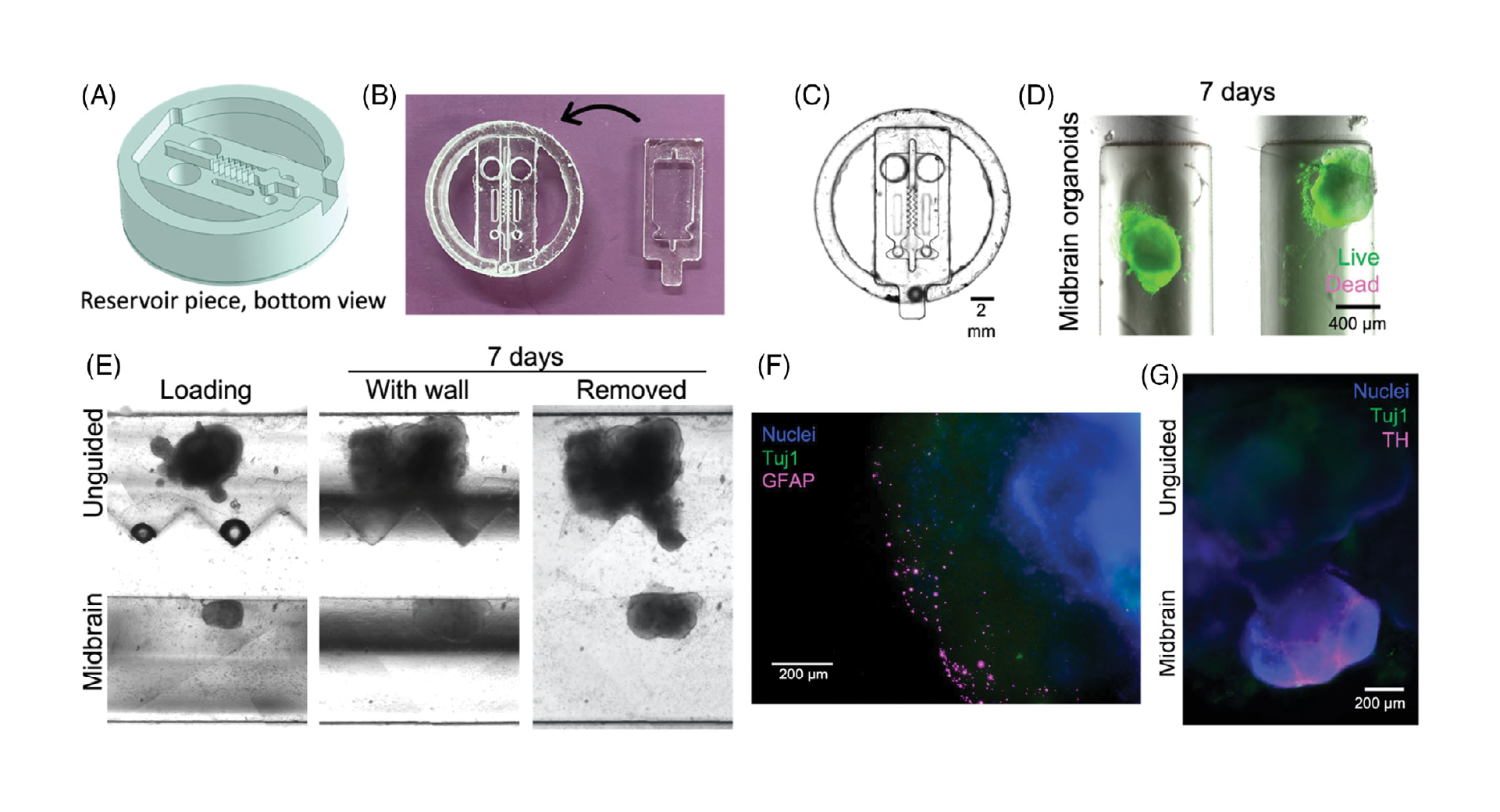
Figure 3. Assembloid formation in two-piece separated devices. (A) 3D schematic of removable insert piece; shown here with a triangular wall geometry. (B) Replica molded two-piece PDMS devices, with base and insert pieces shown. (C) Assembled two-piece device, imaged from below. (D) Midbrain organoids were loaded into channels with Matrigel, and maintained viability for 7 days in culture. (E) Unguided and midbrain organoids were loaded into channels with Matrigel and cultured for 7 days before removing the separating wall. Organoids maintained the shape and spacing imposed by the separating wall before beginning to grow toward each other to form an assembloid. (F) Astrocytes identified with glial fibrillary acidic protein (GFAP; magenta) are observed on the edges of unguided organoids only. (G) Midbrain organoids uniquely express dopaminergic neuron marker tyrosine hydroxylase (TH; magenta). Both organoid types express neural marker β-tubulin III (Tuj1; green), which is observed across the separating bridge within 3 days of insert removal.

3.4. Devices support assembloid formation

As a first proof-of-concept, midbrain and unguided organoids were loaded in Matrigel in adjacent channels to form assembloids from two distinct organoid types. After 5–28 days, when the organoids had expanded to contact and mold themselves against the channel wall, the inserts were removed from the bases, leaving the organoids and surrounding Matrigel separated by the width of the separating wall (600 µm, but could be varied by mold design). This gap was back-filled with Matrigel, and the assembloids were then monitored during growth. We first confirmed that using this system, the organoids retained the shape of the insert wall after removal (Figure 3E). Immunostaining of fixed samples at this stage demonstrated that glial fibrillary acidic protein (GFAP)-positive astrocytes arise in unguided organoids only (Figure 3F), and tyrosine hydroxylase (TH)-positive dopaminergic neurons in the midbrain organoids only (Figure 3G), as expected for this type of organoid.[40] Within 3 days, the organoids bridged the space between them to initiate formation of an assembloid. These results confirm (1) appropriate and expected differentiation of these neural organoids within our devices, including differentiation towards the non-neuronal lineages expected to arise in unguided organoids[9]; (2) that our separated device supports distinct media-driven differentiation patterns in adjacent compartments; and (3) that assembloids can form after removal of the separating wall.


3.5. Axonal projections arise from midbrain organoids during assembloid formation

Having confirmed that the device architecture enables us to reliably examine a reproducible interface between organoids during assembloid formation, we then characterized the early stages of assembloid integration in terms of behavior of cells from each of the two organoids. We noted long and thin cellular processes arising from midbrain organoids, that began to appear after ≈7–9 days of co-culture in our devices (≈15–16 days after organoid seeding; Figure 4A). We confirmed that these were axonal projections by immunostaining for tau-1, which localizes to axons only,[48, 49] as well as for TH, which can also be found in axons[50] (Figure 4B).
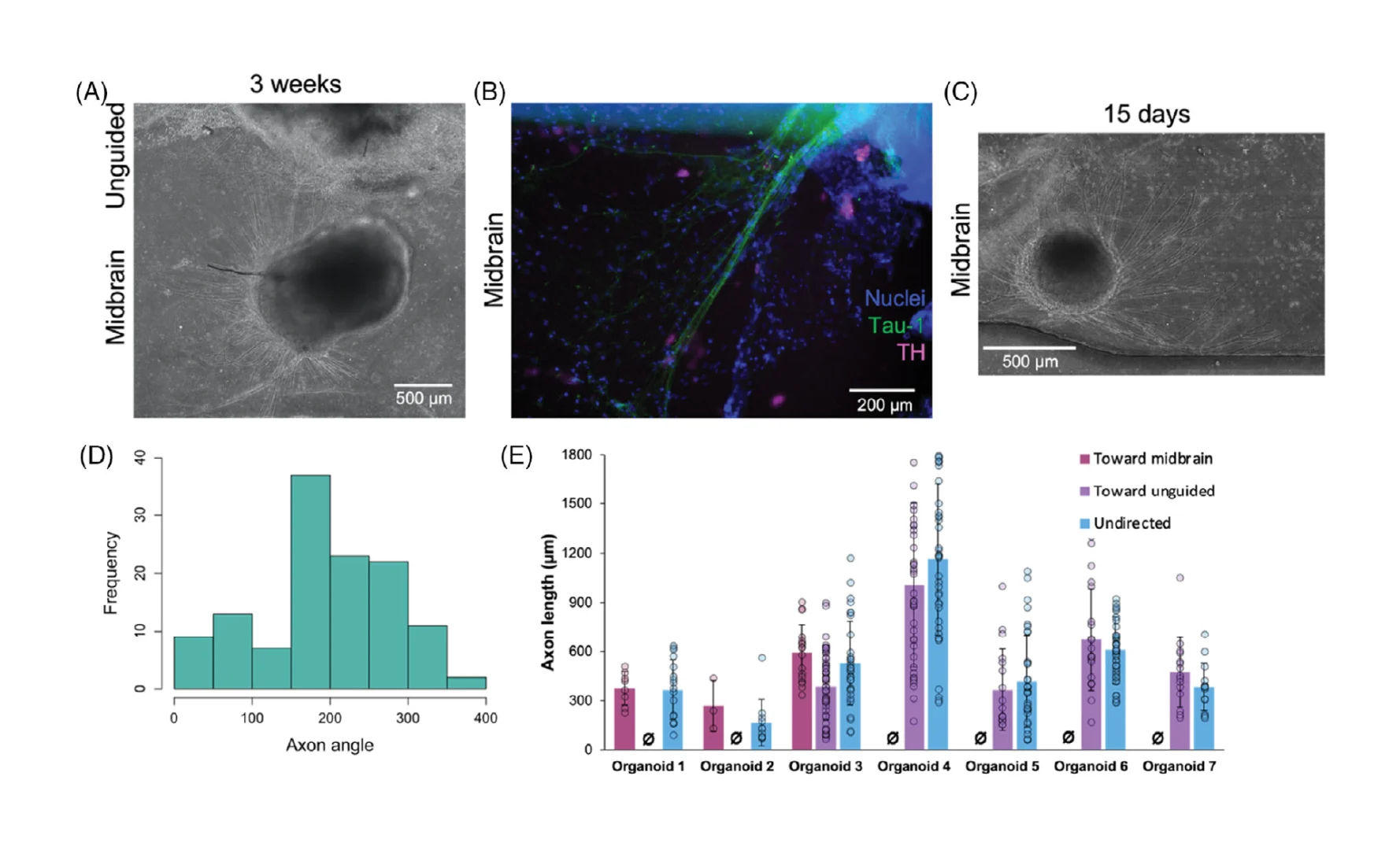
Figure 4. Axonal projection from midbrain organoids. (A) Axonal projections extending from midbrain organoid, and (B) staining positive for axonal marker tau-1 (green). (C) Axonal projections arise from all sides of the midbrain organoid. (D) Representative frequency distribution of angles of axonal projections from a midbrain organoid, showing majority of axons angled towards nearby organoid (distribution is centered around angle towards nearby organoids, 180°). Compared against a statistically random orientation, the distribution is biased toward other midbrain organoids (p < 0.05) and unguided organoids (p < 0.1; n = 50–159 axons from 3–4 organoids, one-sample t-test). (E) No significant differences in axon lengths directed toward an unguided or another midbrain organoid were observed (data presented as individual data points with an overlaid bar graph showing mean ± standard deviation; Ø symbol used to denote no observations in that category; n = 3–57 axons from seven organoids; p > 0.1 by two-sample t-test comparing axon lengths that were directed toward either midbrain or unguided organoids).
Figure 4. Axonal projection from midbrain organoids. (A) Axonal projections extending from midbrain organoid, and (B) staining positive for axonal marker tau-1 (green). (C) Axonal projections arise from all sides of the midbrain organoid. (D) Representative frequency distribution of angles of axonal projections from a midbrain organoid, showing majority of axons angled towards nearby organoid (distribution is centered around angle towards nearby organoids, 180°). Compared against a statistically random orientation, the distribution is biased toward other midbrain organoids (p < 0.05) and unguided organoids (p 0.1 by two-sample t-test comparing axon lengths that were directed toward either midbrain or unguided organoids).

Based on mechanisms of axon guidance[17-19] it is reasonable to suppose that factors secreted during co-culture may direct axonal outgrowth. We first asked whether quantitative analysis would allow us to better understand the factors that might affect axon targeting behaviors. Axonal projections grew from all sides of the midbrain organoid (Figure 4C) toward midbrain organoids in the same channel (oriented at 180°), unguided organoids in the adjacent channel (oriented at 270°), and toward spaces without organoids in them. By comparing the frequency distributions of axonal direction (Figure 4D) against random chance, we found that axonal projections from midbrain organoids were significantly statistically biased toward other midbrain organoids (n = 50–159 axons from 3 to 4 organoids; p < 0.05 by one-sample t-test), while projections toward unguided organoids only approached significance (p < 0.1). In contrast, axon lengths were not significantly different regardless of direction toward which they grow (Figure 4E). This analysis would therefore suggest that when allowed to form in co-culture, the distribution of directed axon targeting may be biased by brain region-specific secreted factors.


3.6. Organoid surface geometry influences cell migration

We also observed invasive migration of cells from the unguided organoids into the inter-organoidal space, and given the known impact of tissue geometry on cellular invasion and migration,[23-25] we asked whether organoid surface geometry might influence this invasive behavior during assembloid formation. We therefore tested flat versus triangular geometric shapes of the separating wall (Figure 5A), and the organoids grew to adopt the shapes provided by the channel wall (Figure 5B,C). Once the organoids had reached this stage, the separating inserts were removed. Interestingly, cells migrated out from the unguided organoids into the Matrigel towards the midbrain organoids regardless of organoid peripheral geometry (Figure 5C), and immunostaining indicated that some of these migrating cells were astrocytes, positive for GFAP (Figure 5D). However, migration distance was significantly different based on the global originating tissue shape (Figure 5E,F). Cells migrating from a flat organoid periphery travelled significantly farther than cells migrating from the flat midpoint of a triangle edge. Given that flat surfaces are predicted to have lower mechanical tension than surfaces of high curvature, it seems likely that differential mechanical priming arising from shape could lead to different migration distances.
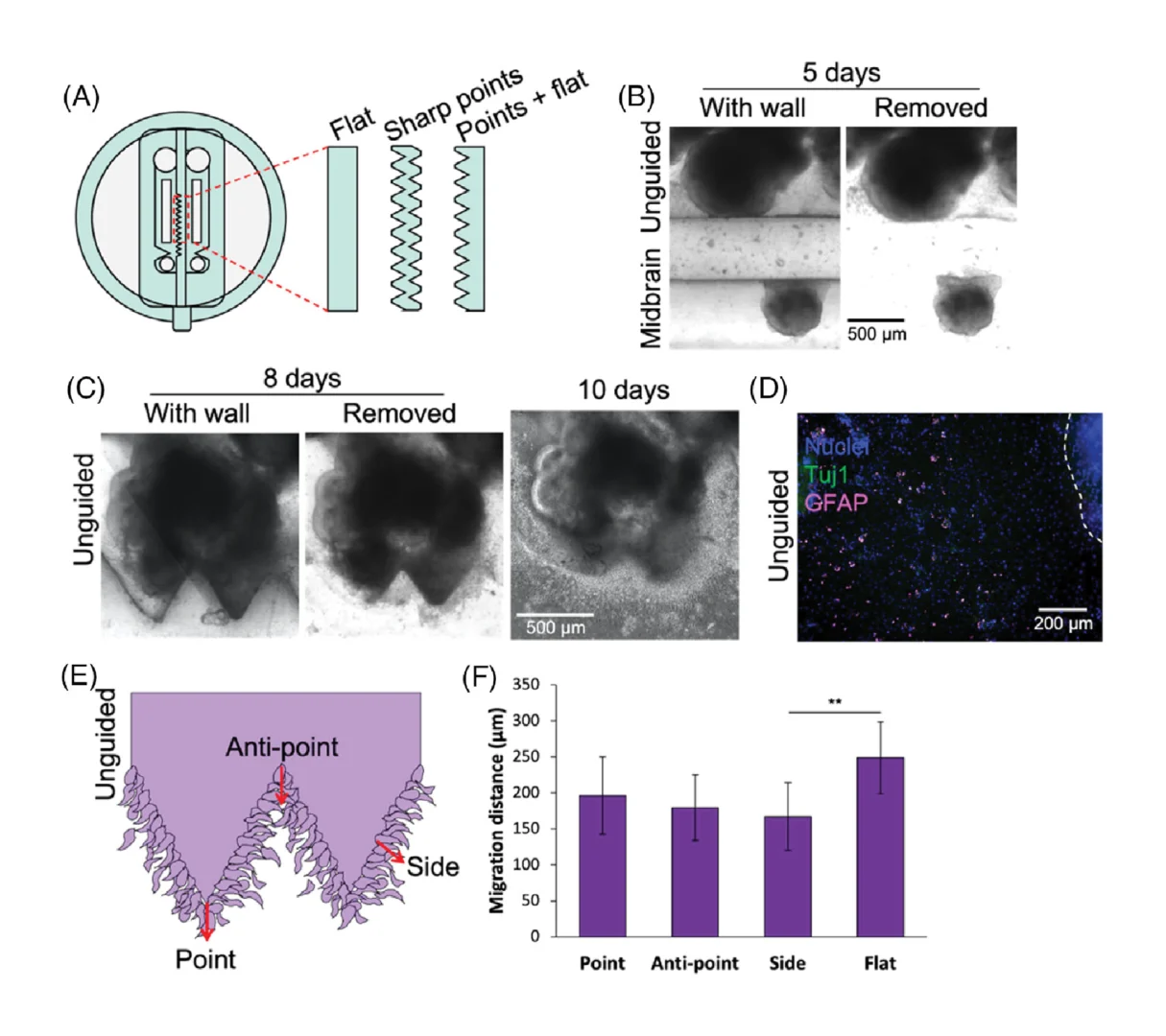
Figure 5. Geometrical shaping of organoids and cell migration. (A) Schematic showing channel-separating walls with different geometries. (B) Unguided and midbrain organoids with flat peripheries, shaped by flat separating wall. (C) Unguided organoid shaped into triangles by separating wall with points, and maintaining shape after wall removal. Cells migrate out of organoid at periphery, regardless of geometry. (D) Stained unguided organoid shows expression of astrocyte marker glial fibrillary acidic protein (GFAP), with astrocytes having migrated out of organoid. The dashed line indicates edge of unguided organoid. (E) Schematic showing locations of measurements of cell migration front from unguided organoid. (F) Measurements of migration distance of cells leaving unguided organoids from locations with different geometries 2–3 days after wall removal (side refers to location at midpoint of triangle edge) (data presented as mean ± standard deviation; n = 5–8 locations; **p < 0.01 by one-way ANOVA with Tukey post hoc comparisons).

Apparatus Used

Master Mold for PDMS

ProFluidics 285D

4. Discussion

In this work, we build on recent advances by Park et al. in culturing shaped organoids[35] and develop a platform and methodology to individually culture multiple organoids of distinct types and control surface shape and spacing of the organoids, before allowing them to interact and form an assembloid on demand. Since the distance between shaped organoids can be precisely defined, the process of assembly can be closely observed in situ across multiple similarly-shaped live cultures during assembloid formation. Constructing devices capable of supporting long-term growth of organoids into predefined shapes, while affording the ability to (1) allow simultaneous but separate culture protocols for each of the organoid types, (2) support distinct surface modification strategies to enhance or prevent adhesion, and (3) to gently remove a separating barrier on demand required complex device geometries. To meet these fabrication demands, we developed a 3D printer-supported double-sided molding technique, which we successfully demonstrated to create barriers as thin as ≈200 µm. This fabrication method has the advantage of being extremely rapid and versatile, allowing design-to-device turnaround times of less than 8 h, while creating novel structures that would be extremely difficult to produce using conventional single-side replica molding approaches.


As a first demonstration of this technology, we investigated assembloid formation processes between midbrain and unguided organoids. Although we focused our experiments on controlling the space between organoids in separate channels, in principle this approach could in future be adapted to control the spacing between individual organoids, by reducing the length of the channel. Despite the simplicity of the current design, we were able to position organoids sufficiently close together to observe axonal projections from the midbrain organoids, and invasion of individual cells from the unguided organoids into the surrounding matrix. Together, these processes should capture key features of the assembloid formation process as two organoids merge with each other, which would be quite challenging to observe over time and quantitatively evaluate when simply placing optically-dense organoids against each other. Using the capacity for microfluidics to position and support these interactions, and to facilitate longitudinal observation using brightfield imaging, we were then able to demonstrate that axonal projections from the midbrain organoids display differential targeted outgrowth. Speculatively, since dopaminergic neurons project to a variety of brain regions in vivo,[51] these findings may ultimately be relevant in understanding how and why neuronal connections form differently in different regions of the brain. We were also able to observe that cell invasion from the unguided organoids was affected by global surface geometries. Unexpectedly, cells leaving flat organoids displayed higher invasive potential than cells leaving the flat regions of triangular shapes. This was unexpected because higher endogenous mechanical stress levels at shape-driven stress points such as triangular apexes have previously been thought of as “launching sites” for invasive cells in cancer models,[23-25] but the opposite was observed in our neural cultures. Taken together, these results suggest that the process of assembloid formation can be dissected using microfluidic systems, and that this general approach might be leveraged to improve our understanding of the development of neural circuitry, in healthy and diseased states, both within the brain and targeting of other organs such as muscle or gut. More generally, our observations that assembloid-formation behaviors can be directed through physical cues in the local microenvironment suggests that such approaches may ultimately be useful in establishing predictive control over complex assembloid formation processes.


Several limitations should be considered in the utility of these devices. First, although the experiments here were designed primarily to prove the concept of these devices using brain organoid components, applying this strategy to other organoids may present unexpected complications. For example, the device architecture was sufficient to support the metabolic needs for brain organoid maturation, but other more energy-intensive processes may require alternative designs or other strategies to enhance metabolic transport and availability. Second, the capacity to observe assembloid-associated processes between organoids is enhanced through our microfluidic system, but is ultimately limited by difficulties in imaging through optically-dense organoids. Strategies such as brain organoid tissue clearing for end-point analysis[52] and genetically-encoded markers to monitor processes in real time may be useful here, but cannot be used in parallel to allow for live, high-resolution imaging of such structures. Alternative imaging modalities such as MicroCT or ultrasound imaging may also have significant value in addressing this specific issue. Finally, the true capacity for assembloid formation to accurately capture in vivo processes and final structures remains unclear. While we hope that the devices presented here will provide important tools in answering such questions, much remains to be done in establishing the fundamental utility of assembloids as in vitro models of development and disease.

5. Reference

  1. Marton, R. M., & Pașca, S. P. (2020). Organoid and assembloid technologies for investigating cellular crosstalk in human brain development and diseaseTrends in Cell Biology30(2), 133143https://doi.org/10.1016/j.tcb.2019.11.004
  2. Qian, X.Nguyen, H. N.Jacob, F.Song, H., & Ming, G. (2017). Using brain organoids to understand Zika virus-induced microcephalyDevelopment (Cambridge, England)144(6), 952957https://doi.org/10.1242/DEV.140707
  3. Di Lullo, E., & Kriegstein, A. R. (2017). The use of brain organoids to investigate neural development and diseaseNature Reviews Neuroscience18(10), 573584https://doi.org/10.1038/nrn.2017.107
  4. Velasco, S.Paulsen, B., & Arlotta, P. (2020). 3D brain organoids: Studying brain development and disease outside the embryoAnnual Review of Neuroscience43375389https://doi.org/10.1146/annurev-neuro-070918-050154
  5. Hofer, M., & Lutolf, M. P. (2021). Engineering organoidsNature Reviews Materials2021 656(5), 402420https://doi.org/10.1038/s41578-021-00279-y
  6. Rossi, G.Manfrin, A., & Lutolf, M. P. (2018). Progress and potential in organoid researchNature Reviews Genetics19671687https://doi.org/10.1038/s41576-018-0051-9
  7. Otani, T.Marchetto, M. C.Gage, F. H.Simons, B. D., & Livesey, F. J. (2016). 2D and 3D stem cell models of primate cortical development identify species-specific differences in progenitor behavior contributing to brain sizeCell Stem Cell18(4), 467480https://doi.org/10.1016/j.stem.2016.03.003
  8. Pasca, A. M.Sloan, S. A.Clarke, L. E.Tian, Y.Makinson, C. D.Huber, N.Kim, C. H.Park, J. Y.O’Rourke, N. A.Nguyen, K. D.Smith, S. J.Huguenard, J. R.Geschwind, D. H.Barres, B. A., & Pasca, S. P. (2015). Functional cortical neurons and astrocytes from human pluripotent stem cells in 3D cultureNature Methods12(7), 671678https://doi.org/10.1038/nmeth.3415
  9. Sloan, S. A.Darmanis, S.Huber, N.Khan, T. A.Birey, F.Caneda, C.Reimer, R.Quake, S. R.Barres, B. A., & Paşca, S. P. (2017). Human astrocyte maturation captured in 3D cerebral cortical spheroids derived from pluripotent stem cellsNeuron95(4), 779–790.e6. https://doi.org/10.1016/J.NEURON.2017.07.035
  10. Zhang, W.Ma, L.Yang, M.Shao, Q.Xu, J.Lu, Z.Zhao, Z.Chen, R.Chai, Y., & Chen, J. F. (2020). Cerebral organoid and mouse models reveal a RAB39b–PI3K–mTOR pathway-dependent dysregulation of cortical development leading to macrocephaly/autism phenotypesGenes & Development34(7–8), 580597https://doi.org/10.1101/gad.332494.119
  11. Chen, X.Sun, G.Tian, E.Zhang, M.Davtyan, H.Beach, T. G.Reiman, E. M.Blurton-Jones, M.Holtzman, D. M., & Shi, Y. (2021). Modeling sporadic Alzheimer’s disease in human brain organoids under serum exposureAdvancement of Science8(18), 2101462. https://doi.org/10.1002/ADVS.202101462
  12. Vogt, N. (2021). AssembloidsNature Methods. Nature Publishing Group, 1827https://doi.org/10.1038/s41592-020-01026-x
  13. Miura, Y.Li, M. Y.Revah, O.Yoon, S. J.Narazaki, G., & Pașca, S. P. (2022). Engineering brain assembloids to interrogate human neural circuitsNature Protocols. Nature Publishing Group171535https://doi.org/10.1038/s41596-021-00632-z
  14. Pașca, S. P.Arlotta, P.Bateup, H. S.Camp, J. G.Cappello, S.Gage, F. H.Knoblich, J. A.Kriegstein, A. R.Lancaster, M. A.Ming, G. L.Muotri, A. R.Park, I. H.Reiner, O.Song, H.Studer, L.Temple, S.Testa, G.Treutlein, B., & Vaccarino, F. M. (2022). A nomenclature consensus for nervous system organoids and assembloidsNature. 2022 6097929609(7929), 907910https://doi.org/10.1038/s41586-022-05219-6
  15. Kim, E.Choi, S.Kang, B.Kong, J. H.Kim, Y.Yoon, W. H.Lee, H. R.Kim, S. E.Kim, H. M.Lee, H. S.Yang, C.Lee, Y. J.Kang, M.Roh, T. Y.Jung, S.Kim, S.Ku, J. H., & Shin, K. (2020). Creation of bladder assembloids mimicking tissue regeneration and cancerNature588(7839), 664669https://doi.org/10.1038/s41586-020-3034-x
  16. Rawlings, T. M.Makwana, K.Taylor, D. M.Molè, M. A.Fishwick, K. J.Tryfonos, M.Odendaal, J.Hawkes, A.Zernicka-Goetz, M.Hartshorne, G. M.Brosens, J. J., & Lucas, E. S. (2021). Modelling the impact of decidual senescence on embryo implantation in human endometrial assembloidsElife10, e69603. https://doi.org/10.7554/eLife.69603
  17. Stoeckli, E. T. (2018). Understanding axon guidance: Are we nearly there yet? Dev145(10), dev151415. https://doi.org/10.1242/DEV.151415/48515
  18. Huberman, A. D.Clandinin, T. R., & Baier, H. (2010). Molecular and cellular mechanisms of lamina-specific axon targetingCold Spring Harbor Perspectives in Biology2(3), a001743. https://doi.org/10.1101/CSHPERSPECT.A001743
  19. Accogli, A.Addour-Boudrahem, N., & Srour, M. (2020). Neurogenesis, neuronal migration, and axon guidanceHandbook of Clinical Neurology1732542https://doi.org/10.1016/B978-0-444-64150-2.00004-6
  20. Birey, F.Andersen, J.Makinson, C. D.Islam, S.Wei, W.Huber, N.Fan, H. C.Metzler, K. R. C.Panagiotakos, G.Thom, N.O’Rourke, N. A.Steinmetz, L. M.Bernstein, J. A.Hallmayer, J.Huguenard, J. R., & Pasca, S. P. (2017). Assembly of functionally integrated human forebrain spheroidsNature545(7652), 5459https://doi.org/10.1038/nature22330
  21. Miura, Y.Li, M. Y.Birey, F.Ikeda, K.Revah, O.Thete, M. V.Park, J. Y.Puno, A.Lee, S. H.Porteus, M. H., & Pașca, S. P. (2020). Generation of human striatal organoids and cortico-striatal assembloids from human pluripotent stem cellsNature Biotechnology38(12), 14211430https://doi.org/10.1038/s41587-020-00763-w
  22. Andersen, J.Revah, O.Miura, Y.Thom, N.Amin, N. D.Kelley, K. W.Singh, M.Chen, X.Thete, M. V.Walczak, E. M.Vogel, H.Fan, H. C., & Paşca, S. P. (2020). Generation of functional human 3D cortico-motor assembloidsCell183(7), 19131929.e26https://doi.org/10.1016/j.cell.2020.11.017
  23. Nelson, C. M.VanDuijn, M. M.Inman, J. L.Fletcher, D. A., & Bissell, M. J. (2006). Tissue geometry determines sites of mammary branching morphogenesis in organotypic culturesScience314(5797), 298https://doi.org/10.1126/SCIENCE.1131000
  24. Boghaert, E.Gleghorn, J. P.Lee, K. A.Gjorevski, N.Radisky, D. C., & Nelson, C. M. (2012). Host epithelial geometry regulates breast cancer cell invasivenessProceedings of the National Academy of Sciences of the United States of America109(48), 1963219637https://doi.org/10.1073/PNAS.1118872109/-/DCSUPPLEMENTAL
  25. Gjorevski, N., & Nelson, C. M. (2010). Endogenous patterns of mechanical stress are required for branching morphogenesisIntegrative Biology2(9), 424434https://doi.org/10.1039/C0IB00040J
  26. Gomez, E. W.Chen, Q. K.Gjorevski, N., & Nelson, C. M. (2010). Tissue geometry patterns epithelial-mesenchymal transition via intercellular mechanotransductionJournal of Cellular Biochemistry110(1), 44https://doi.org/10.1002/JCB.22545
  27. Raghavan, S.Nelson, C. M.Baranski, J. D.Lim, E., & Chen, C. S. (2010). Geometrically controlled endothelial tubulogenesis in micropatterned gelsTissue Engineering Part A16(7), 22552263https://doi.org/10.1089/ten.tea.2009.0584
  28. Nelson, C. M.Jean, R. P.Tan, J. L.Liu, W. F.Sniadecki, N. J.Spector, A. A., & Chen, C. S. (2005). Emergent patterns of growth controlled by multicellular form and mechanicsPNAS102(33), 1159411599https://doi.org/10.1073/PNAS.0502575102
  29. Tran, R.Moraes, C., & Hoesli, C. A. (2020). Controlled clustering enhances PDX1 and NKX6.1 expression in pancreatic endoderm cells derived from pluripotent stem cellsScientific Reports10(1), 1190https://doi.org/10.1038/s41598-020-57787-0
  30. Ma, Z.Sagrillo-Fagundes, L.Tran, R.Parameshwar, P. K.Kalashnikov, N.Vaillancourt, C., & Moraes, C. (2019). Biomimetic micropatterned adhesive surfaces to mechanobiologically regulate placental trophoblast fusionACS Applied Materials & Interfaces11(51), 4781047821https://doi.org/10.1021/acsami.9b19906
  31. Lee, W.Kalashnikov, N.Mok, S.Halaoui, R.Kuzmin, E.Putnam, A. J.Takayama, S.Park, M.McCaffrey, L.Zhao, R.Leask, R. L., & Moraes, C. (2019). Dispersible hydrogel force sensors reveal patterns of solid mechanical stress in multicellular spheroid culturesNature Communications10(1), 114https://doi.org/10.1038/s41467-018-07967-4
  32. Boghdady, C. M.Kalashnikov, N.Mok, S.McCaffrey, L., & Moraes, C. (2021). Revisiting tissue tensegrity: Biomaterial-based approaches to measure forces across length scalesAPL Bioengineering5(4), 41501. https://doi.org/10.1063/5.0046093/1025169
  33. Knight, G. T.Lundin, B. F.Iyer, N.Ashton, L. M. T.Sethares, W. A.Willett, R. M., & Ashton, R. S. (2018). Engineering induction of singular neural rosette emergence within HPSC-derived tissuesElife7, e37549. https://doi.org/10.7554/eLife.37549
  34. Haremaki, T.Metzger, J. J.Rito, T.Ozair, M. Z.Etoc, F., & Brivanlou, A. H. (2019). Self-organizing neuruloids model developmental aspects of Huntington’s disease in the ectodermal compartmentNature Biotechnology2019 371037(10), 11981208https://doi.org/10.1038/s41587-019-0237-5
  35. Park, S. E.Kang, S.Paek, J.Georgescu, A.Chang, J.Yi, A. Y.Wilkins, B. J.Karakasheva, T. A.Hamilton, K. E., & Huh, D. D. (2022). Geometric engineering of organoid culture for enhanced organogenesis in a dishNature Methods19(November), 14491460https://doi.org/10.1038/s41592-022-01643-8
  36. Moraes, C.Sun, Y., & Simmons, C. A. (2009). Solving the shrinkage-induced PDMS alignment registration issue in multilayer soft lithographyJournal of Micromechanics and Microengineering19(6), 065015. https://doi.org/10.1088/0960-1317/19/6/065015
  37. Park, S. E.Georgescu, A.Oh, J. M.Kwon, K. W., & Huh, D. (2019). Polydopamine-based interfacial engineering of extracellular matrix hydrogels for the construction and long-term maintenance of living three-dimensional tissuesACS Applied Materials & Interfaces11(27), 2391923925https://doi.org/10.1021/acsami.9b07912
  38. Azizipour, N.Avazpour, R.Sawan, M.Rosenzweig, D. H., & Ajji, A. (2022). Uniformity of spheroids-on-a-chip by surface treatment of PDMS microfluidic platformsSensors & Diagnostics1(4), 750764https://doi.org/10.1039/D2SD00004K
  39. Boxshall, K.Wu, M. H.Cui, Z.Cui, Z.Watts, J. F., & Baker, M. A. (2006). Simple surface treatments to modify protein adsorption and cell attachment properties within a poly(dimethylsiloxane) micro-bioreactorSurface and Interface Analysis38198201https://doi.org/10.1002/sia.2274
  40. Mohamed, N.-V.Mathur, M.da Silva, R. V.Thomas, R. A.Lepine, P.Beitel, L. K.Fon, E. A., & Durcan, T. M. (2021). Generation of human midbrain organoids from induced pluripotent stem cellsMNI Open Research31https://doi.org/10.12688/mniopenres.12816.2
  41. Lancaster, M. A., & Knoblich, J. A. (2014). Generation of cerebral organoids from human pluripotent stem cellsNature Protocols9(10), 23292340https://doi.org/10.1038/nprot.2014.158.Generation
  42. Cassel de Camps, C.Mok, S.Ashby, E.Li, C.Lépine, P.Durcan, T. M., & Moraes, C. (2023). Compressive molding of engineered tissues via thermoresponsive hydrogel devicesLab on a Chip23(8), 20572067https://doi.org/10.1039/D3LC00007A
  43. Chen, C. X. Q.Abdian, N.Maussion, G.Thomas, R. A.Demirova, I.Cai, E.Tabatabaei, M.Beitel, L. K.Karamchandani, J.Fon, E. A., & Durcan, T. M. (2021). A multistep workflow to evaluate newly generated iPSCs and their ability to generate different cell typesMethods and Protocols4(3), 50https://doi.org/10.3390/MPS4030050/S1
  44. Yeap, Y. J.Teddy, T. J. W.Lee, M. J.Goh, M., & Lim, K. L. (2023). From 2D to 3D: Development of monolayer dopaminergic neuronal and midbrain organoid cultures for Parkinson’s disease modeling and regenerative therapyInternational Journal of Molecular Sciences24(3), 2523https://doi.org/10.3390/IJMS24032523/S1
  45. Schindelin, J.Arganda-Carreras, I.Frise, E.Kaynig, V.Longair, M.Pietzsch, T.Preibisch, S.Rueden, C.Saalfeld, S.Schmid, B.Tinevez, J. Y.White, D. J.Hartenstein, V.Eliceiri, K.Tomancak, P., & Cardona, A. (2012). Fiji: An open-source platform for biological-image analysisNature Methods9676682https://doi.org/10.1038/nmeth.2019
  46. Preibisch, S.Saalfeld, S., & Tomancak, P. (2009). Globally optimal stitching of tiled 3D microscopic image acquisitionsBioinformatics25(11), 14631465https://doi.org/10.1093/BIOINFORMATICS/BTP184
  47. R Core Team. (2017). R: A language and environment for statistical computing. R Foundation for Statistical Computing.
  48. Binder, L. I.Frankfurter, A., & Rebhun, L. I. (1985). The distribution of Tau in the mammalian central nervous systemJournal of Cell Biology101(4), 13711378https://doi.org/10.1083/jcb.101.4.1371
  49. Papasozomenos, S. C., & Binder, L. I. (1987). Phosphorylation determines two distinct species of Tau in the central nervous systemCell Motility and the Cytoskeleton8(3), 210226https://doi.org/10.1002/cm.970080303
  50. Gervasi, N. M.Scott, S. S.Aschrafi, A.Gale, J.Vohra, S. N.Macgibeny, M. A.Kar, A. N.Gioio, A. E., & Kaplan, B. B. (2016). The local expression and trafficking of tyrosine hydroxylase MRNA in the axons of sympathetic neuronsRNA22(6), 883895https://doi.org/10.1261/rna.053272.115
  51. Prakash, N., & Wurst, W. (2006). Development of dopaminergic neurons in the mammalian brainCellular and Molecular Life Sciences63(2), 187206https://doi.org/10.1007/s00018-005-5387-6
  52. Mohamed, N. V.Lépine, P.Lacalle-Aurioles, M.Sirois, J.Mathur, M.Reintsch, W.Beitel, L. K.Fon, E. A., & Durcan, T. M. (2022). Microfabricated disk technology: Rapid scale up in midbrain organoid generationMethods (San Diego, Calif.)203465477https://doi.org/10.1016/J.YMETH.2021.07.008

Evaluation of industrial and consumer 3-D resin printer fabrication of microdevices for quality management of genetic resources in aquatic species

Academic Article

Evaluation of industrial and consumer 3-D resin printer fabrication of microdevices for quality management of genetic resources in aquatic species

by Seyedmajid Hosseini, Jack C. Koch, Yue Liu, Ignatius Semmes, Isabelina Nahmens, W. Todd Monroe, Jian Xu and Terrence R. Tiersch

Abstract: Aquatic germplasm repositories can play a pivotal role in securing the genetic diversity of natural populations and agriculturally important aquatic species. However, existing technologies for repository development and operation face challenges in terms of accuracy, precision, efficiency, and cost-effectiveness, especially for microdevices used in gamete quality evaluation. Quality management is critical throughout genetic resource protection processes from sample collection to final usage. In this study, we examined the potential of using three-dimensional (3-D) stereolithography resin printing to address these challenges and evaluated the overall capabilities and limitations of a representative industrial 3-D resin printer with a price of US$18,000, a consumer-level printer with a price <US$700, and soft lithography, a conventional microfabrication method. A standardized test object, the Integrated Geometry Sampler (IGS), and a device with application in repository quality management, the Single-piece Sperm Counting Chamber (SSCC), were printed to determine capabilities and evaluate differences in targeted versus printed depths and heights. The IGS design had an array of negative and positive features with dimensions ranging from 1 mm to 0.02 mm in width and depth. The SSCC consisted of grid and wall features to facilitate cell counting. The SSCC was evaluated with polydimethylsiloxane (PDMS) devices cast from a typical photoresist and silicon mold. Fabrication quality was evaluated by optical profilometry for parameters such as dimensional accuracy, precision, and visual morphology. Fabrication time and cost were also evaluated. The precision, reliability, and surface quality of industrial-grade 3-D resin printing were satisfactory for operations requiring depths or heights larger than 0.1 mm due to a low discrepancy between targeted and measured dimensions across a range of 1 mm to 0.1 mm. Meanwhile, consumer-grade printers were suitable for microdevices with depths or heights larger than 0.2 mm. While the performance of either of these printers could be further optimized, their current capabilities, broad availability, low cost of operation, high throughput, and simplicity offer great promise for rapid development and widespread use of standardized microdevices for numerous applications, including gamete quality evaluation and “laboratory-on-a-chip” applications in support of aquatic germplasm repositories.

Keywords: germplasm repository; aquatic species; 3-D resin printing; soft lithography; photolithography; aquaculture industry; genetic resources

We kindly thank the researchers at Louisiana State University for this collaboration, and for sharing the results obtained with their system.

1. Introduction

Throughout history, ensuring the protection of economically important agricultural species has involved the storage, assessment, and distribution of genetic resources. One preservation method for these resources involves placing them in a frozen state, a technique known as cryopreservation. Cryopreserved samples are commonly stored in collections or repositories [[1][2][3][4]]. However, scalable cryopreservation technologies and germplasm repositories are not in place for most aquatic species despite the urgent need to protect the genetic resources that provide the foundation for aquaculture, food security, biomedical research, conservation, and wild fisheries. The genetic resources that support billions of dollars [5] of capture fisheries and human livelihoods are not protected, and the risk and expense of maintaining live animals (rather than frozen samples) hinder the growth of numerous aquatic industries [6]. These risks and expenses can be minimized by developing proprietary or shared (open) hardware devices that are capable of accelerating repository development and aiding in management and processing operations for the protection of genetic resources [7].


The growing climate crisis has exacerbated costs, risks, and needs associated with safeguarding genetic resources of aquatic species around the world. A vast majority of aquatic species that are important for aquaculture, food security, biomedical research, conservation, and wild fisheries are native to low-to-middle income nations where genetic resource protection is not a long-term priority or where equipment and reliable resources are scarce. Policy and long-term agendas must be addressed at scales beyond the individual. With the rapid growth of open-additive manufacturing, sustainable capabilities and resources can become widely accessible, and can be developed, customized, and fabricated by anyone.


Reliable tools and devices are essential for safeguarding genetic resources because they enable critical processing and quality management (QM) steps from sample collection to final usage. A relevant example is Bangladesh which is home to >600 species of freshwater and marine fishes. These fishes provide a primary protein source to sustain a growing human population of 171 million. Land use changes, introduced species, overharvesting, and other anthropogenic effects have strained open-water fisheries, and the country now relies heavily on farmed fishes (i.e., aquaculture) [8] with a narrowing gene pool. Cryopreservation is essential for preserving quality genetics, sustaining livelihoods, and ensuring sustainable production and improvement of aquatic species in Bangladesh and abroad. There are ongoing efforts to develop germplasm repositories for aquatic species in Bangladesh [8,9], but access to reliable tools and supplies, especially for quality management, are major roadblocks to these efforts. These same urgent needs for protection of aquatic genetic resources exist throughout the world, including the United States.


Capability needs for cryopreservation are driven by processing steps such as germplasm collection (e.g., sperm, eggs, early life stages, cells), quality evaluation, cryopreservation, storage, thawing, and final usage. Sample quality is of critical importance as the samples frozen today may be stored for decades and processing of poor quality samples wastes time and resources today and in the future. Quality management is a major driving force behind the need to develop novel, customizable, and accessible microdevices (e.g., micromixers [10], microfluidic lab-on-a-chip systems [11], and micro-separators [12]) to assist in safeguarding aquatic genetic resources. Such microdevices need to be versatile and practical for activities centered around germplasm QM, including quality planning, quality assurance (QA, process oriented), quality control (QC, product oriented), quality evaluation, and quality improvement.


There are existing devices to accomplish these processes, but they are often fixed in design, not suitable for multiple species, and prohibitively expensive for global deployment. For example, the process of counting sperm to calculate concentration can be accomplished by use of commercial devices such as a hemocytometer (>US$100) or a Makler chamber (>US$750) with counting by eye (which requires experience and is prone to variation) or by use of a computer-assisted sperm analysis (CASA) system (highly repeatable but >US$25,000). Integration of open-hardware microfluidic and microdevice systems would play a pivotal role in ensuring the dependable quality of germplasm materials, facilitating the isolation and culture of gametes and embryos, and optimizing the efficiency of sperm sorting and separation [13].


The use of soft lithography to develop microdevice systems (e.g., the Microfabricated Enumeration Grid Chamber [MEGC, 14] or the Single-piece Sperm Counting Chamber [SSCC, 15]) began to address some of the issues with sperm counting devices but suffer from prohibitively expensive initial costs and a lack of efficient options for iterative customization. Soft lithography typically makes use of the material, polydimethylsiloxane (PDMS) which yields high-resolution parts with excellent surface finish and low cytotoxicity [[14][15][16][17][18]]. In traditional PDMS-based soft lithography, microdevice fabrication relies on a master mold created through intensive soft lithography processes (e.g., photolithography and etching) [19]. Microdevice creation entails pouring the PDMS onto the master mold, letting it cure, and peeling it off to replicate the mold pattern. Despite its effectiveness, this process is expensive, time-consuming, complex [20], and has a number of drawbacks that limit use, especially for rapid prototyping. Soft lithography is more than capable of fabricating high-resolution devices for germplasm samples that exist at the smallest size ranges of aquatic germplasm (e.g., sperm of zebrafish [0.002 mm head width] or swordtails [0.001 mm head width]). However, it is not reliable for creating devices with larger or varied heights and depths that are required for most other species, and is slow, costly, and restricted to specialized facilities. In this study, we did not directly compare PDMS and resin prints, although such evaluations have been conducted in the past [[21][22][23][24][25][26]]. Instead, our focus was on the evaluation of the potential for shifting to new fabrication techniques, including overall consideration of factors such as cost reduction, improved fabrication accessibility, and development of open-hardware communities based on the sharing of digital design files.


Three-dimensional (3-D) resin printing techniques such as stereolithography (SLA) and digital light projection (DLP) offer a promising and effective alternative to soft lithography and are gaining traction in the development and prototyping of microdevices. These rapidly advancing technologies can play a crucial role in addressing the creation of hardware devices with broad applications in genetic resource protection [14,15,27,28]. Three-dimensional resin printers surpass many of the constraints of soft lithography and other traditional methods through layer-by-layer transformation of computer-aided designs into tangible hardware, crafting accurate 3-D shapes. This process eliminates the need for photo masks, alignment processes, etching, and bonding which require specialized facilities and well-trained personnel, offering a more efficient and flexible manufacturing approach [29]. In addition, resin printers have access to thousands of resin types, including those developed for application in human medicine (e.g., dental-grade resins) and for use with germplasm [e.g., [30]].


Two major levels of resin printers are industrial-grade and consumer-grade. In general, consumer-grade printers have lower prices (US$400 – US$1,000) and lower-grade components, often limiting the resolution that can be achieved. Industrial-grade printers come with greater up-front costs (>US$10,000) but have higher-grade components, access to customizable resin materials, optimized resin polymerization, and system processing features for faster and more successful prints. Even the higher-priced machines, however, are much more widely available and less expensive than traditional soft lithography. Although some groups have taken the approach of pushing the capabilities of consumer-grade printers, a slow and resource-intensive process [31], there are few studies that evaluate the accuracy and precision available and resources required for device fabrication using these different techniques (resin printing and soft lithography) and printer types (industrial and consumer). This understanding is vital for aquaculture and aquatic research communities outside of traditional engineering departments. Consumer-grade products are beneficial because of their accessibility, but for technology developers, it may be more advantageous to prototype quickly with industrial-grade printers before pushing the boundaries of consumer-grade products to make devices widely available. By finding a balance among these factors, 3-D resin printing can offer new opportunities for rapid prototyping and production of micro-scale devices as an alternative to conventional soft lithographic methods.


Thus, the goal of this study was to evaluate the capabilities of 3-D resin printers and demonstrate the fabrication quality of microdevices using industrial and consumer 3-D resin printers and conventional soft lithography (photolithography) techniques. The specific objectives were to: 1) evaluate accuracy and precision in feature fabrication with opaque and clear resins; 2) assess the accuracy and precision between fabrication techniques (resin printing and photolithography), particularly for small features (<1 mm); 3) analyze the visual morphology of features produced by different methods, and 4) evaluate the utility, time, and cost requirements for overall comparison of microfabrication among the methods.

2. Materials and methods

2.1. Device description and fabrication

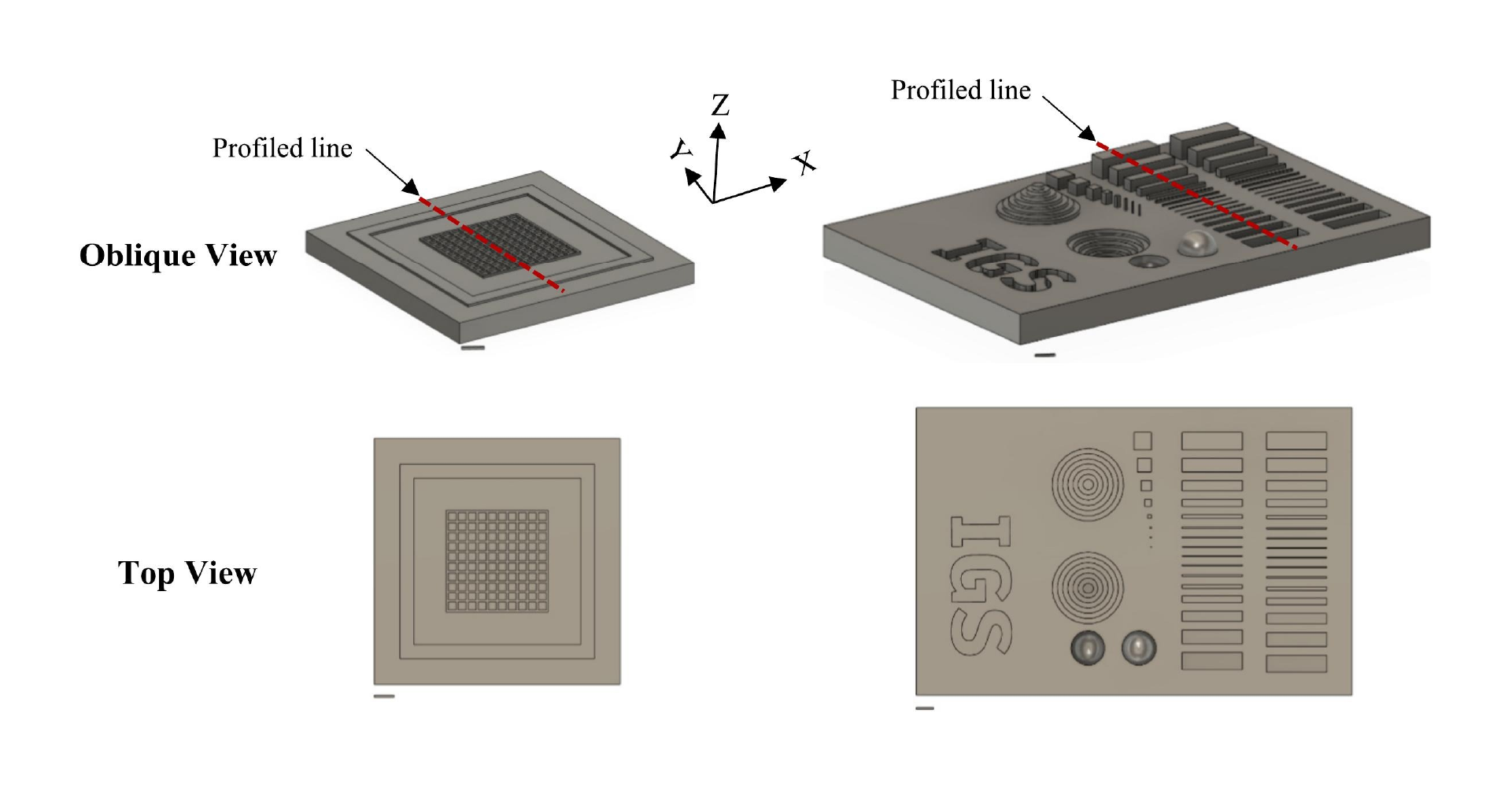
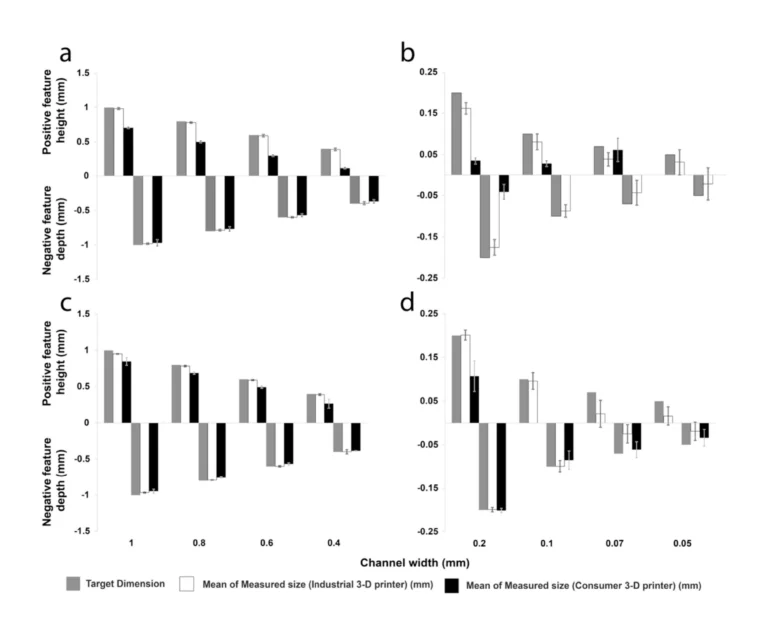
There is a wide range of forms and functions of microdevices. This study evaluated two representative devices: one with real-world application and one specifically designed to test the limits of resin 3-D printers. Both devices were designed using computer-aided design (CAD) software (Fusion 360, Autodesk, San Rafael, CA, USA) for systematic evaluations. The first was the Single-piece Sperm Counting Chamber (SSCC) [15], which consisted of grid and wall features with height of 0.01 mm (photolithography) or 0.1 mm (resin printing), including gaps in the gridlines that connect the squares to allow better distribution of samples for counting or quality evaluation (e.g., sperm motility) (Fig. 1, left column images). This difference in wall height between fabrication technologies prevented direct comparison but was necessary based on the current limitations and nature of the technological processes (e.g., photolithography spinning and resin printing layer height). The SSCC was specifically designed to accurately count sperm concentration in aquatic species such as zebrafish [15]. Its functionality heavily depends on the chamber volume, ensuring precise counting. This chamber provides a simple, customizable, and cost-effective alternative to traditional counting methods, aiding research in reproductive biology and assisted reproduction technologies.

Fig. 1. Three-dimensional schematics illustrating the Single-piece Sperm Counting Chamber (SSCC) (oblique and top views, left column), and the Integrated Geometry Sampler (IGS) (oblique and top views, right). Scale bars are 1 mm. Dotted red lines represent the profile transects (X, Y, and Z) evaluated by profilometry. (For interpretation of the references to colour in this figure legend, the reader is referred to the web version of this article.)
Figure 1. Three-dimensional schematics illustrating the Single-piece Sperm Counting Chamber (SSCC) (oblique and top views, left column), and the Integrated Geometry Sampler (IGS) (oblique and top views, right). Scale bars are 1 mm. Dotted red lines represent the profile transects (X, Y, and Z) evaluated by profilometry. (For interpretation of the references to colour in this figure legend, the reader is referred to the web version of this article.)

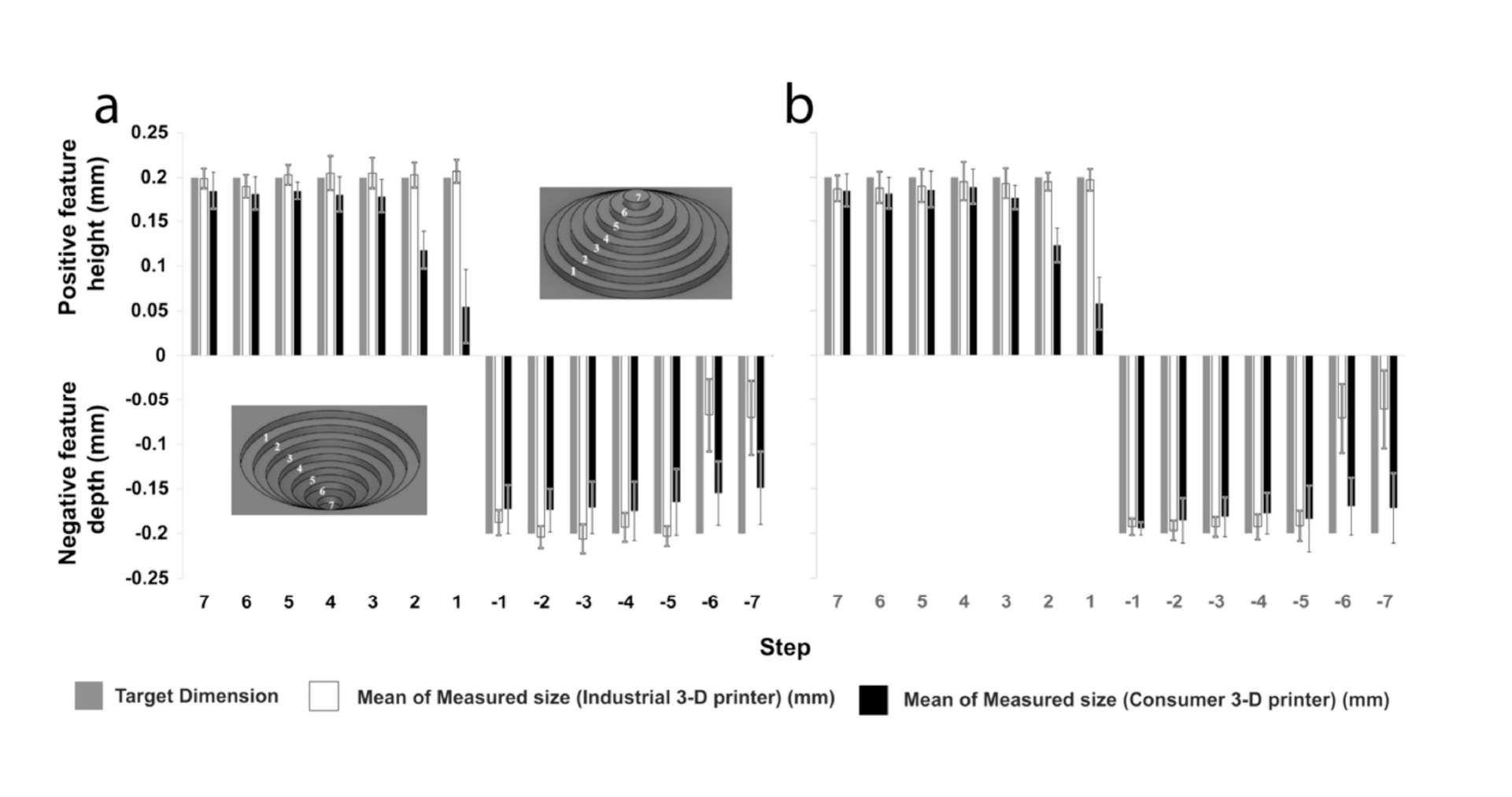
The second was the Integrated Geometry Sampler (IGS), which featured an array of negative and positive features such as a semi-spheres, channels with dimensions ranging from 1 mm to 0.02 mm in width and depth, and concentric circles ranging in diameter from 4.2 mm to 0.6 mm and with step sizes of 0.2 mm (Fig. 1, right column images). Fabricating the IGS with traditional photolithography techniques would be cumbersome due to the many different feature heights on the device, each of which necessitates a separate masking, exposure, and development process. The IGS was designed specifically to evaluate the fabrication quality of 3-D resin printers.


2.1.1. Fabrication by use of soft lithography

The photolithography-based SSCC devices evaluated in this study were fabricated using a master mold created previously [12] on a silicon wafer. The process is briefly described below. A clean silicon wafer (UniversityWafer Inc., South Boston, MA, USA) served as a mold substrate. A 0.01-mm layer of SU-8 photoresist (MicroChem Corp., Newton, MA, USA) was spin-coated (Laurell Technologies Corporation, North Wales, PA, USA) on the wafer. This photoresist was chosen for its resolution and ease of microfabrication [32]. Spin-coater settings (e.g., rotational velocity) and photoresist type [33] determine the minimum and maximum feature height that can be achieved. A precisely aligned mask was set on top of the wafer to transfer the pattern during UV light exposure (American Ultraviolet®, Lebanon, IN, USA). The unexposed SU-8 photoresist was subsequently removed by application of SU-8 developer (MicroChem Corp., Newton, MA, USA), revealing the pattern on the wafer. A 10:1 mixture of PDMS and curing agent (Sylgard-184, Sigma-Aldrich, Inc., MO, USA) was prepared according to the manufacturer’s specifications and was poured onto the mold, covering the SSCC pattern. To remove air bubbles, the PDMS was degassed in a vacuum chamber, followed by curing in an oven at 70 °C for 2 h to solidify the PDMS. The de-molded PDMS was cleaned with 70% isopropyl alcohol (IPA), deionized (DI) water, and dried with nitrogen gas.


2.1.2. Selection of 3-D printers and resin materials

This study evaluated two 3-D resin printer models representative of current (as of January 2024) industrial and consumer levels. This work was not intended as a direct comparison of manufacturers or models. To broadly evaluate the capabilities of 3-D resin printers and microfabrication, we chose an industrial 3-D resin printer (ProFluidics 285D, CADworks3D, Concord, ON) and a consumer-grade printer (Sonic Mighty 8K, Phrozen, Hsinchu City, Taiwan). The IGS produced using the industrial 3-D printer was evaluated against another made with the consumer 3-D printer. Versions of the SSCC made with industrial and consumer 3-D printers were also evaluated with a photolithography-based SSCC, although this was again not intended to be a direct comparison because of a pre-selected difference in the SSCC grid-wall heights (0.1 mm for resin printers and 0.01 mm for photolithography).


The industrial 3-D printer had a 28.5-μm dynamic pixel size and an approximate cost of US$18,000. For the fabrication of devices with the industrial 3-D printer, opaque green mastermold resin (CADworks3D, Concord, Ontario) and clear microfluidic resin (CADworks3D) were used. The consumer 3-D resin printer had a 28-μm pixel size and cost approximately US$700. For fabrication of devices with the consumer 3-D printer, opaque gray Aqua 8K resin (Phrozen, Hsinchu City, Taiwan) and Nova3D ultra-clear resin (Nova3D, Guangdong, China) were used.

Apparatus Used

Clear Microfluidic Resin

Master Mold for PDMS

ProFluidics 285D

2.1.3. Three-dimensional resin printing process

Pre-processing: During the printer slicing process for the SSCC and IGS models, variations were introduced to the dimensions because the slicer needed to adjust the lateral measurements to align with the pixel sizes (∼28 μm) of the LCD array – i.e., the printer cannot use half a pixel to accommodate a specific dimension [34]. This device-pixel alignment improved grid line consistency and uniformity in square designs. Thus, the X-Y dimensions of each device were scaled by a factor of 28. For example, the SSCC width was set at 392 μm, which is divisible by 28. Designs were converted to STL format for slicing using Utility (Ver 6.4.4.t12) for the industrial 3-D printer and LycheeSlicer (Ver 5.2.201) for the consumer 3-D printer. Multiple printing configurations were evaluated for both printers and the chosen settings are listed in Supplementary Table 1. These settings were selected to balance printing of positive and negative features. Based on printer behavior with specific geometries (e.g., a channel printed 20% deeper than expected), device dimensions (e.g., decreased channel depth) and slicer settings can be optimized to target positive or negative features. This study thus evaluated print quality without focus on single fine-tuned adjustments, illustrating the mechanical precision and accuracy differences of industrial and consumer-grade resin printers across a composite range of feature types and sizes that would occur in quality-management devices for aquatic species.


Post-processing: After printing, residual resin was removed by immersing the devices in a plastic bag containing 70% IPA and placing the bag into an ultrasonic water bath for 4 min. The devices were rinsed with fresh 70% IPA and DI water to ensure the complete removal of uncured resins. After 2 min of air drying, devices were exposed to a 405 nm UV light (Elegoo, Mercury X Cure, China) for 1 min to complete curing and post-processing.


2.2. Fabrication quality assessment

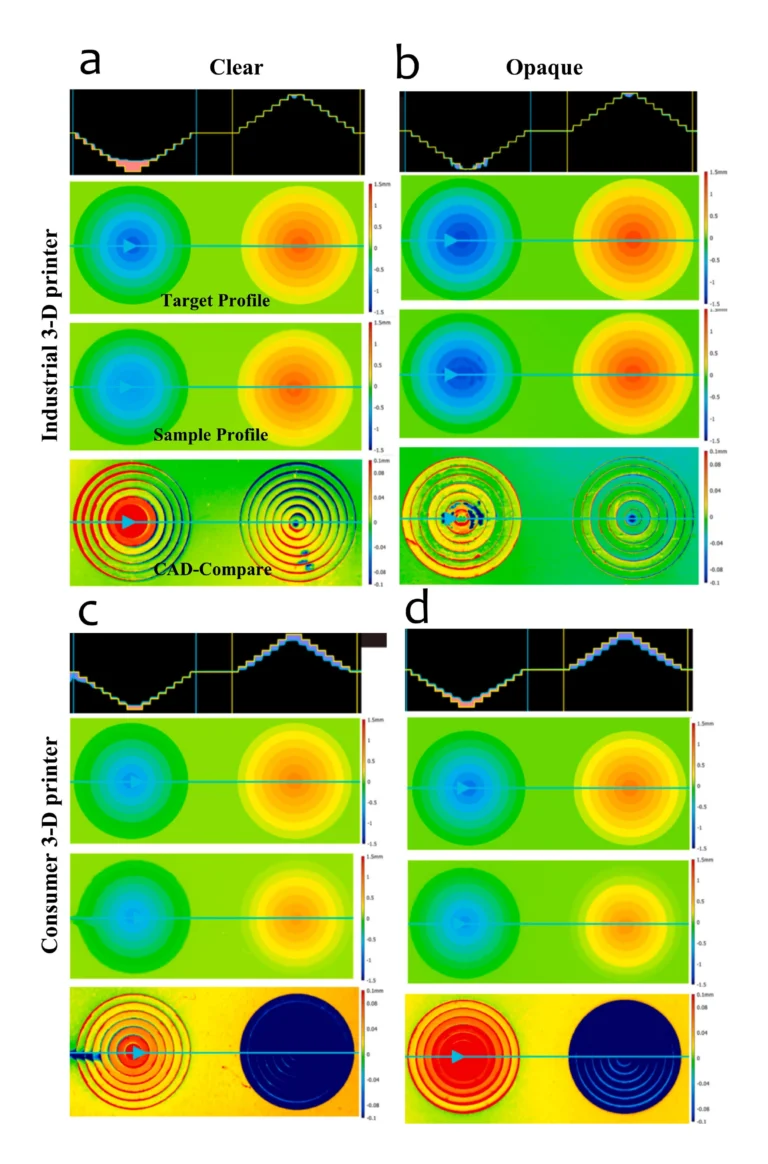
Comparison of multiple device features was used to provide insight into fabrication quality, accuracy, and precision among the different fabrication technologies and served as a preliminary evaluation for the widespread transition from conventional microfabrication approaches to 3-D resin printing. In fabrication of microdevices such as microchannels, clarity in the final device is crucial for use in light microscopy. While clear resin is typically preferred for this purpose in 3-D resin printing, we encountered challenges from reflected light when conducting profilometry on devices crafted from clear resin, which hampered dimensional measurements. To address this, we conducted experiments wherein devices were fabricated in parallel using opaque and clear resins.


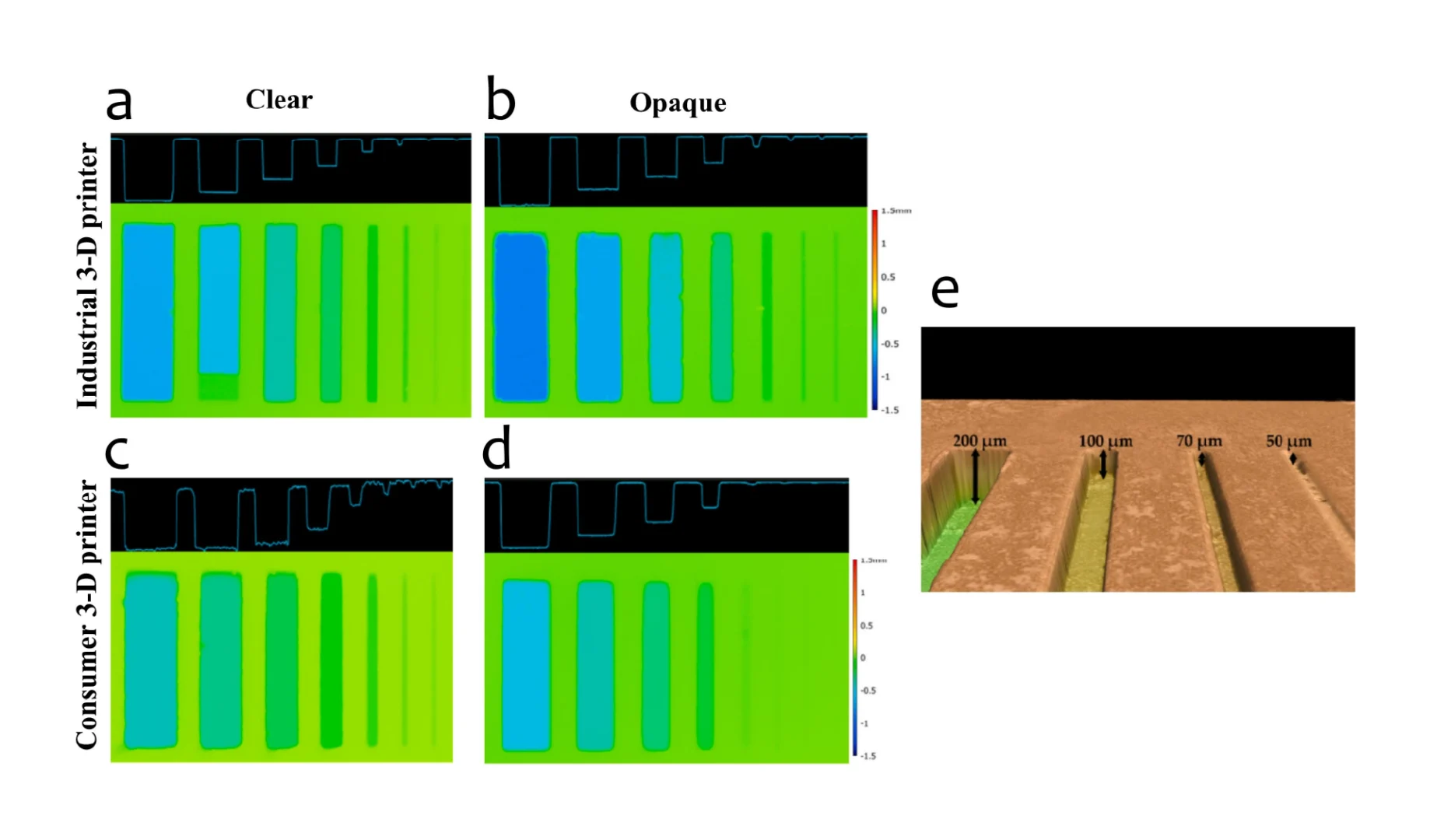
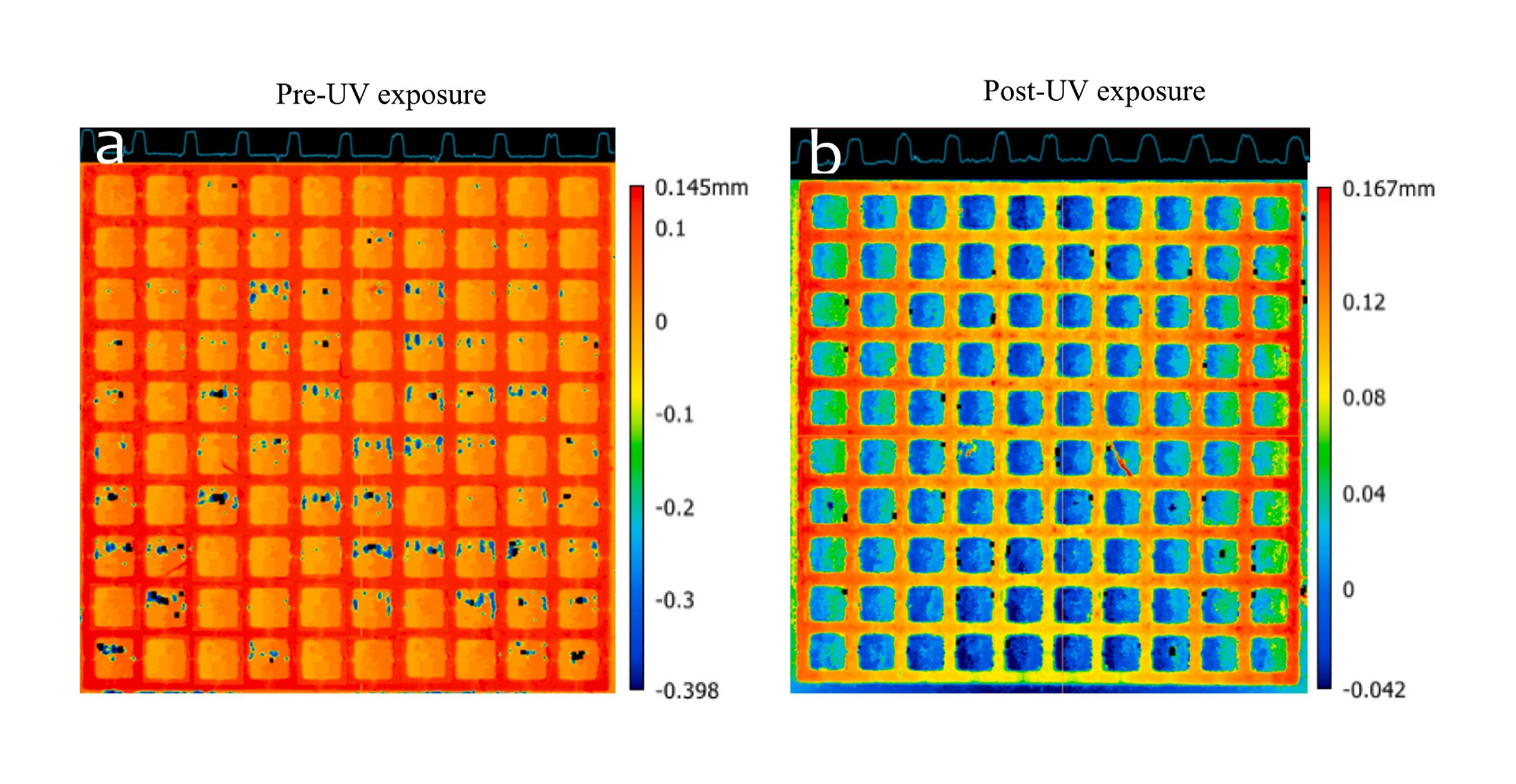
To directly address the profiling of clear resin, a thin coating (<0.005 mm) of titanium dioxide (TiO2nanoparticles was applied to devices. Titanium dioxide nanoparticles were suspended in isopropanol (0.1 mg/ml) and spray coated by use of an airbrush to enhance the surface optical properties (Semmes et al., unpublished data). The gray devices did not require the addition of a TiO2 coating layer. All devices were scanned by use of an optical profiler (Keyence VR-6100, Osaka, Japan) that used non-destructive, non-contact analysis principles. The profiler utilized light to examine surface topography, splitting the light source into two paths: one directed at the surface and the other at a reference mirror. Upon recombination, reflections were projected onto an array detector, enabling precise (0.001 mm) measurements with minimal interference. Dimensional measurements were analyzed using 3D Optical Profilometer VR-6000 software (Keyence). The reference plane for the SSCC was at the bottom of the counting chamber, and for the IGS was at the middle surface between negative and positive features.


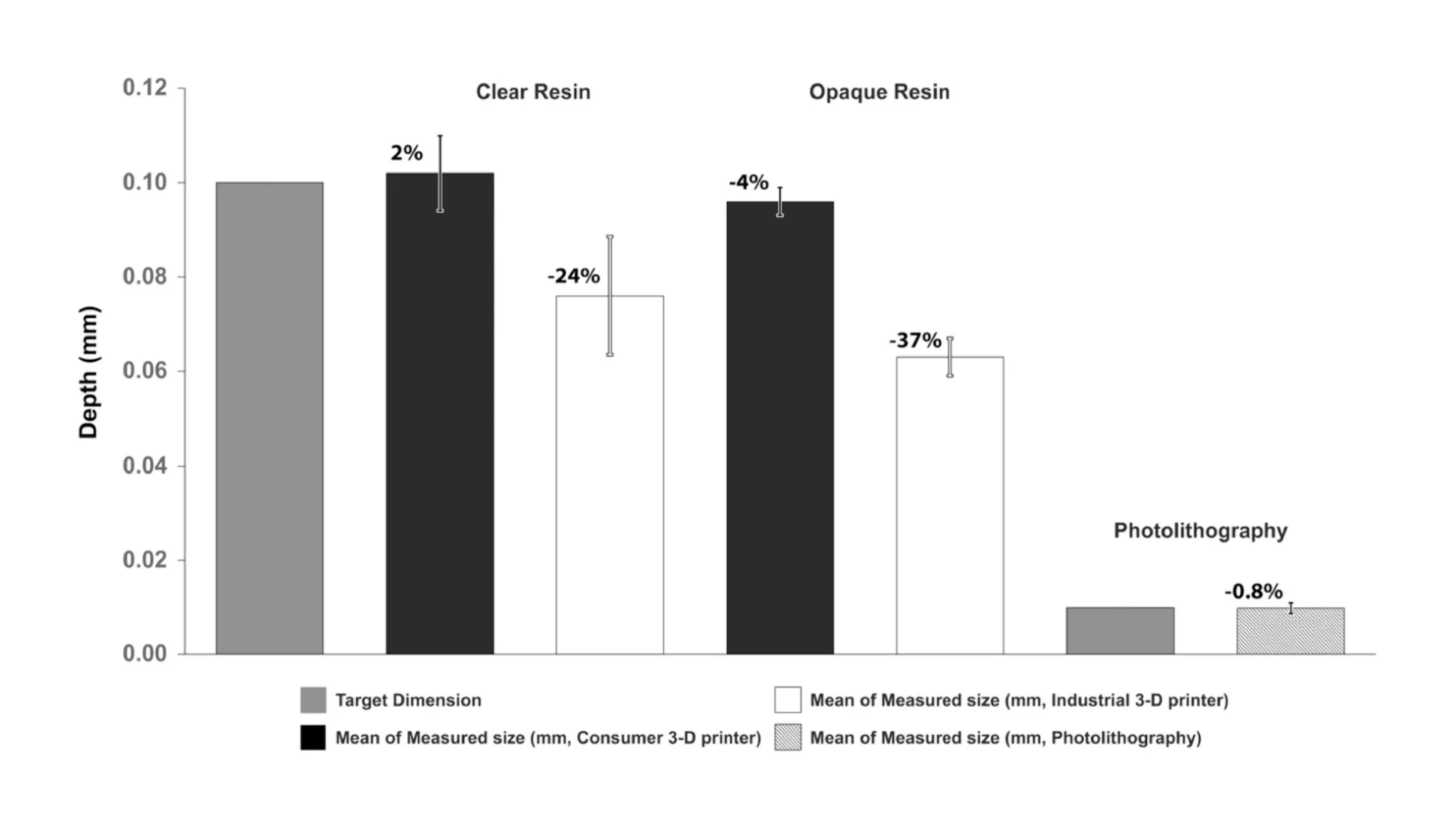
While simple 3-D printed parts with large feature sizes can be assessed by visual observation for suitability, microdevices with features and dimensions that differ from the target dimensions (e.g., micromixers) can show altered performance and require closer inspection upon fabrication. Thus, this study evaluated accuracy and precision of printed device features. Accuracy refers to the closeness of measured values to target values, while precision indicates the consistency and reproducibility of measurements. These metrics are crucial for understanding the reliability and performance of fabrication processes, particularly in the context of transitioning from conventional microfabrication methods to emerging 3-D printing techniques. In this study, accuracy was evaluated by the difference between the target dimension and the mean of measured dimensions (photolithography, n = 6 measurements on 1 device; resin printing, n = 6 measurements each on 4 devices). Precision was assessed by calculating the standard deviation to quantify consistency and reproducibility of the fabrication processes.


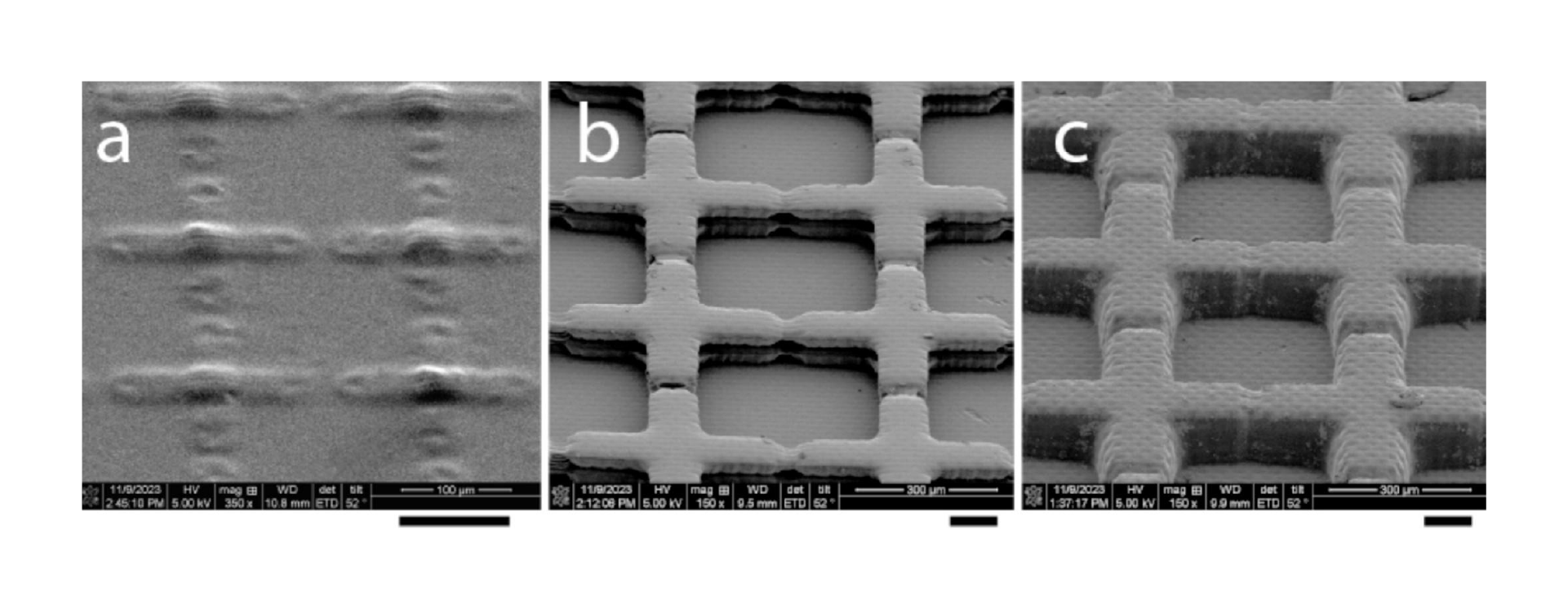
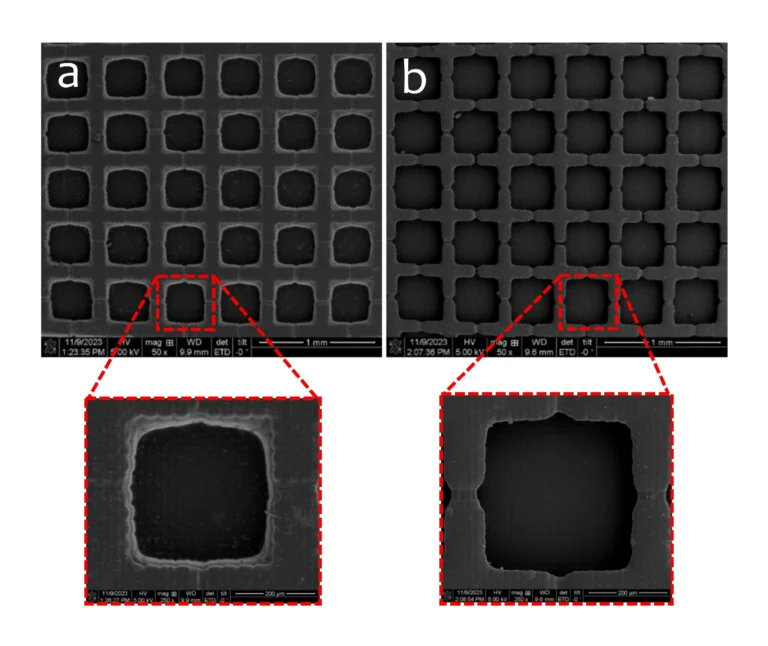
To visually assess surface morphology and examine small changes in residual resin, samples were examined by use of a scanning electron microscope (SEM) (JSM -6610 LV SEM, Jeol USA, Peabody, MA, USA). Preparing devices for SEM imaging involved several steps to achieve high-resolution images. Devices were cleaned with IPA, rinsed with DI water, and air dried. A thin layer of titanium was sputter-coated onto the sample to prevent charging and improve image quality. Prepared devices were loaded into the SEM chamber. A high vacuum was pulled on the chamber in preparation for imaging. Devices were positioned and images from several angles and magnifications were captured for later visual analyses.


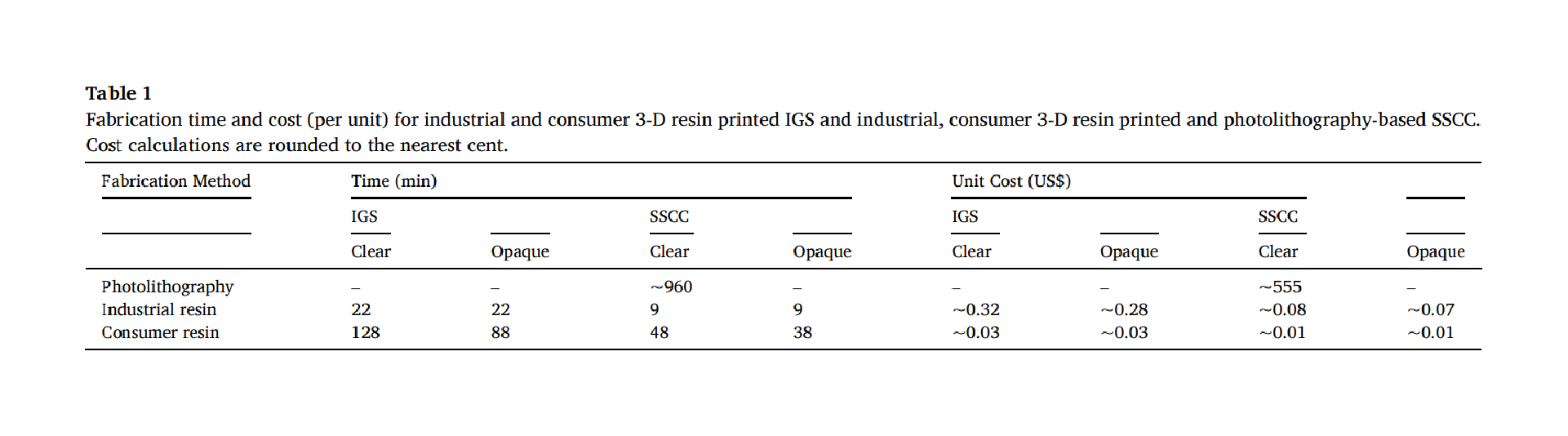
2.3. Time and cost requirements of microfabrication techniques

An evaluation was conducted of the time and cost associated with fabrication, assessing photolithography-based SSCC and devices printed by use of 3-D resin printing. For the photolithography time estimate, we assumed that all necessary equipment was at one facility to perform typical tasks as follows: mask preparation, spin-coating SU-8 photoresist, aligning and UV exposing, developing and curing the photoresist, pouring the PDMS mixture onto the mold, vacuum degassing, curing in an oven, and cleaning and drying the de-molded PDMS. For evaluation, the total printing duration comprised the active printing time (provided by the 3-D printer) and the associated pre-processing (e.g., slicing) and post-processing (e.g., cleaning and curing) steps. For photolithography, costs included mask creation, silicon wafer production, SU-8, SU-8 developer, and PDMS; for the 3-D printers, the cost calculation incorporated the expenses of resin materials.

3. Results

3.1. Accuracy and precision in feature fabrication with opaque resin

Dimensional accuracy (difference between target dimensions and the mean of measured dimensions) and precision (standard deviation) were assessed in fabrication of negative features (microchannel depth) on the IGS using opaque resins. For channel depths of 0.4–1 mm, the industrial 3-D printer depth showed a difference of <2% between the target and measured dimensions (Fig. 2a). In contrast, the consumer 3-D printer displayed a 3–8% discrepancy in channel depths across this range. For smaller channels of 0.1–0.2 mm, the industrial 3-D printer depth showed a difference of about 13% (Fig. 2b). Using the settings described herein, the consumer printer failed to reliably fabricate channels <0.2 mm. The standard deviation of measurements for all channel depths ranged from 0.011 to 0.039 mm for the industrial 3-D printer configuration. In comparison, the consumer printer exhibited standard deviation values ranging from 0.018 to 0.046 mm for all channel depths.

Figure 2. Comparative analysis of IGS positive and negative microchannel features of devices fabricated with industrial-level (white) and consumer-level (black) 3-D resin printers compared to target dimensions (gray). Devices were printed using opaque resin with features ranging from 1 to 0.4 mm (panel a), and ranging from 0.2 to 0.05 mm (b); and clear resin with features ranging from 1 to 0.4 mm (c), and ranging from 0.2 to 0.05 mm (d). Sample size of four devices with six measurements per device were averaged and error bars were reported as standard deviation.

Analysis of the accuracy of positive features (raised microchannels) on the IGS using opaque resins for heights of 0.4–1 mm fabricated by the industrial 3-D printer showed a difference of <2% between the target and measured dimensions (Fig. 2a). In contrast, evaluation of the accuracy of positive (raised) features produced by the consumer 3-D printer revealed fluctuations exceeding 30%. For smaller heights of 0.1–0.2 mm, the industrial 3-D printer depth showed a difference of about 19% (Fig. 2b). The standard deviation of measurements for all channel heights ranged from 0.01 to 0.031 mm for the industrial 3-D printer. In comparison, the consumer 3-D printer exhibited standard deviation values ranging from 0.007 to 0.029 mm.


Seven positive and seven negative stepped features were designed in the IGS with heights and depths of 0.2 mm per step (1.4 mm overall). For the first five negative stepped features the depths fabricated with the industrial 3-D printer showed a difference of <6% between the target and measured dimensions (Fig. 3a). In contrast, the consumer-level printer displayed a 12–26% discrepancy between target and measured dimensions in seven-stepped feature depths. Using the settings described herein, the industrial printer failed for the last two bottom (6th and 7th) stepped features. The standard deviation of depth measurement ranged from 0.011 to 0.042 mm for the industrial printer. In comparison, the consumer printer exhibited standard deviation values ranging from 0.024 to 0.041 mm.

Figure 3. Comparative analysis of IGS stepped features (negative and positive) fabricated with industrial (white) and consumer-level (black) 3-D resin printers compared to target dimensions (gray). The devices were printed with seven positive and seven negative stepped features using opaque resin (panel a), and clear resin (b). Four devices with six measurements per device were averaged and error bars were reported as standard deviation.

For the positive stepped features (diameter range from 4.2 mm to 0.6 mm), accuracy of the industrial 3-D printer had a difference of <5% between the target and measured heights. In contrast, accuracy of positive stepped features produced by the consumer printer was <11% other than the first and second round features (diameters of 4.2 and 3.6 mm) which deviated from the target values by over 40%. The standard deviation of height measurement ranged from 0.011 to 0.019 mm for the industrial printer. In comparison, the consumer printer exhibited standard deviation values ranging from 0.01 to 0.041 mm (Fig. 3a).


Analysis of the accuracy of the opaque SSCC (with a grid height of 0.1 mm) fabricated with the industrial 3-D printer had a 4% discrepancy between target and measured heights (Fig. 4). The consumer printer had a discrepancy of 37% in dimensional height when utilizing opaque resin. The standard deviation for the samples fabricated with the industrial printer was 0.003 mm. Despite the discrepancies with the consumer printer, the standard deviation was 0.004 mm.

Figure 4. Comparative analysis of the target depth versus the mean of measured depth using opaque resin and clear resin for SSCC fabricated with an industrial 3-D printer (white), consumer 3-D printer (black), and photolithography (cross-hatched), compared to target dimensions (gray). Percent difference of the mean measured depth from the target depth was indicated at the top of each bar. Standard deviation was indicated by error bars. The target height for SSCC fabricated by use of resin printers was 0.1 mm and the target height for SSCC fabricated by use of photolithography was 0.01 mm. For resin prints, four devices with six measurements per device were averaged. For photolithography, one device with six measurements were averaged.

3.2. Accuracy and precision in feature fabrication with clear resin

While clear resin proved to be an ideal choice for fabricating microfluidic channels, SSCCs, or any devices requiring transparency (e.g., for visual observation), there were several challenges related to printing and profilometry that must be taken into consideration. During printing, parts in clear resins were vulnerable to distortion from additional light exposure “bleed” from layers above and below the intended layer. Also, during profilometry, reflection and refraction can distort the measurements due to changes in the optical properties of the medium.


For channel depths of 0.1–1 mm, the industrial 3-D printed IGS showed a depth difference of <4% between target and measured dimensions (Fig. 2c and d). In contrast, for channel depths of 0.4–1 mm, the consumer-level printer had less than a 6% discrepancy. It exhibited a 12–15% discrepancy for features of 0.1–0.2 mm. The standard deviation of depth measurement ranged from 0.004 to 0.03 mm for the industrial printer. In comparison, the consumer printer had standard deviation values ranging from 0.003 and 0.027 mm.


Analysis of the accuracy of positive features (raised microchannels) of the IGS fabricated with the industrial 3-D printer using clear resins for heights of 0.1–1 mm showed a difference of 0.5–5% between target and measured dimensions (Fig. 2c and d). In contrast, for channel heights of 0.4–1 mm the consumer-level printer had a 15–17% discrepancy. However, this exceeded 33% for channels ranging from 0.1 to 0.2 mm. The standard deviation of height measurements ranged from 0.005 to 0.031 mm for the industrial printer. In comparison, the consumer printer had standard deviation values ranging from 0.017 to 0.063 mm.


For the first five negative stepped features (diameter range from 4.2 mm to 1.8 mm) the depths with the industrial 3-D printer using clear resin had a difference of <4% between target and measured dimensions (Fig. 3b). In contrast, the consumer-level printer had a 2–15% discrepancy in seven stepped-feature depths (diameter range from 4.2 mm to 0.6 mm). Using the settings described herein, the industrial printer failed for the last two bottom (6th and 7th) stepped features with diameters of 1.2 and 0.6 mm. The standard deviation of depth measurements ranged from 0.009 to 0.044 mm for the industrial printer. In comparison, the consumer printer had standard deviation values ranging from 0.07 to 0.039 mm.


For the positive stepped features (diameter range from 4.2 mm to 0.6 mm), accuracy of the industrial 3-D printer showed a difference of <6% between target and measured heights. In contrast, accuracy of positive stepped features produced with the consumer printer was <12% other than the first and second stepped features (diameters of 4.2 and 3.6 mm) which failed to print. The standard deviation of height measurements ranged from 0.01 to 0.022 mm for the industrial printer. In comparison, the consumer printer had standard deviation values ranging from 0.014 to 0.029 mm (Fig. 3b).


Analysis of the accuracy of the clear SSCC (with grid height of 0.1 mm) fabricated with the industrial 3-D printer had a 2% discrepancy between target and measured heights (Fig. 4). The consumer printer had a discrepancy of 24% in dimensional height when utilizing clear resin. The standard deviation for the samples fabricated with the industrial printer was 0.008 mm. Despite the discrepancies for samples fabricated with the consumer printer, the standard deviation was 0.012 mm.
 

For the photolithography-based SSCC (cast from the wafer), a 0.8% difference between target and measured heights was observed (Fig. 4). The standard deviation was 0.001 mm.


3.3. Visual morphology

Achieving optimal squareness in 3-D printed features posed a notable challenge. Images captured with the optical profilometer illustrated differences in IGS negative features fabricated with industrial and consumer 3-D resin printers using opaque and clear resins (Fig. 5a-e).

Figure 5. Two-dimensional images produced by optical profiling of IGS channels with square cross-sectional design (ranging from 1 mm to 0.05 mm) fabricated with industrial 3-D printer using clear resin (panel a), industrial 3-D printer using opaque resin (b), consumer printer using clear resin (c), consumer printer using opaque resin (d), in comparison to a representative 3-D image (industrial printer using opaque resin) of the negative features (e). Blue colors indicate values below the reference plane and green colors indicate depths closer or equal to the reference plane. (For interpretation of the references to colour in this figure legend, the reader is referred to the web version of this article.)

In general, deeper features appeared to have better squareness at their bottoms. Visually, the industrial resin printer (Fig. 5a and b) was able to produce sharper angles at the bottom and top of negative features compared with the consumer resin printer (Fig. 5c and d).


Visual analysis of stepped features identified different problems than square features. To facilitate visual analysis, a Keyence tool called “CAD Compare” was used (Fig. 6). The line plots (top of each panel) showed that the industrial printer with opaque resin performed best at depth and height feature fabrication. The consumer printer did well when printing negative features with clear resin, while the industrial printer did better when printing positive features with clear resin. This CAD Compare analysis also assessed the roundness of the cylinders which is important in some applications but was not directly addressed herein. Visually, the roundness of the cylinders was good with both printer types and resins, until the smallest (deepest and tallest) layers. This was also where the printers struggled to fabricate accurate depths and heights (Fig. 3).

Figure 6. Images produced by optical profiling of IGS stepped features for target profile, sample profile, and CAD comparison (height difference between target and printed sample) for the industrial 3-D printer with clear resin (panel a), industrial 3-D printer with opaque resin (b), consumer printer with clear resin (c) and, consumer printer with opaque resin (d). Reds indicated measured depths that were shallower than the target, green indicated measured depths and heights that were near or equal to the target, and blues indicated measured heights that were shorter than the target. (For interpretation of the references to colour in this figure legend, the reader is referred to the web version of this article.)

The surface quality of the SSCC imaged by use of scanning electron microscopy (SEM) revealed differences in performance among the fabrication methods (Fig. 7a-c). This showed the pre-selected difference in grid-wall height between the photolithography-based (0.01 mm) and resin-based (0.1 mm) SSCCs. The channels between grids were reliably fabricated with photolithography and the surface detail at the bottom of each cell was smooth (Fig. 7a). In resin-based devices, the channels between the grids were not reliably created, although the surface detail was relatively smooth (Fig. 7b and c). A texturing is visible resembling the pixel pattern from the printer LCD. Of note are the visible layer lines produced with the industrial 3-D resin printer (Fig. 7b). The grid walls appear to be 2-layer lines thick (0.03 mm layer height and 0.1 mm target grid height).

Figure 7. Scanning electron microscopy of SSCC devices fabricated using: photolithography (panel a), industrial 3-D resin printing (b), and consumer 3-D printing (c) (scale bars = 0.1 mm). The SSCC consisted of grid and wall features with heights of 0.01 mm (photolithography) or 0.1 mm (resin printing), including gaps in the gridlines that connected the squares to allow better distribution of sample for counting or quality evaluation (e.g., sperm motility) of biological samples.

To evaluate post-processing, SEM images of SSCC were captured before and after removal of residual resin (Fig. 8a and b). One interesting observation was that post-processing revealed the channels between the grids, which were important for even filling and cellular distribution within the device.

Figure 8. Scanning electron microscopy of SSCC devices made with an industrial 3-D printer. Before post-processing (panel a), and after post-processing (b) (removing residual resin with IPA).

In the final phase of post-processing, UV exposure was applied to the samples for 1 min, enhancing mechanical properties but sometimes introducing a curvature [35]. Various printing parameters including print time, single-layer height, post-curing UV intensity, and total thickness have been reported to play substantial roles in this curvature phenomenon [36]. Images of SSCC with and without post-processing (UV exposure) were captured with the profiler (Fig. 9a and b). Curling was evident in the UV-exposed sample. To mitigate this, an approach was developed allowing the sample to remain affixed to the build plate for approximately 24 h after UV exposure (data not shown). This served as an effective method to alleviate stress in the printed samples, contributing to the reduction of curvature induced by post-processing.

Figure 9. Profiled height of a SSCC device produced by the industrial printer, before curing (panel a), and after curing demonstrating curling (b) (UV exposure). The colour indicates the depth relative to a baseline of zero. Note the difference in scales. Orange indicates measurements equal to the reference plane (a). Reds indicate measurements above, the reference plane and greens and blues indicate measurements below the reference plane (a). Blue indicates measurements equal to the reference plane (b). Reds, oranges, and greens indicate measurements above the reference plane (upward curvature) (b). (For interpretation of the references to colour in this figure legend, the reader is referred to the web version of this article.)

3.4. Comparison of time and cost of microfabrication

Efficiency and cost-effectiveness are pivotal factors in selecting microfabrication techniques for creation of microdevices [31]. In terms of fabrication time, fabrication of a single SSCC with photolithography typically required around 2 d and cost US$555 (Table 1). However, utilizing industrial and consumer-grade 3-D resin printers significantly reduced time and material costs. For example, the industrial printer fabrication time was <38 min and cost as little as US$0.08 per unit (Table 1). The cost calculations (Supplementary Table 2) did not include salary, electrical, or other facilities and personnel costs because these vary by location. The time calculations did not take into consideration the new approach to mitigate post-UV exposure curvature because it may not be necessary for all device configurations.
Table 1. Fabrication time and cost (per unit) for industrial and consumer 3-D resin printed IGS and industrial, consumer 3-D resin printed and photolithography-based SSCC. Cost calculations are rounded to the nearest cent.

4. Discussion

This study evaluated dimensional accuracy and precision, visual morphology, and squareness of depth and height features in devices fabricated by use of traditional photolithography and industrial and consumer-grade 3-D resin printers using opaque and clear resin. In addition, the time and cost requirements were evaluated for microfabrication among the methods. The findings of this study underscored the comprehensive capabilities of industrial-grade and consumer-grade 3-D printers, in relation to photolithography in meeting complex dimensional requirements for specific applications. For this evaluation, the SSCC provided a device with direct relevance to biological usage, and the IGS allowed evaluation of fabrication quality of 3-D resin printers across a range of features. In the selection of IGS features, square geometries were chosen due to their prevalence and significance in microfluidic applications which were the primary focus of this study. Depth and height of stepped features also hold significance in certain applications and pose challenges during fabrication and were thus also chosen for evaluation. Dimensional accuracy and precision and squareness of depth and height features are critical factors for the use of quality management devices for germplasm. Differences in fabrication quality translate to functional performance changes, affecting accuracy of metrics such as sperm concentration which requires accurate volumetric calculations or microfluidic mixing efficiency needing precise feature angles and placement.


The industrial 3-D printer consistently exhibited close accuracy and precision aligned with the photolithography-based SSCC for microchannel fabrication using clear resin, even with minimum feature sizes as small as 0.1 mm. Conversely, the consumer 3-D printer, although less accurate and precise for features smaller than 0.2 mm, demonstrated reliability for features above this threshold. The larger variations, especially for raised features, were likely attributable to the specific printer settings. Throughout preliminary preparation for this study, numerous settings were explored to establish a balance for the evaluation of positive and negative features in the same device. The settings outlined in Supplementary Table 1 were identified as being effective for the specific purposes of this study.


As with traditional fabrication approaches, 3-D printing has a trade-off between extensive optimization for accuracy and precision, and the need for rapid prototyping or production of parts that do not require high tolerances [37]. With targeted refinements it would be possible to identify specific print settings for the consumer-grade printer that would further enhance the quality of the positive or negative features, but this was not the intent of the study. Industrial printers require less adjustment of such settings as they are already optimized for specific applications (e.g., microfabrication in the present study). In fabricating opaque SSCCs using consumer-grade printers, we encountered instances where the devices exhibited high precision comparable to the industrial-grade printer but lacked in accuracy (Fig. 4). Through experimentation involving iterative prototyping and adjustments to factors such as resin types and print settings, achieving a practical balance between accuracy and precision appeared to be achievable.


Stepped features printed with an industrial printer, had positive features (using opaque and clear resins) within 6% of the target dimensions, and thus exhibited reliable accuracy. However, the 6th (1.2 mm diameter) and 7th (0.6 mm diameter) negative stepped features failed to print reliably. This could be attributed to several factors including the round shape of features with small diameters, or the print settings, which may pose challenges for printing. Surprisingly, this was less challenging with the consumer printer. Instead, the consumer printer had problems with the 1st (4.2 mm diameter) and 2nd (3.6 mm diameter) positive stepped features using opaque and clear resins. Due to the higher sensitivity of consumer machines to print settings, achieving better results may be possible through adjustments to these settings. Future evaluations of the roundness (X-Y orientation) of round features on the IGS will provide insight into the potential limitations of LCD-based resin 3-D printers to fabricate round features.


These results highlighted the capabilities of different fabrication methods in terms of accuracy and precision across different feature sizes and types. It established industrial 3-D resin printers as a strong option for applications requiring high-resolution microfabrication, while consumer printers remain a viable choice for less demanding applications where feature sizes are not as critical or where there is more time for optimization of settings and resin types. The rapid advancements being made in consumer 3-D resin printing open substantial opportunities for achieving reliable microfabrication in the future. With respect to aquatic organisms, even the consumer-level printers provided sufficient accuracy and precision for routine practical use with most species and germplasm types.


Apparatus Used

Clear Microfluidic Resin

Master Mold for PDMS

ProFluidics 285D

The width resolution (not directly examined herein), is intricately linked to the X-Y resolution and is influenced by the size of the projected pixels. It operates in conjunction with depth resolution, which is closely tied to Z resolution, representing the thickness of each cured layer [38]. These interrelated factors collectively contributed to the overall accuracy, precision, and level of detail attainable in printed objects. In exploring the relationship between printing orientation and dimensional accuracy and precision, altering printing orientation by 90 degrees could potentially result in a reduction in the variance of depth dimensions compared to width [39,40]. Changing the print orientation may thus influence the dimensional accuracy and precision of features within devices like the SSCC. These considerations should be investigated further and offer another avenue for reducing differences and variations observed in the depth dimensions from the printers.


In terms of visual squareness, the industrial 3-D resin printer using clear resin produced sharper corners in channels compared to prints with opaque resin (Fig. 5). When assessing the final output, it was essential to consider the influence of the slicer settings on dimensions and printer resolution. The industrial printer produced channels of ≥0.1 mm with minimal defects. However, potential defects, particularly in the roundness of the edges, become noticeable for channels smaller than 0.1 mm, affecting positive and negative features under these conditions. The consumer 3-D resin printer using opaque resin produced sharper corners in channels compared to prints with clear resin but was able to produce smaller channels better with the clear resins (Fig. 5). These visual observations of squareness between the two printer types demonstrates the opportunities to advance their capabilities and could be helpful in deciding which printer type would be best suited for specific applications that require square-angle features in clear or opaque.


Surface morphology plays a crucial role in determining the functionality and performance of microdevices. For instance, in biomedical devices it can affect cell adhesion and proliferation [41]. The industrial 3-D printer produced visually smoother surfaces compared to prints with the consumer 3-D printer (Fig. 7b and c). This superior surface quality could contribute to enhanced functionality and reliability of microfluidic channels fabricated using industrial-grade 3-D printing, highlighting its potential for various applications requiring high-quality surface finishes. Comparatively, the photolithography-based SSCC exhibited a visually smoother surface (Fig. 7a) with fewer defects than devices created by the industrial 3-D resin printer. The effect of these differences in surface morphology on the functionality and performance of resin-printed devices requires further investigation and will vary across the range of devices and functionalities desired.


For stepped features, squareness and roundness of the edges were significant factors. These parameters appeared to be satisfactory for industrial 3D-printed samples. However, in the case of consumer 3D-printed samples, while the roundness appeared acceptable, there were noticeable issues with edge squareness. The CAD comparisons showed differences in depth or height of negative or positive features compared to the design. The industrial and consumer printers generally produced better surface morphology for positive stepped features compared to negative features.


The photolithography-based method, despite its time-intensive 2-day fabrication process and substantial cost of approximately US$555 per unit for SSCC fabrication, distinguished itself through accuracy, precision, and control. This makes it particularly well-suited for applications that prioritize exacting accuracy and precision, such as highly quantitative analysis of the smallest of aquatic germplasm types (e.g., zebrafish sperm). It should be noted that the unit cost associated with photolithography decreases once a finalized mold is generated because many devices can be cast from one mold [15]. Although, the unit cost could also increase drastically if customization or changes need to be made to a mold which would require repeating the mold creation process. Industrial resin 3-D printing was efficient, requiring <30 min for IGS and SSCC fabrication with material costs estimated at US$0.32 per unit for clear IGS and US$0.08 for clear SSCC. This method enhanced rapid prototyping and fabrication. On the other hand, consumer resin 3-D printing struck a balance between fabrication time and cost, providing relatively fast times (<150 min) for IGS and SSCC (clear and opaque), with costs estimated at US$0.03 per unit for clear IGS and US$0.01 for clear SSCC. This presents a cost-effective solution for open-hardware applications with budgetary constraints while providing satisfactory fabrication times across the size and resolution range needed for aquatic species. Overall, photolithography can provide accuracy and precision, industrial resin 3-D printing can be useful for rapid prototyping, and consumer resin 3-D printing offers a balance between efficiency and cost-effectiveness, with these differences operating along a gradient of scale.


Aquatic species are in great need for powerful and innovative solutions requiring rapid prototyping and, at a minimum, batch fabrication. Currently, the resolution for resin printing is sufficient for these applications, and eventually printers that can compete directly with soft lithography will become cheap enough to be accessible to the broader community. Moving forward, devices created by use of 3-D resin printing will require testing to ensure accuracy and functionality, and resins will need to be evaluated for cytotoxicity. Though it is important to note that resin contact with sperm is for a short duration (1–2 s) and devices can make use of a disposable sub-sample rather than the entire sample. Even with the current capabilities of resin printing, we can move seamlessly from micro- to milli- to macro- scales in the design process without changing materials or equipment. Overall, the dynamic range of resin printing demonstrated herein enables high precision and throughput that can extend into open hardware, promoting inclusive access to critical technology and fostering community-driven innovation for aquatic species.


In addition, all the architecture necessary for a single device (e.g., Luer locks and other connections) can be printed at one time and in one material enabling direct single-step production of devices. However, resin printers are not limited to direct production and, like photolithography, can also print device molds facilitating access, distribution, and community development. By adding 3-D resin printing to the roster, designers, fabricators, and users now have multiple options for developing and obtaining devices. The greatly broadened accessibility of resin 3-D printers compared to photolithography provides new opportunities for standardized designs and procedures. This approach empowers wider dissemination and adoption within research and aquaculture communities, accelerating the transition to open hardware and sustainable germplasm repository development. By cultivating an international community capable of independent fabrication and design, a collaborative system can emerge to enhance genetic resource protection and promote much-needed innovation in culture, breeding, conservation, and research of aquatic species.

5. Conclusions

This study provided an overall evaluation of the capabilities of representative industrial-grade and consumer-level 3-D resin printing compared to conventional photolithography in fabrication of microdevices with a specific focus on germplasm repository development for aquatic species. This provides a platform for improving critical QM strategies throughout genetic resource protection processes. Fabrication quality distinctions were highlighted through the assessment of various components in microdevices including positive and negative features, channels, and complex structures. Visual morphologic analysis revealed differences in squareness and roundness, emphasizing the importance of considering these factors in the design of devices and the selection of fabrication technologies.


Overall, this research contributes to the ongoing exploration of emerging technologies in microdevice development and prototyping. By understanding the strengths and limitations of 3-D resin printing technologies, researchers and industry professionals can make informed decisions when selecting fabrication methods for specific applications. As the field progresses, studies of this type can provide a solid foundation for future advancements in custom microdevice creation, particularly with essential germplasm repository technology for aquatic species. By pioneering a shift from traditional methods to 3-D resin printing, the stage can be set for more efficient and precise fabrication processes. In addition, insights into the trade-offs between consumer-grade and industrial-grade printers can guide technology selection facilitating broader accessibility and innovation. Such findings will fuel development of standardized protocols, open-hardware designs, and novel solutions, ultimately enhancing aquatic species conservation efforts and genetic resource preservation. Interdisciplinary approaches such as these integrating biology and engineering (e.g., [42]) in a real-world context offer powerful mechanisms for producing innovation to address future challenges including climate change.

Supplementary Materials

References

  1. N. Coxe, Y. Liu, L. Arregui, R. Upton, S. Bodenstein, S.R. Voss, M.T. Gutierrez-Wing, T.R. Tiersch, Establishment of a practical sperm cryopreservation pathway for the axolotl (Ambystoma mexicanum): a community-level approach to germplasm repository development, Animals (Basel) 14 (2024) 206. [Google Scholar]
  2. I. Haagen, H. Blackburn, Efforts to cryopreserve shrimp (Penaeid) genetic resources and the potential for a shrimp germplasm bank in the United States, Aquaculture 580 (2023) 740298. [Google Scholar]
  3. J.C. Koch, A.M. Oune, S. Bodenstein, T.R. Tiersch, Untangling the Gordian Knot of Aplysia sea hare egg masses: an integrated open-hardware system for standardized egg strand sizing and packaging for cryopreservation research and application, HardwareX 16 (2023) e00476. [Google Scholar]
  4. Y. Liu, J.C. Koch, L. Arregui, A. Oune, S. Bodenstein, M.T. Gutierrez-Wing, T. R. Tiersch, Exploring pathways toward open-hardware ecosystems to safeguard genetic resources for biomedical research communities using aquatic model species, J. Exp. Zool. B Mol. Dev. Evol. (2024) 278–290. [Google Scholar]
  5. R.S.V. Pullin, Genetic resources for aquaculture: Status and trends, in: Status and Trends in Aquatic Genetic Resources: A Basis for International Policy, 2006. [Google Scholar]
  6. T.R. Tiersch, C.C. Green, Cryopreservation in Aquatic Species: A Comprehensive Overview of Current Practices, Programmatic Development and Future Directions for Cryopreservation of Gametes Embryos and Larvae of Aquatic Species, World Aquaculture Society, 2011. [Google Scholar]
  7. Y. Liu, W.T. Monroe, J.A. Belgodere, J.-W. Choi, M.T. Gutierrez-Wing, T.R. Tiersch, The emerging role of open technologies for community-based improvement of cryopreservation and quality management for repository development in aquatic species, Anim. Reprod. Sci. 246 (2022) 106871. [Google Scholar]
  8. M.R.I. Sarder, Potential of Fish Gamete Cryopreservation in Conservation Programs in Bangladesh, in: Cryopreservation of Fish Gametes, Springer Singapore, Singapore, 2020, pp. 337–344. [Google Scholar]
  9. S. Bodenstein, T.R. Tiersch, M.A.R. Hossain, M.G. Hamilton, M. Yeasin, M. M. Akhter, T.Q. Trinh, M. Mahmuddin, A cryopreserved sperm repository strategy for WorldFish genetically improved carp, 2023. [Google Scholar]
  10. W. Wang, J. Zhang, C. Xu, Oscillating feedback micromixer: a short review, Chemical Engineering and Processing-Process Intensification 109812 (2024). [Google Scholar]
  11. R. Ghosh, A. Arnheim, M. van Zee, L. Shang, C. Soemardy, R.-C. Tang, M. Mellody, S. Baghdasarian, E. Sanchez Ochoa, S. Ye, Lab on a particle technologies, Anal. Chem. 96 (2024) 7817–7839. [Google Scholar]
  12. A. Ebrahimi, K. Icoz, R. Didarian, C. Shih, E.A. Tarim, B. Nasseri, A. Akpek, B. Cecen, A. Bal-Ozturk, K. Güleç, Molecular separation by using active and passive microfluidic chip designs: a comprehensive review, Adv. Mater. Interfaces 11 (2024) 2300492. [Google Scholar]
  13. M. Hagedorn, Z. Varga, R.B. Walter, T.R. Tiersch, Workshop report: cryopreservation of aquatic biomedical models, Cryobiology 86 (2019) 120–129. [Google Scholar]
  14. Y. Liu, M. Chesnut, A. Guitreau, J. Beckham, A. Melvin, J. Eades, T.R. Tiersch, W. T. Monroe, Microfabrication of low-cost customisable counting chambers for standardised estimation of sperm concentration, Reprod. Fertil. Dev. 32 (2020) 873–878. [Google Scholar]
  15. J.A. Belgodere, Y. Liu, E.L. Reich, J. Eades, T.R. Tiersch, W.T. Monroe, Development of a single-piece sperm counting chamber (SSCC) for aquatic species, G 7 (2022) 231. [Google Scholar]
  16. Beckham, F. Alam, V. Omojola, T. Scherr, A. Guitreau, A. Melvin, D.S. Park, J. W. Choi, T.R. Tiersch, W. Todd Monroe, A microfluidic device for motility and osmolality analysis of zebrafish sperm, Biomed. Microdevices 20 (2018) 67. [Google Scholar]
  17. D.S. Park, R.A. Egnatchik, H. Bordelon, T.R. Tiersch, W.T. Monroe, Microfluidic mixing for sperm activation and motility analysis of pearl Danio zebrafish, Theriogenology 78 (2012) 334–344. [Google Scholar]
  18. D.S. Park, C. Quitadamo, T.R. Tiersch, W.T. Monroe, Microfluidic mixers for standardization of computer-assisted sperm analysis, Cryopreservation in Aquatic Species 2 (2011) 261–272. [Google Scholar]
  19. S. Razavi Bazaz, N. Kashaninejad, S. Azadi, K. Patel, M. Asadnia, D. Jin, M. Ebrahimi Warkiani, Rapid softlithography using 3D-printed molds, Advanced Materials Technologies 4 (2019) 1900425. [Google Scholar]
  20. R. Rahul, N. Prasad, R.R. Ajith, P. Sajeesh, R.S. Mini, R.S. Kumar, A mould-free soft-lithography approach for rapid, low-cost and bulk fabrication of microfluidic chips using photopolymer sheets, Microfluid. Nanofluid. 27 (2023) 78. [Google Scholar]
  21. C. He, S. Li, B. Jiang, F. Chen, W. Hu, F. Deng, Surface hydrophobicity and guest permeability in polydimethylsiloxane-coated MIL-53 as studied by solid-state nuclear magnetic resonance spectroscopy, ACS Appl. Mater. Interfaces 15 (2023) 37936–37945. [Google Scholar]
  22. J. Lee, J. Kim, H. Kim, Y.M. Bae, K.-H. Lee, H.J. Cho, Effect of thermal treatment on the chemical resistance of polydimethylsiloxane for microfluidic devices, J. Micromech. Microeng. 23 (2013) 035007. [Google Scholar]
  23. A.E. Lenhart, R.T. Kennedy, Evaluation of surface treatments of PDMS microfluidic devices for improving small-molecule recovery with application to monitoring metabolites secreted from islets of Langerhans, ACS Measurement Science Au 3 (2023) 380–389. [Google Scholar]
  24. A. Mata, A.J. Fleischman, S. Roy, Characterization of polydimethylsiloxane (PDMS) properties for biomedical micro/nanosystems, Biomed. Microdevices 7 (2005) 281–293. [Google Scholar]
  25. A.-G. Niculescu, C. Chircov, A.C. Bîrca, ˘ A.M. Grumezescu, Fabrication and applications of microfluidic devices: a review, Int. J. Mol. Sci. 22 (2021), https://doi.org/10.3390/ijms22042011. [Google Scholar]
  26. M.W. Toepke, D.J. Beebe, PDMS absorption of small molecules and consequences in microfluidic applications, Lab Chip 6 (2006) 1484–1486. [Google Scholar]
  27. W.M. Childress, Y. Liu, T.R. Tiersch, Design, alpha testing, and beta testing of a 3-D printed open-hardware portable cryopreservation device for aquatic species, J. Appl. Aquac. 35 (2023) 213–236. [Google Scholar]
  28. Y. Liu, M. Eskridge, A. Guitreau, J. Beckham, M. Chesnut, L. Torres, T.R. Tiersch, W.T. Monroe, Development of an open hardware 3-D printed conveyor device for continuous cryopreservation of non-batched samples, Aquac. Eng. 95 (2021) 102202. [Google Scholar]
  29. A. Amini, R.M. Guijt, T. Themelis, J. De Vos, S. Eeltink, Recent developments in digital light processing 3D-printing techniques for microfluidic analytical devices, J. Chromatogr. A 463842 (2023). [Google Scholar]
  30. M.J. Schwing, Y. Liu, J.A. Belgodere, W.T. Monroe, T.R. Tiersch, A. Abdelmoneim, Initial assessment of the toxicologic effects of leachates from 3-dimensional (3-D) printed objects on sperm quality in two model fish species, Aquat. Toxicol. 256 (2023) 106400. [Google Scholar]
  31. N.C. Zuchowicz, J.A. Belgodere, Y. Liu, I. Semmes, W.T. Monroe, T.R. Tiersch, Low-cost resin 3-D printing for rapid prototyping of microdevices: opportunities for supporting aquatic germplasm repositories, G 7 (2022), https://doi.org/10.3390/fishes7010049. [Google Scholar]
  32. R. Zhou, M. Versace, B. Boisnard, M. Gomez-Castano, C. Viana, J.-L. Polleux, A.- L. Billabert, Thermal stability of SU-8 low-loss optical coupling interconnects at 850 nm, IEEE Photon. Technol. Lett. 36 (2023) 159–162. [Google Scholar]
  33. D. Qin, Y. Xia, G. Whitesides, Soft lithography for micro- and nanoscale patterning, Nat. Protoc. 5 (2010) 491–502. [Google Scholar]
  34. S.M. Montgomery, F. Demoly, K. Zhou, H.J. Qi, Pixel-level grayscale manipulation to improve accuracy in digital light processing 3D printing, Adv. Funct. Mater. 2213252 (2023). [Google Scholar]
  35. S. Aati, Z. Akram, B. Shrestha, J. Patel, B. Shih, K. Shearston, H. Ngo, A. Fawzy, Effect of post-curing light exposure time on the physico–mechanical properties and cytotoxicity of 3D-printed denture base material, Dent. Mater. 38 (2022) 57–67. [Google Scholar]
  36. D. Wu, Z. Zhao, Q. Zhang, H.J. Qi, D. Fang, Mechanics of shape distortion of DLP 3D printed structures during UV post-curing, Soft Matter 15 (2019) 6151–6159. [Google Scholar]
  37. A.R. Renner, E. Winer, Exploring print setting tradeoffs to improve part quality using a visual thermal process simulation, Adv. Eng. Softw. 173 (2022) 103243. [Google Scholar]
  38. B.N. Dhanunjayarao, N.V.S. Naidu, Assessment of dimensional accuracy of 3D printed part using resin 3D printing technique, Materials Today: Proceedings 59 (2022) 1608–1614. [Google Scholar]
  39. S. Martínez-Pellitero, M.A. Castro, A.I. Fernandez-Abia, S. Gonzalez, E. Cuesta, Analysis of influence factors on part quality in micro-SLA technology, Procedia Manuf. 13 (2017) 856–863. [Google Scholar]
  40. J.S. Shim, J.-E. Kim, S.H. Jeong, Y.J. Choi, J.J. Ryu, Printing accuracy, mechanical properties, surface characteristics, and microbial adhesion of 3D-printed resins with various printing orientations, J. Prosthet. Dent. 124 (2020) 468–475. [Google Scholar]
  41. H.-Y. Chang, W.-L. Kao, Y.-W. You, Y.-H. Chu, K.-J. Chu, P.-J. Chen, C.-Y. Wu, Y.- H. Lee, J.-J. Shyue, Effect of surface potential on epithelial cell adhesion, proliferation and morphology, Colloids Surf. B Biointerfaces 141 (2016) 179–186. [Google Scholar]
  42. C.A. Graham, H. Shamkhalichenar, V.E. Browning, V.J. Byrd, Y. Liu, M. T. Gutierrez-Wing, N. Novelo, J.-W. Choi, T.R. Tierschc, A practical evaluation of machine learning for classification of ultrasound images of ovarian development in channel catfish (Ictalurus punctatus), Aquaculture 552 (2022), https://doi.org/10.1016/j.aquaculture.2022.738039. [Google Scholar]

On the Development of a New Flexible Pressure Sensor

On the Development of a New Flexible Pressure Sensor

by Florian Pistriţu ,2ORCID,Marin Gheorghe ,Marian Ion ,Oana Brincoveanu,Cosmin Romanitan ,Mirela Petruta Suchea Paul Schiopu  andOctavian Narcis Ionescu

Abstract The rapid advancement of the Internet of Things (IoT) serves as a significant driving force behind the development of innovative sensors and actuators. This technological progression has created a substantial demand for new flexible pressure sensors, essential for a variety of applications ranging from wearable devices to smart home systems. In response to this growing need, our laboratory has developed a novel flexible pressure sensor, designed to offer an improved performance and adaptability. This study aims to present our newly developed sensor, detailing the comprehensive investigations we conducted to understand how different parameters affect its behaviour. Specifically, we examined the influence of the resistive layer thickness and the elastomeric substrate on the sensor’s performance. The resistive layer, a critical component of the sensor, directly impacts its sensitivity and accuracy. By experimenting with varying thicknesses, we aimed to identify the optimal configuration that maximizes sensor efficiency. Similarly, the elastomeric substrate, which provides the sensor’s flexibility, was scrutinized to determine how its properties affect the sensor’s overall functionality. Our findings highlight the delicate balance required between the resistive layer and the elastomeric substrate to achieve a sensor that is both highly sensitive and durable. This research contributes valuable insights into the design and optimization of flexible pressure sensors, paving the way for more advanced IoT applications.

Keywords: pressure sensors; flexible electronics; elasticity; wearability

We kindly thank the researchers at IMT Bucharest for this collaboration, and for sharing the results obtained with their system.

1. Introduction

The need for wearable pressure sensors has significantly increased in recent years due to their extensive application in the medical and Internet of Things (IoT) domains. These advanced sensors are crucial in monitoring and providing valuable data regarding human motion and physiological signals. They play an essential role in capturing human movement dynamics, including intricate muscle activities [1] and specific joint movements such as arm motion [2] and knee bending [2,3]. Additionally, these sensors are essential for monitoring vital signs such as pulse rate [4,5,6,7], respiration [1], and even phonation detection [2,8], which is the ability to detect and analyze sounds produced by the vocal cords. The information obtained from wearable pressure sensors is invaluable in numerous applications. In the medical field, these sensors contribute to more accurate diagnosis, patient monitoring, and the development of personalized treatment plans. For instance, tracking muscle movement and joint activities can aid in the rehabilitation process, allowing for real-time feedback and adjustments to therapy protocols. Monitoring pulse rate and respiration provides critical data for managing cardiovascular and respiratory conditions, ensuring timely interventions. Furthermore, in the realm of the IoT, these sensors enable enhanced human–machine interactions and smart environments, offering a seamless integration of technology into daily life. The manufacturing technology for flexible electronics, which underpins the development of wearable pressure sensors, is generally based on advanced printing techniques. Inkjet printing [9,10,11,12] is widely used due to its precision and ability to create the fine patterns necessary for high-performance sensor components. This method allows for the deposition of functional materials onto flexible substrates, forming the essential layers of the sensors. Screen printing [12,13,14,15], another prevalent technique, is known for its cost-effectiveness and scalability. It involves transferring ink through a mesh screen to create thicker and more durable sensor layers, suitable for various flexible electronic applications. The combination of these advanced manufacturing technologies ensures the production of reliable, flexible, and high-performance wearable pressure sensors. By leveraging inkjet and screen printing methods, manufacturers can achieve the necessary precision, efficiency, and adaptability required to meet the growing demands in medical and IoT applications. As a result, these sensors continue to evolve, providing increasingly sophisticated solutions for monitoring and enhancing human health and interaction with technology.

Flexible substrate-based pressure sensors have been extensively studied. For illustration, Congcong Yang et al. designed a film with a double surface structure to create a sandwich resistive pressure sensor, demonstrating excellent parameters including a high sensitivity (77.78 kPa−1, 24 Pa minimum detection), a wide detection range (0.024–230 kPa), a fast response time (30 ms), and a high reliability over 5000 repetitive cycles. Mohammed Mohammed Ali et al. [16] developed a printed strain sensor by screen printing a silver nanowire (Ag NW)/silver (Ag) flake composite on a flexible and stretchable thermoplastic polyurethane (TPU) substrate. The sensor was tested in two configurations, as follows: a straight line and a wavy line. The average resistance changes over 100 cycles were 104.8%, 177.3%, and 238.9%, and over 200 cycles were 46.8%, 141.4%, and 243.6% for elongations of 1 mm, 2 mm, and 3 mm, respectively. This sensor is intended for biomedical and civil infrastructure applications. Daniel Gräbner et al. [17] examined the influence of electrode geometry on the performance and cross-sensitivity to strain in screen-printed pressure sensors. Their findings indicate that pressure sensitivity increases with the number of interdigital electrodes, while temperature cross-sensitivity remains unaffected by electrode configuration. Dinesh Maddipatla et al. [18] developed a carbon nanotube (CNT)-based pressure sensor for pressure monitoring applications. The flexible capacitive pressure sensor was fabricated using screen printing technology, employing CNT ink for the top and bottom electrodes and PDMS for the non-conductive dielectric layer. The sensor exhibited an 8.2% change in capacitance at a maximum detectable pressure of 337 kPa, a 0.021% change in capacitance per kPa, and a correlation coefficient of 0.9971. Potential applications include sports, military, robotics, automotive, and biomedical fields. Sepehr Emamian et al. [19] successfully fabricated a fully printed piezoelectric-based touch sensor device on flexible polyethylene terephthalate (PET) and paper substrates using screen printing. The device utilized silver (Ag) ink and sandwiched a screen-printed polyvinylidene fluoride (PVDF) piezoelectric layer between the printed Ag top and bottom electrodes. Sensitivities of 1.2 V/N and 0.3 V/N, with correlation coefficients of 0.9954 and 0.9859, were achieved for the PET- and paper-based sensors, respectively. These sensors are suitable for both touch- and force-based applications. As shown by these examples, pressure sensors fabricated using this technology feature flexible PDMS substrates [20,21], contrasting with the rigid substrates used in traditional electronics. Screen printing remains the most prevalent method for printed electronics, as highlighted in the review by Saleem Khan et al. [22].

A new pressure sensor developed in our laboratories features a novel architecture, as illustrated in Figure 1. To enhance sensitivity, the substrate consists of two layers of PDMS with micro-pyramids, topped with a sensitive layer printed on Kapton (Goodfellow, Coraopolis, PA, USA).

Figure 1. The architecture of the proposed pressure sensor and details. (A) The substrate and (B) the KAPTON Foil with the printed sensor.

2. Materials and Methods

 The micro-structured substrate used in the newly developed flexible pressure sensor was made of PDMS Sylgard 184 (DOW Chemical Company, Midland, MI, USA), to which was added 10% powder of aerogel (Powder aerogel < 0.125 mm–Green Earth Aerogels, Barcelona, Spain). The micro-structured substrate designed was of the micro-pyramidal type, with the pyramids having a base of 1500 µm and a height of 1060 µm. The distance between the pyramids was equal to the length of the pyramid base. To obtain the micro-structured substrate, the moulding technique has been used. The moulds were created via 3D printing using the µMicrofluidics M50 3D printer (CADWORKS3D, Toronto, ON, Canada), together with the Utility 6.0 software. The resin used for mould production was Master Mold for PDMS Devices—3D Printing Resin Photopolymer Resin (Composition: methacrylated oligomer, methacrylated monomer, photoinitiator, and additives, (CADWORKS3D).

The procedure of moulding the micro-structured substrate started with the mixing of the polymer Sylgard 184 with the hardening agent in a ratio of 10 to 1. Then, 10% of powder aerogel was added and the process of mixing continued for 10 min. The mixture was poured on the mould and was introduced into a vacuum oven VO400 (MEMMERT, Schwabach, Germany): 49 L; + 20… + 200 °C; 10…1100 mbar). The hardening treatment was conducted at a temperature of 100 °C for 50 min.

The sensing material deposition was performed by printing with the semi-automatic screen printer device LC-TA-250 Model (LC Printing Machine Factory Limited, Guangzhou-Foshan, China) on Kapton. The screen printing process was conducted by using two types of ink. The first type of screen printing ink (Ink1) is composed of 50% carbon micro-powder (graphite and C black), 10% polymer (binder), and the remaining 40% is a xylene-based solvent. The second version of the screen printing ink (Ink2) is composed of 50% carbon micro-powder (graphite and C black), 10% polymer (binder), 15% TiO2, and the remaining 25% is a xylene-based solvent (Chemical materials were sourced from Goodfellow, Coraopolis, PA, USA).

To ensure that the ink components were properly integrated in the printed layers, SEM was used to examine meander resistor prints on a flexible substrate and to analyze their morphology. For this, the Nova NanoSEM 630 device (FEI Company, Hillsboro, OR, USA) was used. The materials used in the inks and the printed resistor were investigated.

Figure 2 below shows some examples of SEM images of nanomaterials used in the ink formulations—Figure 2a–c, as well as the printed layers’ surfaces in Figure 2d,e. As one can see, the printed surfaces are uniform and smooth.

Figure 2. SEM images of nanomaterials used in the ink formulations, as well as the printed layers’ surfaces. (a) graphite; (b) Amorphous carbon; (c) TiO2; (d) Ink 1 on polyamide; (e) Ink 2 on Kapton substrate. Scale 10 µm.

The crystalline structure of nanomaterials used in ink formulations, as well as the printed resistor, were verified using X-ray diffraction analysis (XRD—X-ray Thin-film Diffraction System (XRD)/SmartLab (FN2670N)/ from Rigaku Corporation, Osaka, Japan) and it was observed that their structure is preserved in the printing process.

The pattern of piezoresistive sensors was kept identical for all types of flexible substrates used in printing, varying only the thickness of the ink layer. Thus, we were able to study both the influence of the ink layer thickness and the influence of the flexible substrate on the behaviour of the flexible piezoresistive sensor. After printing the piezo-resistor on the flexible substrate, a measurement of the resistor value was performed to establish the resistance value for each sample prepared. Following the resistance recording, the next step was to connect the terminals to the sensors. The process was carried out by using silver paste LOCTITE ABLESTIK 84-1LMI, (Henkel, Düsseldorf, Germany) and AWG 26 wires (Alpha Wire, Elizabeth, NJ, USA). The polymerization was finalized by applying a heat treatment at 125 °C for 30 min.

Method of Testing

Figure 3 presented below shows the measurement scheme that was used to test the resistive film assembly with the elastomeric substrate, for compression.

Figure 3. Diagram for tests of the resistive film assembly with elastomeric substrate, for compression.

The device used for the compression tests is the Mecmesin MultiTest 2.5I (Mecmesin, Slinfold, West Sussex, UK), together with the Emperor™ Force software v1.18 (Mecmesin, Slinfold, West Sussex, UK). MECMESIN is a single-column computerized tensile testing machine suitable both for metal and non-metallic materials testing. This machine adopts a mechanical and electrical integration design, mainly composed of a force sensor, a transmitter, a microprocessor, a load driving mechanism, and a computer. It has a wide and accurate range of loading speed and force measurement, the ability to measure and control the load, and the displacement has a high precision and sensitivity, but it can also carry out the automatic control test of constant speed loading and constant speed displacement.

Using Mecmesin MultiTest 2.5I, one can test various materials, semi-finished products, and finished products for their tensile strength, compressive strength, and elongation—elongation can be used for peeling, tearing, bending, compression, and other tests; these tests are suitable for metal, plastic, rubber, textiles, synthetic chemicals, wire and cable, leather, and other industries. Due to its capabilities to be programmed in a flexible manner, it could be used easily for cycle testing the pressure sensors. The measurements of the screen-printed resistors were performed with the FLUKE 8846A 6-1/2 Digit multimeter (Fluke, Everett, WA, USA), plus the Pomona 6730–Wide Jaw Kelvin Lead Set test leads (Pomona Electronics, Everett, WA, USA,). The power supply used is Agilent E3648A (Agilent, Santa Clara, CA, USA), a dual output power supply—two 8 V, 5 A or 20 V, 2.5 A. The resistor used in the electrical scheme for testing has a value of 6750 Ω and a tolerance of ±5%.

3. Results and Discussion

Several variants (replications) of meander resistor assemblies with flexible substrates have been produced. It was investigated whether the heat treatment at 125 °C for soldering the terminal wires has an influence on the value of the meander resistor or not.

The values obtained before applying the thermal treatment (named in the table column ‘Initial Value’) for the bonding of the terminal wires and the value obtained after the thermal treatment (named in the table column ‘Final Value’) are given in Table 1.

The thermal treatment at 125 °C was found to affect the resistors by reducing the thickness of the resistive layer, which, in turn, increased the resistance values. This may be a consequence of solvent evaporation. Therefore, it is recommended to use a silver paste that requires a significantly lower heat treatment.

The subsequent investigation focused on examining how bending affects the meander resistor, specifically at 45° and 90° angles. The results indicated that ABS (R3) exhibited the highest variation in resistance during bending, followed by PET (R2) and Kapton (R1). Table 2 provides detailed data, where “Material” denotes the substrate material of the meander resistor, “Initial Value” is the resistance value before bending, “Bending 45°” and “Bending 90°” indicate the resistance values at 45° and 90° bends, respectively, and “Total Variation” shows the percentage change in resistance at a 90° bend.

Table 2. Detailed data of resistance values at bending for resistors onto various substrates.

Three models were tested for assembling a resistive film with an elastomeric substrate: Model I: The resistive film was placed on top of the elastomeric substrate with the micro-pyramidal structure oriented tip up (see Figure 4a). Model II: The resistive film was placed above the elastomeric substrate with the micro-pyramidal structure oriented tip down (see Figure 4b). Model III: The resistive film was placed on an elastomeric substrate featuring an interlocked, paired pyramid structure (see Figure 4c).

Apparatus &Materials

Master Mold Resin

M Series

Figure 4. (a) Model I assembly. (b) Model II assembly. (c) Model III assembly.

At the outset of the study, we evaluated the Model I assembly. The meander resistor printed on ABS and PET exhibited a non-linear response (see Figure 5a,b), leading to its exclusion from subsequent tests. This may be due to the thermal degradation of the polymers. However, the response of the meander resistor printed on Kapton is depicted in Figure 5c.

Figure 5. The non-linear response of the meander resistor. (a) Model R2 v2. (b) Model R3 v2. (c) Response given by three replicas of meander resistors printed on Kapton.

Cyclic compression tests were performed, 20 cycles each, on the meander resistors printed on Kapton (model R1 v2); the assembly mode used was Model I, and the tests were performed at a compression force of 50 N/cm2 and a speed compression of 1 mm/min. An example of the answer to these tests can be seen in Figure 6.

Figure 6. Piezoresistive response of R1 v2 tested in Model I assembly mode, 50 N/cm2 and 1 mm/min.

Compression tests were performed on the printed meander resistor on Kapton (model R1 v3), assembled in all three assembly modes, to study the influence of the assembly mode on the piezoresistive response of the printed meander resistor. The test conditions were as follows: resistor model R1 v3, 50 N/cm2, 1 mm/min, 20 cycles, maximal load applied for 1 s. The results can be seen in Figure 7.

Figure 7. (a) Piezoresistive response of resistor R1 v3, assembly mode Model I, 50 N/cm2, 1 mm/min. (b) Piezoresistive response of resistor R1 v3, assembly mode Model II, 50 N/cm2, 1 mm/min. (c) Piezoresistive response of resistor R1 v3, assembly mode Model III, 50 N/cm2, 1 mm/min.

The piezoresistive response of the meander resistor model R1 v3, to compression, is shown in Figure 8, under the following conditions: 50 N/cm2, 1 mm/min, for all three assembly models—Model I, Model II, and Model III.

Figure 8. The response given by the resistor R1 v3, for the assembly modes—Model I, Model II, and Model III.

After this comparative testing of the three assembly models, it turns out that the assembly models Model II and Model III offer the best piezoresistive response. Further on, the tests will be performed only for these two assembly models.

We optimized our technology by substituting the silver paste used for soldering wires. The original paste required a curing temperature of 125 °C, whereas the new paste cures at just 70 °C. We then compared the piezoresistive response of the meander resistor model R1 before and after this optimization. The tests were conducted on resistor model R1 v3 under conditions of 50 N/cm2, at a speed of 1 mm/min, using assembly models II and III. The results are shown in Figure 9a,b.

Figure 9. (a) Response of meander resistor printed on Kapton R1 v3, before optimization and after optimization, for the Model II assembly model. (b) Response of meander resistor printed on Kapton R1 v3, before optimization and after optimization, for the Model III assembly model.

In this study, we observed that optimization significantly improved the linearity of the piezoresistive response. Post-optimization, the Model III assembly exhibited superior piezoresistive characteristics. We also examined the piezoresistive response of a meander resistor printed on a flexible polyimide substrate. The tests revealed a completely non-linear response, leading to its exclusion from further studies.

The final phase of the research focused on the impact of the resistivity of screen printing inks on the piezoresistive response of meander resistors printed on Kapton R1 v3. We conducted comparative tests using two different inks—Ink1 and Ink2—under identical conditions, as follows: resistors printed on Kapton R1 v3, subjected to 50 N/cm2 pressure, and a 1 mm/min test speed, using both Model II and Model III assembly models, as shown in Figure 10. The results indicated that the sensors printed with Ink 1 and Ink 2 on Kapton exhibited nearly identical piezoresistive responses.

Figure 10. The piezoresistive response given by the meander resistor R1 v3, with Ink 1 and Ink 2, respectively. (a) Assembly Model II and (b) Model III.

Figure 11 show the piezoresistive response of the resistor printed on Kapton R1 v3, with Ink 2, to cyclic tests of 20 cycles, 50 N/cm2, 5 mm/min, for the two assembly models Model II and Model III, respectively.

Figure 11. Piezoresistive response of R1 v3, Ink 2, (a) Model II, (b) Model III assembly model at 50 N/cm2, 20 cycles, 5 mm/min.

The optimization process enhanced sensor performance by improving linearity. While the polyimide substrate was unsuitable due to non-linear responses, the Kapton R1 v3 substrate with both tested inks performed reliably, ensuring consistent piezoresistive responses under the specified test conditions.

4. Conclusions

In this study, the impact of various flexible substrates on the performance of a meander resistor and the effect of elastomeric substrates on a proposed flexible pressure sensor were explored. The findings of this study revealed that the meander resistor, when deposited on a flexible Kapton substrate, demonstrated superior linearity in response. Further investigations indicated that the optimal elastomeric substrate combination involved the Model II and Model III assembly configurations, both of which exhibited nearly identical responses during cyclic testing. Optimization efforts led to significant improvements in response under low compression pressures, specifically for tests conducted up to 50 N/cm2. The introduction of Ink 2 did not yield substantial enhancements; however, it resulted in a higher value of the printed meander resistors. In conclusion, the optimal configuration was determined to be the meander resistor on a Kapton substrate with the Model II assembly model. Both Ink 1 and Ink 2 were deemed suitable for use. For optimal performance, the terminal wires should be soldered with silver paste and cured at 70 °C to maintain the integrity of the Ink 1 ink. Future work will involve developing a series of these flexible pressure sensors and evaluating their performance in a Wheatstone bridge configuration to further enhance their applicability and performance metrics. Sensor Performance

Linearity of Response: The Kapton substrate significantly improved the linearity of the meander resistor’s response, making it the preferred choice for the sensor’s base material.

Elastomeric Substrate Optimization: Model II and Model III assembly models provided the best results, showing a consistent and reliable performance under cyclic loading.

Pressure Response: The optimized sensor showed enhanced sensitivity to low compression pressures, up to 50 N/cm2, ensuring accurate pressure measurements in this range.

Ink Performance: While Ink 2 increased the resistor’s value, it did not notably improve overall performance, indicating that both Ink 1 and Ink 2 are viable options for the sensor.

Assembly and Soldering: The use of silver paste for soldering at 70 °C was crucial to preserving the behaviour and performance of Ink 1, highlighting the importance of the assembly process in sensor fabrication.

By focusing on these optimized configurations and materials, we aim to enhance the performance and reliability of flexible pressure sensors, paving the way for their application in various fields. The next stage of development will involve integrating these sensors into a Wheatstone bridge configuration to further test and refine their performance characteristics.

Open-Top Patterned Hydrogel-Laden 3D Glioma Cell Cultures for Creation of Dynamic Chemotactic Gradients to Direct Cell Migration

Academic Article

Open-top patterned hydrogel-laden 3D Glioma cell cultures for creation of dynamic chemotactic gradients to direct cell migration

by Aditya Rane, Steven Tate, Jenna L. Sumey, Qing Zhong, Hui  Zong, Benjamin Purow, Steven R. Caliari and Nathan S. Swami

Abstract: The laminar flow profiles in microfluidic systems coupled to rapid diffusion at flow streamlines have been widely utilized to create well-controlled chemical gradients in cell cultures for spatially directing cell migration. However, within hydrogelbased closed microfluidic systems of limited depth (≤0.1 mm), the biomechanical cues for the cell culture are dominated by cell interactions with channel surfaces rather than with the hydrogel microenvironment. Also, leaching of poly(dimethylsiloxane) (PDMS) constituents in closed systems and the adsorption of small molecules to PDMS alter chemotactic profiles. To address these limitations, we present the patterning and integration of a PDMS-free open fluidic system, wherein the cell-laden hydrogel directly adjoins longitudinal channels that are designed to create chemotactic gradients across the 3D culture width, while maintaining uniformity across its ∼1 mm depth to enhance cell−biomaterial interactions. This hydrogel-based open fluidic system is assessed for its ability to direct migration of U87 glioma cells using a hybrid hydrogel that includes hyaluronic acid (HA) to mimic the brain tumor microenvironment and gelatin methacrylate (GelMA) to offer the adhesion motifs for promoting cell migration. Chemotactic gradients to induce cell migration across the hydrogel width are assessed using the chemokine CXCL12, and its inhibition by AMD3100 is validated. This open-top hydrogel-based fluidic system to deliver chemoattractant cues over square-centimeter-scale areas and millimeter-scale depths can potentially serve as a robust screening platform to assess emerging glioma models and chemotherapeutic agents to eradicate them.

Keywords: hydrogel; microfluidics; tumor microenvironment; cell migration; glioma

We kindly thank the researchers at University of Virginia for this collaboration, and for sharing the results obtained with their system.

Glioblastoma (GBM) is the most common and aggressive type of primary brain cancer in adults (1) that remains incurable and recurs frequently, (2) highlighting the need for in vitro patient-specific models that can predict disease outcomes. Recent work has correlated the infiltrative nature of the disease to glioma cell migration characteristics, (3) but recapitulation of the chemical and biomechanical cues that affect cell migration in the tumor microenvironment (TME) remains a major challenge within these models. (4) Based on hyaluronan, which is a primary extracellular matrix component in the brain, hyaluronic acid hydrogel networks are known to induce dose-dependent alterations to markers of glioma malignancy. (5) The inclusion of hyaluronic acid-based hydrogel as a matrix, with soluble CXCL12 as a chemoattractant for CXCR4-expressing GBM cells (6) and with chemotherapeutic agents to eradicate them, (7) is being investigated as a less invasive and more targeted pathway to remove residual glioma cells from the TME. To complement prior work on coupling laminar flow profiles to rapid diffusion at flow streamlines in closed microfluidic systems, (8) we present an open-top microfluidic platform to create chemotactic gradients for spatiotemporal control of glioma cell migration in a patterned hydrogel of millimeter-scale depth that is designed to enhance cell–biomaterial interactions.


Pressure-based microfluidic flow control in closed microchannels for cell culture within poly(dimethylsiloxane) (PDMS) backing layers on one side to enable fluidic access and bonded to a glass coverslip to enable access to live-cell imaging, is commonly used to investigate cellular processes. However, to create 3D cultures with biomechanical cues from the hydrogel-based cell microenvironment, without being limited by cell–cell interactions or cell–surface interactions, the cultures must be patterned over several cell layers (∼mm-scale depths) between the flows that deliver the chemotactic cues. The chief challenge to maintaining such 3D cultures in closed microfluidic systems over several days for directing cell migration (9) is the leaching of PDMS monomers into the culture medium, which affects cell proliferation, cell adhesion, and differentiation of cells in pharmacokinetic studies. (10−12) Furthermore, the adsorption of small hydrophobic molecules by PDMS over the long term of the cell culture affects their transport to the culture, thereby altering dose response and drug gradients. (13,14) Also, alterations in oxygen permeability with PDMS bonding (15) and its high permeability to water vapor (16,17) can cause culture media evaporation, drying, and bubble formation that are detrimental to the establishment of chemotactic gradients. (18) Alternate substrates for 3D cell culture, such as PMMA, COC, and adhesive tapes, usually involve cumbersome fabrication and assembly steps that limit rapid prototyping of device designs and assays. (19,20) The availability of open-top hydrogel-laden 3D cultures devoid of PDMS interfaces would mitigate many of these limitations, but current reports (21) do not yet integrate fluidic control operations for dynamic modulation of gradients that provide chemotactic cues to direct cell migration.


The patterning of cell-laden hydrogels for 3D culture in closed microfluidic systems is usually accomplished with arrays of microposts or pillars that use the surface tension of the hydrogel material to confine it between the adjoining media channels. To prevent the hydrogel from spilling into the adjoining fluidic channel, the injection pressure must be carefully controlled, (22−24) which depends on the viscosity, wettability, and other material properties of the hydrogel. High-aspect-ratio microfabrication is needed to create posts that extend several micrometers in the lateral scale and up to millimeters in the depth scale to contain cell-laden hydrogels for 3D culture. This can lead to discontinuities in the interface between the hydrogel and the perfused medium, thereby subjecting the cells to altered biochemical cues. (22) Recent approaches to create continuous interfaces of the hydrogel to the adjoining fluid in closed channels have emerged, such as the use of phase guides, stepped height channels, recoverable elastic barriers, and alignment of core–shells, but these require multilayer fabrication and assembly. (23−27) Rail-based capillary-pinning approaches for the patterning of open-top 3D cell cultures have been reported (21,28,29) but are static and without the fluidic control needed to deliver chemical gradients for dose/drug response assays or directed migration studies. Microfluidic probes (MFPs) to deliver gradients to open-top cell cultures by using injection and aspiration flows (30−38) require careful optimization of the geometry and flow rates of the probes. (35−40) Also, these are impractical for use in patterned 3D hydrogel cultures due to limited depth control of the confined fluid and depletion of the medium that immerses the 3D culture. To address these issues, we present a PDMS-free open microfluidic system (Figure 1A) integrating the patterned cell-laden hydrogel (∼1 mm depth) with adjoining longitudinal microchannels for dynamic flow control to create chemotactic gradients across the 3D culture width to direct glioma cell migration.

Figure 1. (A) Patterned cell-laden hydrogel adjoining fluidic channels. (i) A silanized glass substrate treated for adhesion to the cross-linked hydrogel is (ii) reversibly bonded to a PDMS mold that is then filled with the cell-laden hydrogel and (iii) photo-cross-linked to create the patterned hydrogel on glass. (iv) The PDMS mold is removed to leave open fluidic channels that directly adjoin the patterned hydrogel. (v) The structure is surrounded with culture medium to maintain cell viability and prevent hydrogel shrinkage. (vi) An example of the patterned hydrogel with addressable open fluidic channels through which a FITC gradient was established. (B) (i) Microfluidic flow control setup. (C) (i) 3D-printed holder for fluidic integration with the patterned hydrogel and (ii) image of the patterned hydrogel with tubing to the 3D-printed holder and channel with yellow dye.

While a reversibly bonded PDMS mold to glass is used as a receptacle to fill in and cure the hydrogel to enable its patterning, this PDMS layer is carefully detached after hydrogel curing, leaving behind only the patterned hydrogel layer adjoining the addressable fluidic channels. Another essential feature of our design is the integration of flow control (Figure 1B) over centimeter-scale lengths in the longitudinal open fluidic channels to deliver the culture medium and remove the waste products, while enabling dynamic modulation of the gradient of chemotactic molecules across the cell-laden hydrogel. This is accomplished through injection flow at one end and aspiration flow on the other end, which are placed in a 3D-printed construct to adjust the height of the microfluidic probes at the injection side to be below the hydrogel height level (Figure 1C(i,ii)), and the aspiration tubing to be just above the hydrogel height level, with surface tension confining the culture medium within the channels over the flow length. Rather than perfusing the culture with a peristaltic pump that creates pulsatile flow, which is difficult to monitor and control over the 48 h culture period, a pressure pump is used to deliver injection fluid at a continuous flow rate, and a vacuum line is used for the aspiration flow. In this manner, a set of integrated flow sensors can continually monitor any alterations and correct them by modulating the injection or aspiration flow rates, thereby maintaining an open cell culture within an incubator jacket, without drying of the hydrogel. Using a flow rate of 7.5 μL/min, which is close to the level reported for interstitial flow in brain tissues, (41−43) we present the ability to tune chemical gradients to the cells within the patterned hydrogel culture. This open-top system is validated using a patterned culture of U87 glioma cells laden within a hyaluronic acid (HA)–gelatin methacrylate (GelMA) hybrid hydrogel that is optimized to maintain cell viability, while including the adhesive groups necessary for integrin-mediated cell migration. A chemotactic gradient of CXCL12 delivered to the open-top cell-laden hydrogel culture is used to assay migration cues in the presence and absence of AMD3100, an inhibitor to CXCR4-expressing GBM cells. We envision utilization of this open-top integrated system to deliver chemotactic gradients and serve as a drug testing platform for micropatterned cell-laden hydrogel models.

Results and Discussion

Optimizing the Hydrogel Composition for Maintaining Cell Viability and Adhesion Motifs for Migration

Hyaluronan is a primary extracellular matrix component in the brain, leading to the interest in utilization of HA hydrogels to mimic the glioma microenvironment. However, while it can interact with cells through cell surface markers such as CD44, it lacks the adhesion motifs necessary for integrin-mediated cell migration. (44) Hence, we optimized a hybrid photo-cross-linked hydrogel composed of GelMA, which includes adhesive groups such as RGD, with HA to mimic the brain TME. As shown in Figure 2A, this is accomplished using lithium phenyl-2,4,6-trimethylbenzoylphosphinate (LAP) as a common photoinitiator for free-radical-initiated cross-linking of norbornene-modified HA (NorHA) and GelMA hydrogels. While GelMA hydrogels have higher stiffness, (45) HA hydrogels have been used to mimic the stiffness of native brain tissue. (46) As shown in Figure 2B, this photopatterned hybrid hydrogel, consisting of 2% GelMA and 1% NorHA, exhibits a Young’s modulus that mimics the brain’s white matter and gray matter components. (47) Based on propidium iodide staining (Figure 2C), GelMA hydrogels (10%) support U87 cells to a viability level of only 60% over the 48 h culture period, whereas the hybrid hydrogel supports ∼75% cell viability, which is closer to the 90% viability levels observed within 1% NorHA hydrogels.

Figure 2. (A) Individual and hybrid hydrogels. Molecular structure before and after cross-linking of (i) norbornene-modified hyaluronic acid (norHA), (ii) gelatin methacrylate (GelMA), and (iii) a hybrid hydrogel of NorHA and GelMA. (B) Young’s modulus of the hybrid hydrogel formulation (2% HA, 1% GelMA) compared to that of brain tissue. The hybrid hydrogel recapitulates the reported stiffness of white and gray matter. (C) Cell viability as a function of hydrogel composition. (D) Cell mobility based on cell migration through the hydrogel at the indicated time points (i)–(iii). (E) Measured cell migration speed as a function of hydrogel composition. Significance was determined by one-way ANOVA with Tukey’s post-hoc test, represented as ns, p ≥ 0.05; *, p ≤ 0.05; **, p ≤ 0.01; ***, p ≤ 0.001; ****, p ≤ 0.0001.

Differences in pore size between the respective hydrogels can affect cell viability, with 1% NorHA hydrogels reported at a theoretical mesh size of ∼85 nm, (46) while mesh sizes of 10% GelMA are reported as ∼20 nm.(48) However, this difference in mesh size, as reported for fully swollen hydrogels, is likely less pronounced in our study, since the hydrogels are confined in the device channels and are somewhat restricted from swelling. Instead, GelMA hydrogels that are formed by chain-growth cross-linking are inhibited by oxygen and require a high concentration of free radicals for initiation of polymerization, (49) leading to a loss in viability. On the other hand, step-growth-polymerized NorHA hydrogels require lower free radical concentrations and are not inhibited by oxygen, (50) thereby resulting in faster cross-linking and improved cytocompatibility. (51) This hybrid hydrogel also supports viability of a 3D culture of highly migratory and malignant oligodendrocyte progenitor cells (OPCs) that are progenitors in glioma (52,53) (Figure S1). Based on time-lapse images of U87 cell alignment and migration (Figure 2D(i–iii)), the cell speeds in the hybrid hydrogel resemble those observed within the GelMA hydrogel, rather than the HA hydrogel (Figure 2D(iv) and Movie S1). This indicates the optimization of the hybrid hydrogel for its high viability and migration abilities.


Open-Top Microfluidics for Spatiotemporal Control of Chemotactic Gradients Across Patterned Hydrogel

The open-top 3D culture was utilized with longitudinal injection and aspiration flows to deliver and control chemotactic gradients across the patterned hydrogel width. Using fluorescein isothiocyanate (FITC)-labeled dextran (FITC-dextran) with a 400 Da molecular weight to mimic small-molecule drugs, the images (Figure 3A(i,ii)) show development of the gradient across the hydrogel width. Using FITC-dextran with a 10 kDa molecular weight to mimic proteins or cytokines, fluorescence levels measured from time-lapse images show molecular diffusion profiles at different widths across the patterned hydrogel, indicating the ability of the open-top microfluidic system to induce gradual flattening of the initial diffusion profile. It is apparent that the 10 kDa FITC-dextran takes well over 12 h to reach a steady-state profile (Figure 3B(ii)), whereas the 400 Da FITC-dextran reaches deep into the hydrogel within an hour (Figure 3B(i)). This chemotactic gradient can be created across the complete depth of a 1 mm thick hydrogel, as apparent from similar Z-stack FITC levels (Figures 3C and S2 and Movie S2) at the top and bottom of the hydrogel (normalized to FITC level at the center). Also, this gradient can be sustained across a large width of the hydrogel (∼2 mm), with an ∼15 mm long uninterrupted and continuous interface between the fluid and hydrogel, whereas prior work had used posts. Hence, the open microfluidic system can create well-defined chemical gradients to viable glioma cells over the long durations needed to assay cell responses (48 h).

Figure 3. (A) Bright-field and FITC overlay of the gradient across the hydrogel at various time points with 400 Da FITC-dextran at (i) T = 0 h and (ii) T = 1 h. (B) Temporal development of the gradient across the open hydrogel for (i) 400 Da FITC-dextran, with the gradient developing rapidly to approach steady state within 1 h, and (ii) 10000 Da FITC-dextran, with the gradient developing slowly over 12 h. (C) The chemical gradient develops over the entire hydrogel depth (1 mm) based on the similar FITC levels at the top, bottom, and center of the hydrogel, and its invariance over the hydrogel width at steady state (24 h) for 10000 Da FITC-dextran. Significance is based on one-way ANOVA with Tukey’s post-hoc test, represented as ns, p ≥ 0.05; *, p ≤ 0.05.

Migration Cues to Glioma Cells in the Patterned Hydrogel Using Open-Top Microfluidics

To assess the ability of the open-top microfluidic system to deliver chemotactic gradients for cues to cells across the hydrogel width, we utilized the chemokine: CXCL12, which induces migration of CXCR4-expressing glioma cells, and AMD3100, which inhibits this signaling pathway. (54) As shown in the schematic in Figure 4A(i), gradients of CXCL12 induce calcium influx into the cell upon binding to its cell membrane receptor. Hence, glioma cells labeled with a calcium signaling probe that fluoresces upon calcium binding were used to quantify effect of the chemotactic gradient on cells across the hydrogel width. Fluorescence image analysis of a static culture of glioma cells was used to determine the CXCL12 level in the medium that is needed for signal rise above the baseline. Similarly, inhibition of CXCL12 stimulation at this level was validated using cells pretreated with 1 μg/mL AMD3100. (54) Based on fluorescence signal plots (Figure 4A(ii)) and images (Figure 4A(iii,iv)), we infer that 66 ng/mL CXCL12 in the medium is sufficient to cause signal rise within 5 min of stimulation, and this signal rise is effectively inhibited for cells pretreated with 1 μg/mL AMD3100. Beyond a critical time in the static culture, there is a gradual signal dropoff to the baseline level, similar to that under no CXCL12 stimulation. This is attributed to CXCL12 diffusional limitations, since this is not apparent in the dynamic 3D culture that constantly is replenished with CXCL12. When 66 ng/mL CXCL12 is used in the medium under dynamic 3D culture (7.5 μL/min perfusion) to create a gradient across the width of the cell-laden hydrogel, the fluorescence signal (Figures 4B(i) and S3) develops rapidly at proximal channel widths (0.25 mm) while taking longer to extend to 1 and 1.5 mm widths. With cells pretreated with 1 μg/mL AMD3100, the fluorescence level is diminished at the same widths (Figure 4B(ii)). Comparison of the normalized fluorescence signal with CXCL12 shows a 1.8-fold increase over the control, while the level remains close to the control after inhibitor pretreatment (Figure 4B(iii)). This validates ability of the open-top microfluidic system to deliver well-controlled cues from the CXC12 gradient to cells across the hydrogel width and cause its inhibition with AMD3100.

Figure 4. (A) (i) CXCL12 stimulation through calcium ion influx into U87 cells by binding to its receptor to cause fluorescence upon labeling with signaling probe. (ii) CXCL12 stimulation (66 ng/mL) in a static 2D culture causes fluorescence signal rise for ∼5 min, while the minimal signal rise for AMD3100 (1 μg/mL)-pretreated cells validates inhibition of this stimulation. (iii, iv) Fluorescence images with CXCL12 stimulation (scale bar = 500 μm) at indicated time points of (iii) maximum and (iv) baseline or control level with no stimulation. (B) (i) The temporal fluorescence signal from dynamic (7.5 μL/min) 3D cultures of U87 cell-laden hydrogel with 66 ng/mL CXCL12 in the medium rises sharply for cells at a hydrogel width of 0.25 mm, in proximity to the chemoattractant channel boundary, while widths farther from this boundary show less signal increase. (ii) The signal at the same hydrogel widths is inhibited after pretreatment with AMD3100 (1 μg/mL). (iii) Comparison of CXCL12-stimulated cells at the hydrogel width of 0.25 mm, without and with AMD3100 pretreatment, validates inhibition of CXCL12 stimulation. Significance of the differences between cells in the hydrogel under stimulation vs inhibition at the same time point were determined by one-way ANOVA with Tukey’s post-hoc test: *, p ≤ 0.05; **, p ≤ 0.01; ***, p ≤ 0.001; ****, p ≤ 0.0001.

Conclusions and Outlook

We present patterning of open-top 3D cultures that are integrated with microfluidic flow control to deliver biochemical cues, such as chemotactic gradients, for the purpose of assaying dynamic cell responses, such as cell migration. This open-top microfluidic approach using longitudinal aspiration and injection flows over 15 mm of the hydrogel/fluidic channel boundary, creates a sustained gradient across the hydrogel width (2 mm) that extends invariantly over the entire hydrogel depth (1 mm). This long and continuous hydrogel to fluidic channel interface is used to pattern the chemotactic gradient and sustain glioma cells over the 48 h culture period, whereas the posts used in prior reports within closed microfluidic systems create discontinuous interfaces, while challenges to maintaining a high aspect ratio limit the hydrogel depth to <0.1 mm. A GelMA–NorHA hybrid hydrogel was used to support both glioma cell viability and migration. The improved cytocompatibility of glioma cells in NorHA versus GelMA hydrogels is attributed to their rapid cross-linking ability due to the lower free radical levels needed to initiate step-growth polymerization, whereas the GelMA hydrogels formed by chain-growth cross-linking require a higher concentration of free radicals for polymerization initiation, leading to a loss in viability. Formation of chemotactic gradients was quantified using FITC-dextran of different molecular weights. The effect of chemotactic gradients across the hydrogel width on glioma cell responses, such as migration, was quantified by the fluorescence signal due to CXCL12, with signal inhibition through AMD3100 pretreatment. Improvements in spatial resolution would enable accurate determination of the specific hydrogel width regions that present significant differences in migration cues for modeling brain microenvironments. This open-top hydrogel microfluidic system requires release of the PDMS master mold from the cell-laden hydrogel for patterning adjoining fluidic channels. While release of the flexible silicone-like material is less likely to disrupt the adjoining UV-cross-linked cell-laden hydrogel pattern, inappropriate release can deform edges of the hydrogel region that interfaces with the fluid, thereby disrupting the ability to form long (∼cm scale) uninterrupted and continuous interfaces between the fluid and hydrogel. Hence, we optimized the UV cross-linking time to create well-cured hydrogels, while fixing the UV intensity at levels that maintain cell viability. Furthermore, the length to width (∼2 mm) and length to height (∼1 mm) aspect ratios for the hydrogel and channel patterns were maintained at 5 or less to ensure reproducible release of the PDMS master mold, without deformation to the edges of the hydrogel region that interfaces with the fluid. Given the challenges that closed microfluidic systems present to biocompatibility and growth factor loss from molecular adsorption, this open-top microfluidic system with longitudinal aspiration and injection flows can serve as an alternative platform for creating transverse chemotactic gradients across the 3D culture width, while extending invariantly over its length (∼15 mm) and depth (∼1 mm). This ability to create 3D cultures and chemotactic gradients over large lateral areas of approximately millimeter-scale depth that resemble the tissue microenvironment will be essential for in vitro disease modeling and emerging drug screening assays.

Apparatus Used

Master Mold for PDMS

Clear Microfluidic Resin

The CADworks3D Pr110 3D Printer with a 385nm wavelength projector

PR110
3D Printer

Legacy

Methods

Materials

HA with a 20–28% degree of norbornene functionalization was synthesized by the Caliari group. (46) LAP (Sigma), DTT (Sigma), and GelMA (300 g, 60%, Sigma) were used for the patterning of the hydrogel. For the temporal quantification of developed gradients, 0.33 mg/mL solutions of 10 kDa and 400 Da FITC-dextran (Sigma) were used. To study the migration response of U87 cells, cells were labeled with Fluo-4-AM (Thermo Fisher) and a CXCL12 (Biolegend) gradient in the presence or absence of pretreatment with AMD3100 (Sigma). 3-(Trimethoxysilyl)propyl methacrylate (Sigma) was used for surface modification of the glass slide.


Cell Culture

U87 cells were cultured in 1× MEM (Gibco) supplemented with 10% FBS (Gibco) and pen-strep (100 units/mL penicillin + 100 μg/mL streptavidin) at 37 °C in a humidified incubator. For harvest upon confluency (80%), the medium was removed, and cells were washed in 1× PBS (Thermo Fisher), followed by a 0.25% trypsin-EDTA treatment (Gibco) for 5 min, after which complete medium was added. Cells were then pelleted at 300g for 10 min. For migration assays, cells were loaded with Fluo-4-AM dye (2.5 μM), and CXCL12 (66 ng/mL) was added to the dynamic 3D culture to generate a gradient across the cell-laden hydrogel, containing cells without or with AMD3100 pretreatment (54) (1 μg/mL at 37 °C for 30 min).


Hydrogel Composition

For experiments in which cells were encapsulated in the hybrid hydrogel, ∼2–3 × 10⁶ cells were pelleted and resuspended in 100–200 μL of 1× PBS. Hydrogel precursor solution was added to the cell solution, such that the final solution contained 2% GelMA, 1% NorHA, 0.23 mg/mL DTT, and 0.0328 wt % LAP and the U87 cells at a concentration of ∼4 × 10⁶ cells/ml in 1× PBS.


Nanoindentation

A displacement-controlled nanoindenter (Optics 11 Piuma) was utilized to measure the elastic modulus of the photo-cross-linked hydrogel. After calibration of the nanoindenter, a hydrogel sample was loaded. Three measurements were taken for each hydrogel. An array of indentations were made at each measurement site to collect the data necessary for the analysis. Using the Hertzian contact mechanics model and assuming a Poission’s ratio of 0.5, the Young’s modulus was determined through the loading portion of the force versus distance indentation curve generated by the nanoindenter software. The elasticity data were analyzed and plotted using MATLAB.


3D Printing for Sample Holder and PDMS Molding

To pattern the hydrogel on the glass slide, a temporary PDMS mold was used. This mold was made using soft lithography techniques by casting 10:1 PDMS (Dow) on a 3D-printed master mold overnight at 60 C. The 3D-printed master mold was designed such that the patterned hydrogel and fluidic channel would have a total depth of ∼1 mm, the fluidic channel would have a width of 2 mm and be ∼15 mm long, and the hydrogel would be 2 mm wide in the center and have a total length of ∼22 mm. The PDMS master mold was printed using a Cadworks3D PR series printer in a Master Mold for PDMS Resin. The 3D-printed holder for interfacing the patterned hydrogel with fluidics was printed in Clear Microfluidics Resin (Cadworks3D) to enable transmitted light imaging. The holder was designed to have two holes on each side, with the same diameter as 1/16 in. microfluidic tubing through which the tubing is threaded, to serve as ports for the injection and aspiration. The holder was machined to rest on the edge of the Petri dish, with the ports designed such that the injection tubing can deliver fluid directly into the channel, while the aspiration tubing can be set to the height of the hydrogel.


Open-Top Hydrogel Patterning

Glass slides were methacrylate-silanized using 5 mL of 1:100 3-(trimethoxysilyl)propyl methacrylate in ethanol, with 150 μL of 1:10 diluted glacial acetic acid in water added and mixed in. This solution was pipetted onto fully coated plasma-cleaned glass slides (Tergeo Plasma Cleaner) and left for 3 h at room temperature. Glass slides were then rinsed three times in ethanol, followed by three rinses in distilled water. Slides were allowed to dry and were sterilized under a UV lamp for 6 h. Cured PDMS was detached from the 3D-printed PDMS mold carefully, and an inlet and outlet were drilled using a biopsy punch, followed by cleaning of the PDMS with compressed nitrogen to remove any dust, and rinsing of the PDMS mold in water. The PDMS molds were then sterilized under a UV lamp for 6 h. Prior to patterning, the PDMS mold was immersed in a 2% BSA solution (in 1× PBS) for 45 min, after which the PDMS mold was allowed to air-dry. The PDMS mold was brought into conformal contact with the silanized glass slide, leading to a reversible bond. Through the inlet, a cell-laden hydrogel precursor solution was filled into the mold. Photopolymerization of the hydrogel was carried out using 365 nm UV light at 5 mW/cm2 for 120 s (Omnicure S2000). After 3 min, the PDMS mold was gently peeled away from the glass slide, with the patterned hydrogel adhered to the glass. The cell-laden hydrogel was carefully washed in 1× PBS, and complete medium was added such that the medium level was in line with the top surface of the hydrogel.


Fluidic Interfacing to Open-Top Patterned Hydrogels

The patterned hydrogel was moved to a microscope stage, and the 3D-printed fluidic holder was placed on top of it, with injection tubing to deliver fluid into the fluidic channel and aspiration tubing set on the top surface of the hydrogel. Two channels of an MFCS-EZ pump (Fluigent) were used for fluid injection: one was connected to a reservoir containing culture medium or 1× PBS, while the other was connected to a reservoir containing either FITC-dextran (for profiles in Figure 3) or CXCL12, in the absence or presence of AMD3100 (for profiles in Figure 4). Tubing from the injection reservoirs was connected to Flow-EZ flow sensors (Fluigent) and set up using the control software to deliver a continuous steady flow rate of 7.5 μL/min to the hydrogel channels. Tubing was routed from the flow sensors through the on-stage incubator into the hydrogel through the 3D-printed holder. Aspiration tubing from the 3D-printed holder was connected to a reservoir that was under negative pressure using a vacuum pump (Cellix). Vacuum levels were modulated by using an in-line air valve. All microfluidic connections were made using 1/16 in. outer diameter microfluidic tubing.


Time-Lapse Imaging

Z-stack time-lapse images through the depth of the hydrogel were acquired using an EVOS 620 microscope at 10× magnification with an on-stage incubator (ThermoFisher) every 15 min for 24 h. The on-stage incubator was set to maintain a humidified environment at 37 °C, with 5% CO2 for maintaining cell viability. Microfluidic tubing was routed through the machined holes on the on-stage incubator for delivery of medium and chemoattractant, as well as for aspiration.


Image Analysis

ImageJ analysis was performed to capture the fluorescence signal from FITC-dextran and from cells cultured in monoculture, as well as cells encapsulated in 3D hydrogels. The grayscale intensity levels of individual cells were measured in each field of view to calculate the change in signal intensity over time due to stimulation. The distance from the hydrogel channel was measured based on the scale of the captured images. Cells were measured within similar corresponding distances from the channel boundary to quantify the spatiotemporal signal gradient. All signal intensities were normalized to a common control and plotted by utilizing MATLAB. For quantification of migration velocity in the hydrogels, migrating cells were identified at random and tracked from an origin point. Based on the scale, the distances were measured between each time point. The velocities between each time point were averaged over the duration of the experiment and plotted using MATLAB.


Statistical Analysis

Statistical analysis was performed in MATLAB and presented as the respective mean ± standard deviation for each data point in Figures 2–4, based on at least three experiments conducted on the hydrogel-integrated fluidic system. Significance was calculated by one-way ANOVA with Tukey’s post-hoc test, with p ≤ 0.05 considered as significant.

Apparatus Used

Master Mold for PDMS

Clear Microfluidic Resin

The CADworks3D Pr110 3D Printer with a 385nm wavelength projector

PR110
3D Printer

Legacy

Supplementary Materials

Download:

  • Supplemental Information.
  • Movie 1: showing the migration activity of U87 cells in the hybrid hydrogel.
  • Movie 2: showing the temporal evolution of the concentration gradients of 10 000 Da FITC-dextran across the hydrogel width.

References

  1. Ostrom, Q. T.Gittleman, H.Truitt, G.Boscia, A.Kruchko, C.Barnholtz-Sloan, J. S. CBTRUS statistical report: primary brain and other central nervous system tumors diagnosed in the United States in 2011–2015Neuro-oncology 201820 (suppl_4), iv1– iv86 DOI: 10.1093/neuonc/noy131 [Google Scholar]
  2. Chaichana, K. L.Zadnik, P.Weingart, J. D.Olivi, A.Gallia, G. L.Blakeley, J.Lim, M.Brem, H.Quiñones-Hinojosa, A. Multiple resections for patients with glioblastoma: prolonging survivalJ. Neurosurg. 2013118 (4), 812– 820 DOI: 10.3171/2012.9.JNS1277 [Google Scholar]
  3. Wong, B. S.Shah, S. R.Yankaskas, C. L.Bajpai, V. K.Wu, P.-H.Chin, D.Ifemembi, B.ReFaey, K.Schiapparelli, P.Zheng, X.A microfluidic cell-migration assay for the prediction of progression-free survival and recurrence time of patients with glioblastomaNat. Biomed. Eng. 20215 (1), 26– 40 DOI: 10.1038/s41551-020-00621-9 [Google Scholar]
  4. Logun, M.Zhao, W.Mao, L.Karumbaiah, L. Microfluidics in malignant glioma research and precision medicineAdv. Biosyst. 20182 (5), 1700221 DOI: 10.1002/adbi.201700221 [Google Scholar]
  5. Pedron, S.Becka, E.Harley, B. A. Regulation of glioma cell phenotype in 3D matrices by hyaluronic acidBiomaterials 201334 (30), 7408– 7417 DOI: 10.1016/j.biomaterials.2013.06.024 [Google Scholar]
  6. Giarra, S.Ierano, C.Biondi, M.Napolitano, M.Campani, V.Pacelli, R.Scala, S.De Rosa, G.Mayol, L. Engineering of thermoresponsive gels as a fake metastatic nicheCarbohydr. Polym. 2018191112– 118 DOI: 10.1016/j.carbpol.2018.03.016 [Google Scholar]
  7. Kasapidou, P. M.de Montullé, E. L.Dembélé, K.-P.Mutel, A.Desrues, L.Gubala, V.Castel, H. Hyaluronic acid-based hydrogels loaded with chemoattractant and anticancer drug–new formulation for attracting and tackling glioma cellsSoft Matter 202117 (48), 10846– 10861 DOI: 10.1039/D1SM01003D [Google Scholar]
  8. Young, E. W.Beebe, D. J. Fundamentals of microfluidic cell culture in controlled microenvironmentsChem. Soc. Rev. 201039 (3), 1036– 1048 DOI: 10.1039/b909900j [Google Scholar]
  9. Varma, S.Voldman, J. Caring for cells in microsystems: principles and practices of cell-safe device design and operationLab Chip 201818 (22), 3333– 3352 DOI: 10.1039/C8LC00746B [Google Scholar]
  10. Monteduro, A. G.Rizzato, S.Caragnano, G.Trapani, A.Giannelli, G.Maruccio, G. Organs-on-chips technologies – A guide from disease models to opportunities for drug developmentBiosens. Bioelectron. 2023231115271 DOI: 10.1016/j.bios.2023.115271 [Google Scholar]
  11. Carter, S.-S. D.Atif, A.-R.Kadekar, S.Lanekoff, I.Engqvist, H.Varghese, O. P.Tenje, M.Mestres, G. PDMS leaching and its implications for on-chip studies focusing on bone regeneration applicationsOrgans-on-a-Chip 20202100004 DOI: 10.1016/j.ooc.2020.100004 [Google Scholar]
  12. Castiaux, A. D.Spence, D. M.Martin, R. S. Review of 3D Cell Culture with Analysis in Microfluidic SystemsAnal. Methods 201911 (33), 4220– 4232 DOI: 10.1039/C9AY01328H [Google Scholar]
  13. van Meer, B. J.de Vries, H.Firth, K. S. A.van Weerd, J.Tertoolen, L. G. J.Karperien, H. B. J.Jonkheijm, P.Denning, C.Ijzerman, A. P.Mummery, C. L. Small molecule absorption by PDMS in the context of drug response bioassaysBiochem. Biophys. Res. Commun. 2017482 (2), 323– 328 DOI: 10.1016/j.bbrc.2016.11.062 [Google Scholar]
  14. Toepke, M. W.Beebe, D. J. PDMS absorption of small molecules and consequences in microfluidic applicationsLab Chip 20066 (12), 1484– 1486 DOI: 10.1039/b612140c
  15. Markov, D. A.Lillie, E. M.Garbett, S. P.McCawley, L. J. Variation in diffusion of gases through PDMS due to plasma surface treatment and storage conditionsBiomed. Microdevices 201416 (1), 91– 6 DOI: 10.1007/s10544-013-9808-2 [Google Scholar]
  16. Heo, Y. S.Cabrera, L. M.Song, J. W.Futai, N.Tung, Y.-C.Smith, G. D.Takayama, S. Characterization and Resolution of Evaporation-Mediated Osmolality Shifts That Constrain Microfluidic Cell Culture in Poly(dimethylsiloxane) DevicesAnal. Chem. 200779 (3), 1126– 1134 DOI: 10.1021/ac061990v [Google Scholar]
  17. Hosic, S.Bindas, A. J.Puzan, M. L.Lake, W.Soucy, J. R.Zhou, F.Koppes, R. A.Breault, D. T.Murthy, S. K.Koppes, A. N. Rapid Prototyping of Multilayer Microphysiological SystemsACS Biomater. Sci. Eng. 20217 (7), 2949– 2963 DOI: 10.1021/acsbiomaterials.0c00190 [Google Scholar]
  18. Torino, S.Corrado, B.Iodice, M.Coppola, G. PDMS-Based Microfluidic Devices for Cell CultureInventions 20183 (3), 65 DOI: 10.3390/inventions3030065 [Google Scholar]
  19. Sackmann, E. K.Fulton, A. L.Beebe, D. J. The present and future role of microfluidics in biomedical researchNature 2014507 (7491), 181– 189 DOI: 10.1038/nature13118 [Google Scholar]
  20. Cao, U. M. N.Zhang, Y.Chen, J.Sayson, D.Pillai, S.Tran, S. D. Microfluidic Organ-on-A-chip: A Guide to Biomaterial Choice and FabricationInt. J. Mol. Sci. 202324 (4), 3232 DOI: 10.3390/ijms24043232 [Google Scholar]
  21. Lee, U. N.Day, J. H.Haack, A. J.Bretherton, R. C.Lu, W.DeForest, C. A.Theberge, A. B.Berthier, E. Layer-by-layer fabrication of 3D hydrogel structures using open microfluidicsLab Chip 202020 (3), 525– 536 DOI: 10.1039/C9LC00621D [Google Scholar]
  22. Su, C.Chuah, Y. J.Ong, H. B.Tay, H. M.Dalan, R.Hou, H. W. A Facile and Scalable Hydrogel Patterning Method for Microfluidic 3D Cell Culture and Spheroid-in-Gel Culture ArrayBiosensors 202111 (12), 509 DOI: 10.3390/bios11120509 [Google Scholar]
  23. Pei, J.Sun, Q.Yi, Z.Li, Q.Wang, X. Recoverable elastic barrier for robust hydrogel patterning with uniform flow profile for organ-on-a-chip applicationsJ. Micromech. Microeng. 202030 (3), 035005 DOI: 10.1088/1361-6439/ab68b2 [Google Scholar]
  24. Menon, N. V.Tay, H. M.Wee, S. N.Li, K. H. H.Hou, H. W. Micro-engineered perfusable 3D vasculatures for cardiovascular diseasesLab Chip 201717 (17), 2960– 2968 DOI: 10.1039/C7LC00607A [Google Scholar]
  25. Trietsch, S. J.Israëls, G. D.Joore, J.Hankemeier, T.Vulto, P. Microfluidic titer plate for stratified 3D cell cultureLab Chip 201313 (18), 3548– 3554 DOI: 10.1039/c3lc50210d [Google Scholar]
  26. Varhue, W. B.Rane, A.Castellanos-Sanchez, R.Peirce, S. M.Christ, G.Swami, N. S. Perfusable cell-laden micropatterned hydrogels for delivery of spatiotemporal vascular-like cues to tissuesOrgans-on-a-Chip 20224100017 DOI: 10.1016/j.ooc.2022.100017 [Google Scholar]
  27. Su, C.Menon, N. V.Xu, X.Teo, Y. R.Cao, H.Dalan, R.Tay, C. Y.Hou, H. W. A novel human arterial wall-on-a-chip to study endothelial inflammation and vascular smooth muscle cell migration in early atherosclerosisLab Chip 202121 (12), 2359– 2371 DOI: 10.1039/D1LC00131K [Google Scholar]
  28. Park, D.Lee, J.Lee, Y.Son, K.Choi, J. W.Jeang, W. J.Choi, H.Hwang, Y.Kim, H.-Y.Jeon, N. L. Aspiration-mediated hydrogel micropatterning using rail-based open microfluidic devices for high-throughput 3D cell cultureSci. Rep. 202111 (1), 19986 DOI: 10.1038/s41598-021-99387-6 [Google Scholar]
  29. Park, D.Son, K.Hwang, Y.Ko, J.Lee, Y.Doh, J.Jeon, N. L. High-Throughput Microfluidic 3D Cytotoxicity Assay for Cancer Immunotherapy (CACI-IMPACT Platform)Front. Immunol. 2019101133 DOI: 10.3389/fimmu.2019.01133 [Google Scholar]
  30. Qasaimeh, M. A.Ricoult, S. G.Juncker, D. Microfluidic probes for use in life sciences and medicineLab Chip 201313 (1), 40– 50 DOI: 10.1039/C2LC40898H [Google Scholar]
  31. Brimmo, A.Goyette, P.-A.Alnemari, R.Gervais, T.Qasaimeh, M. A. 3D Printed Microfluidic ProbesSci. Rep. 20188 (1), 10995 DOI: 10.1038/s41598-018-29304-x [Google Scholar]
  32. Qasaimeh, M. A.Pyzik, M.Astolfi, M.Vidal, S. M.Juncker, D. Neutrophil Chemotaxis in Moving GradientsAdv. Biosyst. 20182 (7), 1700243 DOI: 10.1002/adbi.201700243 [Google Scholar]
  33. Juncker, D.Schmid, H.Delamarche, E. Multipurpose microfluidic probeNat. Mater. 20054 (8), 622– 628 DOI: 10.1038/nmat1435 [Google Scholar]
  34. Cors, J. F.Lovchik, R. D.Delamarche, E.Kaigala, G. V. A compact and versatile microfluidic probe for local processing of tissue sections and biological specimensRev. Sci. Instrum. 201485 (3), 034301 DOI: 10.1063/1.4866976 [Google Scholar]
  35. Shinha, K.Nihei, W.Kimura, H. A Microfluidic Probe Integrated Device for Spatiotemporal 3D Chemical Stimulation in CellsMicromachines 202011 (7), 691 DOI: 10.3390/mi11070691 [Google Scholar]
  36. Zhang, Q.Mao, S.Khan, M.Feng, S.Zhang, W.Li, W.Lin, J.-M. In Situ Partial Treatment of Single Cells by Laminar Flow in the “Open SpaceAnal. Chem. 201991 (2), 1644– 1650 DOI: 10.1021/acs.analchem.8b05313 [Google Scholar]
  37. Lovchik, R. D.Kaigala, G. V.Georgiadis, M.Delamarche, E. Micro-immunohistochemistry using a microfluidic probeLab Chip 201212 (6), 1040– 1043 DOI: 10.1039/c2lc21016a [Google Scholar]
  38. Queval, A.Ghattamaneni, N. R.Perrault, C. M.Gill, R.Mirzaei, M.McKinney, R. A.Juncker, D. Chamber and microfluidic probe for microperfusion of organotypic brain slicesLab Chip 201010 (3), 326– 334 DOI: 10.1039/B916669F [Google Scholar]
  39. Qasaimeh, M. A.Gervais, T.Juncker, D. Microfluidic quadrupole and floating concentration gradientNat. Commun. 20112 (1), 464 DOI: 10.1038/ncomms1471 [Google Scholar]
  40. Safavieh, M.Qasaimeh, M. A.Vakil, A.Juncker, D.Gervais, T. Two-Aperture Microfluidic Probes as Flow Dipoles: Theory and ApplicationsSci. Rep. 20155 (1), 11943 DOI: 10.1038/srep11943 [Google Scholar]
  41. Xie, L.Kang, H.Xu, Q.Chen, M. J.Liao, Y.Thiyagarajan, M.O’Donnell, J.Christensen, D. J.Nicholson, C.Iliff, J. J.Takano, T.Sleep drives metabolite clearance from the adult brainScience 2013342 (6156), 373– 377 DOI: 10.1126/science.1241224 [Google Scholar]
  42. Ray, L. A.Heys, J. J. Fluid flow and mass transport in brain tissueFluids 20194 (4), 196 DOI: 10.3390/fluids4040196 [Google Scholar]
  43. Groothuis, D. R.Vavra, M. W.Schlageter, K. E.Kang, E. W.Itskovich, A. C.Hertzler, S.Allen, C. V.Lipton, H. L. Efflux of drugs and solutes from brain: the interactive roles of diffusional transcapillary transport, bulk flow and capillary transportersJ. Cereb. Blood Flow Metab. 200727 (1), 43– 56 DOI: 10.1038/sj.jcbfm.9600315 [Google Scholar]
  44. Goodarzi, K.Rao, S. S. Hyaluronic acid-based hydrogels to study cancer cell behaviorsJ. Mater. Chem. B 20219 (31), 6103– 6115 DOI: 10.1039/D1TB00963J [Google Scholar]
  45. Yue, K.Trujillo-de Santiago, G.Alvarez, M. M.Tamayol, A.Annabi, N.Khademhosseini, A. Synthesis, properties, and biomedical applications of gelatin methacryloyl (GelMA) hydrogelsBiomaterials 201573254– 71 DOI: 10.1016/j.biomaterials.2015.08.045 [Google Scholar]
  46. Unal, D. B.Caliari, S. R.Lampe, K. J. 3D Hyaluronic Acid Hydrogels for Modeling Oligodendrocyte Progenitor Cell Behavior as a Function of Matrix StiffnessBiomacromolecules 202021 (12), 4962– 4971 DOI: 10.1021/acs.biomac.0c01164 [Google Scholar]
  47. Budday, S.Nay, R.de Rooij, R.Steinmann, P.Wyrobek, T.Ovaert, T. C.Kuhl, E. Mechanical properties of gray and white matter brain tissue by indentationJ. Mech. Behav. Biomed. Mater. 201546318– 30 DOI: 10.1016/j.jmbbm.2015.02.024 [Google Scholar]
  48. Vigata, M.Meinert, C.Bock, N.Dargaville, B. L.Hutmacher, D. W. Deciphering the molecular mechanism of water interaction with gelatin methacryloyl hydrogels: Role of ionic strength, ph, drug loading and hydrogel network characteristicsBiomedicines 20219 (5), 574 DOI: 10.3390/biomedicines9050574 [Google Scholar]
  49. Lin, C. C.Sawicki, S. M.Metters, A. T. Free-Radical-Mediated Protein Inactivation and Recovery during Protein PhotoencapsulationBiomacromolecules 20089 (1), 75– 83 DOI: 10.1021/bm700782c [Google Scholar]
  50. Fairbanks, B. D.Schwartz, M. P.Halevi, A. E.Nuttelman, C. R.Bowman, C. N.Anseth, K. S. A Versatile Synthetic Extracellular Matrix Mimic via Thiol-Norbornene PhotopolymerizationAdv. Mater. 200921 (48), 5005– 5010 DOI: 10.1002/adma.200901808 [Google Scholar]
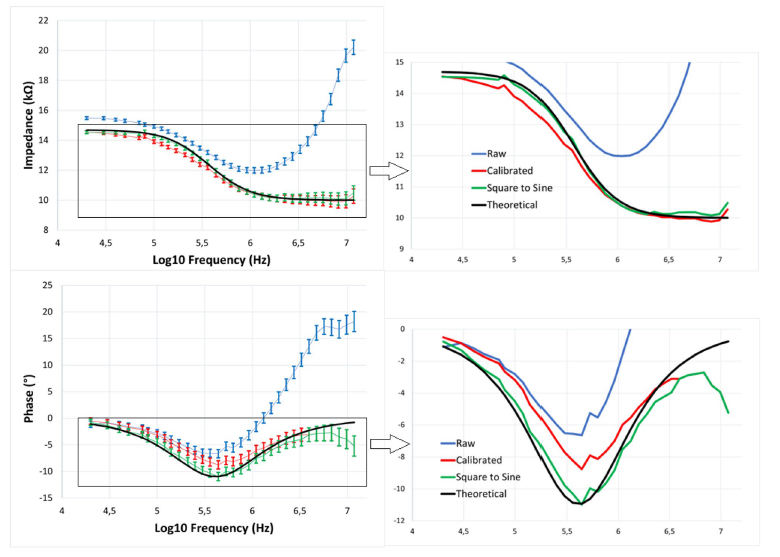
  51. Mũnoz, Z.Shih, H.Lin, C. C. Gelatin hydrogels formed by orthogonal thiol–norbornene photochemistry for cell encapsulationBiomater. Sci. 20142 (8), 1063– 1072 DOI: 10.1039/C4BM00070F [Google Scholar]
  52. Liu, C.Sage, J. C.Miller, M. R.Verhaak, R. G. W.Hippenmeyer, S.Vogel, H.Foreman, O.Bronson, R. T.Nishiyama, A.Luo, L.Zong, H. Mosaic Analysis with Double Markers Reveals Tumor Cell-of-Origin in GliomaCell 2011146209– 221 DOI: 10.1016/j.cell.2011.06.014 [Google Scholar]
  53. Ledur, P.Liu, C.He, H.Harris, A.Minussi, D.Zhou, H.Shaffrey, M.Asthagiri, A.Lopes, M.Schiff, D.Lu, Y.Mandell, J.Lenz, G.Zong, H. Culture conditions tailored to the cell of origin are critical for maintaining native properties and tumorigenicity of glioma cellsNeuro-Oncology 201618 (10), 1413– 1424 DOI: 10.1093/neuonc/now062 [Google Scholar]
  54. Hatse, S.Princen, K.Bridger, G.De Clercq, E.Schols, D. Chemokine receptor inhibition by AMD3100 is strictly confined to CXCR4FEBS Lett. 2002527 (1–3), 255– 262 DOI: 10.1016/S0014-5793(02)03143-5 [Google Scholar]
 

Emergence of preferential flow paths and intermittent dynamics in emulsion transport in porous media​

Emergence of preferential flow paths and intermittent dynamics in emulsion transport in porous media

Michael Izaguirre and Shima Parsa

We investigate the dynamics of emulsions within a two-dimensional porous medium using an integrated experimental approach that combines pore-level dynamics of single emulsions and bulk transport properties of the medium. Using an on-chip microfluidic drop-maker, we precisely control the concentration and sizes of emulsions injected into the medium. The dynamics of emulsion droplets are highly intermittent despite a small average velocity over the trajectory of an individual emulsion. At low concentrations, emulsions predominantly flow through pores with higher local velocities including pores smaller than the size of emulsion droplets, leading to trapping of emulsions and a decrease in medium porosity. Preferential pathways for the emulsions emerge within the medium once the porosity of the medium decreases significantly, from 55% to 36%. At constant injection flow rates and low concentrations of monodisperse emulsions, these pathways remain the only paths of transport of emulsions within the medium. Introducing a slight polydispersity in emulsion sizes unveiled additional transport pathways. Our pore-level measurements reveal that the average velocity of emulsions scales with the inverse residence time of an emulsion, and this scaling separates the emulsions into distinct groups along the emergent preferential pathways.

We kindly thank the researchers at University of Rochester for this collaboration, and for sharing the results obtained with their system.

Introduction

Transport of emulsions in porous media is a subject of significant interest in industrial, medical, and environmental applications including many food products, drug delivery, and immiscible displacement.1–6 The diversity and heterogeneity of most natural and environmental porous materials lead to heterogeneous flow distribution which significantly impacts the transport of droplets of emulsions in a medium.7 Furthermore, the transport properties of porous media can undergo dynamic alterations as a result of the flow and retention of materials inside the pores.8–10 Growth of biofilms in filters,2,11 transport of water-based emulsion in personal care product,12,13 or oil recovery3,8,9,14 are some of the examples in which the properties of the medium change in response to the flow of an immiscible phase. Earlier research shows that although the changes in bulk transport properties such as medium permeability and interstitial flow velocity are not considerably large upon the flow of individual droplets, the local and pore-scale flow can change dramatically leading to anomalous flow behavior locally.8,9,15,16 The transport properties of a single droplet of emulsion in porous media are dictated by the droplet sizes and network properties such as pore size distribution and medium wettability.1,4,15,17,18 Hence, the dynamics of a droplet can be described by the balance of the viscous, interfacial, and drag forces. Only two non-dimensional numbers Capillary number (ratio of viscous to interfacial forces) and Weber number (ratio of drag to interfacial forces) are used to describe the dynamics of droplets with small deformations.1,19–22 However, the collective dynamics of a group of emulsions in a complex network of pores are affected by the fluctuations in local flow due to the droplet–droplet and droplet–pore structure interactions.18 The collective transport of high concentration of emulsions in a medium with random pinning sites shows that dynamics of the droplets sharply transition from a creeping regime to flow along smectic rivers and in groups.23 The deformation of droplets in these experiments was negligible and the majority of the droplets never squeeze through small pores and only pin on the surfaces. Furthermore, measurements of bulk transport of large quantities of polydisperse droplets stabilized by a surfactant and injected into a three-dimensional porous medium show that mostly small droplets appear in effluent and large droplets remain trapped in the medium due to the large pressure required to deform the large emulsion droplets.15,17,18,24 Nevertheless, the pore-level and collective dynamics of droplets in a network of pores, and the impact of trapping and re-mobilization of droplets on pore-level and macro-scale transport properties remain to be examined at the pore-scale. One of the challenges in accurate experimental investigation is tracking and precise object detection in an environment where the interfaces of droplets are in contact and droplets deform based on pore sizes.

In this paper, we quantify the pore-level dynamics of monodisperse emulsions flowing through a two-dimensional (2D) porous medium experimentally. By incorporating a microfluidics drop-maker on the same chip as the 2D porous medium, we control the concentration and sizes of the injected emulsions precisely. In these experiments, we track individual droplets as they flow into the medium using optical microscopy and a long-range recording mode while monitoring the bulk pressure gradient across the medium. By employing advanced image analysis and object tracking, we track individual emulsions as they flow through the medium. We show that at low concentrations, emulsions flow through pores with higher local velocities without being selective about the size of the pores they encounter, and this lack of selectivity can lead to the emulsions becoming trapped. Once a significant number of pores are filled with droplets, newly injected emulsions continuously flow through a few remaining open paths. We show that the average velocity of the droplets that flow through the medium scale with the inverse of the total time of residence in the medium and is proportional to the path lengths of the droplets independent of the distribution of sizes of the emulsions.

Materials

Master Mold Resin

H Series

Pr Series

Experimental method

We generate emulsions and characterize the dynamics of emulsions in 2D micromodel of porous media using microfluidics, fluorescent microscopy, and bulk transport properties of the medium. One of the challenges in studying emulsions in porous media is to control the size, concentration, and injection frequency of emulsions.18,25 This is mainly due to the density contrast between the dispersed phase (emulsions) and the continuous phase. To overcome this challenge, we leverage the capabilities of microfluidics in producing well-controlled monodisperse emulsions.21,26–28 We design an on-chip drop-maker in series with a 2D porous medium as shown in Fig. 1a. This design allows us to control the injection frequency and concentration of emulsions in a porous medium.

2.1 Microfluidics 2D porous media

To generate monodisperse droplets and inject them into a porous medium in a laminar flow condition, we design the microfluidic drop-maker to operate in the dripping regime.27 The drop-maker consists of an inlet for the dispersed fluid (water and 0.1 w% fluorescein sodium salt) at the center, and two inlets for the continuous phase on either side. The continuous phase is a fluorinated oil HFE750 (engineering fluid by 3 M) with 5 w% surfactant FSH oil (by Krytox). The interfacial tension between the dispersed phase and the continuous phase is γ = 26 mN m−1. In the dripping regime, the droplet sizes are proportional to the inlet geometry.13 At equilibrium, where the inner phase fluid is protruding out of the inlet and into the outer phase, the pressure inside the droplet Pd is balanced by the pressure in the outer fluid (P0) and the capillary pressure, image file: d3sm01465g-t1.tif. Here, Rd is the radius of the droplet. The droplet snaps off once the pressure inside the droplet exceeds the outer pressure. The radius of the droplet is Rd > 2R, in a channel with radius R and circular cross-section.29–33

Here, the water inlet is a rectangular channel with dimensions of 84 μm × 200 μm, entering an area measuring 1050 μm × 200 μm, as shown in Fig. 1a. The two oil inlets each have dimensions of 115 μm × 200 μm. The entire channel spans 1100 μm in length and 200 μm in height, tapering down to a 325 μm wide channel before entering the porous medium. We use a syringe pump to inject the continuous phase at a constant flow rate of 5 mL h−1. However, to control the generation of individual droplets precisely, we use a pneumatic pump as shown in the schematic of the experimental setup in Fig. 1b. The viscous pressure of the flow of the continuous phase is balanced by a constant pressure, provided by the hydrostatic pressure of the closed water column. The pneumatic pump applies an additional pulse of pressure to the closed water column at 174 kPa for a duration of 200 ms. This method robustly produces monodisperse emulsion droplets with an average diameter of 295 ± 7 μm with a narrow distribution as shown in Fig. 2. The corresponding capillary and Weber number of the dropmaker in these experiments are Ca = 3 × 10⁻³ and We = 1.5 × 10⁻³. The radii of the emulsions match our prediction of Rd > 2R. The snap-off and monodispersity of the droplets in our experiments are assisted by the hydrophobic coating (aquapel) of all surfaces.34 However, small variations in pulses result in a slightly more polydisperse distribution of droplet sizes. For example, we find that multiple consecutive pulses result in a wider distribution of droplet sizes of 350 ± 10 μm as shown in Fig. 2. We continuously monitor the pressure gradient across the medium using a pressure transducer (Omega-PX409) and apply variational mode decomposition to the signal to eliminate the high-frequency noise of the transducer.35

Fig. 2 Probability distribution function of the sizes of the emulsions in monodisperse (Exp1: blue) and polydisperse (Exp2: red) experiments. The total number of emulsions in Exp1 is 1334, and in Exp2 is 1666.

We design and fabricate 2D porous media using standard soft lithography and microfluidics techniques.36 To obtain a pattern of random pore size distribution, we use a 2D micrograph of a three-dimensional glass bead-pack imaged by a confocal microscope.7 We further enhance the pore size heterogeneity by imposing a gradient in pore size distribution with a larger porosity at the inlet compared to the porosity downstream. This gradient in porosity represents the heterogeneity of natural and geological porous structures.37 We quantify the porosity and pore size distribution of the 2D porous medium using a novel algorithm that utilizes Voronoi tessellation and skeletonization.38–41 The pore size distribution in the medium has an average pore size of 403 μm and varies between 150 and 1150 μm as shown in Fig. 3.

An important point to note from Eq. (3) is that the amplitude of the fundamental differs from the one of a sinewave of amplitude 2Vo by a factor of 4 π . Such a difference biases the measurements and affects the precision but can be mostly corrected (up to a couple of percents) by following an algorithm proposed by Subhan54. Another consideration is the introduction of harmonics in the circuit, which raises the noise floor of the system.

Fig. 3 Probability distribution of the pore sizes in the medium (solid line), the 1/3 entrance to the medium (light gray), and the 2/3 end of the medium (dark gray).

To ensure that the emulsion droplets are small enough to enter the medium, the physical dimensions of the porous medium are proportionally adjusted to allow some passage of the droplets. In these experiments, we utilize a microfluidics 3D printer (CADworks3D Pr110-385 nm). Using this cutting-edge resin-based 3D printer, boasting an XY resolution of 40 × 40 μm2 and a Z resolution of 5 μm, we fabricate microfluidic master-molds with a variety of dimensions. To achieve smooth surfaces on the master-mold, which is critical for the performance of our microfluidic devices, we optimize the printing settings for a commercial powder-base resin with low light dispersion. By controlling the UV-exposure and curing time, the edges and surfaces are smooth. The master-molds are then filled with polydimethylsiloxane (PDMS) and cured at 60 °C before plasma cleaning and bonding to a glass slide.

2.2 Pore-scale imaging

To quantify the dynamics of emulsion within the porous medium, we use a widefield optical microscope (Axiozoom) and a long-range-record camera (FasTec IL5). The camera is operated at 50 Hz with a resolution of 2500 × 1000 pixels at 16 bits, providing a high dynamic range. The microfluidic porous medium is illuminated with a collimated RGB backlight LED providing a high contrast image where emulsions can be identified.

We characterize the dynamics of emulsions at the pore-level and across the entire model porous medium utilizing a modified particle tracking algorithm that accounts for objects in close contact and with highly intermittent kinematics. While most particle tracking methods are optimized to identify sparse objects,42 emulsions trapped in a porous medium are in close contact with each other and are squeezed into a solid structure and can be slightly deformed, see Fig. 4. Here, we first subtract the solid background while applying a drift correction on all images to enhance the accuracy of object detection. Using a circular hough transform, we identify individual droplets within the medium as shown in Fig. 4. Once all droplets are identified, we employ a global nearest-neighbor (GNN) tracking method under Sensor Fusion and Tracking Toolbox in MATLAB R2023. The GNN tracker uses the global nearest-neighbor assignment algorithm to match its detection to identified tracks based on predicted position, velocity, and acceleration. The GNN tracker forms a cost matrix by calculating the distance between each detection and existing tracks. Using this cost matrix, it categorizes the detected objects into either assigned pairs with tracks or unassigned, subsequently updating or initializing tracks as appropriate. Since our detection method is highly accurate, we assign a high cost to new tracks created outside the spatial area in which new emulsions are introduced into the field of view. We overcome the natural challenge of tracking objects that are constantly trapped and mobilized by using an Interacting multiple-model filter. The high-resolution imaging and enhanced edge detection are crucial in successfully applying the GNN tracker to the highly intermittent dynamics of emulsion. See ESI† of Fig. S4 providing a dynamic visual representation of the emulsion transport through the porous medium.

Fig. 4 Transport of individual droplets injected into a 2D porous medium as a function of time (a) 5 s, (b) 25 s, (c) 42.5 s, (d) 62.5 s. Blue circles mark the emulsions. Scale bar is 1 mm.

Results

he dynamics of emulsions in porous media are highly intermittent despite the tendency of the droplets to travel at the center of the pores. As single droplets enter the porous medium, they flow through paths with a higher average velocity. In these experiments, we form and inject the droplets at low concentrations and distribute their points of entry into the medium in the cross-sectional direction, Fig. 4a. The low concentration of emulsion is crucial to avoid a yield stress behavior.41 The emulsions flowing into a porous medium, naturally follow the streamlines with larger velocities. However, there is no feedback mechanism that would prohibit their entry to a pore or a pore throat smaller than the diameter of the droplet. Interestingly, in a porous medium with a random distribution of pore sizes, a considerable number of high-velocity paths flow through small pores. Hence, we observe a substantial number of emulsions getting trapped in the medium during the injection of the first batches of emulsions as seen in Fig. 4b. While a few emulsions find their way to the outlet, more than 65% of the emulsions are trapped following their predecessors as seen in Fig. 4c. A droplet trapped in a pore does not completely block the flow of the continuous phase in this area and the continuous phase passes around the droplet. Consequently, the changes in the local flow within the first few seconds of these experiments do not lead to a change in the global flow, as opposed to pore blocking seen in experiments focusing on conformance control in oil recovery.9,43 Additionally, our continuous measurement of the pressure drop across the medium confirms that the bulk flow is not affected by a few trapped emulsions in the medium. Trapping of a few droplets in the medium changes the medium porosity from 55% in Fig. 4a to 49% in Fig. 4c. Despite the considerable change in porosity, the pressure gradient across the medium increases only from 1400 Pa to 1450 Pa, further confirming the presence of a flow around individual emulsions and through the pores. Further injection of emulsions into the medium results in substantial clogging of individual pores in the medium as seen in Fig. 4d. Considering that the volumetric flow rate is held constant throughout this experiment, one expects that flow should be redirected to other open pores. Once the porosity of the medium decreases to 36% and many pores are filled with emulsions, newly injected emulsions follow paths that were not explored earlier and find their way to the medium outlet. Interestingly, we find that some entire paths are filled with emulsions (seen in the center of Fig. 4d) before the flow of emulsions is diverted. Finally, a tortuous path is formed which is followed by newly injected emulsions. We do not observe clogging of the entire medium at the constant injection flow rate and the concentration of the droplets remains to be below a jamming transition.44 Moreover, the balance between viscous and capillary forces does not change dramatically to mobilize a large number of droplets.45,46

To quantify the emerging flow paths within the medium, we track individual emulsions and superimpose the paths taken by these emulsions as shown in Fig. 5. A few preferential paths are formed in the medium and the subsequently injected emulsions continue flowing along these paths. While only a few tortuous paths are established in the flow of monodisperse emulsions (Fig. 5a), additional paths are explored by introducing a slight polydispersity in the emulsion sizes (Fig. 5b). Interestingly, in the experiment with larger and polydisperse emulsions, large droplets squeeze through the pores and create small perturbations in the flow of subsequent trailing droplets. Hence, droplets are more likely to switch paths as shown in Fig. 5b.

Fig. 5 Spatial distribution of emulsions in (a) monodisperse (Exp1) and (b) polydisperse (Exp2) experiments. Heatmap represents the log-transformed time (in seconds) spent at each location, normalized to match the maximum time value of Exp2.

To quantify the variability of the velocities of the emulsions, we calculate the probability density function (PDF) of the velocities in different experiments as shown in Fig. 6a. The PDF of the magnitude of the velocities of emulsions has an exponential decay with a long stretched tail indicating the presence of rare events with very large velocities compared to the interstitial velocity. The interstitial velocity is vint = q/ϕ, where q is the volumetric flow rate per cross-sectional area and ϕ is the medium porosity. The distributions of velocities of emulsions have similarities with the PDF of the velocities of the flow of a single-phase continuous fluid, measured in identical but separate experiments using 1 μm tracer particles particle image velocimetry (PIV).7,9 However, the tail of the PDF of the velocities of droplets stretches to much larger velocities (5 × vint) than that of the single-phase flow (3 × vint).

Fig. 6 (a)–(c) Probability density function of velocities of emulsions normalized by the interstitial velocity (a) PDf of the magnitude of velocity (b) PDF of the longitudinal component of velocity (vx) (c) PDF of the transverse velocity, vy. Blue triangles represent the monodisperse emulsions, red squares represent the polydisperse emulsions, and black diamonds represent the tracer particles velocities. (d) Distribution of the deviation of location of first 100 monodisperse droplets from fluid elements for 3 time-stamps, 2 seconds after entering the medium (red), 10 seconds (blue), and by the time either object reaches the end of their path in view (black).

Comparing the PDF of velocities of droplets with a single-phase flow confirms the intermittency in the dynamics of droplets where trapping, re-mobilization, squeezing and bursts through pore throats are common. The dynamics of emulsions in these experiments exhibit unique features reminiscent of transport in a porous medium: (1) emulsions only pass through certain areas and some pores within the medium are never explored by the droplets, as seen in Fig. 5. (2) Trapping and accumulation of emulsions within the porous structure result in changes in the medium permeability, leading to an increase in the viscous forces. The latter effect, only observable in pore-level measurements,9,10,43 can significantly change the flow in neighboring pores and consequently affect the global flow. Despite the finite size of the emulsions, and an expected slower velocities than fluid elements (represented as tracers), we find that the PDF of magnitude of the velocities of emulsions has an average comparable to a single phase flow in agreement with the constant flow driven experiment.

The PDF of velocities of emulsions in the direction of the imposed flow, Fig. 6b, has a positive average, 〈vx〉 = 270 μm s−1, consistent with the direction of flow. The significant negative tail in the polydisperse experiments (Exp2) is due to the tortuous path taken by droplets in this experiment. The PDF of vy of emulsions has a slightly higher probability in the downward (vy < 0) than the upward direction, aligning with the most common paths observed in Fig. 5. The average dynamics of droplets in these experiments (Exp1: monodisperse and Exp2: polydisperse) are independent of the distribution of droplet sizes. The average velocity is dominated by the large number of droplets experiencing slow dynamics. However, the rare events with large velocities and bursts of motion are more probable in the experiments with more variable sizes of emulsions.

Additional insights into the preferential paths of the droplets can be drawn by comparing the trajectory of a droplet with a fluid element as it enters the medium. The path of a droplet is determined by the local stress (proportional to the velocity gradient) on the surface of the droplet, while the path of a fluid element is dictated by the fluid velocities. Hence, the trajectory of an emulsion droplet deviates from a fluid element due to the finite size of a droplet. The departure of the trajectory of a droplet from fluid elements increases with time as shown in Fig. 6d. We quantify the distribution of the deviation between the location of the tracers and the emulsions entering the medium at the same initial position. The locations of the tracers are determined by integrating their trajectory using the flow velocity field (from PIV) and a fourth order Runge–Kutta integration scheme.42 The emulsions closely follow the path taken by a tracer for the first few seconds but the location of the center of the droplet quickly departs from the fluid element. After only 10 seconds the distance between the location of the droplets and fluid elements is distributed evenly across the medium. The distribution of the distances shifts towards larger values and closer to the length of the medium by the time either the emulsion or the fluid element reaches the end of their paths. The distribution is converted into a smooth function using MATLAB Kernel smoothing function estimate for univariate and bivariate data.

Our understanding of emulsion transport in porous media can be further enhanced by quantifying the dependence of the average velocity of the emulsions on the time of travel through the medium, which we refer to as residence time. As shown in Fig. 7, the average velocities of all emulsions that pass through the medium scale with the inverse residence time of the emulsions, 〈v〉 ∼ 1/(resident time). We measure the residence time of each individual emulsion as it traverses the medium. Emulsions that pass through the medium quickly have a short residence time, while those that become trapped have a much longer residence time. The longest residence time recorded in our experiments is 800 seconds, comparable to the duration of the experiment, and belongs to an emulsion droplet trapped in the medium. The scaling of 〈v〉 with inverse resident time holds for all emulsions that exit the medium, represented by the light color of the symbols in Fig. 7a. The color of the symbols represents the value of the Euclidean distance along the trajectory of the emulsions, defined based on the initial and final locations of each emulsion droplet along its path. The longest Euclidean distance within the 2D porous medium corresponds to the diagonal of the medium (13.2 mm). Interestingly, the scaling of the average velocity is independent of the distribution of the sizes of the emulsions (Exp1, Exp2). Moreover, the longitudinal component of the velocity scales with the residence time similar to those with the average velocity, 〈vx〉 ∼ 1/(resident time). We attribute the 〈vx〉 scaling to the dominance of the longitudinal direction in the transport of emulsions within the medium. The transverse velocity, 〈vy〉, is an order of magnitude smaller than the longitudinal component in these experiments. The average velocities of the emulsions that are permanently trapped in the medium, or those that do not leave the medium for the duration of the experiment, are smaller than the velocities of emulsions of similar residence time that pass through the medium. Therefore, as illustrated in Fig. 7, the average velocities of the emulsions that remain within the medium consistently fall below the reference line that encompasses those that pass through it. We observe that droplets with longer Euclidean paths, or equivalently those closer to passing through the medium, are more likely to have an average velocity that approaches the population following the scaling with inverse residence time. Throughout the experiments, we extracted over 6 million positional updates and their corresponding velocities. Therefore, in Fig. 7, we aggregate numerous data points into a single symbol for better visualization. The symbol's size corresponds to the logarithmic scale of the data point count.

Fig. 7 Average velocity vs. residence time of emulsions, (a) magnitude of velocity and (b) longitudinal component of velocity. Crosses represent the monodisperse (Exp1) data and circles correspond to polydisperse (Exp2) data. Marker sizes represent the number of emulsions within each velocity-residence time bin. The colormap corresponds to the Euclidean distance along the trajectory of the emulsions.

The scaling of average velocity with inverse residence time of emulsions is described with a simple dimensional argument image file: d3sm01465g-t2.tif. We find that the corresponding length scale is the path length of the trajectory of the emulsions. Here, the emulsions are more likely to take either preferential paths identified in Fig. 5. We identify the emulsions with the paths they take and show that in the monodisperse experiments where emulsions continuously follow two distinct paths, the emulsions on the longer path have a slightly smaller average velocity. Nevertheless, the average velocities of all emulsions are distinctly split into two groups as shown in Fig. 8a. This observation is further confirmed by the location of the exit point of the emulsions as shown in Fig. 8b. Moreover, similar separation of path lengths and exit points are observed for the polydisperse emulsions as seen in Fig. 8c and d. Observation of the distinct paths and exit points in this medium provides clear evidence of the emergence of preferential paths independent of the emulsion sizes. These paths emerge as a consequence of the solid pore structure modified by the trapping of emulsions.

Fig. 8 Dependence of the average velocity of (a) monodisperse and (c) polydisperse emulsions on residence time for emulsions that exit the medium. Final exit location of (b) monodisperse and (d) polydisperse emulsions along the cross sectional direction. Blue symbols represent the path leading to the exit point on top of the medium, red corresponds to the path leading to the bottom of the medium, dashed gray line separates the two populations.

Conclusions

In the present study, we successfully investigate the pore-level dynamics of monodisperse emulsions navigating a two-dimensional porous medium. By leveraging the versatility of microfluidic techniques, we control the concentration and sizes of emulsions, in addition to the injection rate of emulsions, by integrating an on-chip drop-maker driven by an external pneumatic pulse. We find that at low concentrations, emulsions flow through pores with higher local velocities and independent of the pore sizes, leading to trapping of emulsions in pores smaller than the emulsion sizes. This leads to a 35% reduction in the porosity of the medium. Few preferential and highly tortuous flow paths emerge within the medium after this reduction in porosity, along which low-concentrations emulsions continue to flow. Our measurements of the pore-level velocities of the emulsions show a highly intermittent dynamic consisting of trapping and subsequent mobilization of emulsions within the porous structure. Nevertheless, we find that the average velocities of all emulsions that flow through the medium scale with the inverse residence time of the emulsions and is distinguished by the flow paths emulsions take within the medium. This emergent scaling holds for slightly polydisperse emulsions.

The introduction of a slight polydispersity in the emulsions enhances the transport of emulsions despite the larger sizes of the droplets revealing more fluctuations in transport paths. Independent of the distribution of droplet sizes, trapped emulsions within the porous structure play a pivotal role in defining preferential transport paths, showcasing the interaction intricacies between the droplets and the porous network. Although the current experiments are focused on the dynamics of low concentrations of emulsions in porous media at a moderately slow flow rate, corresponding to a small Reynolds number, in the laminar regime, the approach serves as a foundational method for characterizing emulsion dynamics in a variety of flow regimes. The formation and persistence of preferential flow paths and droplet–droplet interactions at higher flow rates where the local flow can be highly unstable remains to be explored. These findings and the associated experimental methodology have the potential to drive advancements in areas such as soil remediation, drug delivery, and oil spill cleanup.

CRISPR-Cas9 Extracellular Vesicles for Treating Hearing Loss

CRISPR-Cas9 Extracellular Vesicles for Treating Hearing Loss

Xiaoshu Pan , Peixin Huang ,Samantha S. Ali ,Tarun E Hutchinson

The treatment of inner ear disorders remains challenging due to the intrinsic anatomical barriers. The majority treatments and delivery approaches for accessing inner hair cells are still engaged with surgical intervention, which is highly invasive and inconsistent in terms of efficacy and safety. In order to address this challenge for crossing anatomical barriers, we report an extracellular vesicle (EVs) -based delivery approach to inner hair cells, which enables carrying CRISPR/Cas9 ribonucleoprotein (RNP)-sgRNA complex in high-throughput and high efficiency. The novel Microfluidic Droplet-based Electroporation System (µDES) is developed to efficiently load cargos into EVs via millisecond pulsed, low-voltage electroporation within flow-through droplets as enormous bioreactors in a continuous-flow and scalable manner. The observed loading efficiency of CRISPR/Cas9 RNA complex into EVs (RNP-EVs) is 10-fold higher than current bulk cuvette electroporation with hundred-fold increase of processing throughput. The low-voltage electroporation minimized the Joule heating influence on nanosized EVs, which retained the native surface membrane properties of cargo-loaded EVs. Both ex vivo and in vivo testing in Shaker-1 mice model demonstrated the high biocompatibility and biodistribution of produced RNP-EVs in the mouse cochlea penetrating inner hair cells. In contrast, the CRISPR/Cas9 RNP lipid-like nanoparticles (RNP-LNPs) control group was unable to penetrate anatomical barriers to access inner hair cells. In the Shaker-1 mouse model, DES produced RNP-EVs demonstrated much higher editing efficiency at Myo7ash1 mRNA level and showed significant hearing recovery in the Myo7aWT/Sh1 mice via Auditory Brainstem Response (ABR) testing.  The report work will present a new solution to advance gene therapy in treating sensorineural hearing loss .

We kindly thank the researchers at University of Florida for this collaboration, and for sharing the results obtained with their system. 

Introduction

Hearing loss is one of the most common neurodegenerative disorders with genetic causes in human affecting more than 450 million people worldwide1-2. In situ delivery of functional gene materials to cochlear hair cells is one of the most promising strategies to repair hair cells and restore hearing function in vivo1,3-6. To date, the gene therapy targeting cochlear hair cells are heavily relied on engineered AAV vectors that can transduce inner hair cells more efficiently. However, a few biosafety investigations of high dose AAV vectors in non-human primates are limiting the clinical translation5,7. On the other hand, the commonly used AAVs in gene therapy have limited capacity on cargo size (∼ ≤ 5Kb), which is unable to carry CRISPR SpCas9-gRNAs, as well as the Myo7a gene (∼100 Mb or a cDNA of ∼ 7 Kb) we studied in this work as a hearing loss causative gene in inner ear hair cells8. Although the lentiviruses have a cargo capacity of ∼10 Kb, the risk of insertional mutagenesis and severe immunogenicity are still significant concerns for clinical translation9. Alternatively, extracellular vesicle (EVs)-based delivery is emerging as a novel, safe approach for addressing such challenges employed in gene delivery10-13, owing to the intrinsic biocompatibility, low immunogenicity, tissue penetration ability, and superb tunability14-17. Although, EVs have been utilized to deliver various genes into tissues, the delivery of CRISPR/Cas9 ribonucleoprotein (RNP)-sgRNA complex has not been explored for inner ear tissue yet. The first-in-human trial using umbilical cord mesenchymal stromal cell derived EVs demonstrated their regenerative potential to attenuate inflammation-based side effects from cochlear implantation and noise trauma10,18, which indicates natural distribution of EVs across anatomical barriers in cochlear may present, making EVs more favorable in hearing loss gene therapy than its counterparts, viral vectors.

However, loading CRISPR RNP complex into EVs has been a grand challenge. Current methods suffer from low loading efficiency and not scalable. For instance, chemical transfection rate for CRISPR RNP complex is generally below < 25%, and the produced EVs are in low stability19. Utilizing cells engineered as the primary EV producer is limited with cargo type and copy numbers that can be passed to EVs for encapsulation. Although electro-transfection is more efficient in terms of transfection rate (∼ 50%), the scalability is limited with only a few milliliters of processing volume in their throughput20-21. Different from cells, EVs generally have much smaller size and higher Brownian motion. Therefore, we introduce a novel continuous-flow platform utilizing microfluidic droplet-based EV electroporation (µDES), which can handle variable cargos loaded into EVs in large throughput and high efficiency. The saturated cargo concentration in the confined uniform droplet bioreactors can maximize mass transport and electroporation efficiency. Such streamlined EV electro-transfection using continuous-flow droplets as the enormous micro-bioreactors has not been explored elsewhere. Compared to microfluidic nanoporation for EV transfection15,17,22-24, the continuous flow enables much larger scale and throughput processing (up to litter range). Only a low-voltage (∼10-30 volts) DC power is needed, which avoids Joule heating and thermal damage on nanosized EVs25. Compared to chemical transfection which introduces unpurifiable chemicals potentially toxic to in vivo system, the instant electric field application across flow-through droplets in millisecond (∼ms) minimizes perturbation of EV molecular components to retain the natural EV property and biocompatibility. We also employed FDA approved additive trehalose 26-30 in the buffer system to preserve EVs in good stability29, 31, and minimize membrane aggregation26-27 and leakage after electro-transfection as reported by other research28, which is suited in clinical settings.

In the realm of hearing loss, CRISPR/Cas9 technology are demonstrating promising editing specificity and efficiency by targeting and correcting genetic mutations responsible for various hereditary hearing disorders32. For instance, it can address mutations in TMC1Bth crucial for the development of sensory hair cells or cochlear function, potentially restoring auditory function33. More pioneer investigations exhibited that CRISPR/Cas9 technology can be applied to both congenital and acquired hearing loss, offering a multifaceted approach to treatment3,7,33-35. In this work, we target on Myo7a gene which plays an essential role in the development and maintenance of auditory hair cells. Myo7a mutation has been identified as the major causative gene (39–55% of the total cases) in Usher syndrome (USH1B), syndromic and non-syndromic hearing loss (DFNA11 and DFNB2), and age-related hearing loss36-37. Thus, timely removal of mutant myoVIIa allele could prevent progression of hearing loss. However, current Myo7a gene therapy is unattainable, due to limited options of vectors. Our work on both ex vivo and in vivo testing in Shaker-1 mouse model demonstrated the high biocompatibility and biodistribution in the inner ear tissue from our μDES produced RNP-EVs in mouse cochlea penetrating into inner hair cells. The RNP-EVs displayed much higher editing efficiency at Myo7ash1 mRNA level and showed significant hearing recovery in Myo7a WT/Sh1 mice via Auditory Brainstem Response (ABR) testing. In contrast, the CRISPR/Cas9 RNP lipid-like nanoparticles (RNP-LNPs) control group was unable to penetrate anatomical barriers to access inner hair cells. Our approach will allow the rapid loading of CRISPR into EVs for delivery of Cas9 without using a split vector, which offers the opportunity to customize sgRNAs addressing different mutant alleles within one gene, and enable customization to patient genetic heterogeneous mutation background, leading to a clinically translatable approach for overcoming current challenges in gene therapy.

 RESULTS

High throughput and highly efficient EV electro-transfection via μDES platform

We developed µDES platform for enhancing EV transfection efficiency, loading capacity, and throughput. The concept of µDES platform and functionality are illustrated in Figure 1 A-E. The device composed one aqueous inlet with purified EVs and RNP cargos, one oil inlet, electroporation chamber and one droplet outlets which streamlines droplet generation with electroporation using a low voltage DC power supply. The device fabrication was detailed in supplemental materials. Continuous generation of droplets uniformly as enormous bioreactors in fast speed enables large-scale encapsulation of EVs with high concentration cargos (Figure 1F). In droplet space, the cargo transport under electric field is more efficient to cross transient pores from EV membrane via electrical mobility of cargo themselves, electric flux, and concentration gradient, which only needs milliseconds to complete in such small scale, in turn, maximizing the loading efficiency and capacity (Figure 1B). The uniform electric field distribution can be formed across each flow-through droplet for highly efficient electroporation as proved by COMSOL simulation in Figure 1C. Notwithstanding, droplet-based electroporation could also lower the dispersity of electric field in the small volume and contribute to more homogeneous electric distribution in small volume range38-40. The COMSOL simulation of μDES device was conducted which showed uniform distribution of both flow profile and electric field profile with focusing on the droplet passing through the electroporation chamber (Figure 1 D and E). The scalability of μDES was also studied by collecting droplets in a large container (Figure 1F) with uniform size of produced droplets (Figure 1G). By using fluorescently tagged 100nm polystyrene beads as the reference particles comparable in size to EVs, it showed that good encapsulation of fluorescent signal from beads in the droplets without any significant signal outside the droplets (Figure 1H). To perform the emulsion of water-in-oil, fluorinated oil FC40 and associated fluoroSurfactant was employed to generate oil phase due to their low conductivity, chemical inertness and stability, and easy removal. Pharmaceutical grade FC40 oil is considered as the highly biocompatible and low-cost recipe for droplet generation employed in pharmaceutics and in compliance with FDA 41-42. We also introduced the pharmaceutical grade trehalose as stabilization additive in the buffer during the electro-transfection, which can enhance the EV stability to minimize membrane fusion and leakage, in turn, improve the electro-transfection efficiency as documented in literatures26-30, 43. The droplet size which determines the throughput can be controlled by adjusting the pressure/flow rate of water-to-oil ratio44. For achieving high throughput, the droplets can be generated in high speed (∼700 droplets/min), which leads to ∼30 mL per hr processing throughput for each device. Note that current cuvette electroporation only handles ∼100 μL per device. The electroporation power did not alter the droplet size and quantity (Figure 1 I and J). For the efficient purification of cargo-loaded EVs from excessive Cas9 cargos, we employed Ni Sepharose high performance magnetic beads to selectively capture the His-tagged Cas9 proteins. The cargo loaded EVs in aqueous phase can be collected via centrifugation through phase separation to fully remove oil phase (Figure 1A cargo-loaded EV collection).

(A) Image of µDES device with illustration of continuous-flow droplet generation, droplet-based electroporation, and cargo-loaded EV harvesting and purification. (B) Schematic illustration of droplet-based electroporation of EVs under uniform electric field distribution as demonstrated by COMSOL simulation (C). The COMSOL simulation of continuous fluidic profile (D) and electric field profile (E) to show the uniformity for precision control. (F) Picture of large-scale collection of cargo loaded EVs in droplets. (G) Microscopic image of continuous flow generated droplets with green fluorescence stained nanobeads mimicking EVs encapsulated inside (H). The droplet size is uniform before(I) and after (J)electric field application for transfection (30 V). The insert scale bar is 1000 μm. (K) Evaluation of EV cargo loading rates among different transfection methods using fluorescence nanoparticle tracking analysis (FNTA). (L) EV recovery rate evaluated by NTA compared with conventional cuvette electro-transfection which requires 1100 volts for electroporation. (M) Quantitative measurement of CRISPR Cas9 proteins from transfected EVs normalized by EV particle number among different transfection methods. (N) The quantitative PCR analysis of transfected sgRNA copy number normalized by total EV RNAs. The electro-transfection was done by using μDES platform in 8 replicates. The native EVs and μDES prepared EVs without RNP cargo both served as the negative control groups. EVs are purified from HEI-OC1 ear hair cell culture.

Our platform can produce ∼80% transfection rate for large proteins including CRISPR Cas9/sgRNA RNP complex, which showed significantly higher efficiency than other conventional transfection methods including direct incubation, lipofection, and cuvette electro-transfection (Figure 1K). EGFP-Cas9 were pre-assembled with gRNA at 1: 2 molar ratio before the electroporation. EVs derived from HEI-OC1 cell, a putative progenitor hair cell line, were isolated and quantified for mixing with EGFP-CRISPR/Cas9 ribonucleoprotein (RNP) in electroporation low conductivity buffer. The final concentration of 1010 /mL of EVs was used for Neon cuvette electroporation as the control group, and our μDES system, as well as other chemical transfection methods. The findings revealed significantly enhanced cargo loading within EVs using μDES system, with a percentage as high as 80% for EGFP and 70% for EGFP-Cas9/sgRNA, surpassing cuvette electroporation and chemical transfection methods while maintaining minimal sample loss (Figure 1K). We also compared the recovery rate with conventional cuvette electro-transfection (Figure 1L), which showed better recovery due to continuous-flow harvesting. We quantified the RNP Cas9 protein loading amount (Figure 1M) to compare between different transfection methods, the μDES group exhibited more than 10-fold increase than other methods. The reproducibility of μDES loading was characterized using qPCR to quantify sgRNA loading amount from 8 replicates, with native EVs and µDES conditioned EVs without RNPs as control groups. Results demonstrated the good loading capacity and reproducibility, and no leakage or changes from intrinsic EV molecular components (Figure 1N). Overall, the μDES platform demonstrated the advanced performance on EV cargo loading.

Characterization of produced RNP EVs in high biocompatibility and tissue penetration

The µDES platform maintained a consistent flow rate, uniform electroporation pulse periods for each droplet and efficient cargo loading into EVs, therefore, retaining good EV properties as their natural un-treated EVs in terms of size (Figure 2A), zeta potential (Figure 2B), protein contents (Figure 2C), morphology and surface properties (Figure 2D). Results also indicated that μDES droplet oil phase with surfactant do not impose adverse influence on the produced EVs in aqueous phase due to phase separation. We tested the essential protein contents (CD81, TSG101, Alix) from µDES produced EVs, which is in line with native EVs in terms of expression level but carry significant amount of transfected Cas9 proteins (Figure 2C). The immune gold nanoparticle (AuNP) staining TEM imaging showed unnoticeable surface adsorption of Cas9/sgRNA RNPs from µDES produced EVs as compared with native EVs, which indicates RNA cargoes are loaded inside of EVs. By comparing with LNPs, we tested the cell biocompatibility (Figure 2E) and cellular uptake behavior (Figure 2F) via dosing HEI-OC1 ear hair cells with both µDES produced bone marrow mesenchymal stem cell derived EVs (RNP MSC-EVs) and HEI-OC1 hair cell derived EVs (RNP HEI-OC1 EVs). Both EV groups showed enhanced ability to promote ear hair cell growth compared with LNP group (LNP-102). The µDES produced RNP EVs did not show noticeable differences with their un-loaded native EVs. After one-hour cellular uptake, µDES produced EGFP-fused Cas9/sgRNA RNP MSC EVs exhibited higher uptake rate for cytoplasmic release and gradual entry into the nucleus (white arrow indication) compared with LNP group (Figure 2F). In order to further characterize the in vivo ear tissue biodistribution behavior, three groups of RNP*EGFP LNP, µDES produced RNP*EGFP MSC EVs and RNP*EGFP HEI-OC1 EVs were used via posterior semicircular canal injection into Shaker-1 mice ear individually. The confocal imaging from LNP group showed the ineffective distribution for entering into inner ear hair cells (Figure 2G and H). In contrast, both EV groups exhibited higher penetration into inner ear and uptake by both outer hair cells (OHCs) and inner hair cells (IHCs) (Figure 2 I and J). Thus, the results strongly support the feasibility of µDES transfected CRISPR RNP EVs employed in gene therapy delivering to inner ear.

(A) Characterization of EV size and zeta potential (B) after transfection using different transfection methods with the original native EVs as the control group. (C) MicroWestern Blotting analysis of essential protein contents (CD81, TSG101, Alix, Cas9) derived from µDES produced RNP MSC EVs in serial dilution, with native EVs as the control group. (D) Immune gold nanoparticle (AuNP) staining TEM imaging analysis of µDES produced RNP MSC EVs with native EVs as the control group, in terms of CD81 surface marker expression and Cas9 surface identification. Scale bar is 200 nm. (E) Cell biocompatibility analysis using MTT assay with HEI-OC1 ear hair cells (∼106) dosed with LNP group (LNP-102, Cayman Chemical, w/o RNP), MSC-EV group (w/o RNP), and HEI-OC1 EV group (w/o RNP) in ∼109 particles. (F) Confocal imaging analysis of HEI-OC1 hair cell one-hour uptake dosed with RNP*EGFP LNP (LNP-102, Cayman Chemical) and RNP*EGFP MSC-EV group in ∼109 particles. The white arrow indicates the cytoplasmic release and gradual entry into the nucleus. Scale bar is 10 μm. (G) schematic illustration of the biological barriers in the structure of Corti and cochlea including blood endolymph barrier (BEB), perilymph endolymph barrier (PEB), and blood perilymph barrier (BPB). Confocal tissue imaging analysis of biodistribution in the organ of Corti via posterior semicircular canal injection of (H) RNP*EGFP LNP, (I) µDES produced RNP*EGFP MSC EVs and (J) RNP*EGFP HEI-OC1 EVs into Shaker-1 mice ears individually. Scale bar is 30 μm. All graphs show the mean ± SEM and biological replicates.

Materials

Master Mold Resin

M Series

 CRISPR design system for allele-specific editing of pathologic Myo7ash1

The Shaker-1 mouse model has been widely used for auditory research encoded by the deafness gene Myo7a, which is expressed very early in sensory hair cell development in the inner ear45. The Myo7a mutation makes up 4.5% of cases of sensorineural hearing loss evaluated in a large human patient cohort46, which presents significant clinical populations with a high level of burden that is not addressable by current therapeutic interventions. Timely removal of mutant myo7a allele could potentially prevent progression of hearing loss. Therefore, we demonstrated an allele-specific editing system using CRISPR/Cas9 with designed gRNAs targeting G-C mutations in hearing loss Shaker-1 mouse model. For in vitro validation using ear fibroblast cells from Myo7ash1/WT mice, we screened SpCas9 and two different gRNA sets harboring sh1 mutation modified with 2’-O-Methyl and 3’-phosphorothionate bonds on the last bases on 5’ and 3’ end (Figure 3A). In each gRNA set, we designed full-length and truncated forms targeting Myo7ash1 (supplementary Table 1). The gel electrophoretic analysis shows that CRISPR/Cas9 complexes efficiently cleaved targeted Myo7a amplicons (supplementary Figure 3). The T7 endonuclease assay was used to screen the allele-specific editing in vitro in Myo7AWT/WT, Myo7Ash1/WT and Myo7Ash1/sh1. The indel percentage is reduced to ∼25% in Myo7Ash1/WT when compared to ∼45% indel percentage in Myo7Ash1/sh1(supplementary Figure 4). The similar halving reduction in indel percentage is also observed in other gRNA designs when targeting Myo7ash1/WT. The data supports a robust editing selectivity when targeting Myo7Ash1/sh1 and Myo7Ash1/WT in vitro. Sanger and next generation sequencing was further used to confirm the allelic cleavage specificity and editing efficiency. ICE (Inference of CRISPR Edits, DeskTop Genetics) analysis of sanger sequencing data showed that a good amount of indel occurred only in Myo7ash1/WT, but not in Myo7AWT/WT(supplementary Figure 4). The sequence percentage analyzed by CRISPResso247 showed that gRNA-1 and gRNA-2 have higher cleaving activity than their truncated versions respectively (Figure 3B). The indel profile revealed that the majority of CRISPR-induced variants were deletions for gRNA-1 while insertions for gRNA-2 (Figure 3C). The sequencing variations demonstrated that 94.83% of Myo7aWT is unedited in Myo7ash1/WT. The small amount of substitution in 0.33% is possibly from PCR and sequencing background errors. In contrast, Myo7ash1 sequences is greatly reduced to ∼18% and the edited sequences account for the rest 82% in Myo7ash1 allele. We then quantified the targeting specificity of gRNA designs by sorting out mutation pattern 5’-CCG-3’ and wild type pattern 5’-CGG-3’ separately when targeting Myo7ash1/WT in vitro. By designing PAM sequence of gRNAs which have closer proximity to the Myo7a mutation, 95% specificity was achieved for in vitro editing (Figure 3D) and the wild-type allele is mostly intact after the CRISPR/Cas9 editing. Taken together, full-length of gRNA-1 and gRNA-2 have the best allele specific editing property in vitro thereby suggesting the potential for further in vivo test. Based on the global analysis of all the sequences in CRISPResso2 (Figure 3F and supplementary Figure 4), the most common mutation type is either single base deletion or single base insertion causing a frame shift in the coding sequence of Myo7a protein. In summary, SpCas9-gRNA-1 and SpCas9-gRNA-2 sets were specific for the Myo7ash1 allele and robust in interfering the shaker-1 mutation at DNA level, indicating the promise for in vivo investigation.

 CRISPR loaded EVs for in vivo restoring the progression of the hearing loss

The Shaker-1 mouse wild type (+/+) and heterozygotes (+/-) initially both have normal hearing. However, the mutant heterozygotes (+/-) animals will gradually progress hearing loss till 6 months of age to be completely deaf, which serves as a good model for testing gene therapy in treating hearing loss in vivo. We found that myo7a point mutation could result in the excess oxidative stress in inner hair cells48-49 compared to wild type animals due to the functional damage of hair cells, leading to develop a facile and straightforward assay for effectively evaluating hearing ability based on oxidative stress markers. As demonstrated in Figure 4, we administrated µDES produced CRISPR RNP MSC-EVs (∼ 109 particles in ∼10 μL) via the posterior semicircular canal into the ear in heterozygote (+/-) mice, with the good hearing wild type (+/+) mice and non-treated heterozygote (+/-) mice as the control groups. After monitoring at the month 3 and month 6, the Shaker-1 organ of Corti tissues were extracted for immunohistochemistry based oxidative stress analysis. The oxidative stress markers 4-Hydroxynonenal (4-HNE) and 3-Nitrotyrosine (3-NT) were stained in green fluorescence. The heterozygous (+/-) mice show high expression level of both oxidative stress markers 4-HNE and 3-NT at 3 and 6 months of age in the inner ear hair cells (Figure 4 white arrows), in contrast to normal hearing wild type (+/+) mice with no oxidative stress marker expression. Interestingly, in our treatment group of heterozygous (+/-) mice, both 4-HNE and 3-NT expression level indicating the oxidative stress was significantly reduced to the unnoticeable level at 6 months of age, indicating the recovery of hair cell auditory function and elimination of pathogenic myosin VIIa allele.

Immunohistochemistry for oxidative stress in the Shaker-1 organ of Corti. The inner hair cell is indicated by the white arrow. Primary staining with 4-Hydroxynonenal (4-HNE) 1:50, and 3-Nitrotyrosine (3-NT) 1:50. Secondary staining 1:1000, nuclei labelled with DAPI. +/+, wild type; +/-, heterozygous Shaker 1 mice. Heterozygous mice show labelling for oxidative stress markers at 3 and 6 months of age whereas wild type mice show no labelling. Heterozygous mice treated with Crispr-EVs that eliminate the pathogenic myosin VIIa allele show no evidence of oxidative stress at 6 months of age, indicating the recovery of inner hair cell auditory function. Scale bar is 150μm.

To further evaluate the gene editing efficiency at molecular precision in vivo using our µDES produced CRISPR RNP MSC-EVs, we administrated EVs (∼ 109 particles in ∼10 μL) via the posterior semicircular canal into the left ear with right ear as the untreated control group in Shaker-1 heterozygotes (Figure 5A). The tissue of Corti was extracted in week 4 after injection for mRNA sequencing (Figure 5B-C). The heterozygous Shaker 1 mutant/wild type mice hearing ability after the treatment of RNP-EVs was followed over six months of age (Figure 5D-F) based on the hearing threshold results from ABR test. In first 4 weeks of treatment, the μDES produced CRISPR EVs group already exhibited the gene changes at the mRNA level, which showed improved gene editing ability compared with RNP-LNPs and cuvette transfected RNP-EVs (Figure 5B). Such gene editing performance differences could potentially be due to the ability and efficiency of delivery carriers entering into the hair cells. The editing efficiency was amplified at mRNA level given the fact that mRNA of Myo7a was only transcribed in hair cells, although myo7a gene exists in every cell type in the organ of Corti.

A) Schematic illustration of animal testing schedule. (B) The indel% mRNA sequencing analysis of Myo7a sequence changes from extracted Corti tissue from Shaker 1 heterozygotes mice in week 4 after CRISPR EV injection, with RNP-LNPs and Cuvette transfection method as control groups. (C) Distribution of resulted sequences treated by μDES produced CRISPR MSC EVs in week 4 from mRNA sequencing analysis. The most common edited sequences were shown. (D) qPCR analysis of Myo7a fold change from extracted Corti tissue in month 6 after injection of mDES produced CRISPR MSC EVs, which showed significant reduction of mutant Myo7a in treatment group. (E) Representative auditory brainstem responses (ABRs) recorded from shaker-1 heterozygotes mice left ear treated with μDES produced CRISPR MSC EVs in month 6, and right ear without treatment. The start showed the hearing ability baseline (F) The groups of shaker-1 heterozygotes mice in p30 as the normal hearing control group, and p120 developing severe hearing loss, to compare with p120 group treated with μDES produced CRISPR MSC EVs, which indicates positive therapeutic function for preventing progression of hearing loss.

At 6 months, the pathogenic myosin VII a allele was nearly removed (Figure 5D). These mice at P30 have normal hearing serving as the control group in Figure 5F blue line, and later on developed a severe sensorineural hearing loss by six months of age in Figure 5F red line Het P120. In contrast, the treated p120 group of mice displayed significant restoration of hearing ability (black line) compared to untreated p120 group of mice (red line). There is no significant difference from treated p120 group of mice (Black) with p30 normal hearing group of mice (Blue), indicating that our developed CRISPR EVs can remove pathogenic myosin VII a allele in these heterozygous mice for restoring hearing ability.

Discussion

 The development of gene therapy correcting or eradicating genetic mutations for restoring functional protein expression is essential in maintaining sensory mechanotransduction and regenerating cochlear hair cells, thereby, to improve hearing function8. It not only requires highly targeted gene editing complexed, but also most effective and cell-specific delivery platforms. Presently, more challenges with the application of viral vectors or lipid nanoparticles were found to deliver functional genetic materials into auditory sensory system, due to the low tolerance from sensitive hair cells to toxicity and the intrinsic anatomical barriers. The safety of the treatment is concerned with the transgene and constitutive expression of gene editing complexes from eukaryotic organelles, as well as the ototoxicity from chemical compounds, for future clinical translation. Using EVs to encapsulate CRISPR/Cas9 gene editing agents provides a transient way to target auditory hair cells for achieving permanent genetic alteration on the deafness gene such as shaker-1 allele. Such treatment prevents supplementary treatment to attenuate the potential ototoxicity induced by delivery vehicles or overexpression of CRISPR/Cas9 complexes in vivo. More importantly, EVs exhibited excellent tissue penetration ability to specifically access and target inner hair cells as we observed in our shaker-1 mouse model (Figure 2).

Droplet-based electro-transfection has been reported to have higher mass and heat transfer demonstrated in single cell electroporation. EVs derived from donor cells also consist of lipid bilayer and similar membrane proteins composition on cells. However, nanosized EVs contain more compact membrane curvatures and strong brownie motion. Using microfluidic droplet-based electroporation to maximize the encapsulation of cargos into EVs, in turn, maximize the gene editing efficiency in vitro and in vivo, has been demonstrated with approximately 10-fold increase on the loading amount of CRISPR/Cas9 RNP into EVs. The throughput is hundred-fold increase compared with conventional cuvette electro-transfection method. Fast continuous flow through with droplet also prevents direct contact of EVs with electrodes for retaining EV natural integrity and stability. Such platform offers an easily amenable approach for scaling up by integrating multiple chip units for future GMP grade manufacturing of cargo-loaded EVs. The rapid loading of CRISPR RNP into EVs will allow the delivery of Cas9 without using a split vector approach, which enables customization of sgRNAs for addressing different mutant alleles within one gene, thus, opening a new avenue for personalized precision gene therapy via tailoring patient genetic heterogeneous mutation background.

Materials and Methods

Materials and reagents All chemical reagents and materials were purchased from ThermoFisher unless otherwise specified. Modified gRNAs were synthesized and quantified by Synthego. NLS-spCas9-NLS, EGFP-spCas9-NLS nucleases, anti-Cas9 antibody (Clone 4A1) were purchased from Genscript. All of DNA oligos were purchased from Integrated DNA Technologies. The collagenase IV was obtained from STEMCELL Technologies. SYLGARD™ 184 Silicone Elastomer Kit was purchased from Dow Silicones Corp. Master Mold for PDMS device was obtained from CADworks3D. Q5 high-fidelity DNA polymerase was purchased from New England Biolabs. Human bone marrow-derived conditioned culture medium and human umbilical cord-derived conditioned culture medium for extracellular extraction were purchased from EriVan Bio. SM-102 LNP in ethanol was the generous gift from Dr. Fan Zhang, in the College of Pharmacy at the University of Florida. 6nm Goat anti-Mouse and anti-Rabbit, IgG, Immuno Gold reagents were purchased from AURION.

Droplet generator on chip

The 3D structure of microfluidic device was designed and drawn by SOLIDWORK CAD. The resin mold for PDMS casting containing 200 µm flow and 500 µm electrode channels, 150 µm as nozzle for droplet generation, was printed by µMicrofluidics Printer (CADworks3D, 30 µm resolution). Briefly, CAD files was opened by utility.exe that is connected to µMicrofluidics Printer. The software setting for printing as follows: 50 µm as thickness, 0.1 for grid size, 40% Power ratio. The microstructure was then sliced and ready to be launched for printing. The resulting resin mold was then soaked in 100% Ethanol or isopropanol for 10 min to remove the free resin before the final UV curing step. And then the resin mold was dried with compressed Nitrogen. The soaking-drying cycles have to be repeated several times until there is no shiny free resin on the microstructure. Each side of resin mold was then cured in the Creative Cure Zone (CADworks3D) for another 10min twice for further photopolymerization and solidification of microstructures. The resin mold was then ready for PDMS casting. PDMS was prepared using the standard 10 : 1 (base to curing agent) ratio. The PDMS mixture was stirred completely at least 3 min and then degassed for at least 30 min before being poured into the 3D-printed molds and then baked at 75°C for 3 hours. After the surface activation of molded PDMS pieces using a corona discharger and the microscope plate, PDMS molds were then assembled and bound onto the microscopic plate as the droplet-based electro-transfection device.

Electrodes with L shape were tailored to fit into electroporation chambers designed in μDES and then manually inserted into the electroporation sites to align well with each other. The 1/16 OD, 1/32 ID tubings were then inserted into the inlets and outlets in μDES. To avoid any potential pressure leakage that can result in the unstable flow rate in μDES, the additional PDMS was then added to the area surrounding the inlets, outlets and electroporation sites before use. And then the device was baked in the oven at 75°C for 30min. The resulting μDES is ready to the following electroporation.

COMSOL Simulation

The proposed microfluidic device was fine-tuned using the COMSOL Multiphysics software package. The device’s mathematical model involves fluid flow and electromagnetism. For both models a standard linear triangular extra-fine mesh was assigned to the geometry. To observe the geometric evolution of our droplets, we used the computational fluid dynamics system (CFD) module using the laminar two-phase flow. For this simulation, the oil phase material was defined as FC-40 with a density of 1850 kg/m3 and a dynamic viscosity of 0.0018 Pa/s. Microfluidic flows are defined by the Navier Stokes equation where ρ is the density of the fluid, u is the velocity of the field, t is time and P is the pressure field:

The physics of the electroporation system of the device were defined using the AC/DC module to simulate the electric field distribution in the microfluidics electroporation model. The material of the droplet was defined as electrolytic buffer with a conductivity of 1×10⁻⁴ S.m-1. The electrical conductivity of the electrode was defined by the composition of the Platinum-iridium wire as 9.43×10⁶ S.m-1. In steady conditions, the flow of electric currents within a conducting fluid follows Ohm’s law:

Here, J represents the total current density within the material while σ represents the electrical conductivity measured in S.m-1. E is the electrical field strength measured in V.m-1 and Je represents the current density. Moreover, to mathematically describe the electric field that acts upon the droplet within the microfluidic device, we use the induced potential difference ΔΨi at a point M of the droplet membrane at any time t

The results of this simulation were then used to adjust and optimize the device’s design for the intended application. Overall, the use of the COMSOL Multiphysics software package allowed for a detailed and accurate analysis of the proposed microfluidic device, ensuring its optimal performance.

Electro-transfection of CRISPR into Extracellular Vesicles

Neon electro-transfection system

EVs in 1x PBS buffer were firstly transferred into Neon R buffer by using 30 kDa cutoff ultrafiltration column to reach the final concentration of 1010 EVs/mL. Basically, EVs were added into the pre-washed 30K cutoff column and centrifuge at 7000 xg for 8 min and then resuspend the concentrated EV (∼80 µL) in 400µL Neon R buffer to centrifuge again under the same condition. The resulting EVs in Neon R buffer (∼60µL) was placed on ice immediately for later use. To electro-transfect CRISPR/Cas9 complexes into EVs, gRNAs and EGFP-Cas9 nuclease were firstly pre-mixed together in 45µL Neon R buffer and self-assembled at room temperature for 10min and then added into EVs solution to obtain 6µM of EGFP-Cas9 and 9µM of gRNA in the ready-to-electro-transfection solution (∼106µL). To stabilize the membrane, 1250mM trehalose was prepared in PBS buffer without Ca2+ and Mg2+ and then 4.4µL added to the ready-to-electro-transfection solution to have 50mM trehalose in the final solution. The addition of trehalose increased the viscosity of electro-transfection solution therefore, to maintain the viscosity balance in Neon electroporation system, 120µL of 1250mM trehalose was added to per 3mL Neon electrolytic buffer. 1500V, 20ms, 1 pulse was used to electro-transfect CRISPR/Cas9 complexes into HEI-OC1 derived EVs with 100uL Neon platform. The resulting electro-transfected CrisprEV was gently transferred to 1.5mL protein low binding Eppendorf tube for membrane recovery at room temperature for 10min. And then 500uL PBS buffer at room temperature was added to EV solutions followed by the further membrane recovery at 37°C for 20 min. The resulting CrisprEV was stored in -20°C for the downstream purification and analysis.

High-throughput droplet-based µDES

Water-in-oil droplets were generated at the flow-focusing junction inside the µDES. As described previously, EVs were first transferred to Cytoporation® Media T (BTXpress™, USA) and then mixed with 5µM gRNA-Cas9 RNP (gRNA:Cas9 molar ratio=1.5:1) at the concentration of EVs 1010/mL. The resulting mixture was delivered into the device as the dispersed aqueous phase. The oil phase contained FC-40 mixed with 2 weight % 008-FluoroSurfactant (RAN Biotech). A microfluidic pressure flow controller (PreciGenome) was used to generate the droplets with the diameter of around 1000µm at 3.0-3.8µL/min of the aqueous solution and 1.5-2µL/min of the oil phase. The electroporation was performed ranging from 10-60V by using direct current-based power supply and the resulting emulsion was collected within an Eppendorf tube or the microplate analyzed under the inverted microscope (Cytation 5, BioTek).

Purification of CrisprEVs

The isolation of aqueous phase containing CrisprEVs was performed under the centrifuge at 2000-3000xg for 5-10min at room temperature. The aqueous phase was then collected by the pipettes and transferred to a new Eppendorf tube for the downstream purification. To remove excessive His tagged CRISPR/Cas9 complexes from CrisprEVs, 100µL Ni Sepharose high performance beads (GE Healthcare) were firstly washed with 10 volume of cold 1x PBS buffer and then pre-equilibrated in PBS buffer for 10min. The beads were then incubated with per 100µL CrisprEV at 4°C for 0.5-1 hours on the rocker. The unbound CrisprEV was then collected in 1 mL of cold 1x PBS buffer while the excessive CRISPR/Cas9 bound on the column. The purified CrisprEV was then concentrated with 30 kDa ultrafiltration column under the same condition mentioned above and stored in -80°C for further analysis.

Characterization of CrisprEV

Nanoparticle tracking analysis

The size and particle number of purified EV and CrisprEV were analyzed by nanoparticle tracking analysis (NTA) using the NanoSight NS300 instrument (Malvern Instruments, UK) supplied with a blue laser (488 nm). Briefly, 25 μL of the final EV solutions was diluted in 1:20 for NTA analysis. A solution of 400 µL was injected into the sample chamber and each trajectory measurement of every sample was repeated five times. Data analysis was performed in NTA 3.4 software (NanoSight) with the following software settings for capture and analysis: camera level=16, screen gain=1, detection threshold=18.

Surface Charge

The zeta potential of the resulting EVs was measured by dynamic laser scattering (Litesizer 500, Anton Paar). Briefly, 25 μL of the final EV solutions diluted in 1:20 with 10% PBS buffer was injected into disposable folding capillary cuvette and each zeta potential measurement was conducted five times. The final measurement is conducted with 2min for pre-equilibrium, under room temperature by selecting PBS as the referenced conductivity.

Loading efficiency of Cas9 protein

The concentration of CRISPR/EGFP-Cas9 loaded into EVs was measured by Cytation5 (BioTek). Firstly, the standard curve of fluorescent intensity of EGFP-Cas9 in PBS buffer was obtained from Cytation 5 with a serial dilution of EGFP-Cas9 in the 96 well microplate. Each dilution was conducted and measured in duplicates. 35uL of the final EV was diluted in 1:1 with PBS buffer and then added to the microplate above and the fluorescent intensity of the resulting solution measured under the same condition with the standard curve. To further quantify the loading efficiency of CRISPR/EGFP-Cas9 in single EV, 25uL of the final EV solutions diluted in 1:40 with PBS buffer was then injected into ZetaView NTA (ParticleMetrix, Germany) for the quantification of EGFP+ EV. Basically, the diluted EVs were measured in scattering and fluorescent mode by using particle number/sensitivity measurement in fluorescent NTA (fNTA) with laser 488nm. By using reference polystyrene beads with Ex 488nm, the sensitivity scale was set at 96-98 with 100% fluorescent labeled beads. And then the final percentage of EGFP+ EVs was normalized against that of the reference beads under the same sensitivity in the fluorescent mode.

Loading efficiency of gRNA

The resulting CrisprEVs were first incubated with 1U of proteinase K followed with 1X Halt™ proteinase inhibitor cocktail (Thermo, USA). The solutions were then incubated with 1U RNase A (Thermo, USA) following the manufacture’s protocol. The resulting RNP-EVs were then directly employed to extract total RNA by using Qiagen kit. The final RNA concentration for RT-qPCR was quantified with Quant-it™ RiboGreen RNA assay kit. For RT-qPCR, 1ng of total RNA was used for 20μL of AMV reverse transcriptase at 55°C for 1 hour following the manufacture’s procedure (NEB, USA). The final cDNA was aliquoted to 4 individual qPCR reactions by using the primers in Table S1.

Automated western blotting of CrisprEVs

Total protein extracts from purified CrisprEVs were prepared in the one volume of lysis solution, RIPA buffer (Thermo), followed by 5min sonication, 30s vortex. Protein concentration was then determined by the Micro BCA Protein Assay (Thermo, USA). Protein extracts (100-150ng per lane) were added and separated in the cartridge compatible with Wes Instrument (Bio-Techne, USA). Simple Western was performed and imaged according to the manufacture’s procedure.

Rapid manufacturing of flexible microstructured PDMS substrates, using 3D DLP printing technique, for flexible pressure sensors

Rapid manufacturing of flexible microstructured pdms substrates, using 3d DLP printing technique, for flexible pressure sensors

Florian PISTRITU , Mihaela CARP , Violeta DEDIU , Catalin PARVULESCU , Marian VLADESCU6, Paul SCHIOPU

In this work, we have carried out research on the microstructured substrates obtained with molds made by the 3D DPL printing technique, in order to obtain a microstructured substrate with maximum displacement. Microstructured PDMS and PDMS/aerogel substrates were tested. Compression tests were performed at 80N, 100N and 120N force The PDMS pyramid-type microstructured substrates, having the side of the base and the height of the pyramid of 1500µm x 1060µm, respectively 2000µm x 1414µm, obtained the best value for displacement. The better results obtained make the PDMS/aerogel composition appropriate to be used as sensitive elements/membranes in pressure sensors.

 Keywords: flexible substrates, microstructured PDMS, 3D printing technique, rapid manufacturing, flexible pressure sensor

We kindly thank the researchers at IMT Bucharest for this collaboration, and for sharing the results obtained with their system.

Introduction

Flexible pressure sensors are mainly used in robotics and medicine. These sensors have found applicability in various fields such as displays [1], robotics [2, 3, 4, 5], human pulse waveform [6,7,8, 9], very sensitive pressure detection [3, 8, 10], voice recognition [10], gas flow monitoring [3,8,10, 11], human-machine interface technologies [3,4,5,9], foot pressure [3]. In the field of medicine, the most used detection methods, of a pressure sensor, are based on the piezoresistive and capacitive effect [12]. The piezoresistive detection method is based on the piezoresistive effect and consists in the conversion of the deformation of a material into a variation of the resistivity, which can be measured. Depending on the application chosen for the pressure sensor, the most important parameters of the pressure sensor is also established, such as response time, sensitivity, measurement range, elasticity, bending resistance, transparency, and cost.

For a low-price method of obtaining a pressure sensor, inkjet printing technology can be used. A pressure sensor made through this technology involves the integration of a flexible substrate with an elastomeric substrate. The flexible substrate can be PET, Kapton or something similar on which it is deposited by inkjet printing, a resistor. Among the materials used for the production of the elastomeric substrate are polydimethylsiloxane (PDMS) [7, 13] and Ecoflex [14], polyethylene terephthalate (PET) [15], polyethylene (PE), polyurethane (PU), polyimide (PI) [16], and others.

In this work, we conducted research on the microstructured substrates obtained with molds made by the 3D printing technique. The duration to obtain a microstructured substrate, through this method, is relatively short (from the 3D CAD modeling to obtaining the microstructured model from PDMS: 4 hours), offering the possibility of rapid modification of microstructure configurations. The purpose of this research is to obtain a microstructured substrate with as much displacement as possible. Integrating this microstructured substrate into a pressure sensor, we have the possibility to measure high pressures. For the realization of the microstructured substrate, Fig. 1 shows the stages from concept to test bench. In the first stage, E-I, we must have software for creating 3D CAD mold models, installed on a PC. Stage II, E-II, includes the creation of 3D CAD models of the molds. The transfer of these 3D CAD models of the molds to the 3D printer and their printing represents Stage III, E-III. After 3D printing, in Stage IV, E-IV, we have the treatments applied to the obtained 3D molds. In Stage V, E-V, we obtain the microstructures from PDMS using the molds obtained in the previous stages. In the last stage, Stage VI, E-VI, we will test these structures with the Mecmesin MultiTest 2.5 i device. When creating the 3D CAD model of the mold, we took into account the type of printer used, CADworks3D µMicrofluidics M50. The resin used to make the molds is Master Mold Resin for PDMS devices. Thus, having the printed mold, we investigated the displacement for microstructured structures from PDMS, but also PDMS/aerogel in two ratios.

Materials and Methods

 2.1 Molds fabrication - Desing and printing of 3D molds

The elastomeric layer was made from PDMS, this being a silicone rubber used in the field of electronic devices. PDMS is a low-cost, low hardness elastomer, it’s a biocompatible material [17, 18], preferred for medical applications.

Several studies on the geometric variation of the microstructured PDMS layer are published in the specialized literature [20]. This microstructured layer is based in most cases on micro-cylinders, micro-pyramids, micro-domes [8]. The analyzes carried out by several authors, on different types of structural models, have shown superiority in terms of sensitivity [19] of micro-domes and micropyramid structures in relation to other structures.

From the more detailed analysis carried out in 2018 by Shuangping Liu and Monica Olvera de la Cruz [22], we observe that the thickness of the base of the micropyramids in the elastomeric layer does not have a significant influence, so we eliminated this parameter from the analysis of the structural models.

Seven 3D CAD mold models were made for the fabrication of pyramidtype microstructured substrates, and one mold model for obtaining a parallelepiped-type microstructured substrate. The general rule for all 8 types of molds was that the size of the base of the microstructure should be equal to the distance between the microstructures in all directions. Pyramid microstructures were made with base side x height of: 200µm x 141µm (P200), 350µm x 247µm (P350), 500µm x 353µm (P500), 750µm x 530µm (P750), 1000µm x 707µm (P1000), 1500µm x 1500µm (P1500), 2000µm x 1414µm (P2000). The microstructures of the parallelepiped type had a base side of 500 µm and a height of 353 µm (D500). Fig. 2 shows the 3D CAD models of the molds.

The stages of making the 3D mold are: 1) Design a 3D CAD model of the mold. The software used is FreeCAD. Execution time: 20 minutes; 2) Preparing the 3D printer for making the mold. The 3D printer used is CADWORKS3D - µMicrofluidics M50; 3) Transferring the file with the mold model from the PC to the 3D printer. The software used for the transfer is Utility 6.0. 4) Making a 3D mold. The resin was used: Master Mold for PDMS Devices – 3D Printing Resin Photopolymer Resin (Composition: Methacrylated oligomer, Methacrylated monomer, Photoinitiator & Additives). Time needed to print: approximately 15 minutes; 5) UV treatment for the printed model. After printing, the mold was cleaned in isopropyl alcohol (Isopropyl Alcohol- IPA, concentration 99.9%) twice for one minute. After cleaning in alcohol, they were dried. Then a UV treatment was performed for 20 minutes for each of the 2 faces.

2.2 Realization of the microstructured layer from PDMS

After obtaining the 3D CAD molds, the next import step is the choice of the elastomeric material to be poured into the obtained molds. Two types of PDMS were used: Sylgard 184 from DOW Chemical Company and KER 4690 from Shin-Etsu Chemical Company. These two types of PDMS are different both in terms of the modulus of elasticity and the method of exposure for curing. The steps for obtaining the microstructured PDMS substrate are: 1) mold cleaning with isopropyl alcohol IPA and drying with a nitrogen gun; 2) obtaining PDMS mixture. To prepare Sylgard 184, the mixing ratio between polymer and hardening agent is 10:1 [21], being one of the best mixing ratios. Homogenization time: 20 minutes. To prepare KER 4690, I mixed the two components KER 4690- A and KER 4690-B in a 1:1 ratio for 20 minutes.; 3) degassing PDMS mixture: for 45 min; 4) PDMS deposition on the mold; 5) Treatment for curing.

The curing treatment for Sylgard 184 consisted of exposure to a temperature of 100 C for 50 minutes, and for KER 4690 it consisted of exposure to UV radiation.

The 3D CAD models of the pyramid-type and parallelepiped-type microstructured substrate can be seen in Fig. 4 and Fig. 5

2.3 Realization of the microstructured layer from PDMS/aerogel

The PDMS used was Sylgard 184 from DOW Chemical Company. The aerogel used is powder aerogel (Powder aerogel <0.125 mm - Green Earth Aerogels).

The steps for obtaining the microstructured substrate from PDMS/aerogel are: 1) mold cleaning with IPA isopropyl alcohol and drying with a nitrogen gun; 2) obtaining the PDMS mixture. For the preparation of Sylgard 184, the mixing ratio between polymer and hardening agent is 10:1, for 20 minutes; 3) Adding to the obtained PDMS a quantity of 5% or 10% of powder aerogel, and mixing for homogenization for 15 minutes; 4) degassing PDMS mixture for 45 min; 5) depositing the PDMS/aerogel mixture on the mold; 5) Treatment for hardening at a temperature of 100°C for 50 minutes.

Materials

Master Mold Resin

M Series

Results

14 types of microstructured PDMS substrates and 4 types of microstructured PDMS/aerogel substrates were tested. Compression tests were performed at 80N, 100N and 120N. In Table 1, you can see a comparison of several parameters for the two types of PDMS used.

The characterization of all microstructured substrates was carried out on the Mecmesin MultiTest 2.5i device. With the help of this device, we analyzed the compression of the microstructured substrates when applying a force of 80N, 100N, and 120N, at a compression speed of 1mm/min. Compression tests were performed using Emperor Force software. At the end of the test, the software generates an analysis report.

 In Table 2 you can see the results when applying a force on a type of microstructured substrate and the displacement obtained.

In Tables 3 and 4 you can see the results obtained for different types of micro-pyramidal substrates when applying a force of 100N and 120N.

In Table 5, the results obtained from the compression of the pyramidaltype microstructured substrates made of both PMDS and PMDS/aerogel are presented.

The tests performed at a compression of up to 80N showed that the microstructured substrates made of PDMS Sylgard 184 have a greater displacement than those made of PDMS KER 4690

The highest displacement values were obtained for the micromicrostructured P1000, P1500 and P2000 substrates, which is why we performed the tests by increasing the compression force to 100N. The displacement obtained when applying a force of 100N on the substrates P1000, P1500 and P2000, can be seen in the diagram from Fig. 6.

According to the obtained results, it appears that the micromicrostructured substrates P1500 and P2000 have the best movement. Additional tests were performed only with these two types of structures, at a compression force of 120N. The results are roughly equal, with a slight edge for the P2000. By introducing aerogel into the PDMS composition, the results showed higher obtained values. The displacement obtained during compression for the microstructured substrates made of PDMS and PDMS/aerogel can be seen in the diagram in Fig. 7.

Conclusion

We conducted research on microstructured substrates obtained with molds made by the 3D DLP printing technique, to show if the obtained substrates are suitable for use as sensitive elements/membranes in pressure sensors. Making the molds according to their 3D CAD models showed the simplicity and speed in obtaining the molds. With these molds we made 4 types of microstructured substrate. The best results were obtained for the substrates obtained from PDMS/aerogel. The large difference between the displacements occurring upon the addition of aerogel makes the obtained pyramid-type microstructured structures suitable for use as sensitive elements/membranes in pressure sensors.

In the future, we will use the obtained substrates to make a flexible pressure sensor

Room temperature roll-to-roll additive manufacturing of polydimethylsiloxane-based centrifugal microfluidic device for on-site isolation of ribonucleic acid from whole blood

The rendered image of the room-temperature roll-to-roll additive manufacturing platform

Academic Article

Room temperature roll-to-roll additive manufacturing of polydimethylsiloxane-based centrifugal microfluidic device for on-site isolation of riboneucleic acid from whole blood

by Trung Hoang, Han Truong, Jiyeon Han, Saebom Lee, Jihyeong Lee, Sajjan Parajuli, Jinkee Lee and  Gyoujin Cho

Abstract: Polymer-based lab-on-a-disc (LoaD) devices for isolating ribonucleic acid (RNA) from whole blood samples have gained considerable attention for accurate biomedical analysis and point-of-care diagnostics. However, the mass production of these devices remains challenging in manufacturing cost and sustainability, primarily due to the utilization of a laser cutter or router computer numerical control (CNC) machine for engraving and cutting plastics in the conventional prototyping process. Herein, we reported the first energy-efficient room-temperature printing-imprinting integrated roll-to-roll manufacturing platform for mass production of a polydimethylsiloxane (PDMS)-based LoaD to on-site isolate ribonucleic acid (RNA) from undiluted blood samples. We significantly reduced energy consumption and eliminated thermal expansion variations between the mold, substrate, and resists by accelerating the PDMS curing time to less than 10 min at room temperature without using heat or ultraviolet radiation. The additive manufacturing technology was applied to fabricate a multi-depth flexible polymer mold that integrated macro (2 mm) and micro-sized (500 μm) features, which overcomes the economic and environmental challenges of conventional molding techniques. Our integrated R2R platform was enabled to print adhesion-promoting films at the first printing unit and continuously in-line imprint with a high replication accuracy (99%) for high-volume manufacturing of a new centrifugal microfluidic chip with an enhancement of mixing performance by integrating an efficient mixing chamber and serpentine micromixer. This research paved the way for scalable green manufacturing of large-volume polymer-based microfluidic devices, often required in real-world sample-driven analytical systems for clinical bioanalysis.

Keywords: room-temperature PDMS; centrifugal microfluidic; RNA extraction; roll-to-roll nanoimprint lithography; sustainable manufacturing

We kindly thank the researchers at Sungkyunkwan University for this collaboration, and for sharing the results obtained with their CADworks3D system.

The rendered image of the room-temperature roll-to-roll additive manufacturing platform

1. Introduction

In the last two decades, microfluidic systems have evolved rapidly for numerous chemical, biomedical, biological, and environmental applications [[1], [2], [3], [4]]. Among those devices, lab-on-a-disc (LoaD) platforms are gaining much attraction for biomedical applications due to the ability to integrate rapid sample preparation stages such as the isolation of nucleic acids from large-volume whole blood samples [5] with assays. The LoaD devices offer significant advantages over other microfluidic systems, especially a reliable, controllable, and compact pumping mechanism that enables efficient mixing of reagents [6], rapid response time, and enhanced assay sensitivity. In this platform, fluid flow is driven by centrifugal pumping which involves minimal instrumentation by using only a simple and compact motor to generate the force. This approach eliminates the need for external interconnects and syringe pumps, thereby preventing contamination of the sample by the surrounding environment [7]. By combining the benefits of both microfluidics and centrifugal forces in a single device, the centrifugal microfluidic technology has been identified as a standard tool for mainstream diagnostics especially point-of-care in vitro diagnostics (IVD), and achieved significant commercial success [8].


A typical LoaD consists of a multilayer platform made from thermoplastics, such as polycarbonate (PC), poly (methyl methacrylate) (PMMA), polystyrene (PS), cycloolefin polymer (COP), assembled by adhesive or through hot embossing and injection molding methods [[9], [10], [11]], which is cost-effective for high-volume manufacturing process. These devices can also be fabricated through a laser or router computer numerical control (CNC) machine for engraving and cutting plastics, in conjunction with the utilization of plotter machines to cut the adhesive film [[12], [13], [14]]. However, for CNC-manufactured microfluidic devices, the surface becomes extremely rough, leading to slow and inaccurate fluid flow and bonding inhibition as well as non-specific binding which can negatively impact the performance of microfluidic devices. Also, the utilization of these subtractive manufacturing systems has been constrained by the capability of the cutting tools, making the fabrication process of micro-scale features even more expensive, lengthy, and complex, limiting the fabrication throughput, and presenting challenges for mass production ability.


Among polymer-based materials, polydimethylsiloxane (PDMS) has been widely used to fabricate microfluidic devices via soft lithography [[15], [16], [17], [18], [19]]. The use of PDMS in manufacturing LoaD devices has been considered as an alternative strategy to the CNC-based one due to its capability to reduce production costs, increase flexibility, facilitate ease of fabrication, and permit rapid prototyping without the use of harmful etching chemicals. The precursors required for preparing PDMS, comprising prepolymers and curing agents, are notable for their cost-effectiveness and widespread commercial availability. The fabrication process of PDMS-based microfluidic devices can be executed without the utilization of specialized cleanroom facilities enabling rapid prototyping of devices at a lower cost than what is feasible using silicon technology [16]. Moreover, the surface properties of PDMS can be easily tuned, enabling the ability to bond with many materials like glass and PDMS itself [20]. The optical transparency and gas permeability of PDMS-based microfluidic devices are ideal for numerous biomedical applications, particularly in optical detection methods and cell culture. Therefore, large-scale manufacturing methods of PDMS-based microfluidic devices have recently gained much importance in various research areas of science and engineering to bring the usages of these devices to practical clinical applications.


Roll-to-roll (R2R) nanoimprint lithography is considered as an up-and-coming alternative to traditional manufacturing methodologies, owing to its ability to achieve high-throughput production and thus facilitate its application at an industrial scale [21]. PDMS was first demonstrated to be R2R processable by Ahn and Guo [22] (2008) for sub-micrometre test structures on a polyethylene terephthalate (PET) substrate. Later, Hiltunen proposed R2R fabrication of integrated PDMS-paper microfluidics for molecular diagnostics [19]. However, both techniques relied on thermal imprinting to cure PDMS resist by heating the imprinting roll to a high temperature with a large amount of energy. This requires roll modifications with complex and expensive auxiliary systems such as piping networks to circulate the heating liquids, the pre-heating and heating units, cooling system as well as temperature monitoring and control system, which increase waste heat and energy consumption, consequently causing greenhouse gas emissions. Additionally, the mismatch in thermal expansion coefficients between the mold and substrate results in the generation of lateral strain, which degrades the quality of the imprinted patterns and the lifetime of the mold [23]. Also, the molds used in these proposed methods were limited to a micrometre scale, making them impossible to apply for the fabrication of large-volume LoaD which requires millimetre-scale thickness.


To overcome those issues mentioned above, we developed the first room-temperature printing – imprinting integrated roll-to-roll (R2R) in-line manufacturing platform for mass production of a PDMS-based LoaD for on-site RNA isolation from whole blood samples with low cost, less energy consumption, and less by-products. In this work, multi-depth master stamps were first fabricated by using a 3D printer, overcoming the challenges of conventional CNC-based and photolithographic molding technology. The large area flexible polymer shim was fabricated by using a rubber sheet to stick PDMS molds which were replicated from 3D-printed stamps. For mass producing the large volume LoaD by R2R technology, the printing unit was integrated in-line with an imprinting platform for coating an adhesion promoter onto PET substrate to facilitate the demolding process. We incorporated well-defined compounds into commercial PDMS Sylgard 184 formulations to accelerate the curing time of PDMS at room temperature enabling the success of a low-temperature R2R imprinting process which helped to reduce heat waste and energy consumption. Finally, as a proof-of-concept study, novel LoaD devices with a high enhancement of mixing performance were sustainably manufactured by our green R2R platform. For the first time, the utility of these R2R-manufactured LoaD devices was demonstrated by isolating RNA from undiluted blood samples.

Apparatus Used

Master Mold for PDMS

Curezone

The CADworks3D Pr110 3D Printer with a 385nm wavelength projector

PR110
3D Printer

Legacy

2. Material and methods

2.1. Fabrication of negative 3D-printed mold

Our LoaD device comprises two layers: the designed patterns layer and a blank PDMS as a coverlid. The 3D model of the top part was designed by using SOLIDWORKS software, which was then exported as an STL file. We used the Utility Version 6.3.0t3 software to convert STL files into sliced files with appropriate layer heights. Printing options were optimized for high-resolution printing of mold features by using a 3D printer (PR110-385 from CADworks3D company) utilizing a 385 nm light source with a printing area of 110 × 62 × 120 mm and XY resolution of 40 μm. In this work, we printed all masters using the 3D printing protocol with the following parameters: a UV projection time per layer: 9.5 s and a z-axis resolution: 50 μm. It has been shown that 3D-printed templates interfere with the curing of PDMS due to uncured resin remaining on their surface [24]. Therefore, a post-print surface treatment technique is commonly necessary to overcome the aforementioned issues and prevent the adhesion of PDMS to the 3D-printed mold. A treatment method involving coating the template with a protective ink using airbrushing was reported by Comina et al. [25]. The group claimed this technique requires much effort for achieving optimal results. Ho et al. proposed another complicated surface treatment method for 3D printed templates, including heating, plasma treatment, and surface silanization [24]. However, cracks were formed in the template during the heating process. To avoid these time-consuming, nonreplicable, and ineffective surface treatment methods, we fabricated master molds directly via the DLP 3D printing method utilizing a novel resin formulated by Creative CADworks company (CCW Master Mold for PDMS devices), composed of methacrylated oligomers and monomers. After removing printed molds from the picker, they were subjected to a thorough rinsing procedure utilizing isopropanol. Subsequently, an air nozzle was employed to eliminate residual resin from edges and within extremely fine features. Finally, we postcured the molds by exposing each part to UV light at a wavelength of 405 ± 5 nm within a curing chamber, and then, the resulting molds were employed in our imprinting works.


2.2. Fabrication of positive PDMS mold

To fabricate positive PDMS mold, we prepared a mixture including PDMS base and curing agent in the ratio (W/W) of 10:1 (Sylgard 184 from Dow Corning, MI, USA). The mixture was mixed and defoamed with a centrifugal mixer (Thinky Mixer ARE-310) for 3 and 2 min, respectively, and then poured onto the 3D-printed molds without undergoing any surface treatment process. Later, we cured it in the oven for 4 h at 60 °C. Subsequently, the cured PDMS was carefully detached from the molds and cleaned thoroughly with isopropyl alcohol (IPA) and ethanol at least three times, followed by air drying between each wash. To be used as the mold for the R2R imprinting process, we applied a conformal coating of parylene C which serves as an anti-adhesion layer for demoulding these positive PDMS replicas [26]. Finally, a flexo plate with 5 mm thickness was cut with precise squares, used as the substrate for inserting PDMS positive molds, and wrapped to form a sleeve for preparing the imprinting cylinder.


2.3. PDMS formulations for R2R imprinting process

We formulated a new recipe for fast curable PDMS at room temperature (named Room-Temp PDMS in this paper) by adding compounds (the Ashby–Karstedt catalyst and tetrakis (dimethylsiloxy) silane) into commercial PDMS Sylgard 184 formulations [27]. SYLGARD™ 184 Silicone Elastomer and curing agent were supplied by Dow. Ashby–Karstedt catalyst (platinumcyclovinylmethyl-siloxane complex; 2 % Pt (0) in cyclomethylvinylsiloxanes) and Tetrakis (dimethylsiloxy) silane (TDS) were supplied by Gelest. We used a ratio of 10:1 (w/w) for the elastomer and curing agent to make the standard Sylgard 184 framework. In this study, these compounds were always added following the optimized recipe in exact order: (1) TDS 2 wt%; (2) Elastomer base 88.95 wt%; (3) Curing Agent 8.9 wt%; and (4) Ashby–Karstedt catalyst 0.15 wt%. After all the chemicals had been added, we placed the mixture in Reactor-Ready included circulator Huber Ministat 230, both were supplied by Radleys company (Fig. S8) for continuous mixing at 500 rpm and cooling at −15 °C to prolong the lifetime of PDMS for the imprinting process. After mixing for 1 h, we turned off the mixer and set the reactor at a vacuum of 0.2 psi for degassing in 1 h meanwhile maintaining cooling during the whole process. For comparison, we also prepared the standard PDMS Sylgard 184 as control samples (named Sylgard 184 in this paper) and the reference samples (named Vinyl-terminated PDMS in this paper) by optimizing the recipe of a fast, thermal-curable liquid resist [28] based on a modified PDMS. The formulation for this reference sample consists of three components: vinyl-terminated PDMS was supplied by Gelest, poly (dimethylsiloxane-co-methylhydrosiloxane) trimethylsilyl terminated which acts as a crosslinker and platinum (0)-1,3- divinyl-1,1,3,3-tetramethyldisiloxane complex solution as a catalyst, both were supplied by Sigma-Aldrich. In our optimized recipe, we mixed a ratio of 5:1 (w/w) for the vinyl-terminated PDMS and crosslinker, then added Pt catalyst into the mixer at a concentration of 470 ppm. This formulation effectively accelerated the curing time of this PDMS-based resist at room temperature, making it possible to be used for the R2R imprinting process.


2.4. Roll-to-roll imprinting process and chip assembly

The replication by the R2R imprinting process was conducted at room temperature through an imprinting unit as illustrated in Fig. S1. First, we treated a roll of 150 mm wide PET substrate with an adhesion promoter (Wacker Primer G790) by gravure printing method with a speed of 3 mm/s for five layers then dried in line at room temperature. The coated PET substrate remained as transparent as the original one, as shown in Fig. S2a. The premixed PDMS was deposited to the gap between the imprinting roll and pressure roll during the R2R imprinting process. We operated the process at room temperature with optimized pressure by testing 1 to 10 kgf/cm2 under an imprinting speed of 0.3 mm/s. After coming out from the imprinting unit, imprinted chips on the PET substrate were collected at the rewind roller and were applied to a cutting process for making single devices. The coverlids were simply fabricated by pouring our room-temperature PDMS into a 3D-printed square mold with a dimension of 55 × 55 mm, resulting in unstructured PDMS layers with a uniform thickness of 1 mm. The inlets and outlets for each chamber were manually punched. After that, a 3 mm diameter circular disc magnet which was supplied by First4Magnets, was preloaded into the mixing chamber of each device, and lids were then bonded onto the imprinted layer with a plasma treatment method.


2.5. Replication accuracy and material characterization

Replication accuracy. Dimensional analysis of the 3D printed mold, PDMS mold, and the R2R imprinted LoaD was performed with an industrial microscope Olympus BX53M.


Optical properties measurement. Autofluorescence measurements of three types of PDMS and glass were conducted by using a Nikon Eclipse Ti2 microscope with 4 different excitation wavelengths. The optical transmittance was measured on all three PDMS types: Sylgard 184, Modified Vinyl-terminated PDMS, and Modified Sylgard 184 using a complete setup of a 508 PV™ UV–visible–NIR Spectrophotometer integrated with a bright field microscope Olympus BX53M. For both measurements, we prepared 3 samples for each PDMS by pouring uncured PDMS into the circle Petri dish with a diameter of 55 mm with a uniform thickness of 2 mm and curing at 80 °C. All the samples were cleaned by sonicating in ethanol for 30 min and then dried with a nitrogen gun before analysis. To check the discoloration phenomenon of these materials, we prepared 5 samples for each type of PDMS in the same way as mentioned above, but all were cured at room temperature. After fully curing all samples, we aged them thermally in 5 isothermal ovens respectively at 20 °C, 40 °C, 60 °C, 80 °C, and 100 °C for 1 h before analyzing.


Contact angle measurements. We measured the static contact angle for each type of PDMS by using a Drop Shape Analyzer (DSA100) from Krüss. Measurements were conducted using an automated drop dispenser and deposition device to dispense a 2 μl drop of deionized (DI) water on the material surface. The static contact angle was calculated using computer software.


Mechanical characterization techniques. Tensile strength tests were conducted using the Instron Electropuls E3000 testing system. All samples for three types of PDMS were prepared following ASTM D-412 standards which were cut into dumbbell shapes, referred to as dogbone, using a type-D specimen die. The samples were put into the uniaxial grips and dragged at a speed of 3.84 mm/s until they reached a breakpoint [27]. We performed the tests on five trials for each sample then the engineering stress and strain were reported as averages and corresponding standard deviations.


2.6. Nucleic acid design and reagents

Complete genomes of SARS-CoV-2 Wuhan wildtypes (accession MN908947.3) were retrieved from NCBI (https://www.ncbi.-nlm.nih.gov/). Forward Primer -ACAGGTACGTTAATAGTTAATAGCGT and Reverse Primer -ATATTGCAGCAGTACGCACACA were purchased from Cosmogenetech Inc., (Seoul, Korea). The experiment used SARS-CoV-2 mRNA spiked in human whole blood (Innovative Research,USA) for further analysis. RNA purification reagents were purchased from MagListo 5 M viral DNA/RNA extraction (Bioneer). The buffer solutions (proteinase K, virus binding buffer (VB)), washing buffer (VWM1, RWA2, and WE buffer), elution buffer (ER buffer), magnetic nanobead (MNPs) were preloaded into the chip with the volume: 20 μl proteinase K, 200 μl VB, 400 μl absolute ethanol, 50 μl magnetic nanobead, 500 μl washing buffer, 100 μl ER buffer. 200 μl of blood was added at the beginning of the operation. Polymerase chain reaction (PCR) was performed using the following protocol: reverse transcription (42 °C for 5 min, 95 °C for 10 s), PCR test (40 cycles of 95 °C for 5 s, 60 °C for 30 s), melting curve analysis (95 °C for 0 s, 65 °C for 15 s, 95 °C for 0 s) with 20 μl of final PCR volume (One Step TB Green® PrimeScript™ RT-PCR Kit II (Perfect Real Time) (Takara Bio, Tokyo, Japan).


In our LoaD devices, we utilized ferro-wax valves which were made by mixing paraffin wax (327,204, Sigma-Aldrich, Inc., St. Louis, MO, USA) with Ferrofluid (EFH1, 60 cc, Ferrotec, Santa Clara, CA, USA) in the ratio of 1:1 b y mass and stirring the mixture at 65 °C on a hotplate for 12h.


3. Results

We developed the first sustainable R2R additive manufacturing platform for fabricating PDMS-based centrifugal microfluidic devices at room temperature without using heat and light sources that minimize the emission of greenhouse gas and hazardous by-products (Fig. 1). In this work, we used the continuous in-line printing and imprinting units of our R2R system, illustrated in Fig. 1a. By utilizing additive manufacturing, we introduced sustainable fabrication techniques for a deep-depth flexible shim that addressed the issues of traditional molding technologies (Fig. 1b). As illustrated in Fig. 1c, LoaD devices were successfully manufactured at ambient condition by using the new fast-room temperature-curing PDMS based on Sylgard 184 to eliminate the need for heat and light sources which are often used in conventional R2R imprinting process. The process of on-chip isolation of RNA from whole blood using our R2R imprinted LoaD was illustrated in Fig. 1d. Before the imprinting process, the PET substrate was uniformly treated by R2R gravure printing unit with an adhesion promoter that effectively assisted the demoulding of structures with a large thickness (∼2 mm) (Fig. 1e and f). Finally, we successfully demonstrated the high throughput and sustainable manufacturing platform for producing the LoaD devices (Fig. 1g).


Figure 1. Overview of the room-temperature roll-to-roll imprinted PDMS-based centrifugal microfluidic devices. (a) Roll-to-roll additive manufacturing platform; (b) Enlarged image of R2R imprint unit; (c) Rewinder unit for collecting imprinted LoaD devices; (d) Illustration of on-chip isolation of RNA from whole blood using our R2R imprinted LoaD device; (e) and (f) R2R gravure coating unit; (g) Mass production of PDMS-based centrifugal microfluidic devices on PET substrate.

3.1. Design and 3D printing of the centrifugal microfluidic devices

Before employing the R2R manufacturing system to mass-produce the LoaD devices, the 3D printed LoaD was first tested to prove the working concept. The prototype of LoaD was designed and fabricated using a 3D printer with a diameter of 55 mm, a channel depth and width of 500 μm, and all the chamber depths of 2 mm which enabled the device to process human blood volume of 150 μl (Fig. 2a). The LoaD was designed to have twelve liquid storage chambers connected by microchannels with ten 3D-printed screw valves, which consist of a head and a rod with a square hole of the channel size. The head has dimensions of 3 mm in diameter and 2 mm in height, while the rod has dimensions of 2 mm in diameter and 3 mm in height. The valve is opened by aligning the hole with the microchannel. To close the valve and stop fluid flow, it is rotated so that the hole is perpendicular to the microchannel [29]. In addition, a groove parallel to the microfluidic channel on the top head of the valve allows easy operation by using a screwdriver. Finally, the whole device was fabricated by the 3D printing method (Fig. 2b) to test the device’s performance. The structure of the valve and operating mechanism are shown in Fig. 2c. We conducted experiments on different geometries of the plasma separation chamber, such as a simple square chamber, a tilted square chamber [30], and a square chamber with tilted structures [31] to evaluate the separation efficiency (Fig. S3). Since the plasma separation efficiency was almost the same, we decided to choose the simple square chamber for easy fabrication. The mixing performance of our device was enhanced by integrating an S-shaped microchannel as a serpentine micromixer [32] and an optimized mixing chamber [33]. The whole process of RNA isolation from whole blood on this device consists of four steps: lysis step, binding step, washing step, and elution step. In Fig. 2d, we qualified the effectiveness of mixing performance and logical design of the 3D printed LoaD by using food dye color solutions. The solution flow direction is indicated by the red dashed line area to the light blue dashed line area. First, during the lysis step, when valves 1 and 2 were opened then the chip was centrifuged to transfer the solution (orange dye color) in three chambers (blood, proteinase k, and binding buffer chambers as named in Fig. 2a) to the mixing chamber. Second, in the second binding step, valve 2 was closed while valves 3 and 4 were opened sequentially to transfer the solution in the ethanol chamber and MNPs chamber respectively by centrifuging the device. After opening valve 5, the solution in the mixing chamber was transferred to the waste chamber. Third, in the washing step, valves 6,7, and 8 were opened serially to move the solution in VWM1, RWA2, and WE buffer chambers to the mixing chamber respectively, meanwhile, valve 5 was opened and closed alternatively to release the solution in the mixing chamber to the waste chamber. Finally, the elution step was performed by closing valve 5 and opening valve 9 to transfer the solution from the ER buffer chamber to the mixing chamber then valve 10 was opened to move the solution into the elution chamber to complete the sample preparation process. The eluted solution can be used for the diagnosis by extracting it from the elution chamber. Since our design has been proven to have efficient mixing and transferring performance, it can be further fabricated by the R2R additive manufacturing platform. After several flow tests on the 3D printed LoaD, the leakage at screw valves was observed because the micro-gap between the valve and the holding hole is inevitable. To solve this issue, we employed laser-actuated ferro-wax microvalves [34] for our R2R imprinted LoaD. Briefly, the working mechanism of this photonic valve is relied on the phase transition of the ferro-wax, actuated by using only a single laser diode instead of many microfabricated heaters and magnets. The valve can be opened by melting the ferro-wax plug in the channel with laser irradiation for a few seconds, allowing the melting wax to flow into two assistant chambers. The response time for the actuation of these photonic valves was accelerated due to the effective heating of iron oxide nanoparticles embedded in the paraffin wax matrix by the laser beam. The ferro-wax can be solidified rapidly at room temperature when we stop the laser illumination, enabling us to make a plug in the channel again as a closed valve. This simplifies the control of multiple microvalves. We demonstrated the operation of the ferro-wax microvalves in Fig. S4.


Figure 2. Design and 3D printing of the centrifugal microfluidic devices. (a) 3D model and detailed function of lab-on-a-disc (LoaD) device; (b) 3D printed LoaD device; (c) 3D design of screw valves; (d) Demonstration of device operation by food dyes, “v.1-10” stand for valve 1–10 and fluid flow sequences were indicated by dashed lines and yellow arrow, while red color circle represent closed valve and yellow one represents for opened valve.

3.2. The multi-depth macro-to-micro flexible polymer shim

Due to the dramatic increase in complexity, more microfluidic devices require 3D structures, like multi-depth and layer channels. Moreover, microfluidic chips that combine micron-sized structures with large-volume liquid storage chambers are often required in real-world sample-driven analytical systems for clinical bioanalysis. The conventional way of using photolithography for fabricating these structures is time-consuming and labour-intensive, requiring a precise alignment process and extremely difficult to generate macro-sized features. By utilizing additive manufacturing technology, we developed a rapid and low-cost method for fabricating a multi-depth flexible polymer mold that overcomes the difficulties of traditional molding techniques, especially in integrating macro and micro-sized features. The whole process of fabricating this polymer shim is shown in Fig. 3a. We employed a commercially available resin from the Creative CADwork for the direct 3D printing of master molds that effectively addressed the current issues of time-consuming, nonreplicable, and ineffective surface treatment methods. A commercial flexoplate with low cost, flexible, and uniform thickness was used as the substrate for carrying the patterned molds. This method enabled to rapid manufacture of a large area flexible mold at the lab without using an industrial-scale high-resolution 3D printer. The multi-depth mold, which has a total thickness of 4 mm and consists of 2 mm in chamber depth with a channel depth of 500 μm was well fabricated with the dimension shown in Fig. 3d.


Figure 3. Fabrication of multi-depth flexible polymer shim. (a) Fabrication steps of polymer mold; (b) The complete large-area flexible polymer mold; (c) Wrapped polymer shim on imprinting roller; (d) Image of multi-depth macro-to-micro features of the mold; (e) Demonstration of effective anti-adhesive coating layer for long lifecycle of the mold by replicating master template M10 to 10 copies from C1 to C10.

Before starting the R2R imprinting, we applied a conformal coating of parylene C served as surface anti-adhesion (Fig. 1a). This coating material is not only environment-friendly but also extremely effective to prolong the lifetime of the mold without any adhesion to the PDMS resist during the demolding process. To demonstrate that the mold treated with a single coating of parylene C can maintain its anti-adhesive property for a long lifecycle regardless of the number of replica molding cycles, we replicated 10 copies named from C1 to C10 from the master mold named M10. As shown in Fig. 3e, replicas remained high fidelity to the M10 without damaging the master mold. Finally, the flexible properties of this high-thickness polymer mold were demonstrated by wrapping on the imprinting roll with a conformal contact shown in Fig. 3c. This flexible polymer mold was found to be durable because of its capability to withstand high nip pressure (2MPa) for many imprinting cycles.


3.3. The fast-room temperature-curing PDMS

We effectively accelerated the curing time of our PDMS at room temperature by modifying Sylgard 184 formulation with Ashby-Karstedt catalyst and tetrakis (dimethylsoloxy) silane (TDS). As shown in Fig. 4a, the curing time at room temperature of standard Sylgard 184, our PDMS, and vinyl-terminated PDMS are 2 days (2880 min), 10 min, and 12 min, respectively. The addition of 0.1–0.3 wt% Ashby-Karstedt catalyst accelerated the curing time of Sylgard 184 at room temperature and improved its mechanical properties which were demonstrated by Murphy et al. [35]. Additionally, the incorporation of TDS can reduce the curing time significantly [27]. Aiming to reduce the heat waste and energy consumption of conventional R2R hot embossing methods, we optimized the concentration of Pt and TDS into Sylgard 184 formulation to make it possible for the R2R imprinting process at room temperature without using UV and thermal curing systems, which helps to reduce heat waste and energy consumption. In this work, we also modified vinyl-terminated PDMS to cure it rapidly at room temperature as a reference to compare with our PDMS.


Figure 4. Characterization of the fast-room temperature-curing PDMS. (a) Curing time of three different types of PDMS at room temperature; (b) Autofluorescence of all PDMS types and glass at four different excitations: 405 nm, 488 nm, 594 nm, and 647 nm; (c) Transmission spectra of PDMS samples; (d) Discoloration of all three PDMS formulations after 1 h of thermally accelerated aging; (e) Mechanical properties of Sylgard 184 and Room-temp PDMS.

The optical properties of three types of PDMS in this study were measured (Fig. 4b, c, and d). The autofluorescence intensities of three materials and glass substrate were measured by exciting light with four different wavelengths 405 nm, 488 nm, 594 nm, and 647 nm corresponding the excitation wavelength of DAPI, FITC, TRITC and Cy5. In Fig. 4b, the fluorescence intensity of 3 types of PDMS are almost the same in every excitation wavelength, while the glass showed a little decrease in fluorescence intensity. Overall, this confirmed the feasibility of using our room-temperature cured PDMS for biomedical devices at a good quality as the commercial PDMS Sylgard 184 and glass, which were used reference samples. The data about the fluorescence intensity is shown in Table S1. The transmittance of light through the microchannel, also referred to as optical transmittance, is a critical issue for a lab-on-chip (LOC) application since numerous analytical protocols employ visualization equipment operating within the visible wavelength range. For our devices, transmittance plays an important role in the efficiency of the laser-actuated ferro-wax valve. To verify the results, the optical transmittance was measured on all three PDMS samples after the thermal treatment, as shown in Fig. 4c. The transmittance of our room-temperature cured PDMS was lower than that of Sylgard 184 b y an amount of ∼3 %, and both samples exhibited an optical transmittance above 90 % for visible light. On the other hand, the vinyl-terminated PDMS showed poor transparency from 22 % to around 60 % for visible light, which causes difficulty for biomedical applications. This can be explained by the clear-to-yellow discoloration phenomenon of silicones caused by the interaction of platinum-complex [[36], [37], [38], [39]]. We observed the discoloration phenomena on all three types of PDMS by aging them for 1 h in a wide range of temperatures from 20 °C to 100 °C. As illustrated in Fig. 4d, the vinyl-terminated sample produced obvious color changes as temperatures increased. The significant discoloration of this sample can be explained due to the large concentration of platinum-complex by the addition of the Asbhy-Karstedt catalyst and the catalytic reaction of Pt was accelerated as temperature increased. The Sylgard 184 samples remained transparent because no additional platinum was added. Interestingly, even though platinum-complex was added in the formulation of our room-temperature cured PDMS, it remained almost transparent as Sylgard 184 for two reasons. First, the concentration of Pt added was small compared to the vinyl-terminated PDMS to be both cured rapidly at room temperature so that the discoloration level was significantly different between those samples. Second, the addition of TDS prevented discoloration in our PDMS [27].


The mechanical properties of our room-temperature cured PDMS and Sylgard 184 were measured by tensile testing on the dogbone specimens, as shown in Fig. 4e, confirming the quantitatively significant distinction between those two samples. The tensile test results revealed that the room-temp PDMS became harder and less flexible due to the addition of platinum-complex catalyst [35]. The maximum stress and strain of Sylgard 184 are 6.25 ± 0,83 MPa and 101.8 ± 7.02 %, while those of our room-temperature cured PDMS are 5.89 ± 0.98 MPa and 87.51 ± 9.64 %, respectively. We failed to measure the tensile strength of vinyl-terminated PDMS samples due to their extremely low modulus so they were broken during the gripping process before the measurement, as shown in Fig. S6. The water contact angle measurement results shown in Fig. S5 revealed that our room-temp PDMS has the same hydrophobicity property as Sylgard 184 (112.4°) in the meantime the vinyl-terminated PDMS showed a reduction to 105°, which caused adhesion problems during the imprinting process.


3.4. Roll-to-roll replication accuracy

Dimension analysis using the industrial microscope of imprinting tools and PDMS replica (Fig. 5) has shown that the master mold structures were transferred with high accuracy. The results (Fig. 5a) demonstrated that steep sidewalls could be fabricated by our R2R manufacturing platform with only slight bevelling. The cross-section images revealed that the multi-depth of the devices was successfully replicated with an accuracy of 99%. As shown in Fig. 5a, the imprinted chamber depth is 1.99 ± 0.011 mm, and the channel depth is 501.58 ± 1.36 μm while the CAD design were 2.00 mm and 500 μm, respectively. Since parameters such as roll temperature, applied nip pressure, and web transfer speed mainly influenced the quality of imprinted patterns, we optimized those parameters as shown in Table S1. In our developed platform, the operating temperature is low as room temperature, which is not only environmentally friendly but also addresses the common issue in the embossing process resulting from thermal expansion variations between the mold, substrate, and resists. The influence of nip pressure can be seen obviously in Fig. 5a. When the nip pressure increased from 1 kgf/cm2 to 10 kgf/cm2, the deformation of imprinted structures was generated and reduced the thickness of imprinted substrate resulting in failure products. Because the large volume of the devices required a large amount of dispensed PDMS, the imprinting speed was set at 0.3 mm/s to ensure the PDMS filled into the mold patterns with high fidelity and without generating bubbles. Therefore, the curing time of PDMS and printing parameters should be adjusted depending on the structures of the designs so that small devices could be manufactured more efficiently. The best condition for imprinting the LoaD is 1 kgf/cm2 and 0.3 mm/s as nip pressure and imprinting speed, respectively (Table S2). The dimension of three critical positions in the LoaD design (valve, inlet hole of each chamber, and S-shaped channel) of 3D printed mold, PDMS mold, and R2R imprinted LoaD were investigated as shown in Fig. 5b. The lowest variation of structural dimension between final products and computer aid design was in the range of ±2.7 μm, confirming the high replication accuracy of our R2R manufacturing method.


Figure 5. Roll-to-roll (R2R) replication accuracy. (a) Cross-sectional images with different magnifications from R2R imprinted samples under different operating nip pressure. Dashed areas on the left side images present the regions shown on the right; (b) Replication accuracy measuring at three positions: waste channel, S-shaped channel, and inlet hole on CAD design, 3D printed mold, PDMS mold, and R2R replicated LoaD with five samples per each.

3.5. RNA extraction from whole blood on the R2R additive manufactured LoaD

To evaluate RNA extraction on our device, we implemented a design featuring ten preloaded liquid storage chambers that are separated by photonic valves. The complete protocol for extracting RNA from whole blood can be executed utilizing our LoaD (Fig. S7), comprising plasma separation, sample lysis, magnetic binding, washing, and elution which were designed based on prior literature [31]. The magnetic nanobeads were previously loaded into the mixing compartment and coupled with a small magnet (d = 3 mm) for binding to the intended RNA. All procedures were executed using a centrifuge machine manufactured by Optolane (Fig. S9).


As demonstrated in Fig. 6a, the whole chip process was conducted by using food dye for visualization of leakage testing and real blood samples for RNA extraction which shown in left and right images of each step, correspondingly. A variety of food dyes were pre-loaded onto the LoaD to illustrate each step and validate the functional capabilities of the LoaD in relation to leakage, separation, and mixing criteria (step 1) as following the same process in Fig. 2e. Under the centrifugal force of 2000 rpm per 1 min, no leakage was observed between compartments, and the buffer solutions were efficiently conveyed to the mixing compartment without any backflow to the primary channel. We proceeded with the whole operations (step 1–10) for evaluating all the compartments and obtained similar outcomes. This indicated that the whole functions of our R2R-manufactured devices were successfully tested. As a result, the LoaD was subsequently utilized for testing whole blood for the extraction and validation of RNA. The reagents and procedures are summarized in Table S3. 150 μl of whole blood (step 1) were loaded onto the LoaD and centrifuged at 2000 rpm in 3 min for successfully separating red blood cells (RBCs) and plasma (step 2). The simulation of this separation of plasma from whole blood was reported in our previous work [33]. The blood chamber was optimized on different designs for the easy fabrication and enhancement of the sedimentation rate of RBCs (Fig. S3). Furthermore, the connection channel to the mixing chamber is positioned at a higher elevation in the blood storage chamber to prevent the adhesion of RBCs on the connection channel, allowing the plasma to freely flow into the mixing chamber (step 3). After the plasma separation step, photonic valves 1 and 2 were activated by illuminating them with a laser (808 nm, 500 mW). The iron oxide nanoparticles embedded in the paraffin wax matrix (called ferro-wax) were heated by a laser beam, resulting in the melting of the ferro-wax and moving it from chamber 1 to chambers 2 and 3, thereby opening/closing the connection channel (as shown in Fig. 6b,c and Fig. S4). The chip was then centrifuged at 1000 rpm for 30 s which enabled the transfer of plasma, proteinase K, and VB buffer into the mixing chamber for lysing cell compartments (step 3). Subsequently, photonic valve 3 was opened to allow for the centrifugation-assisted transfer of ethanol to the mixing chamber which precipitated the DNA/RNA released from plasma (step 4) then rotating the devices at a mixing mode for 30 s and incubated at 60 °C for 10 min (step 5). After that, valve 4 was opened to transfer the magnetic nanobeads to the mixing chamber by spinning the chip at 1000 rpm for 15 s (step 6). The DNA/RNA is then attached to the MNPs and magnet in the mixing chamber by mixing and incubating at room temperature for 60 s. The magnet was placed in the mixing chamber from the beginning to reduce the number of steps as shown in Fig. 6d. For further improvement, we can preload magnetic nanobeads in the mixing chamber to avoid issues in improper movement of MNPs to the mixing chamber caused by resistance from PDMS walls. Following the binding process, photonic valve 5 was opened to transfer the aqueous part to the waste chamber. Next, valve 5 should be closed again to prevent waste solution from flowing back into the mixing chamber. Subsequently, photonic valve 6 was opened to release VWM1 and washout any impurities remaining on the mixing chamber and on the DNA/RNA (step 7). After washing, the VWM1 buffer was removed to the waste chamber by reopening valve 5 through centrifugation. This washing process was repeated twice with RWA2, and WE buffer to thoroughly washout all impurities (step 8 and 9). Finally, photonic valve 9 was opened to release ER buffer into the mixing chamber which detached the purified DNA/RNA from the magnet. The eluted DNA/RNA was then transferred to the eluent chamber through valve 10 (step 10). The eluent was then extracted for further analysis by RT-qPCR. The entire purification process of 150 μl blood on the chip could be completed within 30 min.


Figure 6. Room-temp PDMS-based LoaD operation. (a) Food dye visualization for testing leakage issues and photonic valves operation and snapshot images of the device for the whole process of RNA extraction from the whole blood, which were described by left and right images of each step correspondingly. The solution moves from the yellow dashed line area to the red dashed line area; (b) and (c) Photonic valve in close (left) and open (right) state. In the close state, ferro-wax was stored in chamber 1 and the connection channel, while assistant chambers 2 and 3 contained no wax (white dye color). In the open state, ferro-wax in the connection channel was melted by a laser and then moved to chambers 2 and 3 to open the channel enabling the transfer of liquid; (d) Magnification of magnet (d = 3 mm) in mixing chamber; (e) Gel electrophoresis of PCR result of on-chip extraction sample. Lane 1 represents the 50 bp ladder, lane 2 displays GAPDH gene in human, and lane 3 shows the amplification plot of SARS-CoV-2 (103 copies/μl) spiked in whole blood, and lane 4 is the SARS-CoV-2 (103 copies/μl) in whole blood and proceeded with conventional extraction method using the same kit as a positive control.

As a demonstration of the feasibility of our method, we performed RT-PCR to further confirm the extraction process by utilizing the LoaD. To validate the on-chip extraction and purification process, we included GAPDH gene primers as an internal control (IC) for house-keeping genes in human. The amplicons were visualized through gel electrophoresis after running a benchtop PCR. In Fig. 6e, lane 1 represents the 50 bp ladder, lane 2 clearly displays a strong band for the GAPDH gene in human, indicating that the plasma was successfully lysed and purified by our device. Next, lane 3 shows the amplification plot of SARS-CoV-2 (103 copies/μl) spiked in whole blood, and lane 4 is the SARS-CoV-2 (103 copies/μl) in whole blood and proceeded with conventional extraction method using same kit as a positive control for comparison with on-chip spiked samples. The intensity of COVID-19 in lane 3 exhibited adequate amplification efficiency compared to the positive sample in lane 4. However, it still demonstrated successful amplification on gel electrophoresis, indicating the extraction and purification of RNA from human whole blood. The weak amplitude may be caused by losing the spiked RNA during the centrifugation of whole blood in the plasma separation chamber. In summary, as a proof-of-concept test, we have successfully employed the R2R additive manufacturing platform to develop a whole blood extraction by utilizing the room-temperature cured PDMS chip and amplified both spiked SARS-CoV-2 and housekeeping gene (GAPDH) using our LoaD.

4. Discussion

The scope of this study was limited in terms of production rate compared to other techniques such as injection molding due to the lab-scale facilities. However, it is certainly possible to scale up this manufacturing process by increasing roll size with optimized mold design as well as reducing the PDMS curing time by adjusting the chemical composition. Firstly, we demonstrated that the production rate could be significantly enhanced approximately ∼7 times compared to the current one by simply optimizing the mold space with the current imprinting roll size (Fig. S10). Therefore, a larger imprinting roll can be employed to enable high throughput industrial-scale manufacturing process. Secondly, the curing time of PDMS is limited by 10 min due to the lack of an efficient dispensing unit that can continuously perform the mixing, degassing, and dispensing the proper amount of uncured PDMS in-line with the imprinting process. By developing this unit, a further study could assess the faster curing time at room temperature. As a result, the cooling condition (−15 °C) can be eliminated by simply adjusting the concentration of catalysts. Furthermore, a PDMS-tape bonding method can be employed for a rapid, simple, inexpensive, and energy efficient laminating method [40] which enable a greater degree of high throughput and sustainability for our proposed manufacturing process.


5. Conclusions

In conclusion, we demonstrated the printing-imprinting integrated R2R continuous in-line additive manufacturing platform, called as green R2R platform, for producing the PDMS-based LoaD with lower energy consumption and less by-products. To realize the green R2R platform, we addressed two main technological hurdles: multi-depth mold fabrication and the fast-room temperature-curing PDMS precursor, enabling a rapid imprinting process. Thus, we developed a rapid, cost-effective fabrication method of a multi-depth flexible polymer shim using 3D-printing technology, which overcomes the challenges in traditional molding techniques especially for integrating macro- and micro-sized features. In addition, we unveiled a novel PDMS formulation by utilizing Ashby–Karstedt catalyst that not only could cure quickly at room temperature, but also could gain better mechanical performance than Sylgard 184 standard. Finally, the resulting PDMS-based LoaD could be expandable for on-site RNA/DNA isolation from the large to a small sample size of whole blood (<150 μl). Our novel fabrication method operated at room temperature which eliminated energy consumption for UV light and heat source will pave the way for addressing the challenges in sustainable high-throughput manufacturing of PDMS-based microfluidic devices which have been highly demanded in the era of Coronavirus (COVID-19) pandemics.


Supplementary Materials

References

  1. X. Wei, W. Zhou, S.T. Sanjay, J. Zhang, Q. Jin, F. Xu, D.C. Dominguez, X. Li
    Multiplexed instrument-free bar-chart SpinChip integrated with nanoparticle-mediated magnetic aptasensors for visual quantitative detection of multiple pathogens
    Anal. Chem., 90 (2018), 10.1021/acs.analchem.8b02055
  2. M. Dou, S.T. Sanjay, D.C. Dominguez, S. Zhan, X. Li
    A paper/polymer hybrid CD-like microfluidic SpinChip integrated with DNA-functionalized graphene oxide nanosensors for multiplex qLAMP detection
    Chem. Commun., 53 (2017), 10.1039/c7cc03246c
  3. M. Dou, S.T. Sanjay, M. Benhabib, F. Xu, X.J. Li
    Low-cost bioanalysis on paper-based and its hybrid microfluidic platforms
    Talanta, 145 (2015), 10.1016/j.talanta.2015.04.068
  4. H. Tavakoli, W. Zhou, L. Ma, S. Perez, A. Ibarra, F. Xu, S. Zhan, X.J. Li
    Recent advances in microfluidic platforms for single-cell analysis in cancer biology, diagnosis and therapy
    TrAC, Trends Anal. Chem., 117 (2019), 10.1016/j.trac.2019.05.010
  5. F. Hu, J. Li, N. Peng, Z. Li, Z. Zhang, S. Zhao, M. Duan, H. Tian, L. Li, P. Zhang
    Rapid isolation of cfDNA from large-volume whole blood on a centrifugal microfluidic chip based on immiscible phase filtration
    Analyst, 144 (2019), pp. 4162-4174, 10.1039/C9AN00493A
  6. Z. Noroozi, H. Kido, R. Peytavi, R. Nakajima-Sasaki, A. Jasinskas, M. Micic, P.L. Felgner, M.J. Madou
    A multiplexed immunoassay system based upon reciprocating centrifugal microfluidics
    Rev. Sci. Instrum., 82 (2011), 10.1063/1.3597578
  7. R. Gorkin, J. Park, J. Siegrist, M. Amasia, B.S. Lee, J.M. Park, J. Kim, H. Kim, M. Madou, Y.K. Cho
    Centrifugal microfluidics for biomedical applications
    Lab Chip, 10 (2010), 10.1039/b924109d
  8. I.J. Michael, T.H. Kim, V. Sunkara, Y.K. Cho
    Challenges and opportunities of centrifugal microfluidics for extreme point-of-care testing
    Micromachines, 7 (2016), 10.3390/mi7020032
  9. T.H. Kim, V. Sunkara, J. Park, C.J. Kim, H.K. Woo, Y.K. Cho
    A lab-on-a-disc with reversible and thermally stable diaphragm valves
    Lab Chip, 16 (2016), 10.1039/c6lc00629a
  10. M.M. Aeinehvand, F. Ibrahim, S.W. Harun, A. Kazemzadeh, H.A. Rothan, R. Yusof, M. Madou
    Reversible thermo-pneumatic valves on centrifugal microfluidic platforms
    Lab Chip, 15 (2015), 10.1039/c5lc00634a
  11. S.M.A. Mortazavi, P. Tirandazi, M. Normandie, M.S. Saidi
    Efficient batch-mode mixing and flow patterns in a microfluidic centrifugal platform: a numerical and experimental study
    Microsyst. Technol., 23 (2017), 10.1007/s00542-016-3109-7
  12. B.L. Thompson, Y. Ouyang, G.R.M. Duarte, E. Carrilho, S.T. Krauss, J.P. Landers
    Inexpensive, rapid prototyping of microfluidic devices using overhead transparencies and a laser print, cut and laminate fabrication method
    Nat. Protoc., 10 (2015), 10.1038/nprot.2015.051
  13. S. Hosseini, M.M. Aeinehvand, S.M. Uddin, A. Benzina, H.A. Rothan, R. Yusof, L.H. Koole, M.J. Madou, I. Djordjevic, F. Ibrahim
    Microsphere integrated microfluidic disk: synergy of two techniques for rapid and ultrasensitive dengue detection
    Sci. Rep., 5 (2015), 10.1038/srep16485
  14. E. Duffy, R. Padovani, X. He, R. Gorkin, E. Vereshchagina, J. Ducrée, E. Nesterenko, P.N. Nesterenko, D. Brabazon, B. Paull, M. Vázquez
    New strategies for stationary phase integration within centrifugal microfluidic platforms for applications in sample preparation and pre-concentration
    Anal. Methods, 9 (2017), 10.1039/c7ay00127d
  15. Y. Xia, G.M. Whitesides
    Soft lithography
    Annu. Rev. Mater. Sci., 28 (1998), pp. 153-184, 10.1146/annurev.matsci.28.1.153
  16. G.M. Whitesides
    The origins and the future of microfluidics
    Nature, 442 (2006), pp. 368-373, 10.1038/nature05058
  17. L. Gervais, N. De Rooij, E. Delamarche
    Microfluidic chips for point-of-care immunodiagnostics
    Adv. Mater., 23 (2011), 10.1002/adma.201100464
  18. C.D. Chin, V. Linder, S.K. Sia
    Commercialization of microfluidic point-of-care diagnostic devices
    Lab Chip, 12 (2012), 10.1039/c2lc21204h
  19. J. Hiltunen, C. Liedert, M. Hiltunen, O.H. Huttunen, J. Hiitola-Keinänen, S. Aikio, M. Harjanne, M. Kurkinen, L. Hakalahti, L.P. Lee
    Roll-to-roll fabrication of integrated PDMS-paper microfluidics for nucleic acid amplification
    Lab Chip, 18 (2018), 10.1039/c8lc00269j
  20. E.K. Sackmann, A.L. Fulton, D.J. Beebe
    The present and future role of microfluidics in biomedical research
    Nature, 507 (2014), 10.1038/nature13118
  21. N. Kooy, K. Mohamed, L.T. Pin, O.S. Guan
    A review of roll-to-roll nanoimprint lithography | nanoscale research letters | full text
    Nanoscale Res. Lett., 9 (2014)
  22. S.H. Ahn, L.J. Guo
    High-speed roll-to-roll nanoimprint lithography on flexible plastic substrates
    Adv. Mater. (2008), p. 20, 10.1002/adma.200702650
  23. Y. Hirai, S. Yoshida, N. Takagi
    Defect analysis in thermal nanoimprint lithography
    J. Vac. Sci. Technol. B: Microelectronics and Nanometer Structures, 21 (2003), 10.1116/1.1629289
  24. H.N. Chan, Y. Chen, Y. Shu, Y. Chen, Q. Tian, H. Wu
    Direct, one-step molding of 3D-printed structures for convenient fabrication of truly 3D PDMS microfluidic chips
    Microfluid. Nanofluidics, 19 (2015), 10.1007/s10404-014-1542-4
  25. G. Comina, A. Suska, D. Filippini
    PDMS lab-on-a-chip fabrication using 3D printed templates
    Lab Chip, 14 (2014), 10.1039/c3lc50956g
  26. Y. Chen, W. Pei, R. Tang, S. Chen, H. Chen
    Conformal coating of parylene for surface anti-adhesion in polydimethylsiloxane (PDMS) double casting technique
    Sens Actuators A Phys, 189 (2013), 10.1016/j.sna.2012.09.024
  27. Z. Brounstein, J. Zhao, D. Geller, N. Gupta, A. Labouriau
    Long-term thermal aging of modified Sylgard 184 formulations
    Polymers, 13 (2021), 10.3390/polym13183125
  28. C. Pina-Hernandez, J.S. Kim, L.J. Guo, P.F. Fu
    High-throughput and etch-selective nanoimprinting and stamping based on fast-thermal-curing poly(dimethylsiloxane)s
    Adv. Mater., 19 (2007), 10.1002/adma.200601905
  29. M.T. Guler, P. Beyazkilic, C. Elbuken
    A versatile plug microvalve for microfluidic applications
    Sens Actuators A Phys, 265 (2017), pp. 224-230, 10.1016/j.sna.2017.09.001
  30. T.H. Kim, H. Hwang, R. Gorkin, M. Madou, Y.K. Cho
    Geometry effects on blood separation rate on a rotating disc
    Sensor. Actuator. B Chem., 178 (2013), 10.1016/j.snb.2013.01.011
  31. C.J. Kim, J. Park, V. Sunkara, T.H. Kim, Y. Lee, K. Lee, M.H. Kim, Y.K. Cho
    Fully automated, on-site isolation of cfDNA from whole blood for cancer therapy monitoring
    Lab Chip, 18 (2018), 10.1039/c8lc00165k
  32. J. Clark, M. Kaufman, P.S. Fodor
    Mixing enhancement in serpentine micromixers with a non-rectangular cross-section
    Micromachines, 9 (2018), 10.3390/mi9030107
  33. J. Lee, S. Lee, M. Lee, R. Prakash, H. Kim, G. Cho, J. Lee
    Enhancing mixing performance in a rotating disk mixing chamber: a quantitative investigation of the effect of euler and coriolis forces
    Micromachines, 13 (2022), 10.3390/mi13081218
  34. J.M. Park, Y.K. Cho, B.S. Lee, J.G. Lee, C. Ko
    Multifunctional microvalves control by optical illumination on nanoheaters and its application in centrifugal microfluidic devices
    Lab Chip, 7 (2007), 10.1039/b616112j
  35. E.C. Murphy, J.H. Dumont, C.H. Park, G. Kestell, K.S. Lee, A. Labouriau
    Tailoring properties and processing of Sylgard 184: curing time, adhesion, and water affinity
    J. Appl. Polym. Sci., 137 (2020), 10.1002/app.48530
  36. A.K. Antosik, P. Bednarczyk, Z. Czech
    Aging of silicone pressure-sensitive adhesives
    Polym. Bull., 75 (2018), 10.1007/s00289-017-2083-2
  37. K.R. McIntosh, J.N. Cotsell, J. Cumpston, A.W. Norris, N.E. Powell, B.M. Ketola
    The Effect of Accelerated Aging Tests on the Optical Properties of Silicone and EVA Encapsulants
  38. E.D. Cifter, M. Ozdemir-Karatas, A. Cinarli, E. Sancakli, A. Balik, G. Evlioglu
    In vitro study of effects of aging and processing conditions on colour change in maxillofacial silicone elastomers
    BMC Oral Health, 19 (2019), 10.1186/s12903-019-0798-1
  39. J.J. Gary, C.T. Smith
    Pigments and their application in maxillofacial elastomers: a literature review
    J. Prosthet. Dent, 80 (1998), 10.1016/S0022-3913(98)70111-8
  40. C.S. Thompson, A.R. Abate
    Adhesive-based bonding technique for PDMS microfluidic devices
    Lab Chip, 13 (2013), pp. 632-635, 10.1039/C2LC40978J


Portable impedance‑sensing device for microorganism characterization in the field

Portable impedance‑sensing device for microorganism characterization in the field

Karim Bouzid 1*, Jesse Greener 2, Sandro Carrara 3 & Benoit Gosselin

A variety of biosensors have been proposed to quickly detect and measure the properties of individual microorganisms among heterogeneous populations, but challenges related to cost, portability, stability, sensitivity, and power consumption limit their applicability. This study proposes a portable microfluidic device based on impedance flow-cytometry and electrical impedance spectroscopy that can detect and quantify the size of microparticles larger than 45 μm, such as algae and microplastics. The system is low cost ($300), portable (5 cm × 5 cm), low-power (1.2 W), and easily fabricated utilizing a 3D-printer and industrial printed circuit board technology. The main novelty we demonstrate is the use of square wave excitation signal for impedance measurements with quadrature phasesensitive detectors. A linked algorithm removes the errors associated to higher order harmonics. After validating the performance of the device for complex impedance models, we used it to detect and differentiate between polyethylene microbeads of sizes between 63 and 83 μm, and buccal cells between 45 and 70 μm. A precision of 3% is reported for the measured impedance and a minimum size of 45 μm is reported for the particle characterization.

Microorganisms are ubiquitous in nature, being found in environments such as lakes, soils, plants, and within animals. Some are involved in well-known bioprocesses such as fermentation in the food and drink industry, and more recently antibiotics and biofuels. New applications are currently researched in the field of biotechnology, with goals to degrade synthetic plastics1– 3, regularize emotions and stress responses using gut microorganisms4,5, monitor climate change and natural habitats6– 8, remediate nuclear wastes9, detect buried landmines10, or judge of the water quality of popular beaches based on the presence of large phytoplankton that produce neurotoxins such as Karenia brevis, Alexandrium fundyense, Dino-physis acuminata, and Pseudo-nitzschia11. However, despite their utmost importance and numerous applications to human and ecological activities, the vast majority of microorganisms are currently not catalogued, their existence having been only extrapolated from the results of recent phylogenetic studies and genomics12,13. Sophisticated sensors and equipment and a thorough understanding of physics, genomics, optics, taxonomy, and biology are necessary to test, characterize, and classify microorganisms, and a wide array of properties can be tested using different bioreceptors14– 16. Studying microorganisms is thus time-consuming and costly, added that microorganisms are too small to be studied with the bare eyes and mutate at a considerably faster rate than animals and plants, making it difficult to characterize them across time12,17,18. Moreover, replicating their heterogeneity, motility and unique behavior in laboratory settings is found to be challenging, especially considering their extreme sensitivity to their environment, where a minute variation in humidity, light intensity, pH, or temperature is enough to stunt the growth of entire populations19. The more resilient microorganisms are the ones most studied in the literature, the best example being the wellknown Escherichia coli.

Following these challenges, the objective of this study is to conceive a portable intelligent biosensor to characterize multiple properties of large microorganisms and microparticles autonomously and directly in their own natural habitat14. The device should be autonomous, requiring little to no supervision. Automated operations should include the retrieval of the important parameters of hundreds to thousands of microparticles per second. This will lead to a high-throughput technique to characterize and differentiate between microorganisms and microparticles polluting the ecosystems. A broad range of approaches currently exists for the characterization and study of microorganisms, including imaging and hyperspectral-based solutions20– 22, mass spectroscopy23, specialized biochemical sensors15,24, and flow cytometry25. Impedance-based measurements, especially when combined with electrical impedance spectroscopy (EIS)26,27 and impedance flow cytometry (IFC)28,29 seems especially promising.

The common way to monitor impedance is to use commercial benchtop instruments. However, those are generally too expensive and bulky for portable applications. Certain commercial LCR meters offer high precision impedance measurement with errors under 0.5%, but those units are costly, high power consuming, heavy, and bulky, which makes them unpractical for high-volume portable applications. Market-available impedance analyzers can be found in portable formats, but their prices are prohibitive for large scale deployment. As an alternative to these instruments, low-power low-cost integrated chips exist with impedance analyzer capabilities30– 33. These chips can be used as all-in-one-package solutions for low-cost impedance analysis, but are not as versatile as benchtop instruments and their excitation frequency often proves insufficient for microorganism characterization. Other portable impedance analyzers reported in Table 1 exist in the literature, based on techniques such as digital-signal-processing (DSP) sine-fitting34, direct digital synthesizer (DDS) EIS35, mixed analog/digital lock-in amplifier (LIA)36, indirect Kramers–Kronig transformation37, but none of these solutions is a perfect match for high-throughput microparticle characterization.

To fill this gap, we present here a low-cost portable impedance biosensor which improves the authors previous sensor design38,39 and concepts from printed circuit board integrated directly in a microfluidic device40. The presented device can autonomously monitor the impedance of large microorganisms at a high throughput directly in their own natural habitats without using any harmful chemicals, and determines their characteristics based on their impedance profile using EIS and IFC. The main novelty of the device is found in its square wave excitation signal and quadrature phase-sensitive detectors (PSDs). It is used with an algorithm to compensate for the high-level harmonics introduced with the square wave signal.

We kindly thank the researchers at Laval University for this collaboration, and for sharing the results obtained with their system.

Principles of impedance‑flow cytometry

The characterization of microorganisms can be performed using their impedance spectrum, which is a function of the resistivity, dielectric constant, and geometry of the substance under test (SUT). The resistivity and dielectric constant depends on the mobility and quantity of charge carriers in the material41. The impedance is defined from the complex Ohm’s law based on the ratio of a voltage signal to a current signal37, as shown in Eq. 1, where Z is the impedance, V is the applied (or measured) voltage, I is the measured (or applied) current, φ is the phase difference between the voltage and current, ω is the angular excitation frequency, and j is the imaginary unit value. EIS measurement consists in injecting an AC sinusoidal waveform of a known voltage or current to the SUT and measuring its respective output current or voltage response, for a certain number of frequency

IFC41,44,46,47 is the technique offering the best results in the literature for whole cell characterization so far. It is a label-free non-invasive impedimetric measurement technique based on the Coulter counter48 to measure the volume displacement of particles flowing in a fluid. The particles are detected using IFC by monitoring the impedance changes observed each time a particle passes over electrodes in a narrow channel. This is the case since the particles and fluid have different impedances. Figure 1 describes the principles of IFC. Electrodes are positioned on the walls of a microchannel and the impedance of a liquid flowing within is measured for several excitation frequency. A pulsed waveform resembling the one shown at the bottom of Fig. 1 is thus retrieved for each frequency when a cell flows in the channel. The shape of this pulse depends on the position and relative impedance of the microparticle and fluid in the channel, while its measured module and phase depends on the

Figure 1. Two microparticles named a and b submerged in a liquid flow from left to right at two different height in a microchannel. (a) Five-electrode configuration proposed by De Ninno51. (b) Observed current responses at the first and second pair of electrode based on the position of the two microparticles a and b, with which the impedance and permittivity can be calculated.

volume (or size) of the particle compared to the dimensions of the channel. When used as a spectroscopy with multiple excitation frequencies, it is possible to adequately characterize the dielectric properties of the cells flowing inside a microchannel, which can be used in association with their impedance models to retrieve important characteristics of microorganisms28,29,45,49. The impedance is generally converted to a complex permittivity since the geometrical parameters of the microchannel and electrodes are known, and used for the characterization. This is a simple and effective technique to count and characterize particles in a fluid, providing information in real-time for feedback control, or data for later analysis or post-processing50.

The high volume factor between the cell and detection area when using coplanar electrodes in IFC creates a fringing effect between the electrodes, which is difficult to modelize. A simple empirical equation is given in51 and52 as an alternative to estimate the size of microparticles when using IFC. The particle diameter D can be estimated using a fit to the cubic root of the combined measured impedance magnitude difference |Z1| and |Z2| observed when a particle passes the first and second electrode pairs in the channel, respectively. This is shown in Eq. 2, where G is a constant that accounts for all the parameters linked to the electronics and fluidics, such as the electrode configurations, magnitude and frequency of the excitation signal, filter bandwidth, channel depth and width, electrodes width, EDL capacitance Cedl , buffer conductivity, and electronics gains. The constant G can be determined empirically by testing the IFC system with circular beads of know diameters, then adjusting G until the estimated diameters match the effective beads diameters used during the test.

From the Randles53 model and from the impedance model of single-shelled cells42,43, it is possible to deduce the optimal excitation frequency range for microorganism characterization, which is found to be between 100 kHz and 10 MHz. For frequencies lower than 100 kHz, the sensibility of the sensor to microparticles is reduced considering that the electrical double-layer (EDL) and ionic diffusion from the Warburg element dominate the measured impedance38,44,46. Above 10 MHz, the PCB dielectric begins to shunt the channel impedance, and the parasitics of the measurement electronics significantly reduces the precision of the results. Above 1 GHz, the dionic reorientation of water molecules also affect the measured impedance. Calibration algorithms can be used to compensate for the errors obtained when using excitation frequencies outside of this range.

Materials

Master Mold Resin

H Series

Material and methods

The design and fabrication of the impedance-sensing system and microfluidic system will be described in this section based on the principles of IFC.

Impedance‑sensing system. The bloc-diagram of the impedance-sensing device is shown in Fig. 2. It is based on a LIA topology, and extracts the amplitude and phase of a high frequency input signal. It features two channels used to perform a differential analysis. A square waveform with frequency ranging from 200 kHz to 200 MHz is created by the clock-system (Si5351, Silicon Lab). This signal is sent to a quadrature generator to create two 90-degree phase-shifted square waveforms at half the clock signal frequency. The in-phase waveform is attenuated to 100 mVpp to keep a safe linear current response that will not harm the cells during the experiment, and then sent to the two differential electrode pairs of the microfluidics system. Two current responses are obtained, which are then amplified and converted to voltage signals by transimpedance amplifiers (TIAs). The outputs of the TIAs are mixed by two phase-sensitive detectors (PSDs). This yields four output signals representing the real and imaginary current responses of two electrode pairs, which can be sampled by the ADCs. The impedance magnitude and phase differences can be retrieved from the real and imaginary impedance components, and are processed by a square-to-sine spectroscopy algorithm to accurately retrieve the cells properties at a high throughput. The differential design is important to decrease the effects of the common noise and increase the sensitivity to the flowing particles46.

Square input signal. IFC and EIS systems are generally performed using sinewaves. The main advantage of square-waves over sinewaves is that they replace the complex hardware associated with conventional LIAs with much simpler clock-based circuitry54. For instance, the digital-to-analog converter (DAC), wave generator, and linear mixer can all be replaced by a simple clock-system and inexpensive controlled switches. This leads to a decrease of the system’s power-consumption and cost, which are of a prime importance in portable applications. The square wave input voltage Vin outputted by the clock-system and sent to the electrodes is defined in the time domain by Eq. (3). Square signals are multi-frequency signals. Looking at their Fourier transform, we see that a square wave is composed of a fundamental frequency followed by odd-frequency harmonics of decreasing amplitudes. An ideal symmetrical square wave of amplitude 2Vo with peaks at −Vo and +Vo follows the geometrical sum of Eq. (3).

An important point to note from Eq. (3) is that the amplitude of the fundamental differs from the one of a sinewave of amplitude 2Vo by a factor of 4 π . Such a difference biases the measurements and affects the precision but can be mostly corrected (up to a couple of percents) by following an algorithm proposed by Subhan54. Another consideration is the introduction of harmonics in the circuit, which raises the noise floor of the system.

Transimpedance amplifiers. Current responses are obtained from the two electrode pairs that follow Ohm’s law for complex impedance. Current responses being difficult to interact with, two transimpedance amplifiers (TIAs) are used to convert them to voltage signals. TIAs are current to voltage converters generally implemented using one operational amplifier, as shown in Fig. 3. The practical implementation also uses a capacitor for stability in parallel with the resistor in the feedback loop. In the simplest case for a square input signal, Eq. (4) represents the voltage output of the TIAs in time VTIA(t) , where |Z| and θ are respectively the impedance magnitude and phase of the SUT for any harmonic angular frequency nω0.

To accommodate for a wide range of input impedances, a programmable gain array (PGA) with a feedback resistor Rf and capacitor Cf is added to the TIAs to control the gain at will. The PGA is achieved using a multiplexer toggled by a microcontroller that can switch between different gain resistors in the feedback loop of the TIAs30. The feedback capacitor is needed by the TIAs to prevent high-frequency ringing. This can cause a limitation for high-frequency measurements since attenuation is expected at frequencies higher than a couple of megahertz because of the time constant of the RC network formed by Rf and Cf. However, the prototype can still be used at higher frequencies with adequate calibration, although with a reduced accuracy associated with the lessened measured signal amplitude. The trade-offs associated with TIAs are described in Orozco55

Phase‑sensitive detectors. The TIAs outputs cannot be sampled directly using an ADC since the frequency of the signals of interest is too high (the relevant harmonics can go as high as 110 MHz considering the five first harmonics of a 10 MHz square signal). A solution consists of using a mixing and filtering stage implemented from a phase-sensitive detector (PSDs). PSDs act as narrowband filter similarly to LIAs to precisely retrieve the amplitude and phase of a signal buried in noise41. PSDs use square signals and an inverter to switch between the original and inverted version of the signal of interest at the frequency of the square reference signal. This switching yields DC components proportional to the real and imaginary current of the SUT’s impedance. The behavior and implementation of the PSD is shown in Fig. 3. The DC values of the real and imaginary components of the current responses at the output of the PSDs are described by Eqs. (5) and (6).

Quadrature generator. Operating the PSDs mixers requires two square signals in quadrature. Those signals can be precisely obtained from a quadrature generator circuit using a comparator and two D-Flip-Flops, as shown in Fig. 3. This technique is ultrawideband and relatively simple to implement but can be used only for low-power binary signals since the current is sunk directly from the low-power flip-flops. Programmable delays are added in the path of the reference signals to compensate for the delays of the TIAs circuits. This way, the measured phase response from the PSDs is only affected by the SUT.

Square to sine spectroscopy algorithm. Now, as can be seen from Eqs. (5) and (6), it is not trivial to recover the impedance magnitude and phase of the fundamental when using PSDs, as is the case with LIAs. Indeed, harmonics of the square excitation signal are present at every odd frequency of the fundamental which adds a systematic error to the impedance measurement54,56. The harmonics present in the square signal are multiplied together by the mixer and pushed to DC along with the desired fundamental frequency. This systematic error is non-trivial as it depends on the impedance response of the SUT.

An algorithm inspired by Subhan54 can be used to cancel the systematic error. The values of square impedance at the harmonics can be subtracted or added to the fundamental impedance following a certain set of rules described in Subhan54. It is thus necessary to measure the entire impedance spectrum before computing the corrected impedance at a given frequency. The real component of the impedance devoid of the systematic error Vsine−ω0 , follows Eq. (7)

where E is the residual error after correction, which depends on the number of frequency points that were subtracted. There is, however, a practical limit to the number of points that can be subtracted considering that the impedance at that frequency must be measured (or extrapolated) beforehand, which might not be possible for high frequency samples. A similar process can be repeated for the quadrature component in Eq. (8). The corrected impedance magnitude and phase of Eqs. (9) and (10) can then be reconstructed

Printed circuit board. Considering that the microparticles that pass in the channel are microscopic, the sensor has to possess a high sensitivity. For the electronics, a thorough understanding of noise and best PCB design practices is required. The impedance-sensing system is made from a four-layer PCB, and has a size of 50 × 50 × 15 mm including the components. The substrate is FR-4 TG150, with minimum spacing of 0.1524 mm and a thickness of 1.5 mm. Finally, the surface finish is HASL with 1 oz copper. The final PCB with all components is shown in Fig. 2.

Microcontroller unit. The IFC system uses a MSP430F5529 as microcontroller unit (MCU). The MSP430F5529 is a mixed signal MCU used in low-power applications. It dissipates about 6 mW when active and 24 μW when in low-power mode. 6 channels of the 12-bit ADCs are used by the impedance-sensing system to measure the real and imaginary values of the outputs of the phase sensitive detectors ℜ(VPSD−ω0 ) and ℑ(VPSD−ω0 ) of the two electrode responses, as well as the 5V power-supply voltage VDD and the battery voltage. The I2C module is used to program the clock-system and modify the excitation signal frequency. The UART module is used with the external integrated chip FT232RL to transfer the data to a nearby computer using Bluetooth or USB 2.0. A couple of I/O pins are used to enable the power-supplies and status LEDs, modify the gains of the PGA on the fly, reset the phase of the measurement by enabling or disabling the flip-flops of the quadrature generator, and reset the MCU.

Microfluidics system. The microfluidics system created for this study encompasses the micro-electrodes designed on PCB and a PDMS microchannel squeezed hermetically between 3d-printed components.

Microchannel. The microfluidic system manufactured in this study has an inlet and an outlet, where the liquid respectively enters and exits the device, fitted to soft Tygon thermoplastic tubing57. The inlet tube is linked to a glass syringe connected to a precise motorized syringe pump by Cole-Parmer model CP-120 that compresses the syringe at a constant programmable rate. The SUT flows from the syringe to the tubes before entering the inlet. It then reaches the PDMS microchannel where it is sensed by the PCB microelectrodes. The liquid finally exits through the outlet tube, which is connected to a waste container. The microfluidics system is shown in Fig. 4.

The whole fabrication process is described in Bouzid38. A mold is initially drawn on a CAD software such as Solidworks. The drawn model is sent as a .STL file to the CADworks3D software to be meshed. This new meshed model is used by the stereolithography 3d-printer CADworks3d H50-405 to print a 3D-mold using Master Mold for PDMS Device Photopolymer Resin TM. The resin is then rinsed with IPA (90%) or methyl hydrate for 5 min and blow dried using an air gun. The mold is then cured using UV light around 400 nm in a LED light curing box for 50 min. PDMS ( SYLGARDTM 184 Silicone Elastomer Base) and a curing agent ( SYLGARDTM 184 Silicone Elastomer Curing Agent) are mixed at a ratio of 10:1 and degassed by letting the solution rest for 60 min. The mixture is put in the mold and cooked on a hot plate for 50 min at 70◦ , then dried overnight at 40 ◦C58. A scalpel is used to gently prick-off the channel from the mold. The surfaces of the PDMS microchannel are then exposed to plasma at 600 KPa for one min. Polyethylene glycol is immediately applied on the surface to keep its hydrophilicity for longer periods of times. After a 10 min wait time, the PDMS microchannel is cooked for 10 min at 130 ◦ C on a hot plate58. A dry gun is blown on the channel to take away any residues. The PCB electrodes are aligned on the microchannel and a pressure is applied to seal them. The PDMS channel and PCB electrodes are sealed tight by a system of 3d-printed squeezers that compress the channel and PCB electrodes. Those are tightened together by bolts, hermetically sealing the microchannel and PCB electrode due to the flexible nature of PDMS. Finally, tubes are inserted at the inlet and outlet of the PDMS microchannel, concluding on the whole process. The microfluidics system is thus hermetic and easy to handle.

The shape of the mold is shown in Fig. 4. The volume fraction (i.e. the ratio between the volume of the microparticle and volume of the fluid affected by the electrical field of the electrodes) should be maximized in IFC applications to obtain the highest sensitivity. Maximizing the volume fraction requires that the channel and electrodes size be identical to the microparticle of interest. In practice, the channel must be larger by a given safety factor to allow the fluid to circulate without clogging. Hemispherical bubble traps based on the work of Kang59 were added to the channel to reduce the quantity of air bubbles reaching the electrodes which could falsify the measured impedance. Using the stereolithography 3d-printer H50-405, a theoretical resolution of 30 μm is possible, although in practice, the minimum size of a printable channel without major defects is 90 μm. For the case of this study, a channel size of 180 μm was chosen. The PDMS cured in this mold solidifies into a structure with four openings where are placed the bolts. The electrode and squeezers share the same shape and openings for the bolts as the PDMS.

Electrodes. Coplanar electrodes are chosen in this design because they are 2D structures that can easily be made using a lithography mask or directly on a PCB28. The non-homogeneous electrical field distribution of coplanar electrodes does introduce errors in the measurement since the cell’s vertical position in the channel are subject to varying levels of electrical field. A higher particle in the channel typically experiences weaker electrical field than a low particle, which results in a lower perceived amplitude51,52, as was shown in Fig. 1. Since the amplitude of the spike is used to infer the cell properties, a significant error is thus observed. Three solutions can be used to counter this problem: (1) Using parallel facing electrodes placed diagonally opposed in the channel instead of coplanar ones52. (2) Using centering techniques such as dielectrophoresis, acoustophoresis, inertial focusing and sheath flows51. (3) Using coplanar electrodes with distinctive geometry to obtain additional information about the vertical position of the particle in the channel41,51. The 5-electrode configuration described in De Ninno51 is one of those distinctive geometry and has been chosen for this study, and is shown in Fig. 2. The relative prominence of the signal obtained from such a configuration can be used to correct the measured particle size. The downside of such a technique is that it reduces the sensibility of the sensor since the intricate electrode geometry increases the sensing volume60

The electrodes in this study are fabricated on a one-layer PCB. They have a size of 46 × 21 × 1.6 mm. The PCB uses the conventional substrate FR-4 TG130 in the exact shape of the microfluidics channel. The employed surface finish is immersion gold (ENIG) (1U”) with 1 oz copper. Inert metals such as gold or platinum are used for the electrodes because of their convenience in casting for small dimensions, for their unlimited lifetime, and since other types of electrodes such as Ag/AgCl are unsuitable for high excitation frequency28. The electrodes are 101.6 μm wide and are separated by 101.6 μm each. The PCB electrodes and their alignment with the microchannel are shown in Fig. 4.

Figure 5. Bode plot of the impedance magnitude and phase response of a 10-k discrete resistor in series with the parallel combination of a 4.47-k resistor and a 100-pF capacitor. 320 samples were taken from the SUT for each frequency, and the average and standard deviations are calculated and displayed on the error bar on the left. Four sets of data are displayed, the measured raw impedance, the raw impedance after calibration, the calibrated impedance after transformation using the square to sine spectroscopy algorithm, and the theoretical impedance of the SUT.

Results and discussion

To test and calibrate the performances of the device, EIS analysis of discrete resistors and capacitors forming complex circuits were measured. EIS analysis on saline water, as well as the detection and characterization results of microbeads and buccal cells using IFC also follow. Finally, the performance of the system is discussed.

Complex impedance circuit. The performances of the impedance-sensing system are measured from the EIS analysis of a 10 k discrete resistor in series with a parallel combination of a 4.7 k resistor and a 100 pF capacitor. The impedance-sensing system has a lowest excitation frequency of 20 kHz and a highest of 12 MHz. The square excitation signal is initialized at the lowest frequency, samples 64 data points, then the frequency is incremented logarithmically until the end frequency is reached. When that is the case, the frequency is reinitialized to the lowest frequency, and the process begins anew. The impedance magnitude and phase are shown in Fig. 5, and were recorded for about 34 s at a sampling rate of 655 Sps, which amounts to about 320 data points per frequency.

To solve some of these issues and linearize the sensor, a calibration using a look-up table is realized using resistors of known values. Since the parasitics are singular to the electronics, the same nonlinearity will be found for different values of resistance, which can be used as a frequency-dependent factor to linearize the magnitude and phase curves. The square-to-sine conversion adapted from Subhan54 is then performed on the calibrated dataset. The raw, calibrated and converted-to-sine results are shown in Fig. 5 for the median impedance at each frequency points. At high frequencies, a bias is observed both in the impedance and phase since higher frequency data points are not available to perform the square to sine conversion from Eqs. (7) and (8). A way to solve this issue would be to extrapolate the behavior of the system from the previous points and use that extrapolation in the square to sine conversion. For the sake of simplicity, no such correction was attempted in this study. Apart from that bias, errors of less than 3% are observed for the magnitude and phase, for the frequency range considered in the spectroscopy. This is comparable to the commercial devices presented in Table 1, at a fraction of the power consumption and cost.

Saline solution. Following the proof of functioning and the calibration, we measure the impedance spectrum of a complex system. A solution of saline water at 22 ◦ C is passed in the 180 μm wide PDMS microchannel of the microfluidic system, and the EIS is measured. The calibrated and converted EIS curves for the two pairs of electrodes follow the behavior of a series capacitor and resistor, as expected from the Randles model. This dataset will be used to calculate the corrected impedance after using the square-to-sine transformation algorithm after the addition of microbeads and buccal cells

The measured impedance varies slightly according to the pressure exerted by the liquid flow. This difference is caused by a slight contraction of the PDMS walls caused by the liquid pressure, which also increases the liquid volume measured by the electrodes. The same effect can be observed for variations in temperature of the liquid. Thus, the liquid pressure and temperature are controlled for the whole duration of the experimentation.

Microbeads. In order to replicate more accurately the expected behavior from cells and microparticles, polyethylene microbeads are added to the previous saline solution. This SUT is kept at the same conditions as before, at 22 ◦ C and passed in a 180 μm wide microchannel. Only one square excitation signal is used this time, at a frequency of 1 MHz. The corrected impedance can then be calculated with Eq. (7) using the measured impedance of the microbeads as fundamental and the EIS of saline water as the harmonics. Considering the small difference in impedance spectroscopy between both tests, errors less than 1% are expected.

To avoid overloading the MCU, the impedance is sampled at a fixed high-frequency rate of 5461 Sps, while data is saved to memory only when a significant difference is observed in the real parts of the measured impedance of either electrodes. When that condition is detected, a burst of 64 consecutive measurement points is saved. This method produces regularly fixed data point with dense bursts of data when an event is detected. This event detection can be caused by a microparticle passing in the channel, or by sudden changes in liquid property or microchannel geometry. Signal processing is performed offline to retrieve only the events associated with a particle detection. Firstly, the average of the magnitude difference is removed using wavelet decomposition, the signal is then de-noised, low-pass filtered, and smoothed so that the impedance spikes caused by the particles are easier to recognize. A particle detection algorithm is used on this dataset to recover the positions of the peaks. A peak detection algorithm is first used, followed by a weak supervision approach using Snorkel61 to discriminate between the peaks obtained from microbeads, bubbles, or any other outliers. Most of the oddly shaped, or weird behaving particles are thus removed from the dataset automatically. With the particles peak locations, it is possible to recover the amplitude and width of the patterns, which are used to estimate the microbeads size using Eq. (2).

As an example, the pattern in (a) of Fig. 6 is studied. The first electrode has an impedance magnitude difference of 230 , while the second electrode has an impedance magnitude difference of 250 . Its G constant is estimated from the dataset to be around 10. This leads us to a diameter value of 78 μm. It is also possible to measure the particle velocity by dividing the distance between the electrode pairs L with the time it took for the particle to go from one electrode to the other t (which is the time difference between the two impedance maximums). The time it took for the particle to pass the electrodes is found to be 2.9 ms, while the distance between the electrode pairs is of 406 μm. This leads to a velocity around 14 cm/s. This flow rate has been found empirically to provide good and reliable measurements, since lower flow-rate can cause particles to stick to the walls of the channels or electrodes, and higher flow-rate are associated with a decreased time resolution. The fastest useful flow-rate for this sampling rate is when a minimum of 5 points are detected for a full particle. Any less than that is considered an outlier by the classifier. This leads to a maximum theoretical flow-rate of 89 cm/s.

Buccal cells. The proposed system works to detect cells of a maximum size fixed by the width of the microchannel, and of a minimum size fixed by the sensibility and inherent noise of the sensor. For the case of this study, this leads to a minimum and maximum cell size of 45 μm and 180 μm respectively. An easy to test cell that fits those size requirements are those found in the mouths, the so-called buccal cells, with sizes typically ranging between 50 and 60 μm62. Those cells were scraped from the tongue and cheek of the corresponding author, and mixed with the same saline solution used in the previous tests. An example of a cell detection is shown in Fig. 6, where the 1st and 2nd pair of electrodes each detected successive impedance events, which were used to characterize the cell size around 51 μm.

Collected datasets. The true potential of IFC sensors lies in how automatizable the sampling and testing process can be for biological studies. It could be imagined that a team of biologists collects the impedance data of millions of cells and particles using the portable device described in this study, and efficiently extract the

Figure 6. Magnitude difference of both electrode pairs (a) when a 78 μm polyethylene microbead passes in the 180 μm wide microchannel. (c) when a 51 μm buccal cell passes in the 180 μm wide microchannel. Distribution of (b) the 63–83 μm microbeads population and (d) the buccal cells population

important information of these cells using machine learning and high-end signal processing. As a small-scale example, two datasets were collected from the proposed system and passed into the peak detection and classification algorithm. 447 beads were detected from 617 detection events, and 360 buccal cells were successfully detected from 2823 detection events. The debris in the saline solutions from the cheek and tongue scraping, and the low impedance difference obtained from the buccal cells explain why so much detection events were detected by the algorithm compared to the number of actual buccal cells. The diameters of the microbeads and buccal cells were estimated as described previously and compiled in the histograms of Fig. 6. A minimum impedance difference threshold is used to classify what counts as a detection event from the measurement noise. This lower threshold means that the microparticles of sizes below 45 μm that are present in the solution are not registered by the algorithms. It could be said that the effective sensitivity of the impedance-sensing system to detect small particles is of 45 μm when used with a 180 μm wide microchannel

Measured performance. The performance and characteristics of the presented impedance-sensing device and microfluidic system are summarized in Table 2. The impedance-sensing system created for this study is the first found in the scientific literature to achieve great sensitivity level over wide frequency and impedance range while boasting a small size, low-cost, and low power-consumption. The impedance-sensing device coupled with the microfluidics systems are effectively capable of measuring and estimating the properties of the microparticles of sizes going as low as 45 μm when used within a 180 μm wide microchannel. The dimensions of the microchannel are fixed by the limitations of the 3D-printer, which could be improved for this study by using a 3D-printer such as the one designed by Gong63. This homemade 3D-printer is specifically made for microfluidics and can attain truly microscopic scales of 18 × 20 μm by modifying the type of resin used and optimizing the stereolithographic process. This higher resolution would help increase the sensitivity of our device for smaller particle detection. The impedancesensing device takes 50 mm × 50 mm × 15 mm of space, while the microfluidics system is 46 mm × 25 mm × 50 mm, with a combined weight of 300 g, making them portable enough to be put in a backpack for applications in the field. The electrode pairs in the microchannel are separated by 424 μm and each have a width of 106 μm compared to the microchannel size of 180 μm × 180 μm. The impedance-sensing system only needs 1.2 W to

function adequately, and is powered by a low-voltage battery of 2.5–3 V. The power consumption of the system is sufficient for portable applications and could be powered for a couple of hours at a time. The power consumption could, however, be greatly reduced by creating a custom ASIC instead of using discrete components. Indeed, the vast majority of the power (about 80%) is dissipated in the op-amps, while they serve only to do basic functions such as inverting and amplifying signals that could be replaced by optimized high frequency transistors. The impedance-sensing system costs around $300, while the microfluidics system costs only $10 per microchannel excluding the initial cost of the 3D printer. The impedance measurement range between 200 and 120 k is similar to the portable impedance analyzer described in the literature, such as the ones from Al-Ali37, and Radil34. The frequency range is adequate for IFC applications, with the important frequency range between 100 kHz and 10 MHz covered by the device. The upper frequency limit of 12 MHz observed in this work is fixed by the limitations of the op-amps used in the TIAs. The limited bandwidth of the op-amps attenuates the harmonics of the square signal, which progressively modifies the square excitation signal into a sinusoidal shape. This introduces significant disparity for frequencies higher than 12 MHz which goes above the 3% precision reported for the device. The device can theoretically be used with excitation frequencies as high as 100 MHz, but the reported error would increase significantly. Finally, an excitation voltage of only 100 mVpp is used, which is low enough to not affect most microorganisms in that size range.

Conclusion

This study succeeded in creating an autonomous device for the characterization of microorganisms in the fields. Using an inexpensive 3D printing manufacturing technique and standard printed circuit board technology, the presented device can detect and characterize microorganisms larger than 45 μm. The device succeeded in characterizing and differentiating between buccal cells and polyethylene microbeads. Future work will focus on improving the sensibility of the sensor to characterize microparticles of smaller sizes, as well as increasing the number of parameters that can be monitored to achieve a better characterization. Following the recent advances in micro-optical systems, adding a low-power 3D-imaging system to the device will be investigated.


Data availability
The Python, MATLAB, and C source code for this project, and the dataset obtained from the device are available upon reasonable request to the corresponding author. Python was used to sample the dataset from the device. C code was used to interact with the sensors and MCU. Post processing was done in Matlab and Python.

Tissue-Engineered Cochlear Fibrosis Model Links Complex Impedance to Fibrosis Formation for Cochlear Implant Patients

Tissue-Engineered Cochlear Fibrosis Model Links Complex Impedance to Fibrosis Formation for Cochlear Implant Patients

Simone R. de Rijk, Alexander J. Boys, Iwan V. Roberts, Chen Jiang, Charlotte Garcia, Róisín M. Owens, Manohar Bance

Cochlear implants are a life-changing technology for those with severe sensorineural hearing loss, partially restoring hearing through direct electrical stimulation of the auditory nerve. However, they are known to elicit an immune response resulting in fibrotic tissue formation in the cochlea that is linked to residual hearing loss and suboptimal outcomes. Intracochlear fibrosis is difficult to track without postmortem histology, and no specific electrical marker for fibrosis exists. In this study, a tissue-engineered model of cochlear fibrosis is developed following implant placement to examine the electrical characteristics associated with fibrotic tissue formation around electrodes. The model is characterized using electrochemical impedance spectroscopy and an increase in the resistance and a decrease in capacitance of the tissue using a representative circuit are found. This result informs a new marker of fibrosis progression over time that is extractable from voltage waveform responses, which can be directly measured in cochlear implant patients. This marker is tested in a small sample size of recently implanted cochlear implant patients, showing a significant increase over two postoperative timepoints. Using this system, complex impedance is demonstrated as a marker of fibrosis progression that is directly measurable from cochlear implants to enable real-time tracking of fibrosis formation in patients, creating opportunities for earlier treatment intervention to improve cochlear implant efficacy.

We kindly thank the researchers at Laval University for this collaboration, and for sharing the results obtained with their system.

1 Introduction

Hearing loss affects 20% of the world's population with an ≈5% needing clinical intervention.[1] Cochlear implants (CIs) are life-changing technology that allows people with severe hearing loss to hear and achieve speech perception.[2] CIs, arguably the most successful neural prostheses to date, transform sounds into electrical pulses that directly stimulate the auditory nerve.[3] The intracochlear[4, 5] multi-electrode array of CIs takes advantage of tonotopic, frequency-dependent, organization of the cochlea by electrically stimulating different parts of the auditory nerve processes to convey different sounds.[3] However, these implants are known to cause fibrosis when placed, which can limit their efficacy long-term.

Implants are known to elicit an inflammatory response, associated with fibrotic encapsulation.[6-8] Fibrosis is of particular concern for neural implants, as the fibrotic capsule can limit electrical signal transduction to surrounding tissues.[8-11] For CIs, the inflammatory response is driven by mechanical trauma during insertion, which results in protein absorption, particularly fibrin,[9, 12-15] extracellular matrix (ECM) deposition, and subsequent cell-mediated contraction into a dense fibrotic capsule around an implant.[11, 16, 17] This process is initiated by various immune cells, such as macrophages, before infiltration by fibroblastic cells that lay down further ECM.[9, 12-15] The extent of new tissue formation in the cochlea can vary from a thin fibrous sheath surrounding the electrode array, to new bone formation.[18-22] This overall inflammatory response to CI insertion has been associated with the loss of intracochlear hair cells and auditory neurons[4, 9, 23-25] and restriction of basilar membrane vibration,[26] which subsequently results in residual acoustic hearing loss.[18, 23, 27-29] Studying cochlear fibrosis can inform new treatments, such as efficacy for drug-eluting electrode arrays, and may provide insight into current treatments to prevent fibrosis[4, 5, 27, 30-32] or emerging treatments, such as cell and gene therapies and optogenetic stimulation.[33, 34]

Despite the relevance of intracochlear fibrosis to residual hearing loss, we possess few methods for tracking fibrosis in CI patients.[18] One indirect method is the measurement of contact “impedances,” an increase of which has been associated with fibrotic tissue formation and residual hearing loss in patients.[5, 19, 35-37] While not actual electrical impedance measurements, contact impedances are voltage responses at a single timepoint to a biphasic charge-balanced current pulse, normalized to the amplitude of input current.[38] These have been investigated in preclinical models with posthumous evaluation[4, 5] but lack real-time measurements and vary significantly from human anatomy. Other studies have explored fibrosis using 2D in vitro models,[36, 39] but these studies lack the complexity of the 3D matrix deposition and contraction seen in vivo.[40] Tissue-engineered models provide a potential in-roads for examining the relationship of fibrosis to electrical measurements, given their capabilities for simulating cellular phenomena in 3D, such as tissue contraction.[41, 42] Further, these models could be coupled to clinical-grade implants, where the overall frequency and responses of the model can be studied. While replication of the immune system is challenging in vitro, resultant tissue-engineered ECMs can possess similar properties to in vivo fibrotic tissue by harnessing the capabilities of cells to remodel tissue-engineered matrices.[43, 44] Electrochemical impedance spectroscopy (EIS) has long been used to measure cell and tissue behavior such as proliferation, differentiation, cell adhesion, detect various forms of malignancies, monitor 3D cell cultures, and detect liver fibrosis.[45-47] By measuring frequency response of impedance, EIS provides higher-content information on tissues, lending promise for tracking fibrosis progression.

In this study, we investigate complex impedance as a biomarker for fibrosis progression by developing a 3D tissue-engineered model of cochlear fibrosis. We replicate the intracochlear fibrotic environment by encapsulating clinical-grade CI electrode arrays inside tissue-engineered fibroblast-seeded fibrin gel constructs. We show significant and consistent changes in complex impedance over time, with which we produce a realistic electrical circuit model for fibrosis development. We also utilize full voltage waveform measurements to propose an electrical marker of fibrosis development that could be implemented clinically, finding similar electrical behavior in our measurements of patient samples. The results presented in this study and the markers we propose will enable us to track cochlear fibrosis progression in real-time, allowing for earlier treatment intervention for combating residual hearing loss for CI patients.

2 Results

2.1 Development of a Tissue Engineered Model of Cochlear Implant Fibrosis

 We modeled cochlear fibrosis by producing a fibrous sheath around a clinical-grade cochlear electrode array. To generate this model, we injected molded fibrin gels containing fibroblasts into a 3D-printed mold, with the cochlear electrode array centered on the axis. These electrode arrays with cell-seeded gel constructs were suspended in culture media inside a conical bioreactor, to set the electrode array and ground electrode location for consistent electrical measurement (Figure 1). Fibrin was chosen as the biological scaffold as it is the provisional matrix laid down during wound healing,[48] both post-implantation of cochlear implants[9, 12-15] and other implanted biomaterials scenarios.[49] Given the composition of the constructs, cells were expected to interact with and contract fibrin gels into a denser conformation around the array.[42] To promote increased interaction between fibroblasts and gel, a contractile medium was formulated, along with media supplementation of TGF-β1 to promote fibroblast differentiation into a more fibrotic-like, contractile phenotype.[49-51] Images were captured to track contraction throughout the experiment. We measured EIS and voltage waveforms at six timepoints over the course of 14 days (days 2, 4, 7, 9, 11, and 14) and took concurrent images beginning on day 0 (Figure 1A; Figure S1A,B, Supporting Information). To examine the effects of electrical stimulation, from our measurement criteria, we also utilized an unstimulated control.

Figure 1 Open in figure viewer PowerPoint Schematic of 3D bioreactor setup. A) Schematic of the tissue-engineered cochlear fibrosis model construct including a cochlear implant electrode array encapsulated with a fibrin gel with 3D-seeded fibroblasts. e1 represents the first/most apical electrode. B) Image of the three apical electrode contacts including connecting wires.

Figure 2 Open in figure viewer PowerPoint Contraction and histology analysis of the constructs. A) Representative image set showing contraction of the construct over the course of the experiment. The length of the construct was calculated using the known mid-to-mid contact spacing of the electrode arrays to calculate the scale of the images for each electrode array and timepoint separately, which was then used to calculate the length of the construct. B) Relative contraction of the constructs, normalized to day 0 absolute length, over time. Single datapoints are shown in grey lines with open circles. Mean ± standard deviation is shown for the stimulated and unstimulated groups (ns = not significant, univariate n-way ANCOVA) in bold as well as all constructs. Relative contraction is significant over time (p < 0.001, univariate n-way ANCOVA) with the inflection point between days 7 and 9 (Tukey's post hoc test). C) Hematoxylin & eosin (H&E) and polarized picrosirius red (PSR) stained histology slices, transverse and longitudinal sections, of two constructs. “*” represents the location of the electrode array. H&E staining shows higher density of cells at the lateral and medial edges of the construct. PSR reveals birefringence and thus collagen formation. No differences between the stimulated and unstimulated constructs are visible.

Next, we performed histology to retrieve information on cellular orientation and extracellular matrix morphology (Figure 2C; Figure S2, Supporting Information). Hematoxylin and Eosin (H&E) staining revealed a higher lateral density of cells with denser medial ECM, indicating cellular repositioning with respect to available nutrients. We performed picrosirius red (PSR) staining for oriented fibrillar collagen[52, 53] to examine for collagen orientation. Some coloration is evident (Figure 2C), indicating that the fibroblasts are producing dense, fiber-like collagen bundles, most likely via mechanical boundary conditions,[54] which are inherently applied by the presence of the CI array. We also utilized a Ki-67 stain, a marker of cell proliferation,[55] to confirm that cells within the constructs where proliferating in all cases (Figure S2, Supporting Information).

Use of electrical stimulation as a method to prevent CI fibrosis has sparked recent interest.[35, 36, 56, 57] Therefore, we tested the effect of stimulation on contraction, while correcting for additional sources of variation. No significant effect of stimulation was found (F = 1.59, p = 0.23, df = 1, univariate n-way ANOVA, relative contraction on day 14-dependent variable, stimulation, electrode design-fixed factors, and experiment number-random factor). We also did not observe any differences from our histological analysis (H&E, PSR, Ki-67). To confirm these similarities, we performed a Hoechst fluorescence assay to quantify DNA at day 14 (Figure S3, Supporting Information). No significant effect of stimulation was found (F = 0.08, p = 0.78, df = 1, univariate n-way ANOVA, DNA per µg dry weight as dependent variable (n = 10), stimulation-fixed factor (n = 4 simulated, n = 6 unstimulated), experiment number-random factor (n = 2 Exp1, n = 4 Exp2, n = 4 Exp3)). These results agree with studies investigating the effects of early switch-on and more extensive stimulation post-operatively, which show little effect on long-term markers of fibrosis formation.[58, 59]

Given that constructs axially contract, we found in some cases, constructs would contract away from electrodes that were covered on day 0. To understand the 3D structure of the constructs relative to positioning along the arrays, samples (n = 2, 1 stimulated, 1 unstimulated) were stained for DNA and actin. The edge and center of the constructs are visible, showing dense cells attached to the arrays (Figure 3A). This allowed us to visualize areas that had become uncovered during contraction, where we observed no evidence of construct remnants. We also observed cellular spreading on an exposed electrode at the trailing edge of the construct (Figure 3B). This observation indicates that cells can adsorb directly onto electrodes, potentially effecting electrode–electrolyte (EE) interface during stimulation. However, as no residual construct remained in areas of arrays that had become uncovered during contraction, this interface is potentially recoverable.

Apparatus &Materials

Master Mold Resin

M Series

Figure 3 Open in figure viewer PowerPoint Confocal fluorescence imaging of the construct. 3D orientation of the construct, as fixed on day 14, related to the electrode array. The nuclei are stained blue via DNA staining with Hoechst 33258, while actin was stained with phalloidin-iFluor 594 showing in red. A) Edge and mid-construct images without stimulation. B) Total and close-up of a stimulated construct. Both constructs show attachment of the cells on the electrode surfaces. Actin fibers in the cells can be seen spreading out over the surface of the electrodes and numerous cells are attached to a singular electrode alone.

Within the statistical tests described in this section, an effect of experiment number was found on relative contraction and DNA quantification (Figures S1C and S3, Supporting Information), possibly indicating some variance within the fibroblast cell line used for this study.

2.2 Electrochemical Impedance Spectroscopy Shows Significant Changes in the Bulk of the Gel

 We hypothesized that complex impedance would change as measured via EIS with cellular contraction and construct remodeling. To test this hypothesis, we tracked complex impedance spectra over six timepoints to day 14. These spectra were fitted to a circuit model (Figure 4A), consisting of a constant phase element (CPE) representing EE interface, a resistor (R1) in parallel with a capacitor (C) representing the bulk of the construct, and an additional resistor (R2) representing the resistance of the media and ground. Since we did not expect a major contribution to overall impedance with changes in cell media and pathway to ground, R2 was fixed based on the earliest available timepoint for each electrode. The EE interface and bulk of the construct have been hypothesized to change during cochlear fibrosis.[35, 36, 39, 60, 61] So, these elements were fitted without constraints. The average weighted sum-of-squares, proportional to the average percentage error between original and fitted data, was <1% for most fittings and at least <5% for all fittings (Figure S4A, Supporting Information). An example of impedance magnitude and phase angle over time, for both measured and modeled data, for 1 electrode with the construct on throughout the experiment can be seen in Figure 4B and without construct in Figure S4B (Supporting Information). An increase in absolute impedance magnitude is seen at higher frequencies (>10 kHz), while phase angle decreased across most frequencies in this example.

Figure 4 Open in figure viewer PowerPoint Complex impedance measured with electrochemical impedance spectroscopy (EIS). EIS was measured on all electrodes, regardless of having an open circuit (e.g., air bubble or broken electrode). The exclusion criteria, as described in the materials & methods section, led to n = 231 recordings with construct and n = 153 without construct being included (of a combined total of n = 528 recordings). A) Proposed equivalent circuit of the 3D bioreactor model with a constant phase element (CPE) representing the electrode-electrolyte (EE) interface, a resistor (R1) in parallel with a capacitor (C) representing the bulk of the construct, and an additional resistor (R2) representing the media and ground (GND). B) Absolute impedance magnitude and phase angle of an example electrode over time, showing both measured and modeled values. Measured data are shown as mean ± standard deviation. C) Modeled circuit elements over time of all timepoints and electrodes with construct (and thus modeling fibrosis) on the electrode. Individual data are shown in grey. The arithmetic mean ± standard deviation is shown in bold black, except for C where the geometric mean and standard deviation is shown. CPE-P and CPE-T show no significant (ns) changes from day 2 to day 14 (univariate n-way ANOVA, Tukey's post hoc test). R1 shows a significant increase from day 2 to day 14 (****p < 0.001, univariate n-way ANOVA, Tukey's post hoc test), while C shows a significant decrease (****p < 0.001, univariate n-way ANOVA, Tukey's post hoc test).

Fitted circuit elements over time with construct on showed CPE phase (CPE-P) and magnitude (CPE-T) stay constant, while circuit element R1 increased and C decreased (Figure 4C). This change is not seen for electrodes without constructs on them (Figure S4C). R1 showed a large significant effect of time (F = 21.51, p < 0.001, df = 5), with the inflection point between days 7 and 9 as revealed by Tukey's post hoc test, and overall significant change between day 2 and day 14 (p<0.001). C also showed a large significant effect of time (F = 15.12, p < 0.001, df = 5), with the inflection point between days 4 and 7 as revealed by Tukey's post hoc test, and an overall significant decrease between days 2 and 14 (p < 0.001). CPE-P and CPE-T remained largely. When comparing to fitted circuit elements for electrodes without construct, no significant effect of time is found for CPE-P (F = 1.06, p = 0.38, df = 5), CPE-T (F = 0.79, p = 0.56, df = 5), R1 (F = 0.78, p = 0.56, df = 5), and C (F = 1.85, p = 0.11, df = 5). Overall, these data suggest changes in EIS can be explained by an increase in resistance and decrease in capacitance of the bulk of the construct with no significant changes in EE interface seen.

A commonly studied circuit to model contact impedances in relation to cochlear fibrosis was introduced by Tykocinski et al. and includes a resistor in parallel with a capacitor representing EE interface and a single resistor in series representing the bulk of tissue (Figure S5A, Supporting Information).[62] This circuit is extracted from a voltage waveform (contact impedance timepoints) and models access resistance, initial increase in voltage at the start of the waveform, and polarization impedance, the capacitive build-up after access resistance.[62] Changes in polarization impedance have since been linked to protein adsorption (increase) and resorption (decrease) on the electrode.[35, 39, 57] Changes in access resistance are more commonly associated with changes in bulk tissue surrounding the electrode, where an increase in access resistance is linked to an increase in tissue formation.[36, 39, 56, 60] However, changes are not specific to new tissue formation only, as an increase in access resistance has also been associated with electrode-modiolus distance, translocation of the electrode from one scala to another intracochlearly, extracochlear electrodes, and electrode failure.[63-67] We fitted this circuit to our example data (Figure 4B; Figure S5B, Supporting Information) mainly showing a large error in phase angle for complex impedance. Average weighted sum-of-squares was >10% in all six timepoints (Figure S5C, Supporting Information), suggesting this circuit is too simple to model complex impedance for our model of fibrosis.

2.3 Contact Impedances and Second Phase Peak Ration (SPPR) of Voltage Waveforms Increase Significantly Over Time

To translate the changes in complex impedance to an electrical measurable in patients, we measured voltage waveforms at all timepoints for electrodes with and without construct on (Figure 5A; Figure S6A, Supporting Information). Generally, an increase in voltage over time is observed with construct on the electrode, while no changes are seen without construct on the electrode. When the construct contracts off an electrode, the voltage waveform was seen to normalize back to the level of the waveform at day 2 (Figure S6B).

Figure 5 Open in figure viewer PowerPoint Measured voltage waveforms, contact “impedances” and SPPR over time. Voltage waveforms were only measured when EIS measurements were included and a single pulse did not elicit high voltage waveform responses, leading to n = 221 with construct and n = 115 without construct. A) Example mean voltage waveforms over time for the same electrode as in Figure 4B, with a cathodic-leading biphasic pulse and anodic-leading biphasic pulse as an input. B) Absolute and relative contact “impedances” over time. Individual traces are shown in grey, while mean ± standard deviation is shown in bold black. Absolute contact “impedances” significantly increased over time from day 2 to day 14 (****p < 0.001, univariate n-way ANOVA, Tukey's post hoc test). C) Absolute and relative SPPR shown over time. Individual traces are shown in grey, while the mean ± standard deviation is shown in bold black. A schematic of how the SPPR is calculated is shown (second phase peak as a percentage of the first phase peak). Absolute SPPR significantly increased over time from day 2 to day 14 (****p < 0.001, univariate n-way ANOVA, Tukey's post hoc test). (D) Example of linear function fitting to SPPR over time including the output slope are shown for a relatively good (blue) and bad (green) fit. The linear function is shown as a dashed black line. The slope of the linear fit is significantly positively correlated with R1 as fitted with EIS and significantly negatively correlated with C as fitted with EIS (Pearson's correlation coefficient).

Contact impedances, voltage at the end of the first phase of a cathodic-leading pulse normalized to the input current, were calculated with (Figure 5B) and without (Figure S6C, Supporting Information) constructs on the electrode. Contact impedances with construct on the electrode were normalized to day 2. Contact impedances significantly increased over time when construct was on the electrode (F = 23.91, p < 0.001, df = 5, univariate n-way ANOVA corrected for experiment number (random factor)), with inflection point between days 7 and 9 as revealed by Tukey's post hoc test, and an overall significant change between days 2 and 14 (p < 0.001). Without construct on the electrode, no significant changes were seen over time (F = 1.32, p = 0.26, df = 5).

We hypothesized that with an increase in R1 and a decrease in C over time for electrodes with construct on, ratio of the second peak as a percentage of the first peak would change over time, as the contribution of capacitive discharge to the second phase peak would decrease. Therefore, we calculated the second phase peak ratio (SPPR) as shown in Figure 5C, which describes second peak voltage as a percentage of the first peak voltage. The SPPR increased significantly over time when the construct was on the electrode (F = 38.05, p < 0.001, df = 5, univariate n-way ANOVA corrected for experiment number (random factor)), with the inflection point between days 4 and 7 (Tukey's post hoc test). Here, a significant difference was found between days 2 and 14 (p < 0.001). Without construct on the electrode (Figure S6D, Supporting Information), no significant changes were seen with time (F = 1.07, p = 0.38, df = 5).

To compare change in SPPR over time with a single measure to EIS-fitted circuit elements R1 and C, we calculated slope of SPPR over time with a linear function. Two examples of such slopes can be seen in Figure 5D, with both SPPR that shows a linear increase over time and one that does not. We only fitted data to a linear function when >3 datapoints and datapoints after day 7 (inflection point of R1) were available, leading to n = 33 slopes. These slopes were correlated with the final available timepoint used for the linear fit (Figure 5D) of EIS-fitted circuit elements. A significant positive correlation was found between the SPPR and R1 (Pearson's r = 0.37 (95% CI: 0.03 to 0.63), p < 0.05, n = 33), while a significant negative correlation was found between SPPR and C (Pearson's r = −0.51 (95% CI: −0.20 to −0.72), p < 0.005, n = 33).

2.4 Voltage Waveform-Fitted Circuit Elements Correlate Significantly with EIS-Fitted Circuit Elements

To expand information extraction from voltage waveforms, we reverse fitted (voltage waveform (VW) fitted) (Figure S7A, Supporting Information) our chosen circuit (Figure 4A) to the voltage waveforms (Figure 6A). R1 and C show similar trends, yet capacitance is higher for the VW-fitted example. Additionally, C is capped at its upper limit (102 nF) for days 2 through 7.

Figure 6 Open in figure viewer PowerPoint Reverse fitting of voltage waveforms (VW) to electrical circuit. A) EIS-fitted and VW-fitted voltage waveforms (top row), absolute impedance magnitude (middle row), and phase angle (bottom row) of electrical circuit in Figure 4A on example data shown in Figures 4B and 5A. B) Example of direct comparison between EIS-fitted (blue) and VW-fitted (pink) circuit element sizes for the example shown in (A). C) VW-fitted circuit elements over time of all timepoints and electrodes with construct on the electrode (n = 193). Individual data is shown in grey. The arithmetic mean ± standard deviation is shown in bold black, except for C where the geometric mean and standard deviation are shown. R1 shows a significant increase from day 2 to day 14 (****p < 0.001, univariate n-way ANOVA, Tukey's post hoc test), while C shows a significant decrease (****p < 0.001, univariate n-way ANOVA, Tukey's post hoc test). D) Correlation between VW-fitted and EIS-fitted R1 and C, excluding uncapped values (including n = 89 for R1 and n = 79 for C, compared to n = 193 for both) as part of the bimodal distribution seen in Figure S7C (Supporting Information). A significant but modest correlation was found for both circuit elements (Pearson's correlation coefficient). For R1, the correlation is stronger when VW-fitted elements >2 kΩ are excluded, suggesting outliers are more likely with R1 > 2 kΩ in VW-fitting.

CPE-P and CPE-T were fixed based on day 2 values in addition to fixed R2 values, and so only data with EIS fitting available on day 2 was included (Figure 6C). R1 increased significantly over time (F = 17.83, p < 0.001, df = 5, univariate n-way ANOVA corrected for experiment number (random factor)), whilst C decreased significantly over time (F = 23.98, p < 0.001, df = 5). The inflection point, as shown by Tukey's post hoc test, was in between days 7 and 9 for R1 and days 4 and 7 for C. Significant differences from days 2 to 14 were present for both R1 (p < 0.001) and C (p < 0.001).

A percentage of VW-fit output shows capped values where R1 caps its lowest bound of 50 Ω and C caps its upper bound of 10−7 F. Capping mainly happens when the voltage waveform peak is at its lowest, since 60.6% of the output values is capped in at least one element over all timepoints, whilst from days 9 to 14, only 21% of the VW-fittings is capped (Figure S7B, Supporting Information). This leads to a bimodal distribution for output values of VW-fitted R1 and C with the element bounds used (Figure S7C, Supporting Information). Widening the element bounds, however, leads to capping at both bounds for both circuit elements (Figure S7D, Supporting Information). To compare EIS-fitting with VW-fitting we correlated EIS-fitted values of circuit elements R1 and C to VW-fitted values of the same electrode and timepoint. A significant positive correlation was found between EIS-fitted R1 and VW-fitted R1 (Pearson's r = 0.48 (95% CI: 0.30 to 0.63), p < 0.001, n = 89). However, outliers were seen when VW-fitted R1 reached >2 kΩ. Excluding VW-fitted R1 > 2kΩ showed a stronger correlation between VW-fitted and EIS-fitted R1 (Pearson's r = 0.72 (95% CI: 0.59 to 0.82), p < 0.001, n = 73). A significant positive correlation was also found between EIS-fitted C and VW-fitted C (Pearson's r = 0.42 (95% CI: 0.22 to 0.59), p < 0.001, n = 79).

2.5 Changes in Contact Impedances and SPPR in CI Patients Postoperatively are in Line with Changes Found in the Tissue Engineered Model

Based on our findings of SPPR changes in our tissue-engineered model, we wanted to test this marker in recently implanted CI patients. We used the CI company's software function to measure mutliple timepoints along voltage waveform response, to measure an altered version of SPPR (6 µs into each phase) as well as compare this to the contact impedances (Figure 7A) over 2 and 3 timepoints, respectively, in four patients. We assumed no or little fibrosis was present before cochlear implantation, since these were new CI patients, and at least some fibrosis formation to occur within 5 months postoperatively. It should be noted that, given the inability of currently-used diagnostics to monitor fibrosis progression, we have no independent information about fibrosis status at the collected timepoints.

Figure 7 Open in figure viewer PowerPoint Contact “impedances” and altered SPPR of four recently implanted CI patients. A) Schematic of input current (dashed line), measured timepoints (circles), and analyzed timepoints (filled circles). An example response from a patient is shown in turquoise. B) Contact “impedances”, as measured at the end of the first phase (25 µs), intraoperatively, 3 months postoperatively, and 5 months postoperatively for four patients. Individual data are shown in grey, the mean of each patient is shown in bold. A significant increase in contact “impedances” is seen from intra-op to post-op on group level (****p < 0.001, univariate n-way ANOVA, Tukey's post hoc test), but not from 3 to 5 months postoperatively (ns = not significant, univariate n-way ANOVA, Tukey's post hoc test). C) Altered SPPR (6 µs into each phase) is shown for two post-operative timepoints. Individual data are shown in grey, the mean of each patient is shown in bold. A significant increase in SPPR is seen from 3 to 5 months post-op on group level (**p < 0.01, univariate n-way ANOVA, Tukey's post hoc test).

Contact impedances showed a significant increase from intraoperative to postoperative timepoints (F = 139.1, p < 0.001, df = 2, n = 264 datapoints across four patients, univariate n-way ANOVA, p < 0.001 Tukey's post hoc test), when correcting for patient as a random factor and electrode number as a fixed factor (Figure 7B). No significant effect of patient (F = 2.36, p = 0.07, df = 3–4 patients) nor electrode number (F = 0.35, p = 0.997, df = 21,22 electrodes) were found. Postoperative contact impedances at 3 and 5 months were not significantly different from each other (p = 0.995, Tukey's post hoc test). SPPR was only available for two postoperative timepoints (Figure 7C). The altered SPPR showed a significant increase over time (F = 6.83, p < 0.01, df = 1, n = 176 datapoints across four patients, univariate n-way ANOVA), when correcting for patient and electrode number. No significant effects for patient (F = 1.99, p = 0.118, df = 3–4 patients) or electrode number (F = 1.41, p = 0.120, df = 21–22 electrodes) were found. The largest increase in mean altered SPPR is seen for patient 4 (P4, Figure 7C), while a modest increase is seen for P1 and P3 and a modest decrease for P2. While an increase in altered SPPR is found for all 22 electrodes for P4, a variation of increase and decrease is found for the other three patients when looking at electrode level changes.

Mean comfortable loudness levels (MCLs), expressed in the log-scale unit of current levels (CLs), were available for the 3 and 5 months postoperative timepoints for a subset of electrodes. MCLs are complex and likely to vary due to patient-related factors such as, but not limited to, auditory nerve survival and central factors. Therefore, we looked at the relationship between change in SPPR and contact impedances with change in MCLs, as to correct for between-patient differences in absolute MCL. When looking at changes in contact impedances and SPPR (Figure S8, Supporting Information) from 3 to 5 months per electrode, no significant correlations were found with changes in MCLs (change in contact impedances: Pearson's r = 0.23 (95% CI: −0.15 to 0.54), p = 0.23, n = 30, change in altered SPPR: Pearson's r = −0.32 (95% CI: −0.61 to 0.05), p = 0.09, n = 30). The negative correlation between change in altered SPPR with change in MCL per electrode was mainly driven by three datapoints of P4 that showed a large positive change in altered SPPR and a decrease in MCL. An overview of all the patient data can be found in Table S1 (Supporting Information).

3 Discussion

In this study, we tissue engineered a 3D model of cochlear fibrosis that behaves similarly to data we collected from a postoperative population of patients with cochlear implants. This model was designed to improve our understanding of the fibrotic response that occurs during cochlear implantation and ideally will be used in conjunction with large-scale human data collection and animal models to improve outcomes for patients experiencing the effects of fibrosis from the placement of a cochlear implant. We used a tissue-engineered, cell-seeded gel to simulate the electrical environment of a fibrosing cochlear implant on a clinical cochlear electrode array. We analyzed these data both biologically and electrically to confirm the usefulness of this system as a model for cochlear fibrosis. Finding that we could recreate some of the conditions that we observed in a patient population, we developed a new marker based on our electrical data that was also found to increase in our postoperative patient-derived data at group level. Cochlear implants are known to cause fibrosis formation in the cochlea that can lead to residual hearing loss for cochlear implant patients.[4, 9, 23-26] An electrical marker of fibrosis progression could create an early window for treatment intervention to reduce the residual hearing loss for patients.

Our tissue-engineered model of cochlear fibrosis has the advantage of including the electrode array that is used in the clinical setting for CI patients, as well as incorporating the 3D aspect of fibrous tissue encapsulation that is known to behave differently from 2D tissue.[40] Using this model, we were able to examine some cellular behaviors for which the field has only been able to previously speculate.[39, 68] We found attachment of the fibroblasts to the electrode surfaces, where numerous cells were situated on an electrode. This is in line with what is thought to happen in vivo[39, 68] and is important to detect any changes in electrode–electrolyte interface that might be caused by this attachment. As these cells are seeded into a tissue-engineered gel, the cells can also remodel and change this construct. In line with previous studies,[42, 69] the cells cause significant contraction, ultimately resulting in contraction of the construct away from some electrodes that were originally embedded in construct at the beginning of the experiment. These electrodes show full recovery from an electrical perspective (data included in Figure S4, Supporting Information). This result is very promising for patients in that we also show electrodes can return to their original state, indicating that the development of treatments for the reduction or reversal of fibrosis has the potential to restore degradation in stimulation efficiency in clinical scenarios.

To design a new electrical marker of fibrosis progression, we first needed to understand the complex impedance changes over time in our model. We proposed a new electrical circuit to represent the changes in our model of cochlear fibrosis and showed significant changes in complex impedance over time. The elements representing the bulk of the construct (R1 and C) showed significant changes over time, while the CPE representing the electrode–electrolyte interface did not. This suggests that biological changes affecting electrical impedance can be explained by changes in the bulk of the construct, such as ECM formation and reorganization, rather than changes in the electrode-electrolyte interface. In line with the complex impedance results, full voltage waveform recordings showed significant changes in the clinically measurable contact impedances over time, as well as in a newly proposed electrical marker, SPPR. The SPPR is directly measurable in patients and could allow for earlier detection of fibrosis formation and progression allowing for earlier treatment intervention. This marker, in addition to the further information we show to be retrievable from fitting full voltage waveforms, could also be utilized as a measurement tool in drug developing and testing studies.

EIS revealed changes in both impedance magnitude and phase angle over time and when modeled with our proposed circuit, revealed significant changes for those circuit elements representing the bulk of the construct. The changes in R1, however, are of a larger magnitude than the changes in C, suggesting absolute impedance magnitude changes are due to an increase in the resistance of the construct. No significant changes from day 2 to endpoint for the CPE representing the EE interface, even with cells visibly attached on the electrode surface, were found. A recent study by Fuentes-Vélez et al. used the same electrical circuit as presented in the current study as a marker of liver fibrosis in mice.[70] Liver fibrosis follows a wound-healing response similar to what is thought to happen intracochlearly post-implantation and includes an increase in ECM deposition.[71] The authors saw an increase in bulk resistance, similar to that presented in the current study, when stimulating liver fibrosis and correlated this increase in resistance to the formation of ECM. This supports the use of our presented circuit model and suggests changes seen in this study could be due to cellularly mediated ECM alterations. Furthermore, our findings are in line with previous patient studies modeling fibrosis through voltage waveforms with the Tykocinski et al. circuit, where a change in access resistance is found over time.[36, 56, 60, 62] We also tested this circuit model on our EIS data and found a large error for fitting across multiple frequencies, indicating that this model oversimplifies complex impedance. This has been previously described by Mesnildrey et al., who found a large residual error when using the simple RC circuit for the EE interface and proposed the use of a CPE instead for both EIS and voltage waveform fitting.[72] Combining these observations, the circuit model presented in this study provides a more accurate picture of the electrical changes present during cochlear fibrosis formation. This model could potentially be used to study other types of input pulses, such as triphasic of pseudomonophasic pulses, for which SPPR could also be sensitive.

To allow for easily measurable data in CI patients using current clinical software and to provide a comparison with currently collected data from patients, we measured voltage waveform responses at each electrode. The clinically measurable contact impedances showed an increase over time, which is in line with studies examining contact impedances and fibrosis formation.[4, 19, 35, 56] As mentioned above, we present a new electrical marker that would require only one extra timepoint to be measured and so provides an opportunity to easily expand data collection in patients. Interestingly, the inflection point for our SPPR marker was at an earlier timepoint than for the measured contact impedances. We were able to test our SPPR in patients at 2 timepoints postoperatively, which revealed a significant change on a group level in SPPR from 3 to 5 months postoperative while no significant change was found for contact impedances between these timepoints. However, interpretation of the statistical tests on this data should be done with caution as the sample size is small. Additionally, no control measure for fibrosis is present. To further test SPPR as a marker for fibrosis formation in patients, as well as test its correlation with residual hearing, a large patient study with intra-operative and post-operative timepoints of SPPR and auditory thresholds should be done. This would allow for a clearer indication of no fibrosis present (intra-operatively) to fibrosis present (post-operatively) than at only post-operative timepoints as presented here.

We fitted our circuit model of fibrosis encapsulation to voltage waveforms measured and found significant correlations with the output of complex impedance fitting, showing an opportunity for additional information extraction from voltage waveforms in CI patients, which is possible with research software.[38, 61, 73] However, proposed fitting of full voltage waveforms needs to be optimized further and needs to include a circuit model fitting to CI patients rather than an in vitro model. Our VW fitting had a large percentage of values capped at the limits and needed fixed values for the EE interface.

The model presented in this paper could be used as a drug-testing platform, where changes in complex impedance, SPPR, and contraction could be used to test ways to inhibit or even reverse fibrosis. Patient biopsies could be used to build patient-specific models of cochlear fibrosis. In our study, we did not observe any effects on our cells from applied electrical stimulation, despite contrary observations in some studies.[74] Analysis of different stimulation regimens could yield different results, which would be easily achievable using our model. However, this criterion for examination was outside the range of our goals for this study.

As our system is meant to represent the immune response to CI implantation, we have notably not included immune cells within this model. Fibrosis in vivo is complex and involves other cell types beyond just fibroblasts.[15, 16, 75, 76] Immune cells play a major role in the development and progression of fibrotic tissue. Previous animal studies indicate that after CI implantation, fibrin is first adsorbed onto electrodes. This matrix is infiltrated with macrophages and leukocytes, whose presence is reduced upon the infiltration of fibroblasts, which has been shown to occur around 7 days post-implantation.[12, 14, 15] Our model focuses on this latter stage of development after fibroblast infiltration. Of note, the presence of these immune cells plays a major role in the development of fibrotic response in vivo and would, therefore, likely have an effect on our model if present. We would speculate that the addition of immune cells would produce a more accurate timeline for fibrosis with possible changes in tissue morphology and structure. However, given that our model mostly focuses on the electrical response from the CI electrodes, these changes are unlikely to result in a different outcome from that which we observed.

One limitation of this model is that clinical fibrous encapsulation is attached to the walls of the cochlea, making longitudinal contraction to the levels seen in our study less likely.[29, 77] This effect is also influenced by the positioning of the electrode array positioning in the tapered 3D structure of the cochlea, which could influence baseline complex impedance.[65] On the next iterations of this model, we envision incorporating different characteristics of the cochlear environment using a tapered conical model of the cochlea. In this cochlea-shaped bioreactor, we can incorporate testing of current spread towards the auditory nerve with fibrosis development to help understand CI performance changes due to bulk tissue formation. Nevertheless, this study shows significant and large changes from baseline in complex impedance and allowed us to present electrical changes in real-time on a clinical electrode, which we were able to translate to a directly measurable electrical marker for fibrosis in CI patients.

4 Conclusion

In conclusion, this study presents a tissue-engineered model of fibrosis progression on a clinical cochlear implant array. It demonstrates complex impedance as a marker of fibrosis progression and applies the changes found in complex impedance to directly measurable cochlear implant patient data. A new marker, the SPPR, provides a potential mechanism for gauging cochlear implant fibrosis formation progress in patients, with no additional software or equipment needed. These findings can be used to track fibrosis formation in patients in real-time, allowing for earlier treatment intervention, and can be used in drug-testing platforms to test and develop new treatments inhibiting fibrosis and therefore combating residual hearing loss. The findings in this study hold the potential for generalization to other neural implants with fibrosis formation, opening up new areas of exploration and treatment, for improving implant science.