
Research Article Summary
5 Minute Read
University of Zagreb researchers build a 3D printed lung-on-a-chip housing for flexible printed pH sensors
Title
Flexible Inkjet-Printed pH Sensors for Application in Organ-on-a-Chip Biomedical Testing
Authors
Željka Boček, Donna Danijela Dragun, Laeticia Offner, et al.
Journal
Biosensors, 2026, 16, 38
DOI Link
Summary
A team at the University of Zagreb used a digital light processing (DLP) 3D printer to fabricate a hexagonal lung-on-a-chip housing that holds a flexible printed pH sensor against a tissue-like membrane, creating a reusable platform for studying how inhaled aerosols move through lung tissue. The chip body was printed from a clear microfluidic resin and designed around the repeating geometry of real alveoli (Boček et al.).

Summary Author
This page was prepared by CADworks3D to summarize and highlight a peer-reviewed research article authored by independent researchers utilizing the CADworks3D system.
Title
Flexible Inkjet-Printed pH Sensors for Application in Organ-on-a-Chip Biomedical Testing
Authors
Željka Boček, Donna Danijela Dragun, Laeticia Offner, et al.
Journal
Biosensors, 2026, 16, 38
DOI Link
Key Results at a Glance
DLP
3D-Printed Chip Body
The lung-on-a-chip housing was printed using digital light processing.
Hexagonal
Alveolus-Inspired Design
Geometry modeled on the repeating hexagonal pattern of real alveoli.
20 µm
Electrospun Fiber Size
PCL membrane fibers reached up to 20 µm, mimicking lung tissue scaffolding.
10-100 µm
Hydrogel Pore Range
Alginate hydrogel pores matched the transport structure of human lung tissue.
Objective
Lung-on-a-chip devices are small engineered systems that recreate, on a benchtop, the conditions found deep inside the lung. They matter because a lot of modern medicine is inhaled. Asthma inhalers, aerosolized drugs, and airborne irritants all act at the thin barrier where air meets tissue, and researchers need a realistic, controllable place to watch what happens there. A traditional flat dish of cells cannot reproduce the moving, layered, chemically active surface of a real alveolus, so the field has been pushing toward physical models that capture both the mechanics and the chemistry of breathing.
The problem this paper addresses is a practical one. Building a useful lung model means assembling several parts that each have to fit together precisely: a rigid housing to hold everything in place, a flexible membrane that behaves like the alveolar wall, a hydrated layer that behaves like the mucosal lining, and a sensor that can report what is happening chemically. The housing is where it all starts. It has to be reproducible, dimensionally accurate, transparent enough to inspect, and shaped to match the biology it stands in for. Machining or molding such a part for every experiment is slow and hard to standardize, which makes it difficult for different labs to build the same device and compare results.
This is the gap the researchers set out to close. Rather than outsource or hand-fabricate the chip body, they designed it in CAD and produced it directly with a desktop resin 3D printer, using a resin formulated for microfluidic work. The aim was a standardized, repeatable housing that any lab could reprint from the same file, scaled up from a single alveolus so it is large enough to handle and instrument. By printing the structure instead of molding it, the team could iterate the geometry quickly and tune the internal shape to support the membrane and sensor stack, showing that an accessible print-based workflow can deliver a research-grade organ-on-a-chip platform.
Methodology and Design
The build centers on one printed part that everything else attaches to. That housing was drawn in CAD, then produced through digital light processing (DLP), a resin printing method that uses projected light to cure a whole layer of liquid photopolymer at once. The team printed it from a clear microfluidic resin, chosen because it cures into a transparent, dimensionally stable part suited to fluid handling. Once printed, the housing served as the frame onto which the remaining biological layers were built up in sequence to complete the assembled chip.
The finished device brings together four components, each contributing a distinct structural or sensing role:
Lung-On-A-Chip Housing
Electrospun PCL Membrane
Alginate Hydrogel
Flexible Printed Sensor
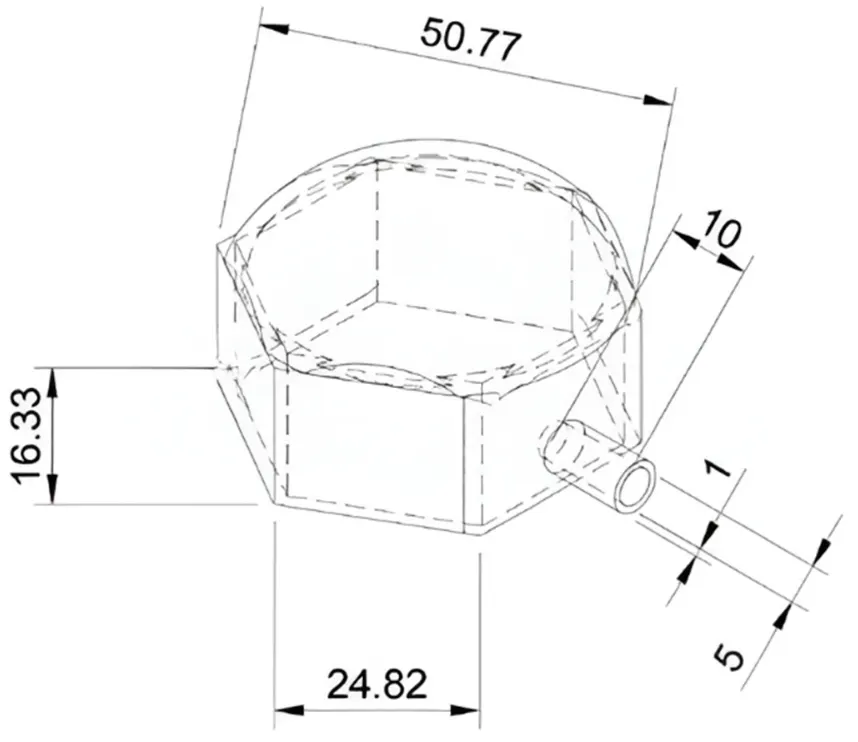
The housing itself was designed as a hexagonal block with a curved, dome-like inner base meant to echo the shape of an alveolar wall, plus lateral ports so gases or aerosols can be pumped in and out. The geometry was deliberately scaled up from a single real alveolus so the finished device is large enough to assemble and instrument by hand, while preserving the repeating hexagonal pattern that alveoli naturally form.
With the housing printed, the biological layers were built up inside it. The flexible membrane was produced by electrospinning polycaprolactone (PCL), a process that draws a polymer solution into a mat of very fine fibers; under the microscope these fibers measured up to 20 µm and formed a porous, stretchable scaffold standing in for the alveolar wall. The membrane was secured onto the printed housing so it sat in full contact with the supporting frame. A soft alginate hydrogel was then cast over the membrane and set in place by spraying it with a calcium chloride solution, which crosslinks the gel into a stable, hydrated layer; its pores ranged from 10 to 100 µm, close to the structure of real lung tissue.
Finally, the flexible printed pH sensor was placed onto the gel and sealed under a second hydrogel layer, embedding the probe directly in the tissue-like medium.
The final device is a tree-like concentration gradient generator splits and recombines two inlets across six outlets, producing a stable, stepped gradient for applications in drug-dosing studies.
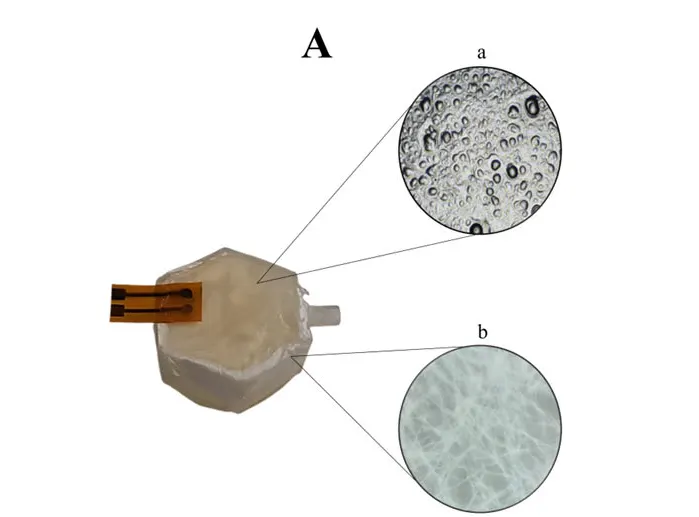
Figure 1. A flexible printed electrode on a polyimide strip, the type of sensor embedded inside the 3D printed chip. Source: Boček et al. Flexible Inkjet-Printed pH Sensors for Application in Organ-on-a-Chip Biomedical Testing. Biosensors. 2026.
The assembled chip was connected to a breathing source that pushed a dilute acetic acid stream through the device, letting the team watch pH change in real time as the “aerosol” diffused through the membrane and gel. Because the housing came straight off the printer, the whole stack could be rebuilt reliably whenever a fresh device was needed.
Results
The headline outcome is that a research-grade lung-on-a-chip housing can be produced directly on a desktop resin printer. The chip body was fabricated by DLP 3D printing from a clear microfluidic resin, yielding a transparent, dimensionally stable part that could be reprinted from the same CAD file for every experiment. Printing the structure rather than molding it gave the team a standardized, reproducible platform and let them refine the geometry quickly.
The printed hexagonal design did its job as a physical scaffold. Modeled on the repeating hexagonal arrangement of real alveoli and scaled up to the size of a single alveolar unit, the housing held the membrane and sensor stack in a consistent, reproducible configuration and provided lateral ports for delivering the test aerosol. This made the device easy to assemble by hand while keeping a biologically meaningful shape.
The biological layers built inside the housing matched their tissue targets closely. The electrospun PCL membrane formed fibers up to 20 µm across, producing a porous, flexible mat that behaved like the thin alveolar barrier and could withstand repeated breathing-like motion. The cast alginate hydrogel set into a soft, hydrated layer with pores spanning 10–100 µm, a range that closely resembles human lung tissue and supports molecular transport. Together the printed housing, electrospun membrane, and hydrogel produced a model that balanced mechanical resilience with realistic structure.
The assembled chip worked as a functional test bed. With the flexible sensor embedded in the gel and the device connected to a breathing source, the platform tracked pH changes in real time as a dilute acetic acid stream diffused through the membrane and hydrogel. The demonstration confirms that a printed housing combined with electrospun and hydrogel layers can host an integrated sensor and report a chemically changing environment, supporting its use as a reproducible tool for inhalation and respiratory research.
“Printing the chip body from a single CAD file gave every experiment an identical starting structure, turning a hard-to-standardize part into one any lab can reprint on demand.“
— Summary of Boček et al., Biosensors (2026)
Products Used In This Study

Questions on how our 3D printing system can work for your research? Connect with one of our specialists.
More Research Article Summaries
McGill University researchers build a 3D printed double-sided mold system to shape and merge brain organoids on a chip
University of Hawaiʻi researchers 3D print wearable "sweatainer" devices with true microscale internal channels
Want to read more article summaries?
We summarize the latest microfluidics and 3D printing research.
Curated from peer-reviewed publications featuring the CADworks3D system.