
Research Article Summary
5 Minute Read
University of Hawaiʻi researchers 3D print wearable "sweatainer" devices with true microscale internal channels
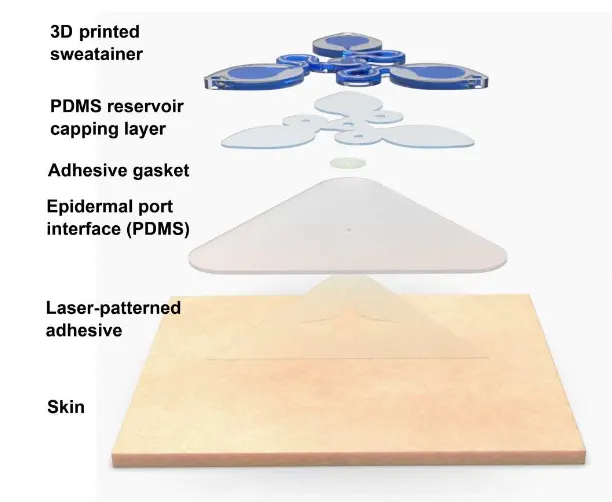
Title
Skin-interfaced microfluidic systems with spatially engineered 3D fluidics for sweat capture and analysis
Authors
Chung-Han Wu, Howin Jian Hing Ma, Paul Baessler, et al.
Journal
Science Advances, Vol. 9, Issue 18, eadg4272 (2023)
DOI Link
Summary
This summary covers a study in which researchers used a desktop DLP resin 3D printer to fabricate skin-worn microfluidic devices that collect and analyze sweat, building fully enclosed channels and valves below 100 µm that older flat-layer methods could not produce. Wu et al. show that careful tuning of print settings unlocks a true 3D design space for these wearable “epifluidic” devices.
Summary Author
This page was prepared by CADworks3D to summarize and highlight a peer-reviewed research article authored by independent researchers utilizing the CADworks3D system.
Title
Skin-interfaced microfluidic systems with spatially engineered 3D fluidics for sweat capture and analysis
Authors
Chung-Han Wu, Howin Jian Hing Ma, Paul Baessler, et al.
Journal
Science Advances, Vol. 9, Issue 18, eadg4272 (2023)
DOI Link
Key Results at a Glance
<100 µm
Internal channel features
Enclosed channels printed below the 100 µm mark, reaching true microfluidic scale.
~20 min
Print time: 6 devices
Six full devices come off a single build plate in about twenty minutes.
Fully 3D
Channels and valves
Non-planar networks and angled valves that flat-layer fabrication cannot make.
Objective
Sweat is a useful fluid to monitor because it carries biomarkers (electrolytes, metabolites, hormones, proteins) without the need for a needle. To capture and read that sweat on the body, researchers build thin, skin-worn devices with tiny internal channels, reservoirs, and valves. These are often called epidermal microfluidic, or “epifluidic,” devices.
The usual way to make them is soft lithography: precise molds are used to cast and bond patterned layers of a rubbery material such as PDMS. That approach works, but it is slow, needs cleanroom-grade equipment, and is fundamentally flat. Every channel layer is planar, so even a “3D” device is really a stack of 2D sheets. That limits the shapes a designer can make and stretches out each design cycle.
3D printing offers a different path. A digital light processing (DLP) resin printer builds a part layer by layer straight from a CAD file, so in principle the internal channels can follow genuinely three-dimensional paths. The catch is resolution: printers are advertised with fine numbers, but in practice the smallest usable internal channels usually land around 250 µm, which is too coarse for real microfluidics.
The gap this paper addresses is that practical limit. The authors set out to show that a commercial DLP resin printer, with the right design rules and print settings, can fabricate enclosed channels and working valves at true microfluidic scale (below 100 µm) and make them clear enough to read a colour-changing chemical test through the wall of the device.
Methodology and Design
Every device started as a CAD model, which was exported as an STL file and sent straight to a DLP resin printer running a 385 nm light source, printing parts in a transparent photocurable resin at a 10 µm layer height, six devices per build plate. Two print settings did most of the work: layer cure time (LCT), tuned to 0.8 s to balance channel strength against dimensional accuracy, and layer height, which the authors varied dynamically within a single print — using gentle exposure on the surface that gets imaged and stronger exposure elsewhere — to keep internal channels open while keeping the imaging window clear enough to read a colour test through. Because resin can cure shut a fully enclosed channel, enclosed devices were built in a three-step process: print the device with the reservoirs open, blow out the uncured liquid resin with clean dry air, then print a thin capping layer on top to seal it; for some versions, a thin PDMS layer was bonded over the printed body instead, after a surface treatment that makes resin and PDMS stick.
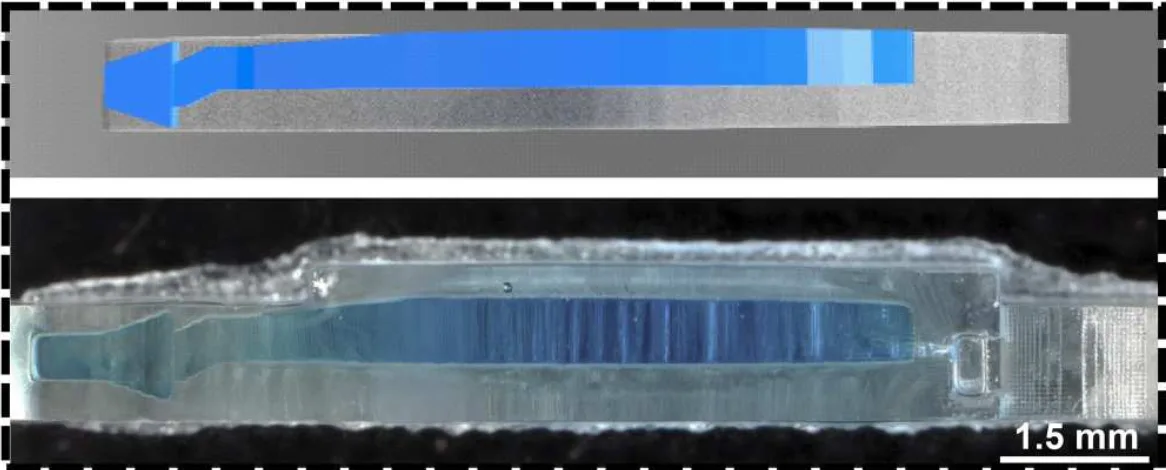
Figure 1. A CAD model (top) and the matching printed part (bottom) with dye filling the internal channel, showing the design carried directly into a fabricated 3D channel. Source: Wu et al. Skin-interfaced microfluidic systems with spatially engineered 3D fluidics for sweat capture and analysis. Science Advances. 2023.
To benchmark the printer, four devices spanning sweat capture, sequential sampling, resolution mapping, and optical readout were built and tested:
Sweatainer
Capillary Burst Valves
3D Test Channels
Printed Microcuvettes
The flagship device, the sweatainer, routes incoming sweat through a central inlet into a series of reservoirs, each gated by a capillary burst valve (CBV). A CBV is a passive valve with no moving parts: it holds fluid back until the pressure crosses a set threshold, then lets it through. By printing the valve’s diverging angles in 3D rather than 2D, the authors could tune each valve’s threshold so reservoirs fill one after another in a set order, capturing sweat as separate timed samples, a mode they call “multidraw.”
To find the printer’s true limits, the team printed a row of square test channels from 100 to 900 µm and measured how far each printed part drifted from its design. That mapping defined a reliable “printable region,” with 100 µm as the smallest channel that still flowed.
The printed microcuvettes lean on this same adaptive exposure control: the clear, gently-cured imaging window created during printing is what allows a colour-based test to be read straight through the device.
Results
The headline fabrication result is that a commercial DLP resin printer produced enclosed internal channel features below 100 µm, well past the roughly 250 µm ceiling typical of practical 3D-printed microfluidics. Systematic testing pinned the smallest reliable channel at 100 µm, below which parts failed as the features approached the printer’s pixel size.
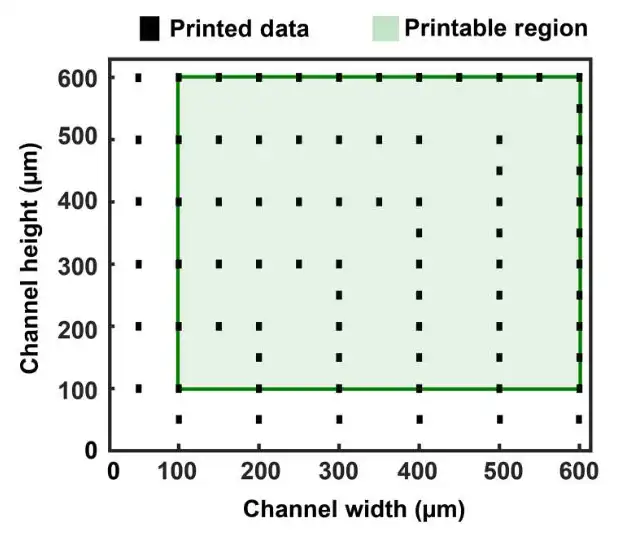
Figure 2. Map of which channel sizes printed successfully. The shaded zone marks the reliable printable region, with 100 µm as the lower bound for an open, flowing channel. Source: Wu et al. Skin-interfaced microfluidic systems with spatially engineered 3D fluidics for sweat capture and analysis. Science Advances. 2023.
Tuning layer cure time to 0.8 s gave the best trade-off between channels that survived handling and channels that matched their designed size. Pushing cure time longer improved how clear the part looked but risked curing resin shut inside the channels, which is exactly why the adaptive print process mattered: it let one part be both optically clear where it needed to be read and open where fluid needed to flow.
Throughput was practical rather than precious. Six devices printed per build plate in about 20 minutes at a 10 µm layer height, supporting the paper’s broader point that this is a fast, low-cost, iterate-friendly way to make wearable microfluidics.
On the design side, printing valves in true 3D gave finer control over burst pressure than flat valves allow, and the team set valve thresholds inside the physiological range of sweat pressure so reservoirs filled in sequence on the body. The same printed channels were clear enough to support a colour-changing chloride test read straight through the device wall.
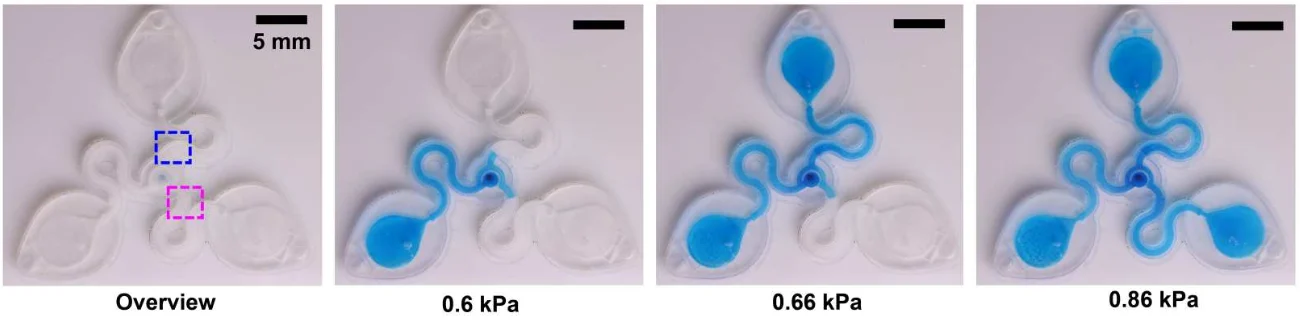
Figure 3. A printed sweatainer filling in stages. Tuned valve pressures send dyed fluid into each reservoir in order, capturing separate timed samples. Source: Wu et al. Skin-interfaced microfluidic systems with spatially engineered 3D fluidics for sweat capture and analysis. Science Advances. 2023.
“This platform, to our knowledge, represents the first 3D printed epifluidic platform with true microfluidic dimensions.”
— Wu et al., Science Advances (2023)
Products Used In This Study

Questions on how our 3D printing system can work for your research? Connect with one of our specialists.
More Research Article Summaries
McGill University researchers build a 3D printed double-sided mold system to shape and merge brain organoids on a chip
Sungkyunkwan University researchers build microfluidic blood-test discs from 3D printed molds at room temperature
Want to read more article summaries?
We summarize the latest microfluidics and 3D printing research.
Curated from peer-reviewed publications featuring the CADworks3D system.