
Research Article Summary
5 Minute Read
Sungkyunkwan University researchers build microfluidic blood-test discs from 3D printed molds at room temperature
Title
Room temperature roll-to-roll additive manufacturing of polydimethylsiloxane-based centrifugal microfluidic device for on-site isolation of ribonucleic acid from whole blood
Authors
Trung Hoang, Han Truong, Jiyeon Han, et al.
Journal
Materials Today Bio, Volume 23 (2023), Article 100838.
DOI Link
Summary
Researchers at Sungkyunkwan University used a desktop 3D printer to make the master molds for a spinning “lab-on-a-disc” that pulls genetic material out of whole blood, replacing the slow CNC-machined and photolithography molds that normally bottleneck this kind of device. The 3D-printed approach let them combine large millimetre-scale chambers and fine 500 µm channels in a single mold and copy it accurately at room temperature, with no heat or UV curing step. (Hoang et al.)
Summary Author
This page was prepared by CADworks3D to summarize and highlight a peer-reviewed research article authored by independent researchers utilizing the CADworks3D system.
Title
Room temperature roll-to-roll additive manufacturing of polydimethylsiloxane-based centrifugal microfluidic device for on-site isolation of ribonucleic acid from whole blood
Authors
Trung Hoang, Han Truong, Jiyeon Han, et al.
Journal
Materials Today Bio, Volume 23 (2023), Article 100838.
DOI Link
Key Results at a Glance
99%
Replication accuracy
3D printed mold features copied into the final part almost exactly
500 µm - 2 mm
Micro and macro features in one mold
Fine channels and deep chambers printed together in a single step
±2.7 µm
Dimensional variation
Largest drift between the CAD design and the finished device.
Objective
A lab-on-a-disc is a credit-card-sized spinning chip that prepares a blood sample for testing. Spinning the disc generates a centrifugal force that pushes fluid outward through a series of chambers, so the device can lyse cells, bind genetic material to magnetic beads, wash it, and release a clean sample, all without external pumps or tubing. That makes it attractive for point-of-care diagnostics. The hard part is not the spinning; it is making the disc cheaply, repeatably, and at a size large enough to process a real blood volume.
Most of these discs start from a mold, and the mold is where the manufacturing problem really lives. Traditionally that mold is cut on a CNC machine or patterned with photolithography in a cleanroom, and both routes have real drawbacks. CNC cutting is subtractive, so it leaves rough tool-marked surfaces that disturb fluid flow and interfere with the bonding step that seals the disc, and the cutting tools struggle with very small features. Photolithography handles tiny features beautifully but is slow, needs precise alignment, relies on cleanroom access, and is poorly suited to the deep, millimetre-scale chambers a blood-handling disc requires. Neither method comfortably produces a single mold that carries fine detail and deep volume at once.
That tension sets up the gap this paper addresses. A working disc needs both worlds at the same time: fine channels around 500 µm wide for controlled flow and mixing, and chambers a couple of millimetres deep to hold blood and reagents. Producing one mold that carries both length scales, at low cost, without a cleanroom, and in a form that can be reused many times, is the core challenge. The researchers approached it by 3D printing the master mold directly from the CAD design, then using that printed master to cast flexible polymer tooling that could be copied over and over. In doing so they shifted the precision part of the job away from cutting tools and cleanrooms and onto a digital design file and a printer, which is the shift this summary focuses on.
Methodology and Design
The disc began as a CAD model: a 55 mm circle holding twelve reagent chambers linked by microchannels, drawn in SOLIDWORKS and exported as an STL file for printing. The deep chambers were set at 2 mm and the connecting channels at 500 µm, so a single part had to span both length scales. That CAD file, not a machined blank, was the thing the whole process needed to reproduce faithfully, and every later step is essentially a chain of copies of that original design.
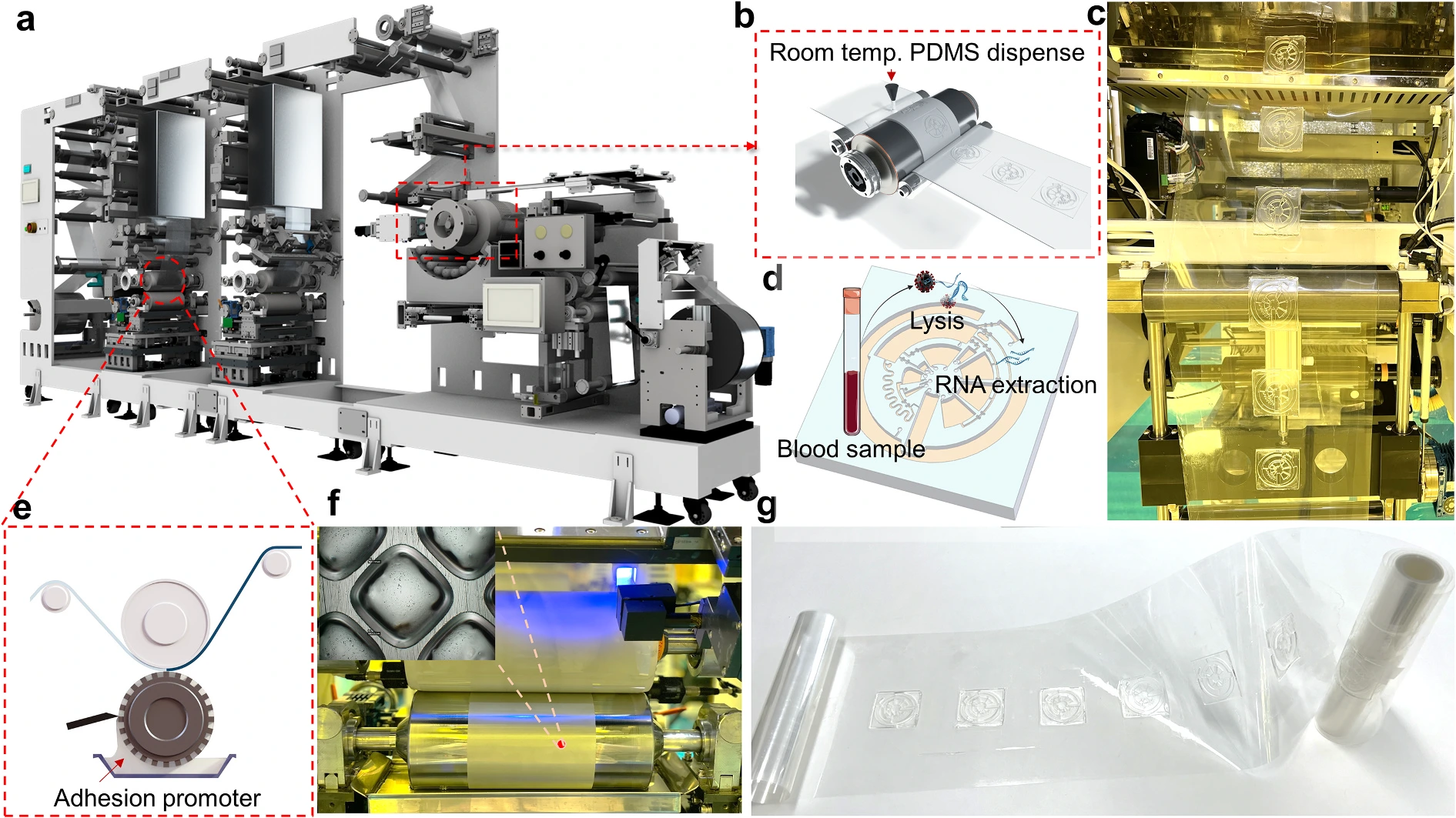
Figure 1. The end-to-end manufacturing line: the printed mold is mounted, PDMS is dispensed and formed at room temperature, and finished discs come off on a continuous transparent sheet. Source: Hoang et al. Room temperature roll-to-roll additive manufacturing of polydimethylsiloxane-based centrifugal microfluidic device for on-site isolation of ribonucleic acid from whole blood. Materials Today Bio. 2023.
This workflow was used to build and test four devices central to the platform’s design:
Lab-on-a-disc (LoaD)
Multi-depth polymer shim
Screw valve
Serpentine micromixer
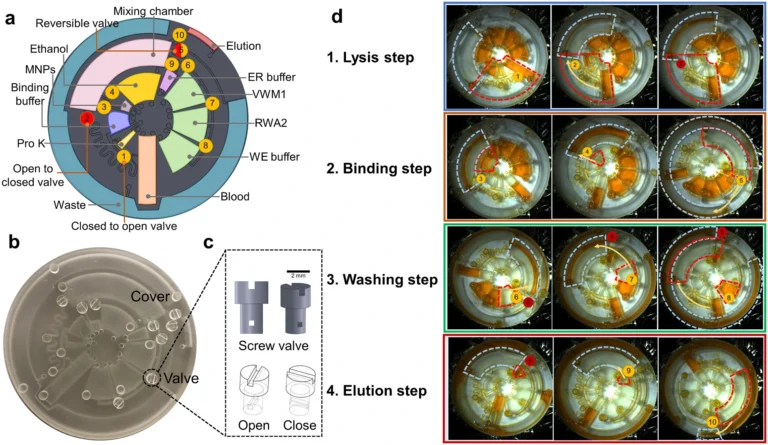
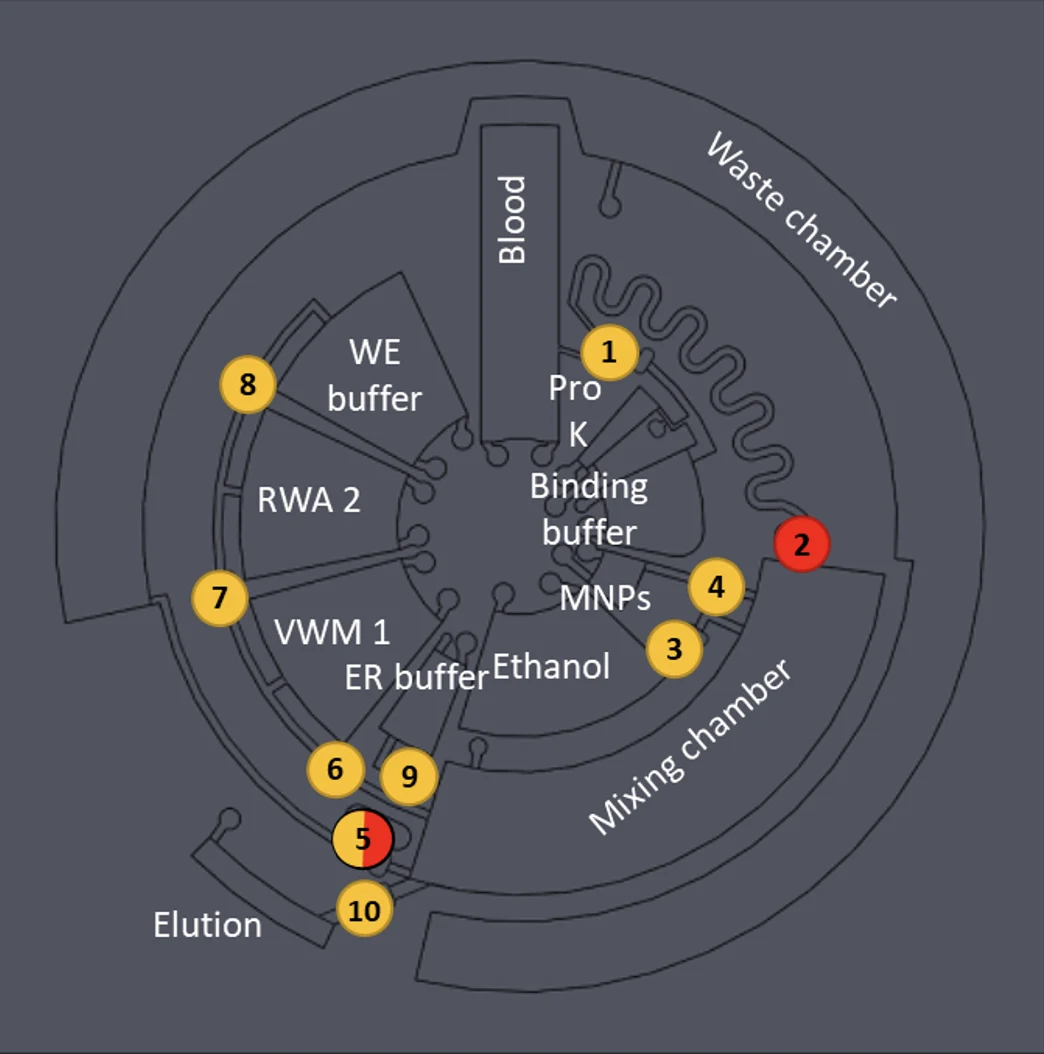
Figure 2. The lab-on-a-disc layout. The CAD map names each reagent chamber, while the 3D printed disc and screw-valve detail show how the design was realized as a physical part. Source: Hoang et al. Room temperature roll-to-roll additive manufacturing of polydimethylsiloxane-based centrifugal microfluidic device for on-site isolation of ribonucleic acid from whole blood. Materials Today Bio. 2023.
The master mold was printed directly on a DLP 3D printer using a 385 nm light source, at 40 µm in-plane resolution and a 50 µm layer height. Printing the mold this way sidesteps a well-known headache with 3D printed molds: leftover uncured resin on the surface can inhibit PDMS from curing, so the cast part never sets properly. Rather than reach for the usual workarounds, such as airbrushing protective inks or running heat-and-plasma treatments that can crack the part, the team printed in a resin formulated specifically for casting PDMS. After printing, they rinsed the mold in isopropanol, cleared resin from the finest features with an air nozzle, and post-cured under 405 nm light. The result was a printed master that PDMS releases from cleanly, without a fussy surface-treatment routine.
From that printed master they cast a positive PDMS mold, then coated it with a thin parylene C anti-stick layer so parts demold cleanly. Several of these PDMS molds were mounted onto a flexible backing sheet to build a large-area “shim” that could be wrapped around a roller and reused across many forming cycles, turning a single printed part into production tooling. To show the tooling held up, the team copied one master into ten replicas and confirmed all ten reproduced the pattern faithfully, with no visible damage to the original.

Figure 3. Building the reusable mold. CAD design becomes a 3D printed master, then a PDMS copy, then a parylene-coated mold; one master reliably produces ten identical replicas (C1–C10). Source: Hoang et al. Room temperature roll-to-roll additive manufacturing of polydimethylsiloxane-based centrifugal microfluidic device for on-site isolation of ribonucleic acid from whole blood. Materials Today Bio. 2023.
The finished printed mold measured 4 mm thick overall, carrying the 2 mm chambers and the 500 µm channels together in one piece: exactly the macro-plus-micro combination conventional molding struggles to deliver, straight out of the printer without machining, cleanroom lithography, or a heated forming step.
Results
The headline result is fidelity, the degree to which the printed design survives all the way to the finished part. Measured against the original CAD file, the finished discs reproduced the mold geometry with 99% accuracy. Broken down by feature, imprinted chamber depth came out at 1.99 mm against a 2.00 mm target, and channel depth at 501.58 µm against a 500 µm target. Both numbers matter because they sit at opposite ends of the scale range: the deep chamber and the fine channel transferred correctly out of the same mold, confirming that the multi-depth design did not force a trade-off between the two.
To check that the accuracy held through every copy, the team tracked three critical features (a valve, a chamber inlet, and the S-shaped mixing channel) across four stages: the CAD design, the 3D printed mold, the cast PDMS mold, and the final device. Across that whole chain, the largest deviation at any stage was only ±2.7 µm, small enough to be practically negligible for a device this size and without meaningful accumulation from one copy to the next. Cross-sections showed steep, cleanly defined sidewalls with only slight bevelling, which is what you want when a channel’s width controls how fluid moves through it.
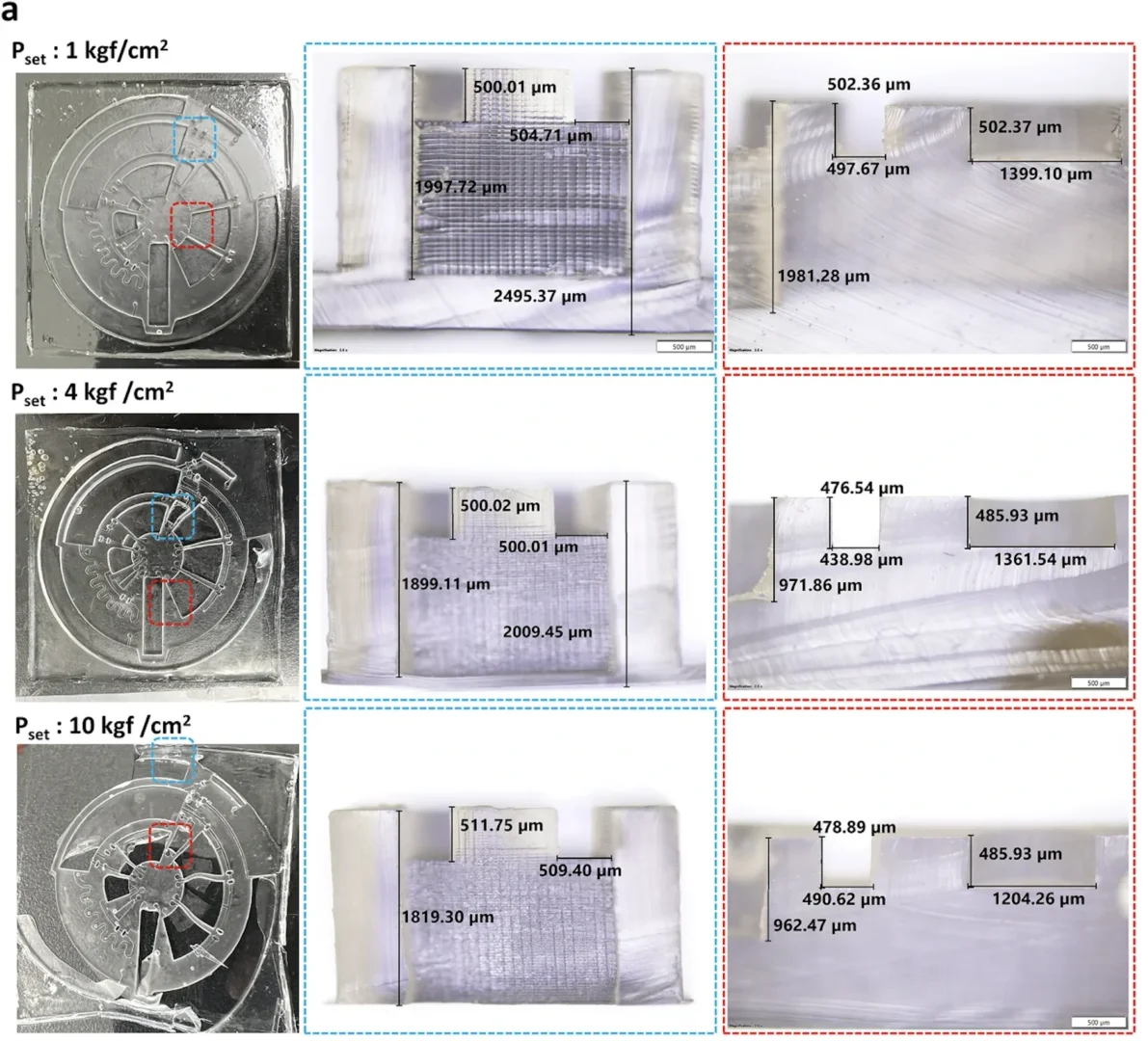
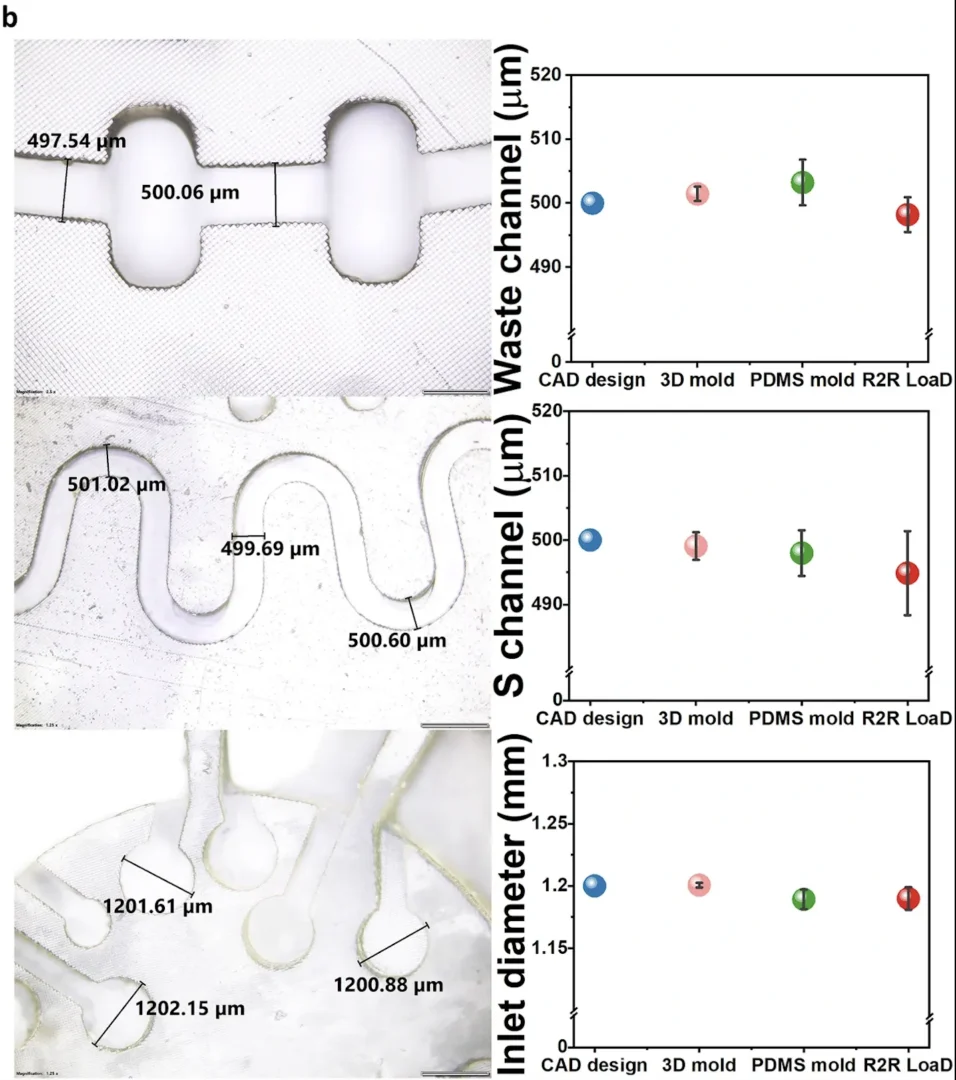
Figure 4. Cross-sections comparing the printed mold to the finished part. Channel and chamber dimensions track the CAD targets closely, confirming the 99% replication accuracy. Source: Hoang et al. Room temperature roll-to-roll additive manufacturing of polydimethylsiloxane-based centrifugal microfluidic device for on-site isolation of ribonucleic acid from whole blood. Materials Today Bio. 2023.
The tooling also proved durable and repeatable, which is what makes it useful for production rather than a one-off. A single parylene C coating let one printed master be copied into ten faithful PDMS replicas with no loss of detail and no damage to the master, and the flexible mold withstood the nip pressure of repeated forming cycles. A large part of why the geometry came through so cleanly is temperature: because the whole process ran at room temperature, the team avoided the thermal-expansion mismatch between mold and substrate that distorts patterns in heat-based methods. Nothing expanded or shrank unevenly between the printed master and the finished disc, so the CAD design and the physical part stayed in agreement.
“We developed a rapid, cost-effective fabrication method of a multi-depth flexible polymer shim using 3D-printing technology, which overcomes the challenges in traditional molding techniques especially for integrating macro- and micro-sized features.”
— Hoang et al., Materials Today Bio (2023)
Products Used In This Study
Questions on how our 3D printing system can work for your research? Connect with one of our specialists.
More Research Article Summaries
Sungkyunkwan University researchers build microfluidic blood-test discs from 3D printed molds at room temperature
University of Hawaiʻi researchers 3D print wearable "sweatainer" devices with true microscale internal channels
Want to read more article summaries?
We summarize the latest microfluidics and 3D printing research.
Curated from peer-reviewed publications featuring the CADworks3D system.