
Research Article Summary
5 Minute Read
University of Virginia researchers 3D print a tubeless impeller pump that recirculates fluid on organ-on-chip devices
Title
Microscale Impeller Pump for Recirculating Flow in Organs-on-Chip and Microreactors
Authors
Sophie R. Cook, Hannah B. Musgrove, Amy L. Throckmorton, et al.
Journal
Lab on a Chip, 2022, 22(3), 605–620
DOI Link
Summary
A team at the University of Virginia, working with Drexel University, designed a magnetically driven impeller pump that is almost entirely 3D printed, needs no tubing connections, and can recirculate fluid and cells through up to 36 organ-on-chip devices at once inside a standard cell culture incubator. Summary based on Cook et al.

Summary Author
This page was prepared by CADworks3D to summarize and highlight a peer-reviewed research article authored by independent researchers utilizing the CADworks3D system.
Title
Microscale Impeller Pump for Recirculating Flow in Organs-on-Chip and Microreactors
Authors
Sophie R. Cook, Hannah B. Musgrove, Amy L. Throckmorton, et al.
Journal
Lab on a Chip, 2022, 22(3), 605–620
DOI Link
Key Results at a Glance
36
Devices Per Incubator
One pump platform design scales to run three dozen chips side by side
$1-3
Cost Per Printed Chip
Each device resin-printed in about an hour for just a few dollars
Zero
Tubin Connections
A spinning magnetic field replaces pumps, tubes, and fittings entirely
24 hours
Cell Viability Maintained
Jurkat T cells recirculated all day on-chip with no drop in survival
Objective
Organ-on-chip devices try to recreate a tissue’s natural environment on a small, controllable scale. Fluid flow is central to that goal. In the body, flowing fluid delivers nutrients, clears waste, and carries immune cells between organs, all while applying a gentle mechanical force, known as shear stress, that living tissue depends on to function normally. Flow rates vary widely across tissues, from a slow trickle in the interstitium to a fast rush through blood and lymphatic vessels, so a useful organ-on-chip pump must reproduce a wide range of flow rates.
Most existing pump options fall short in some way. Syringe and peristaltic pumps give precise control but are bulky, need many tubing connections, and often give off enough heat to disrupt a cell culture incubator. Pneumatic pumps avoid some of these issues but still require several tubing lines per device, adding complexity and leak risk. Gravity-driven systems remove tubing altogether but sacrifice fine control over flow rate. A few groups have tried spinning external magnets to drive an on-chip stir bar, which removes tubing and allows some flow control, but these designs typically rely on a bulky benchtop stir plate, making it hard to run more than one or two devices inside an incubator at once.
To close this gap, the research team set out to build a pump that was small, low in heat output, free of tubing, and easy to multiply across many devices at once, all while still reaching physiologically relevant flow rates. Their solution paired a rotating magnetic field with a fully 3D printed chip and impeller, aiming for a platform that any lab could reproduce with a 3D printer and a handful of inexpensive parts.
Methodology and Design
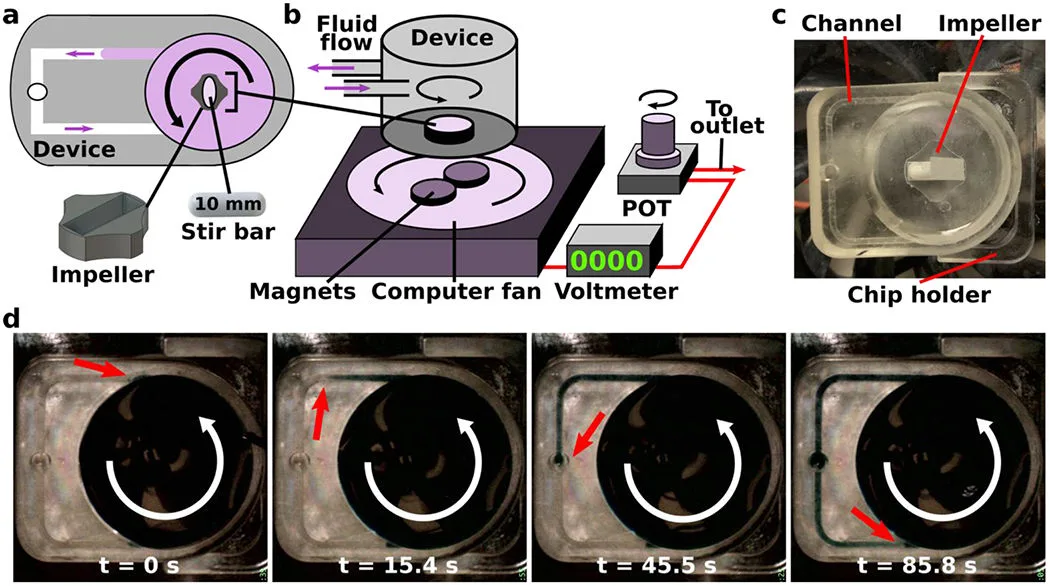
The pump has two 3D printed parts: a microfluidic chip with a circular well connected to a looping channel, and a small impeller that fits inside the well and holds a magnetic stir bar. Both parts were designed in Fusion 360 and printed on a digital light processing (DLP) 3D printer, which cures liquid resin layer by layer using a beam of light. Because DLP printing builds a device directly from a digital file, the team could iterate on channel dimensions, well geometry, and impeller shape in hours instead of days. Once printed, each chip was placed in a holder mounted above a computer fan fitted with two small magnets. Spinning the fan rotated the magnets, which in turn spun the impeller inside the well and drove fluid around the channel loop, all without a single tube or fitting.
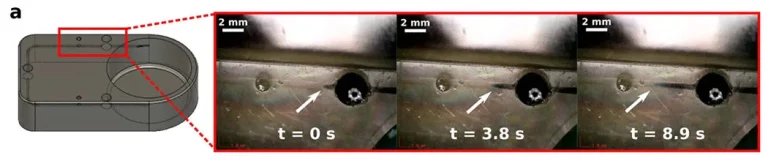
Figure 1. A CAD rendering of the printed microfluidic chip's well and channel geometry, alongside time-lapse photos of the printed device in use. Source: Cook et al. Microscale impeller pump for recirculating flow in organs-on-chip and microreactors. Lab on a Chip. 2022.
This fabrication pipeline supported three complementary builds, each proving out a different piece of the platform.
Impeller Pump Chip
Multiplexed Fan Platform
Cell Recirculation Model

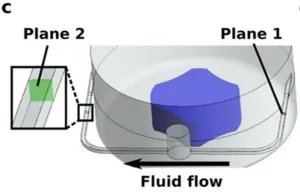
Figure 2. A 3D model of the chip's fluid pathway, showing the channel loop, the impeller pocket, and the two connected chambers used to guide the device's internal geometry. Source citation: Source: Cook et al. Microscale impeller pump for recirculating flow in organs-on-chip and microreactors. Lab on a Chip. 2022.
The core chip held a 26 mm diameter well linked to a microchannel loop with a square cross section, printed in either 0.5 mm or 1 mm widths to change flow resistance and access different velocity ranges. Two resins were tested for the print: Clear Microfluidic Resin (formerly BV007a), chosen for its high resolution, and FormLabs Clear, chosen for better biocompatibility. Each chip printed in about an hour and cost only $1 to $3 in resin, while the matching impeller took just 15 minutes and $0.03 to $0.12 to print. After printing, parts were rinsed in isopropyl alcohol, dried, and cured under UV light before a magnetic stir bar was glued into the impeller’s center. Layer heights of 50 to 100 µm were used depending on the resin and printer, with drain ports added to the Clear resin design so uncured resin could escape the channel during printing.
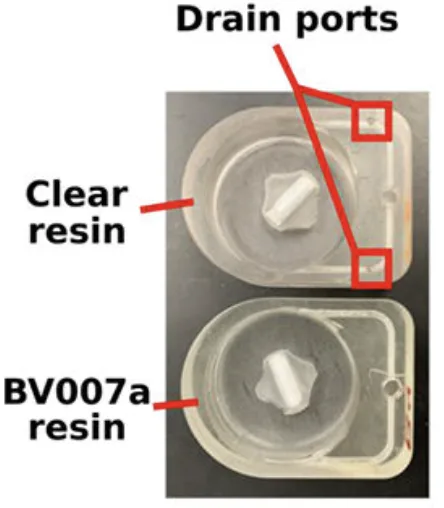
Figure 3. Two resin options tested for the printed chip: a high-resolution resin (top) and a clear, more biocompatible resin (bottom) chosen for extended cell culture. Source: Cook et al. Microscale impeller pump for recirculating flow in organs-on-chip and microreactors. Lab on a Chip. 2022.
For the external platform, two magnets were glued to the center of a standard computer fan, paired with a potentiometer for speed control and a voltmeter for readout, sealed inside a small plastic project box to protect the electronics from incubator humidity. Matching the distance between the magnet centers to the length of the stir bar was critical: too wide a gap, and the impeller spun unpredictably with no flow. Once matched, rotation stayed stable for at least 90 hours. Because each platform used inexpensive, off-the-shelf parts, about $50 to $75 in materials and roughly two hours to assemble, the team scaled up to six devices per incubator shelf, with room for up to 36 devices across a full incubator.
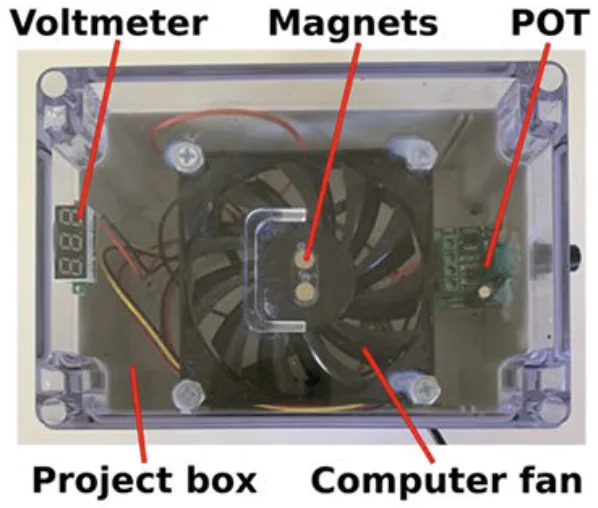
Figure 4. Inside the external pump platform: two magnets glued to a computer fan spin to drive the printed impeller, with a potentiometer and voltmeter for speed control and readout. Source: Cook et al. Microscale impeller pump for recirculating flow in organs-on-chip and microreactors. Lab on a Chip. 2022.
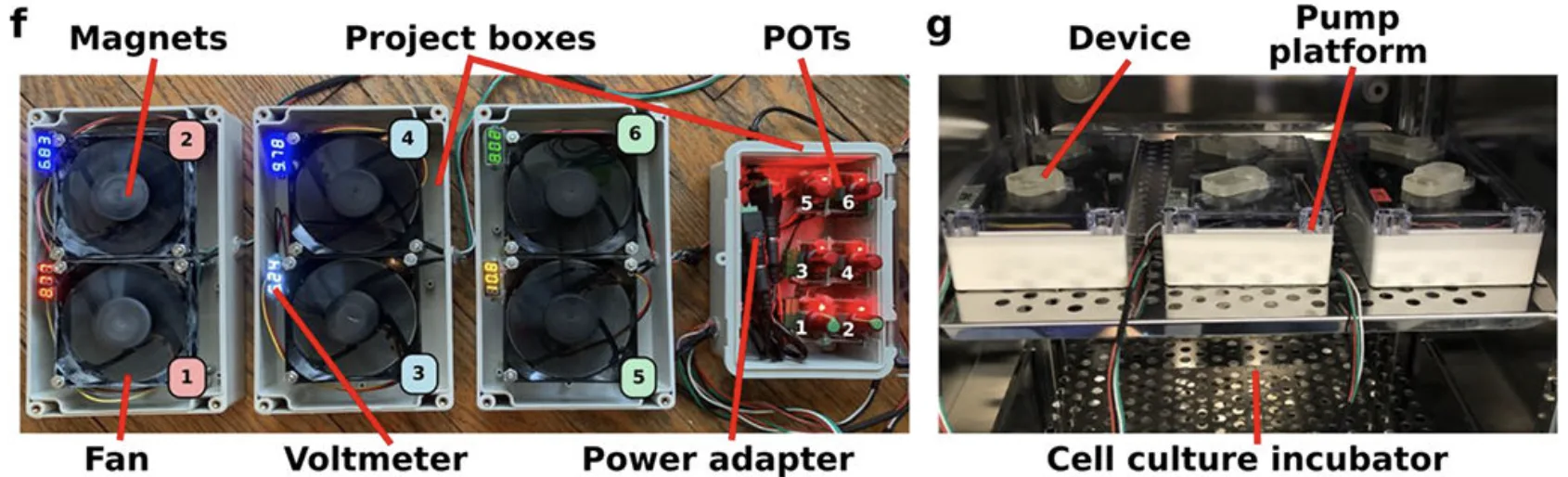
Figure 5. The platform scales easily: several project boxes house multiple fan units side by side, and six devices can run together on a single incubator shelf. Source: Cook et al. Microscale impeller pump for recirculating flow in organs-on-chip and microreactors. Lab on a Chip. 2022.
To test whether the pump could safely move living cells, the team recirculated primary mouse splenocytes and Jurkat T cells, a human T-cell line, through the printed chips. Cells were first allowed to settle to the base of the well, then resuspended and carried through the channel loop once the impeller started spinning, confirming the pump could recirculate cells from a resting start and sustain flow for up to 24 hours.
Results
The finished platform met its central design goals. Each pump ran without any tubing, and a full incubator shelf could hold 36 printed devices at once, letting the team run many experiments in parallel rather than one device at a time.
Print costs stayed low throughout testing: each microfluidic chip cost $1 to $3 in resin and printed in about an hour, while the matching impeller added only pennies more per device. That combination made it practical to produce large batches of chips for repeated experiments without a major materials budget.
Heat output, a common problem for incubator-based pumps, was minimal. Running six platforms at once inside a working incubator raised the temperature near the pumps by just 0.4°C, well within the ±1°C window needed for stable cell culture, compared to a jump of more than 30°C when a peristaltic pump was tested under similar conditions.
Most importantly for future organ-on-chip use, the pump did not harm the cells it circulated. Jurkat T cells recirculated for a full 24 hours showed no significant drop in viability compared to off-chip controls, and primary splenocytes recirculated for 1 hour maintained healthy viability across a range of flow speeds. Resin choice mattered more than flow itself: chips printed in FormLabs Clear supported cell survival far better than the higher-resolution Clear Microfluidic Resin, which was significantly more toxic to primary cells.
“This pump platform required no tubing connections and could accommodate up to 36 devices.”
— Cook et al., Lab on a Chip, 2022
Products Used In This Study

Questions on how our 3D printing system can work for your research? Connect with one of our specialists.
More Research Article Summaries
McGill University researchers build a 3D printed double-sided mold system to shape and merge brain organoids on a chip
University of Hawaiʻi researchers 3D print wearable "sweatainer" devices with true microscale internal channels
Want to read more article summaries?
We summarize the latest microfluidics and 3D printing research.
Curated from peer-reviewed publications featuring the CADworks3D system.