
Research Article Summary
5 Minute Read
University of Virginia Researchers 3D Print a Reconfigurable SlipChip for Targeted Tissue Delivery
Title
Rapid Fabrication by Digital Light Processing 3D Printing of a SlipChip with Movable Ports for Local Delivery to Ex Vivo Organ Cultures
Authors
Megan A. Catterton, Alexander G. Ball, Rebecca R. Pompano
Journal
Micromachines, 2021, 12, 993
DOI Link
Summary
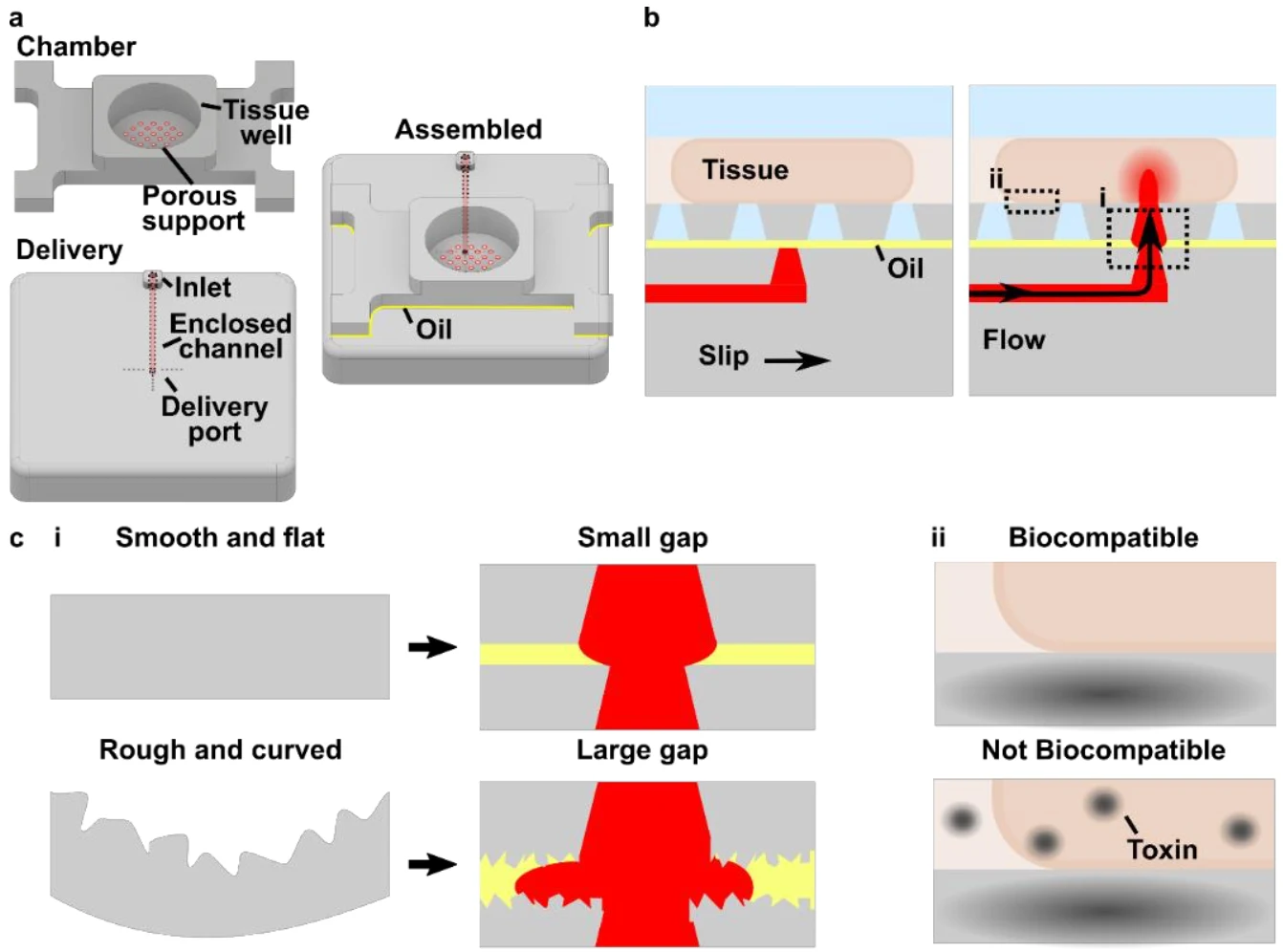
Catterton et al. at the University of Virginia used digital light processing (DLP) 3D printing to fabricate a two-part, reconfigurable microfluidic device called a SlipChip, replacing a slow, hand-built glass etching process with a design that can be printed, repeated, and shared in hours.

Summary Author
This page was prepared by CADworks3D to summarize and highlight a peer-reviewed research article authored by independent researchers utilizing the CADworks3D system.
Title
Rapid Fabrication by Digital Light Processing 3D Printing of a SlipChip with Movable Ports for Local Delivery to Ex Vivo Organ Cultures
Authors
Megan A. Catterton, Alexander G. Ball, Rebecca R. Pompano
Journal
Micromachines, 2021, 12, 993
DOI Link
Key Results at a Glance
≤ 0.3 µm
Surface Smoothness
DLP-printed surfaces were smooth enough to keep the oil-filled gap leak-free
0.138 mm
Smallest Printable Port
The delivery port printed reliably at this diameter, within about 10% of the drawn design
9 of 9
Leak-Free Deliveries
Every tested delivery across three assembled chips showed zero leakage into the oil gap
120 µm
Finest Delivery Resolution
The chip could target a region this small within a single live tissue slice
Objective
Microfluidic devices let researchers work with tiny, precise volumes of fluid, useful for studying living tissue. One such design, called a SlipChip, is built from two flat layers stacked together with a thin film of oil in between. Sliding, or “slipping,” one layer relative to the other opens and closes different fluid pathways, so a single chip can be reconfigured for different jobs, including delivering a probe or drug to a specific spot on a tissue sample.
SlipChips are difficult to make. The earliest versions were cut from glass and etched with hydrofluoric acid (HF), a hazardous chemical that only a trained technician can safely handle. Newer slip-based designs, including ones built from several stacked layers, are even harder to fabricate by hand. This bottleneck limits how many devices a lab can produce and makes it hard to share a working design with collaborators who lack the same specialized skills or equipment.
The authors tested whether digital light processing (DLP) 3D printing, in which a projector cures liquid resin into solid layers, could replace hand fabrication for SlipChips. Any replacement method has to meet four requirements: surfaces facing the oil layer must be smooth and flat enough to hold a gap of only a few µm, those surfaces must be hydrophobic (and fluorophilic, if a fluorinated oil is used) so the aqueous solution does not spread into the oil, the chip must be optically clear enough to align by eye, and for tissue work, the resin must not harm living cells. As a case study, the team chose a previously hand-built device called the movable port (MP) device, a SlipChip designed to deliver fluid to a user-selected spot within a live tissue slice.
Methodology and Design
Every part of the chip started as a 3D model, was sliced into 50 µm layers, and printed on a DLP resin printer. Each piece was rinsed, cured under UV light, and in some cases treated with a fluorinated coating or laser-etched to add features too fine to print directly. Once both halves were finished, they were assembled around a thin layer of oil and clamped together, ready for testing.
This pipeline built the two halves of the movable port SlipChip, each optimized for a different job:
Delivery Component
Chamber Component
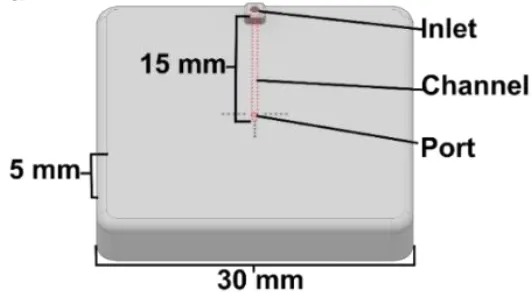
Figure 1. The CAD design of the delivery component, showing the inlet, enclosed channel, and terminating delivery port. Source: Catterton et al. Rapid Fabrication by Digital Light Processing 3D Printing of a SlipChip with Movable Ports for Local Delivery to Ex Vivo Organ Cultures. Micromachines. 2021.
The delivery component forms the bottom half of the chip. It holds a single enclosed channel running from an inlet to a small delivery port, and it was designed to stay flat and smooth across its full 30 mm width so the oil gap above it stayed thin and leak-resistant. Because photocurable resin shrinks slightly as it cures, thin prints tend to warp, and increasing the part’s thickness to 5 mm was enough to keep it flat. The channel was kept short (15 mm) and narrow (a 0.5 x 0.5 mm square cross section) so leftover uncured resin could be rinsed out through the delivery port, which printed reliably down to 0.138 mm in diameter. A separate inlet was sized to press fit snugly onto standard PTFE tubing.
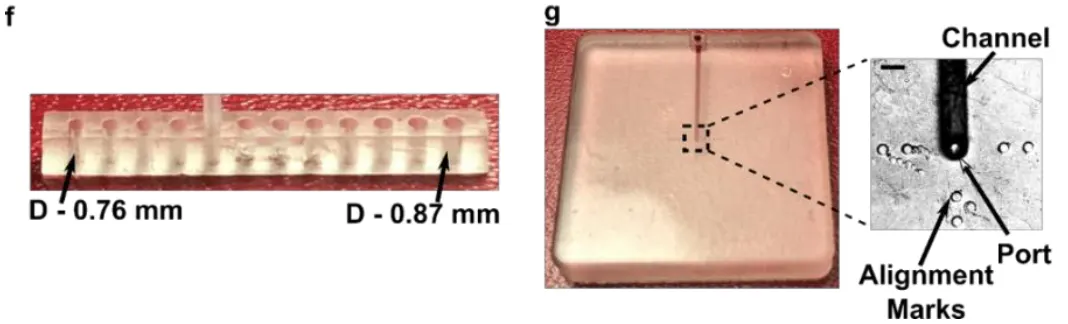
Figure 2. (f) A test piece used to fit the inlet port to PTFE tubing, shown with red dye. (g) The finished delivery component with the channel filled with red dye to show the flow path; inset shows a close-up of the delivery port and alignment marks. Source: Catterton et al. Rapid Fabrication by Digital Light Processing 3D Printing of a SlipChip with Movable Ports for Local Delivery to Ex Vivo Organ Cultures. Micromachines. 2021.
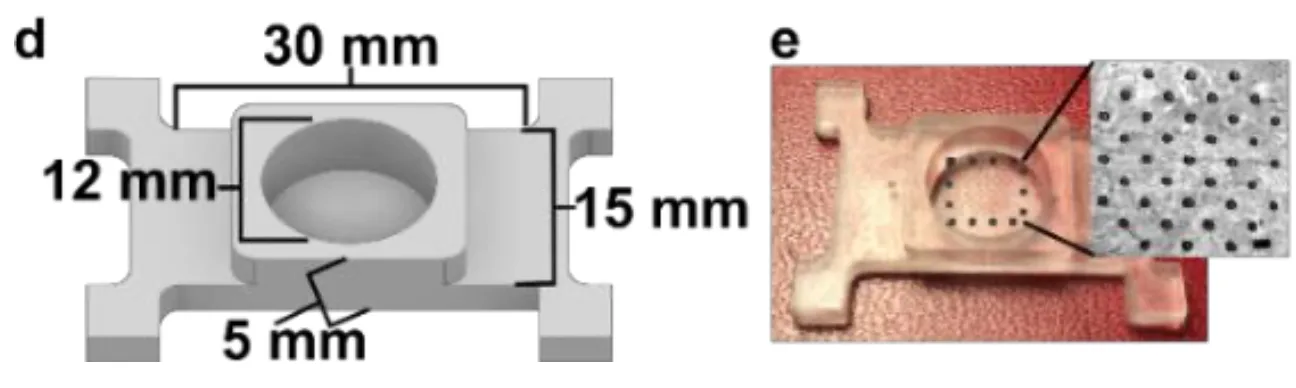
Figure 3. (d) CAD design of the chamber component. (e) The 3D printed and laser etched chamber, with a close-up of the finished port array. Source: Catterton et al. Rapid Fabrication by Digital Light Processing 3D Printing of a SlipChip with Movable Ports for Local Delivery to Ex Vivo Organ Cultures. Micromachines. 2021.
The chamber component forms the top half of the chip, where a slice of tissue or hydrogel sits on a porous support. That support needed an array of very small ports, in the 70 to 110 µm range, large enough to let fluid pass through easily but small enough to keep each delivery localized. Printing the ports directly proved difficult: printed flush against the build platform, the first layers overexposed and blurred; printed as an unsupported overhang, the ports reached an acceptable size but the surface stretched and lost transparency. The team solved this with a two-step process instead, printing a solid, transparent chamber floor first, then laser etching an array of 80 µm ports into it in under a minute, with no melting or warping of the surrounding resin.
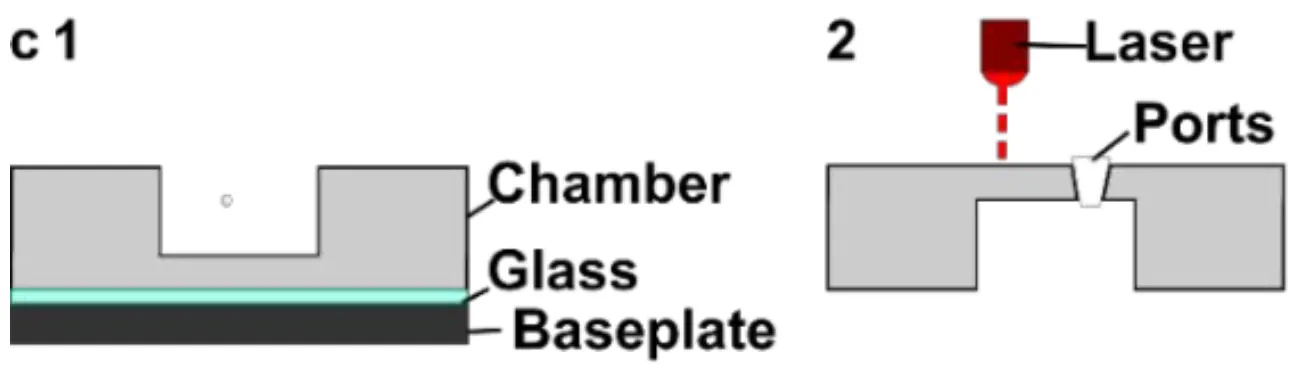
Figure 4. (c1) The two-step process used to make the chamber's port array: The chamber is printed solid against glass, then (c2) a laser etches the port array into the printed floor. Source: Catterton et al. Rapid Fabrication by Digital Light Processing 3D Printing of a SlipChip with Movable Ports for Local Delivery to Ex Vivo Organ Cultures. Micromachines. 2021.
Print settings mattered as much as the design. Parts were printed at a 50 µm layer height using a slow peel speed, a 0.1 mm gap adjustment, and 75% light power, and printing onto glass, rather than the standard aluminum build plate, produced smoother, optically clear surfaces essential for a thin oil gap and for seeing through the chip during alignment. To make the printed surface repel water at the oil interface, it was treated with a fluorinated silane coating, raising the water contact angle from about 60 degrees to over 115 degrees. To seal the assembled chip, the two halves were sandwiched around a thin oil layer and held together with binder clips, with no adhesive or bonding step needed.
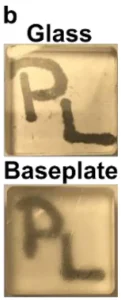
Figure 5. The same resin part printed on glass (top) came out optically clear, while the version printed on the aluminum baseplate (bottom) came out cloudy. Source: Catterton et al. Rapid Fabrication by Digital Light Processing 3D Printing of a SlipChip with Movable Ports for Local Delivery to Ex Vivo Organ Cultures. Micromachines. 2021.
Results
The printed resin met the platform requirements for a working SlipChip. Surfaces printed against glass reached a roughness of 0.3 µm or better, smooth enough to maintain the thin oil gap that keeps the two phases separated, while surfaces printed against the rough aluminum baseplate were far rougher and optically opaque. Short exposures under 15 minutes, longer than the device would ever contact tissue in real use, did not reduce the viability of live lymph node tissue slices compared to an off-chip control.
The delivery component’s channel and port were printed with close fidelity to the CAD drawing, down to a smallest working port diameter of 0.138 mm. The chamber component’s port array, made with the two-step print-and-laser-etch process, produced a uniform set of roughly 81 µm ports with no visible deformation of the surrounding resin.
When the two halves were assembled and tested with a pulse of fluorescent dye, 9 of 9 deliveries across three separately assembled chips showed no leakage into the oil-filled gap, confirming a reliable capillary pressure barrier between the aqueous and oil phases.
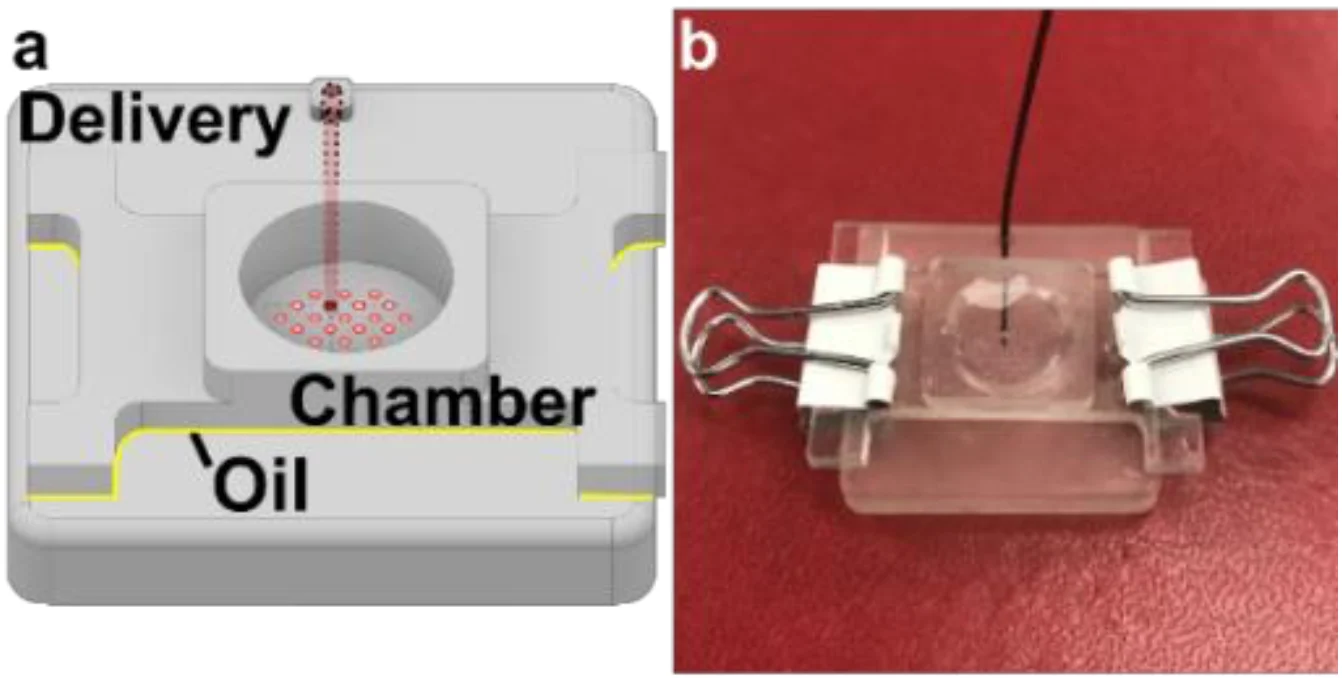
Figure 6. (a) Schematic of the assembled two-component device, showing the delivery, chamber, and oil layers. (b) Photo of the assembled device, clamped together with binder clips. Source: Catterton et al. Rapid Fabrication by Digital Light Processing 3D Printing of a SlipChip with Movable Ports for Local Delivery to Ex Vivo Organ Cultures. Micromachines. 2021.
Finally, the chip delivered fluid locally to soft hydrogel and to live mouse lymph node tissue slices with a spatial resolution as fine as 120 µm. The SlipChip’s sliding mechanism let the team redirect delivery to a new position on the same slice by shifting the top layer, without removing or repositioning the sample by hand.
“Establishing these design rules turns SlipChip fabrication from a specialist’s skill into a reproducible print job that other labs can share.”
— Catterton et al., University of Virginia, 2021
Products Used In This Study

Questions on how our 3D printing system can work for your research? Connect with one of our specialists.
More Research Article Summaries
McGill University researchers build a 3D printed double-sided mold system to shape and merge brain organoids on a chip
University of Hawaiʻi researchers 3D print wearable "sweatainer" devices with true microscale internal channels
Want to read more article summaries?
We summarize the latest microfluidics and 3D printing research.
Curated from peer-reviewed publications featuring the CADworks3D system.