
Research Article Summary
5 Minute Read
UTS researchers 3D print molds to fabricate a biomimetic sperm-selection device
Title
A biomimetic sperm selection device for routine sperm selection
Authors
Steven A. Vasilescu, Dale M. Goss, Kathryn H. Gurner, et al.
Journal
Reproductive BioMedicine Online (RBMO), Volume 50, Issue 2, Article 104433 (2025)
DOI Link
Summary
Vasilescu et al. built a biomimetic microfluidic sperm sorter using 3D printed molds to cast the final PDMS device, replacing cleanroom fabrication with a rapid, benchtop workflow. Across 61 donor and patient samples, the device isolated motile sperm with significantly less DNA damage than the standard clinical method.

Summary Author
This page was prepared by CADworks3D to summarize and highlight a peer-reviewed research article authored by independent researchers utilizing the CADworks3D system.
Title
A biomimetic sperm selection device for routine sperm selection
Authors
Steven A. Vasilescu, Dale M. Goss, Kathryn H. Gurner, et al.
Journal
Reproductive BioMedicine Online (RBMO), Volume 50, Issue 2, Article 104433 (2025)
DOI Link
Key Results at a Glance
92%
Lower DNA Fragmentation
Proof-of-concept DFI dropped 92.2%, compared with 57.4% for the standard method
2x
Higher Progressive Motility
Motile sperm output nearly doubled compared with conventional sperm selection
<1%
Average DFI Achieved
Device output averaged under 1% DNA fragmentation across both studies
61
Samples Validated
Tested across two separate clinical studies totaling 61 donor and patient samples
Objective
Infertility affects roughly 15% of couples worldwide, and a male factor contributes in about half of these cases. Despite the growing use of assisted reproductive technology (ART), live birth rates per treatment cycle have stayed near 26% for the past two decades. Sperm quality is a major reason why. Sperm carrying fragmented DNA can lower fertilization rates, reduce embryo quality, and raise the risk of miscarriage, even when standard semen parameters like count and motility look normal.
The default method for picking sperm before IVF or ICSI is density gradient centrifugation (DGC), which spins semen at high speed to separate sperm by density. DGC works, but the centrifugal force involved can generate oxidative stress that damages sperm DNA, potentially undoing the benefit it is meant to provide.
Microfluidic sperm sorters have been proposed as a gentler alternative, using channel geometry instead of spinning force to separate motile sperm. However, many existing designs are complex to build, inconsistent in performance, or dependent on cleanroom fabrication, which has limited how widely they have been adopted in routine clinical labs.
This study set out to test a simpler, biomimetic microfluidic device, one that mimics the boundary-following behavior sperm naturally show inside the female reproductive tract, against DGC in a real-world, two-phase clinical comparison.
Methodology and Design
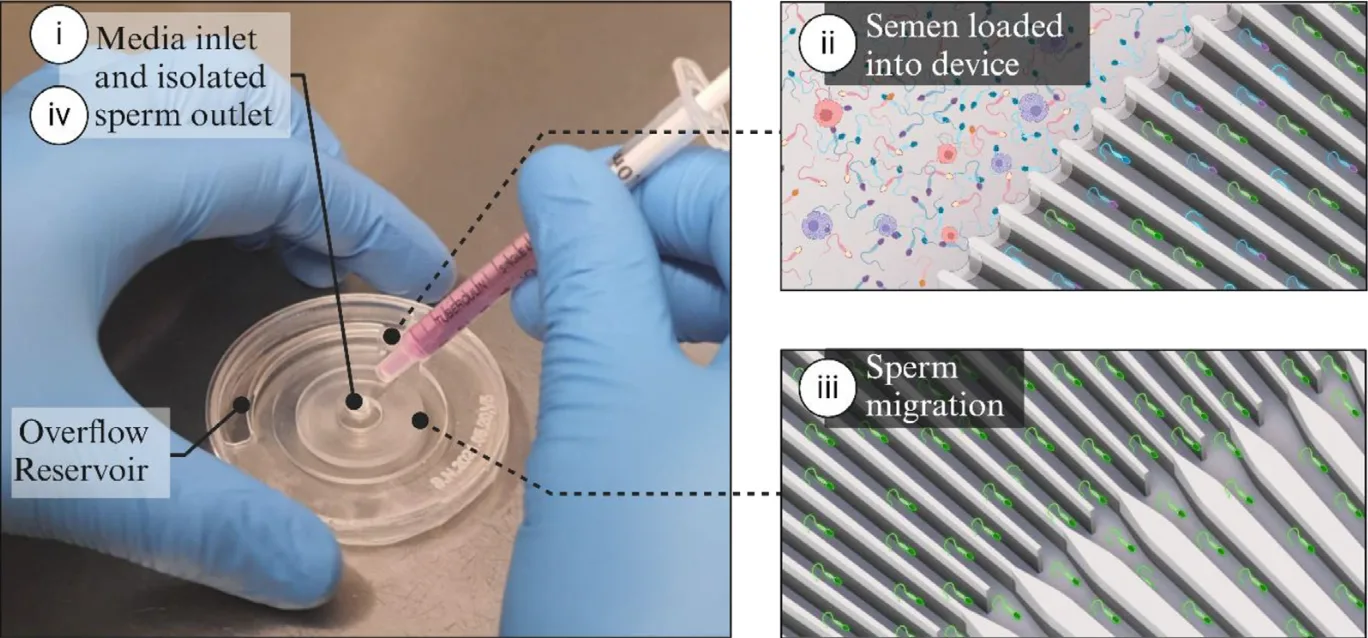
The sperm selection device was built using a mold-and-cast approach rather than cleanroom photolithography. The channel network was first modeled in CAD software, then the mold geometry was 3D printed as two separate pieces representing the top and bottom halves of the device. After printing, the molds were cleaned and cured, then used as a template to cast the finished device in PDMS (polydimethylsiloxane), a flexible, biocompatible silicone. Once cured, the two PDMS layers were bonded together to form the final chip: a radial network of hundreds of channels leading from an outer semen reservoir to a central collection well.
This 3D printed mold-and-cast method was used to fabricate the same device tested across two separate validation studies:
Biomimetic Sperm Sorter
Biomimetic Sperm Sorter
In the proof-of-concept study, 21 donor semen samples from university volunteers aged 18 to 24 were split three ways and processed in parallel as raw semen, DGC, and the microfluidic device, allowing a direct side-by-side comparison. The molds themselves were printed on a digital light processing (DLP) 3D printer, sliced at a 25 µm layer height to capture the fine channel geometry, then washed in isopropanol three times, UV cured for 2 minutes, and soaked in a 70% ethanol bath for 2 hours. The molds were then treated with oxygen plasma and a silane coating so the cured PDMS would release cleanly. PDMS was mixed at a 1:10 ratio of base to curing agent, degassed to remove air bubbles, cast onto the molds, and cured in a 75°C oven for 2 hours. The cured layers were peeled free, punched with inlet, overflow, and outlet holes, then bonded with a second round of oxygen plasma treatment to seal the finished chip.
The diagnostic andrology study moved the same device into a working fertility clinic, testing it on 40 consenting patients aged 26 to 54 who presented for semen analysis. To operate the finished device, users load 1.5 mL of media through the central outlet, then 1.0 mL of liquefied semen into the outer inlet to create a semen-media interface. The outlet is sealed with adhesive tape, and the device sits undisturbed on a 37°C warm plate for 15 minutes while motile sperm migrate along the boundary-following channels toward the center. The tape is then removed and the isolated, washed sperm are aspirated directly for use, a three-step process that only requires a syringe, a pipette, and a heated stage.
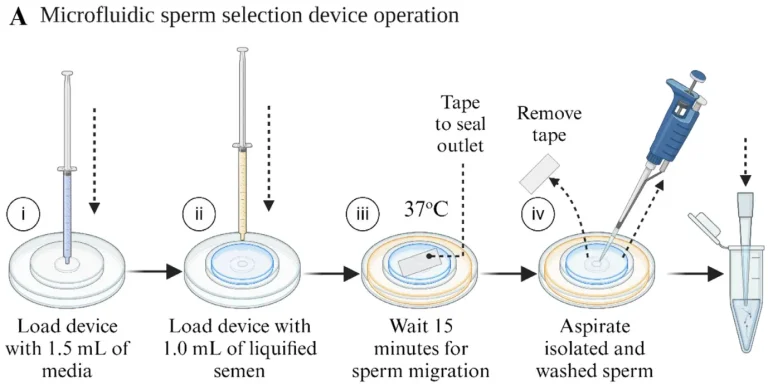
Figure 1. The finished device's three-step workflow: load media and semen, incubate for 15 minutes at 37°C while motile sperm migrate inward, then aspirate the isolated, washed sperm for use. Source: Vasilescu et al. A biomimetic sperm selection device for routine sperm selection. Reproductive BioMedicine Online. 2025.
Results
Across both studies, sperm isolated with the microfluidic device consistently showed lower DNA fragmentation and higher motility than sperm isolated with the standard method, though in smaller numbers overall.
In the proof-of-concept study, the device reduced the average DNA fragmentation index (DFI) by 92.2% compared with raw semen, well ahead of the 57.4% reduction achieved by DGC. Progressively motile sperm output was roughly 2x higher with the device than with DGC, a jump from a 30.5% average increase with DGC to 61.1% with the device. These trends held in the diagnostic andrology study, where the device improved DFI by 82.9% on average and consistently kept DFI values under 10%, while DGC left 10 of 33 samples above that threshold.
Sperm concentration was the one measure where DGC came out ahead. Because the device selects only the most motile cells able to travel through its narrow channels, it recovers far fewer sperm overall, typically a few million per milliliter rather than tens of millions. Across the full two-phase study of 61 donor and patient samples, the device delivered an average DFI below 1%, making it best suited to procedures like ICSI, which need a small number of very high-quality sperm rather than a large volume.

Figure 2. (Left): A phase-contrast micrograph of raw, unprocessed semen before selection, showing a mixed population of motile and non-motile sperm alongside round cells and debris.
(Right): Sperm isolated using the 3D printed microfluidic device, showing a cleaner, more uniform population of motile sperm, free of round cells and debris. Source: Vasilescu et al. A biomimetic sperm selection device for routine sperm selection. Reproductive BioMedicine Online. 2025.
“A biomimetic mode of sperm selection offers consistent results and can be performed with minimal training, with the operation of the microfluidic device requiring only a syringe, a pipette, and a heated stage or incubator to operate the device.“
— Vasilescu et al. A biomimetic sperm selection device for routine sperm selection. Reproductive BioMedicine Online. 2025.
Products Used In This Study

Questions on how our 3D printing system can work for your research? Connect with one of our specialists.
More Research Article Summaries
McGill University researchers build a 3D printed double-sided mold system to shape and merge brain organoids on a chip
University of Hawaiʻi researchers 3D print wearable "sweatainer" devices with true microscale internal channels
Want to read more article summaries?
We summarize the latest microfluidics and 3D printing research.
Curated from peer-reviewed publications featuring the CADworks3D system.