
Research Article Summary
5 Minute Read
UTS researchers build a modular cell-harvesting system entirely from 3D printed microfluidic parts
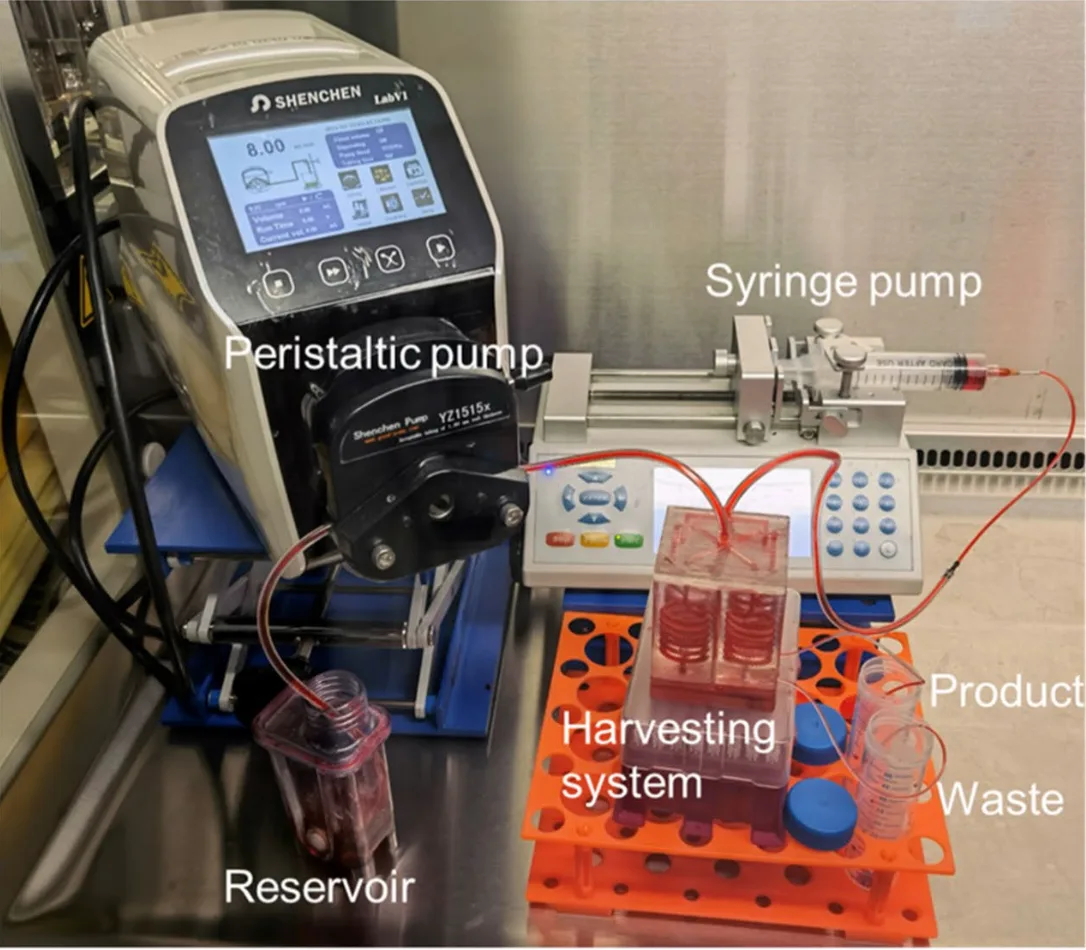
Title
A modular 3D-printed microfluidic system: a potential solution for continuous cell harvesting in large-scale bioprocessing
Authors
Lin Ding, Sajad Razavi Bazaz, Mahsa Asadniaye Fardjahromi, et al.
Journal
Bioresources and Bioprocessing (2022) 9:64
DOI Link
Summary
Researchers at the University of Technology Sydney designed a fully 3D printed, modular microfluidic system that links four printed units, two micromixers, a spiral separator, and a zig-zag concentrator, to detach, separate, and concentrate stem cells from the tiny beads they are grown on. Because every part is printed, the team could redesign and rebuild the whole device in hours instead of weeks. (Ding et al.)

Summary Author
This page was prepared by CADworks3D to summarize and highlight a peer-reviewed research article authored by independent researchers utilizing the CADworks3D system.
Title
A modular 3D-printed microfluidic system: a potential solution for continuous cell harvesting in large-scale bioprocessing
Authors
Lin Ding, Sajad Razavi Bazaz, Mahsa Asadniaye Fardjahromi, et al.
Journal
Bioresources and Bioprocessing, (2022) 9:64
DOI Link
Key Results at a Glance
10 µm
Finest print layer
Layer thickness used to print the spiral and zig-zag channels.
<3 hrs
Mold-to-device
3D-printed resin parts let the team build working devices in hours, not days.
25
Designs
16 zig-zag channels, 6 concentrator designs, and 3 micromixers were printed and tested.
5 layers
Stackable build
The scaled-up version is a single printed five-layer stack of parts.
Objective
Microfluidic devices, networks of channels smaller than a millimetre wide, move and sort cells with a precision that bulk lab equipment cannot match. The classic way to build them is soft lithography. A master mold is patterned in a cleanroom, then liquid PDMS rubber is poured over it and cured into a chip. It works, but it is slow. Patterning and revising those molds takes time and specialized facilities, and combining several single chips into one larger system means a tangle of external tubing and connectors. That friction is a big part of why microfluidics has stayed largely in the research lab instead of scaling into industry.
The bottleneck becomes obvious in stem cell manufacturing. Cells are often grown on microcarriers (MCs), small spherical beads roughly 150 to 220 µm across that give the cells a large surface to attach to and multiply on. Once enough cells have grown, they have to be detached from the beads, separated out, and concentrated before the next processing stage. The standard harvesting routes, membrane filtration and centrifugation, tend to clog, foul, or mechanically stress the cells, which can quietly reduce the quality of the final product.
The gap this paper addresses is fabrication speed and modularity, not cell biology. The authors set out to show that resin 3D printing can produce an entire multi-stage microfluidic device, along with the molds behind soft-lithography parts, quickly and cheaply enough to redesign on the fly. The printed device also had to keep the cells healthy, but the central question is a manufacturing one: can you print a whole working system, iterate it in an afternoon, and then scale it without redrawing the design?
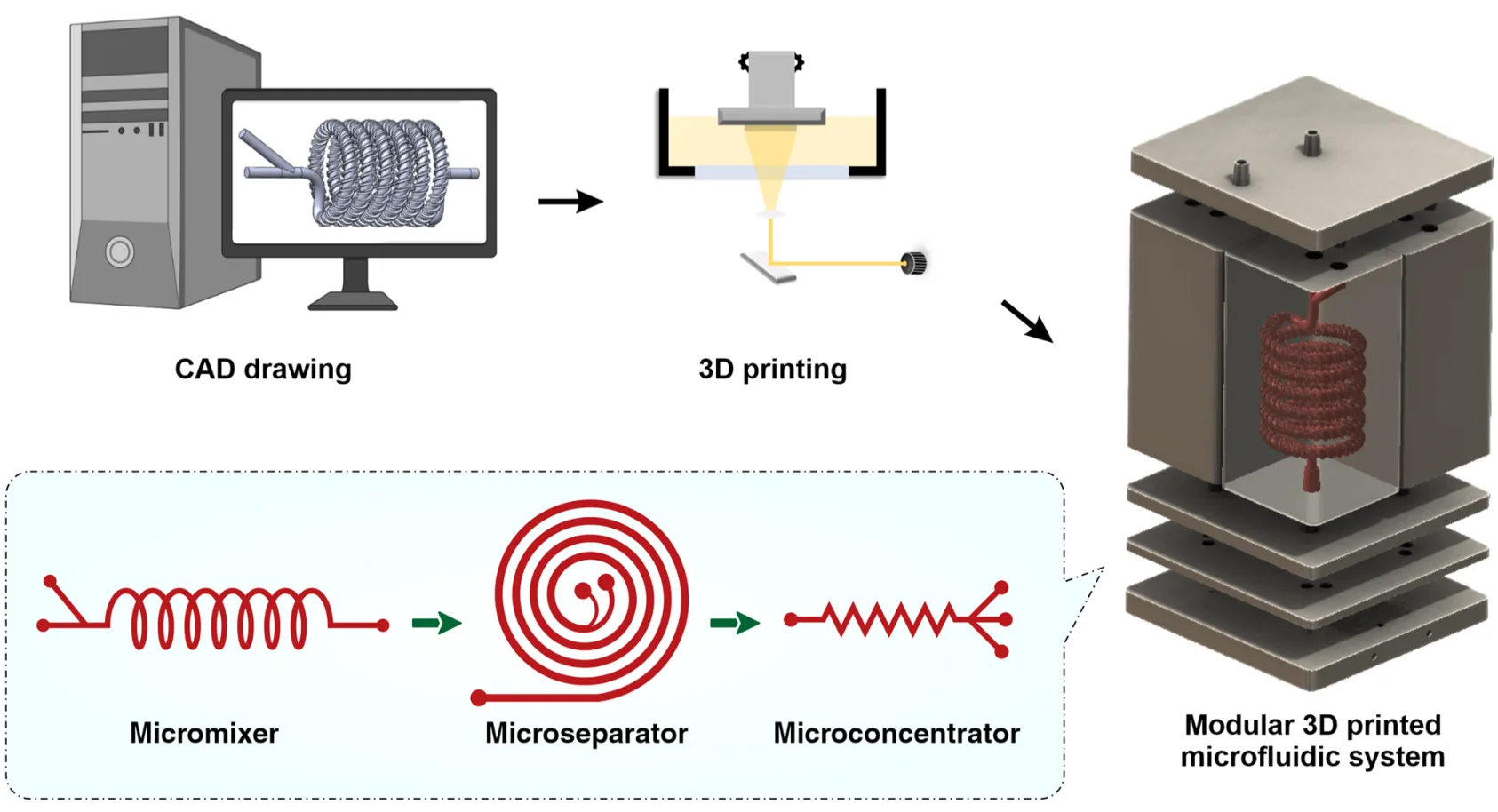
Figure 1. The build workflow at a glance. A device is drawn as a CAD model, printed on a DLP resin printer, and assembled into a stacked modular system made of three printed units: a micromixer, a microseparator, and a microconcentrator. Source: Ding et al. A modular 3D printed microfluidic system: a potential solution for continuous cell harvesting in large-scale bioprocessing. Bioresources and Bioprocessing. 2022.
Methodology and Design
The whole approach is a print-and-assemble pipeline. Each unit was first drawn as a CAD model, then printed on a high-resolution DLP (Digital Light Processing) resin printer, where a projector cures an entire layer of liquid resin at once with patterned light, building the part layer by layer. The team chose DLP over wax printing because it is more accurate, faster, and produces robust channels without the fragility and multi-step handling that wax parts require.
To carry out this cell-processing workflow, four printed units were built and connected in series:
Micromixer
Spiral Separator
Zig-Zag Channel
Five-Layer Stack
Each printed unit does one job. The micromixers blend the cell-and-bead suspension with a detaching enzyme so cells release from the microcarriers; because their channel geometry is comparatively open, they were printed at a 50 µm layer thickness using an acrylate-based microfluidics resin. The spiral separator uses channel curvature: as fluid rounds the bends, size-dependent forces push the large beads and the much smaller cells toward different outlets. The zig-zag concentrator then focuses the recovered cells into a tight stream to shrink the final volume. Both the spiral separator and zig-zag concentrator have tighter internal geometry, so they were printed at a finer 10 µm layer thickness to preserve that detail. Because the design is modular, the same printing recipe was reused to build a stacked five-layer version that runs four of each unit in parallel. That is the key design idea: scaling up means printing and stacking more identical parts, not engineering a new device.
Every printed part then went through the same short post-processing routine: a rinse in isopropyl alcohol to clear uncured resin, drying with an air nozzle, repeated three times so resin cannot cure inside and block the channels, followed by a UV cure to fully harden the part. The finished parts were bonded to a PMMA backing sheet with double-sided tape and connected in series with tubing.
Results
The headline result is fabrication freedom. Because each part prints and washes in a single quick cycle, the team iterated through 16 zig-zag channel designs, 6 concentrator designs, and 3 micromixers, roughly 25 design variants, to find the best geometries. That kind of sweep is impractical with traditional molding, where every revision means a new master. The finest features were printed at a 10 µm layer thickness, fine enough to build channels with cross-sections measured in tens of µm.
The printed parts also worked as designed. The micromixers reached over 95% mixing efficiency, the spiral cleanly handled microcarriers at a 0.75% v/v loading, and the zig-zag concentrator captured beads with a 100% recovery rate across its working flow range while removing about 70% of the liquid volume. End to end, the system removed 100% of the microcarriers while recovering roughly 77% of the cells in a single pass, and the harvested cells stayed viable.
The scale-up path is the other key outcome. The five-layer printed stack parallelises the entire pipeline in one build, and the authors note that reaching litre-per-minute throughput is a matter of printing and stacking more identical units rather than redesigning anything. The design scales with the printer, not with the cleanroom.
The fabrication time for each device was significantly reduced to under five hours, with the cell-culture chamber mold printing in just 45 minutes. Additionally, the biocompatibility results were decisive. MCF-7 cells seeded into the PDMS microchamber and incubated for 24 hours at 37 °C showed more than 98% viability under live/dead staining, confirming that no cytotoxic residues were transferred from the printed mold to the cast PDMS replica. Because the resin requires no silanization, it eliminates a key step that typically makes standard 3D-printed molds unsuitable for cell-based applications.
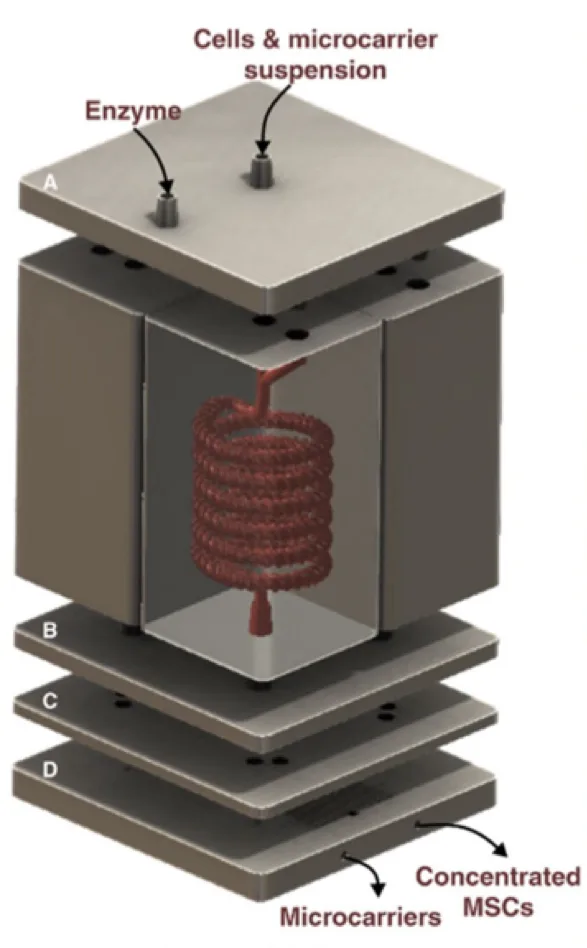
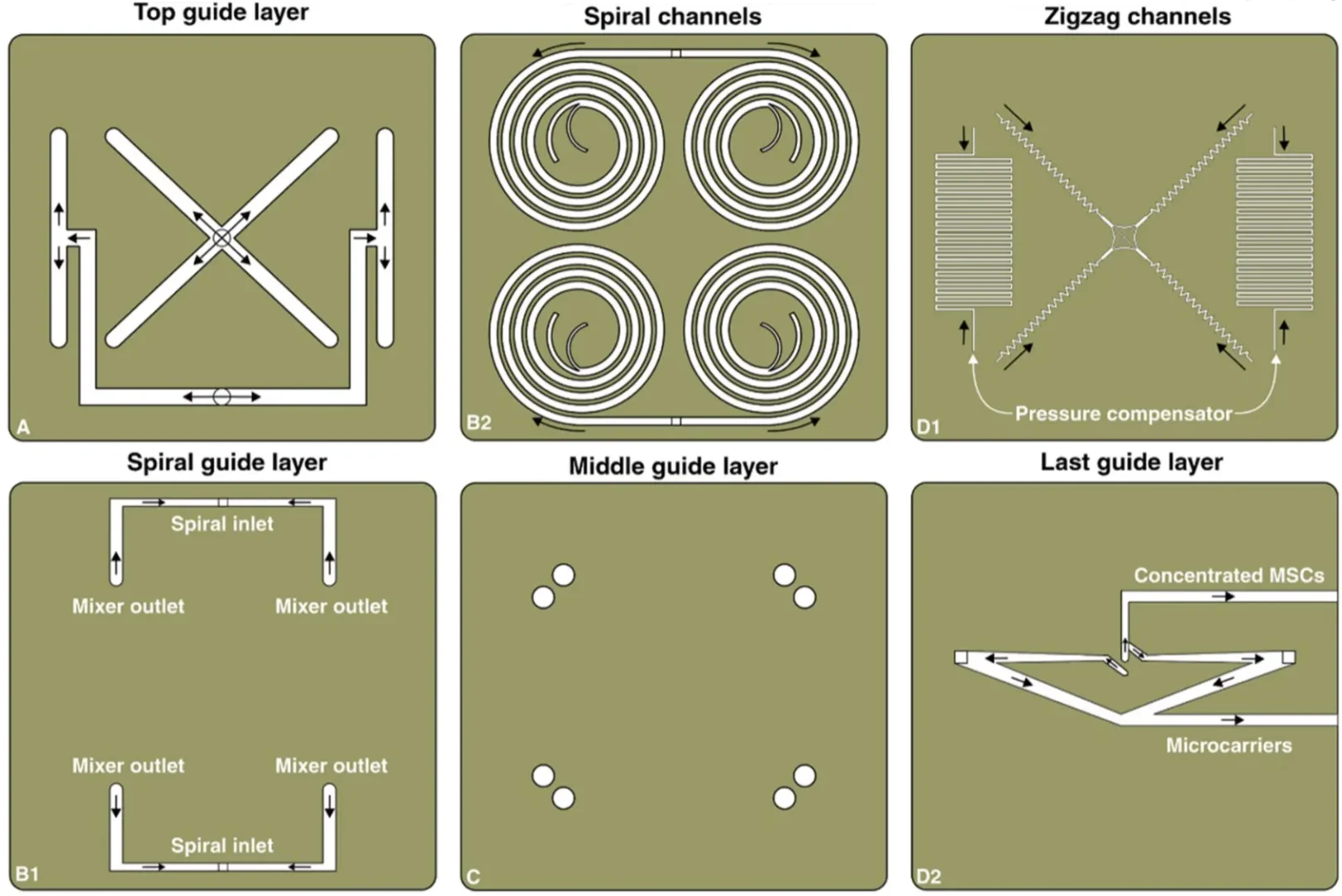
Figure 2. The scaled-up device shown as five printed layers. Left: an exploded view of the stack, with inlets for enzyme and the cell suspension at the top and separate outlets for concentrated cells and microcarriers at the bottom. Right: the channel pattern printed into each layer, including the top guide layer, the four parallel spiral separators, and the zig-zag concentrator channels with their pressure compensator. Scaling up means printing and stacking more of the same parts. Source: Adapted from Ding et al. A modular 3D printed microfluidic system: a potential solution for continuous cell harvesting in large-scale bioprocessing. Bioresources and Bioprocessing. 2022.
“This rapid, low-cost prototyping [of the modular system] is not possible without 3D printing technology.”
— Ding et al., Bioresources and Bioprocessing (2022)
Products Used In This Study

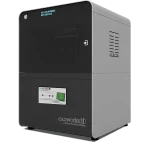
Questions on how our 3D printing system can work for your research? Connect with one of our specialists.
More Research Article Summaries
McGill University researchers build a 3D printed double-sided mold system to shape and merge brain organoids on a chip
University of Hawaiʻi researchers 3D print wearable "sweatainer" devices with true microscale internal channels
Want to read more article summaries?
We summarize the latest microfluidics and 3D printing research.
Curated from peer-reviewed publications featuring the CADworks3D system.