
Research Article Summary
5 Minute Read
UCLA researchers 3D print a diffractive processor that captures light's hidden phase in a single snapshot
Title
All-optical complex field imaging using diffractive processors
Authors
Jingxi Li, Yuhang Li, Tianyi Gan, et al.
Journal
Light: Science & Applications, Volume 13, Article 120 (2024)
DOI Link
Summary
Li et al. designed and 3D printed a stack of diffractive layers that lets a standard camera sensor capture both the brightness and phase of light in one snapshot, with no computer processing needed after the image is taken. The team proved the design was physically buildable by fabricating and testing a working terahertz version of the device.

Summary Author
This page was prepared by CADworks3D to summarize and highlight a peer-reviewed research article authored by independent researchers utilizing the CADworks3D system.
Title
All-optical complex field imaging using diffractive processors
Authors
Jingxi Li, Yuhang Li, Tianyi Gan, et al.
Journal
Light: Science & Applications, Volume 13, Article 120 (2024)
DOI Link
Key Results at a Glance
3 layers
3D Printed Optical Stack
Three engineered diffractive layers, each 3D printed and stacked to form the complete imaging device
120 x 120
Features Per Layer
Individually tuned diffractive features 3D printed onto every single layer
20 mm
Layer-to-Layer Spacing
Precise axial gap between each 3D-printed layer, fixed by a custom-printed holder
4.8 mm
Test Target Pixel Size
Size of each pixel on the 3D-printed calibration targets used to validate the device
Objective
Ordinary cameras, whether in a phone or a microscope, only record how bright light is at each point. This is called the amplitude of light. What these sensors cannot directly see is the phase of light, a property that describes how a light wave is shifted as it passes through or reflects off something. Phase carries a large amount of structural information. It can reveal the thickness of a transparent cell, the refractive index of a material, or fine surface details that never show up in a normal photo.
To recover phase, researchers have traditionally relied on interferometry or digital holography. These methods work, but they usually require bulky optical setups, multiple exposures, and extensive post-capture computation to reconstruct the phase information. That reconstruction step adds latency and demands processing power, which limits how fast or how compact a phase imaging system can be.
More recent approaches, including metasurfaces and deep learning-based reconstruction, have tried to shrink the hardware or speed up processing. Most of these solutions still depend on digital computation, extra optical components such as polarizers, or fabrication techniques that are difficult to scale beyond a specialized lab.
The gap this paper addresses is straightforward: could a single optical device output both amplitude and phase directly as images, using nothing but a standard intensity camera and zero digital reconstruction? The researchers set out to design such a device using diffractive layers whose surface patterns are optimized by deep learning, then to prove the concept was physically buildable by fabricating and testing it, using 3D printing to turn the digital design into working hardware.
Methodology and Design
The fabrication pipeline began entirely in software. A deep learning algorithm optimized the surface thickness profile of a series of stacked diffractive layers so that, together, they would route incoming light into two separate output regions: one that reproduces the light’s amplitude pattern and another that reproduces its phase pattern as a plain intensity image. Once training was complete, these optimized thickness maps were sent directly to a 3D printer, which converted the digital design into physical diffractive layers without any additional lithography, etching, or polishing steps.
Turning this single design-to-print workflow into a working device meant 3D printing several distinct components that all had to work together:
Spiral Separator
Test Targets
Alignment Holder
The diffractive layers formed the core of the imaging device. Three layers, each carrying 120 × 120 individually engineered surface features, were 3D printed with thickness values ranging between 0.4 mm and 1.4 mm, the exact range needed to produce the correct phase delays at the terahertz wavelengths used in testing. Because the lateral size of each printed feature was set by the resolution of the 3D printer itself, the printer’s precision directly determined how finely the optical design could be reproduced in hardware.
To test whether the printed layers actually worked, the team needed known reference objects with a controlled amplitude or phase pattern. Phase-only test targets were 3D printed with spatially varying surface heights, since the thickness of the printed material directly controls how much a light wave’s phase is shifted as it passes through. Amplitude-only test targets were printed as flat, uniform layers and then hand-coated with aluminum foil in a five-by-five pixel pattern, with each pixel measuring 4.8 mm, to physically block or transmit light and define a known amplitude image.
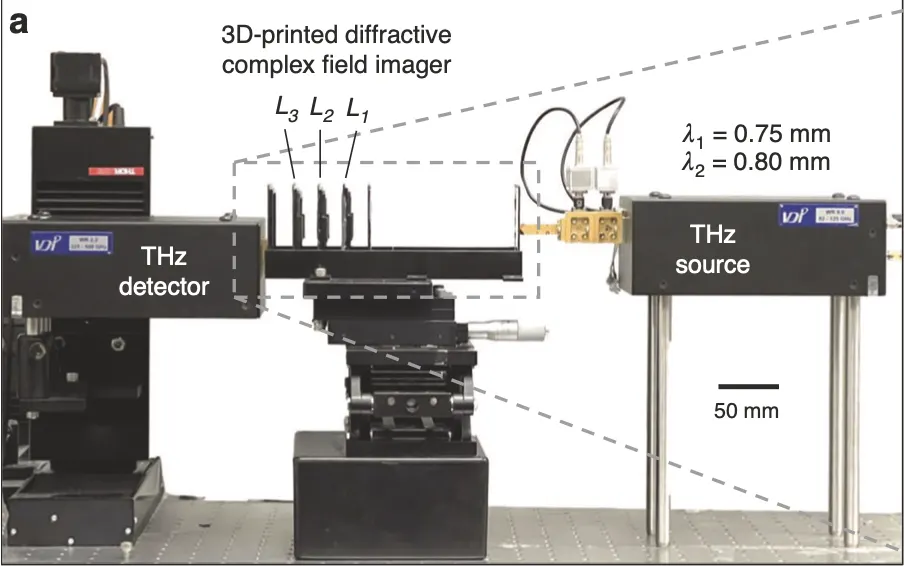
Finally, a custom holder was 3D printed to keep the diffractive layers and the input test objects aligned exactly as specified in the digital design. The printed layers, spaced 20 mm apart along the optical axis for a total device length of about 80 mm, needed to sit in precise relative positions, since even small misalignments between layers can introduce measurement noise. A separate 3D-printed aperture, coated with foil to form a pinhole, was also added in front of the input plane to clean up the incoming beam before it reached the diffractive stack.
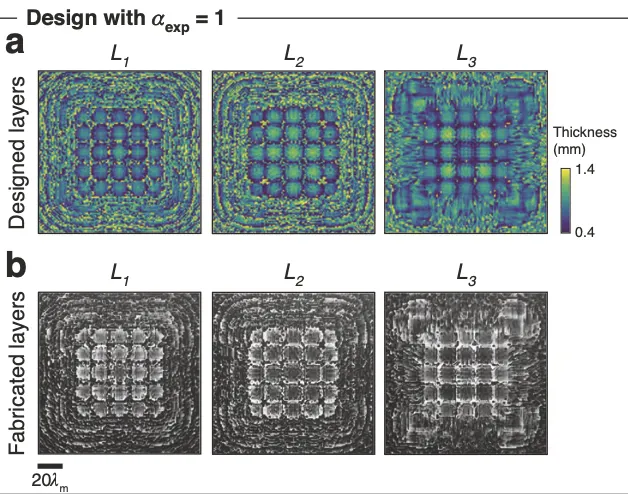
Figure 1. Each layer's digital thickness design (top) next to a photograph of the same layer after 3D printing (bottom). Source: Li et al. All-optical complex field imaging using diffractive processors. Light: Science & Applications. 2024.
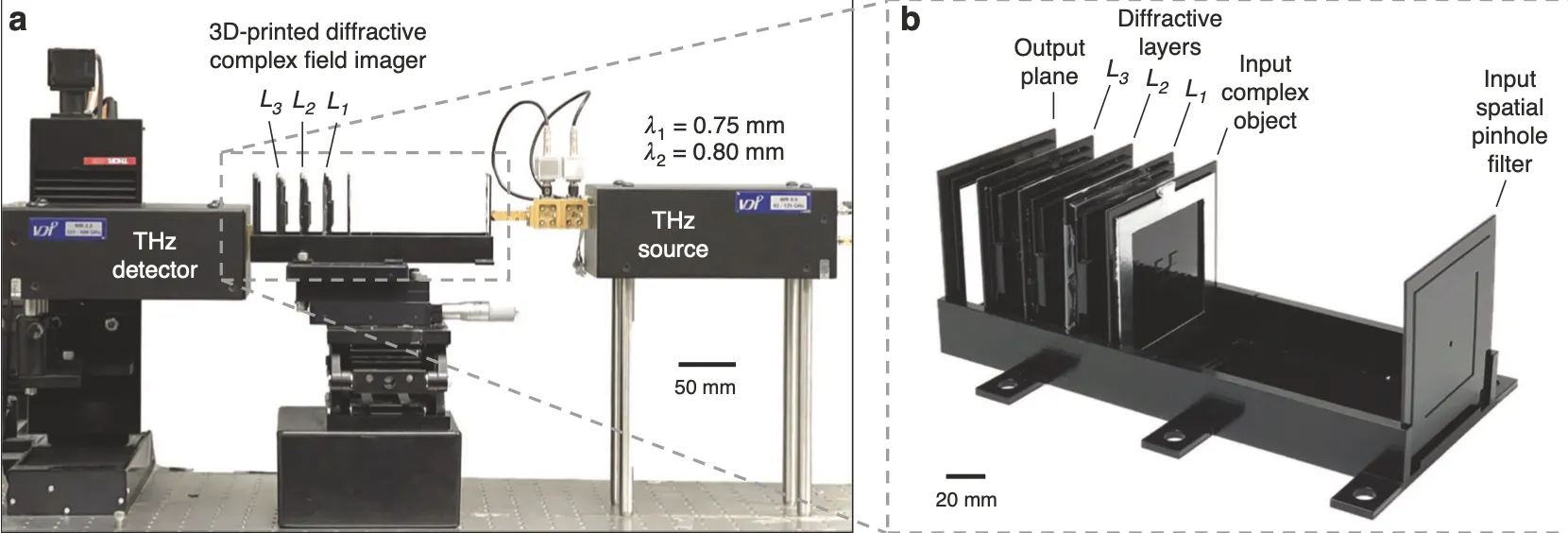
Figure 2. The printed imager within the full terahertz test path shown at the top of this page (left), and a closer view of the 3D printed diffractive layers held in precise alignment inside their custom printed holder (right). Source: Li et al. All-optical complex field imaging using diffractive processors. Light: Science & Applications. 2024.
Results
The 3D printed diffractive layers closely matched their digital designs. When the fabricated stack was photographed and compared against the original thickness profiles used for printing, the physical layers reproduced the intended surface patterns with high fidelity, confirming that the three 3D printed layers and their 120 × 120 engineered features per layer transferred cleanly from simulation to hardware.
Using the terahertz test setup, the team fed 3D-printed phase-only and amplitude-only targets through two separately fabricated versions of the imager, one designed for a full 0 to π phase range and another for a reduced 0 to 0.5π range. The output images captured directly by the intensity sensor, with no digital reconstruction, closely matched both the numerical simulations and the ground-truth patterns of the test objects in both versions, showing that the fabrication approach was repeatable across different design parameters.
The 20 mm layer spacing maintained by the 3D printed holder proved sufficient to keep the assembled device aligned with its intended optical path, and the 4.8 mm pixel targets were resolved clearly in the output images. Together, these results show that a deep learning-optimized diffractive imager can be reliably translated from a digital design straight into a functioning physical device using 3D printing alone, with no additional fabrication steps required.
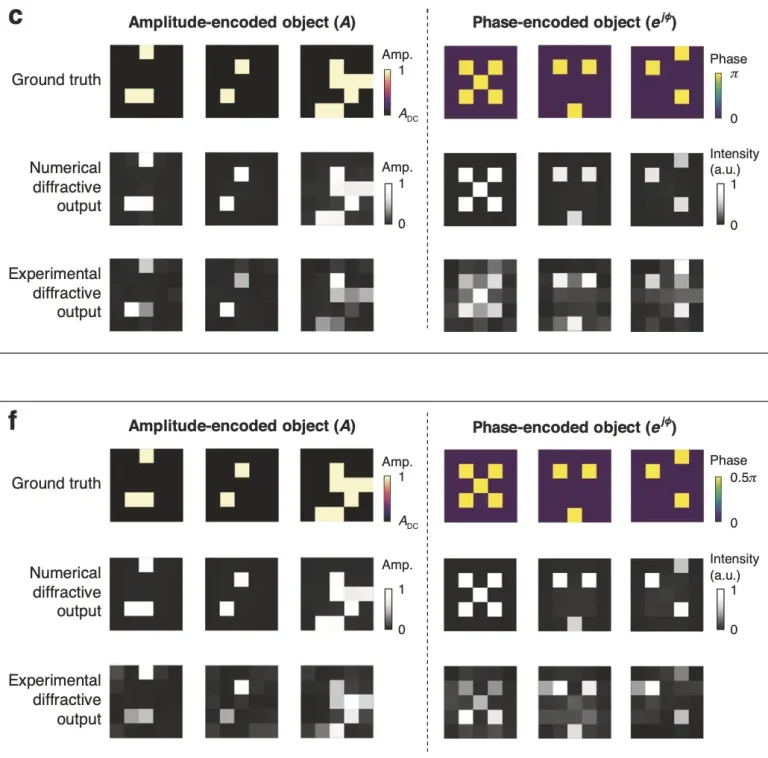
Figure 3. Images captured by the 3D printed imager (bottom rows) closely match the numerical simulation and ground truth (top rows), for both amplitude- and phase-encoded test objects. Source: Li et al. All-optical complex field imaging using diffractive processors. Light: Science & Applications. 2024.
“These results also represent the first demonstration of all-optical complex field imaging achieved through a single diffractive processor.”
— Li et al., Light: Science & Applications, 2024
Products Used In This Study
Questions on how our 3D printing system can work for your research? Connect with one of our specialists.
More Research Article Summaries
McGill University researchers build a 3D printed double-sided mold system to shape and merge brain organoids on a chip
University of Hawaiʻi researchers 3D print wearable "sweatainer" devices with true microscale internal channels
Want to read more article summaries?
We summarize the latest microfluidics and 3D printing research.
Curated from peer-reviewed publications featuring the CADworks3D system.