
Research Article Summary
5 Minute Read
Nanjing University researchers map the full 3D printing workflow for ceramic cores inside hollow turbine blades
Title
Research Progress on Additive Manufacturing Technology and Equipment for the Vat Polymerization of Ceramic Cores of Aeroengine Blades
Authors
Haoqin Yang, Zhongde Shan, Runmou Wu, et al.
Journal
Additive Manufacturing Frontiers, Volume 4 (2025), Article 200204
DOI Link
Summary
A team led by Yang et al. reviews how vat polymerization 3D printing builds the hollow ceramic cores that shape the internal cooling channels of aeroengine turbine blades, walking through slurry preparation, light-curing, debinding, and sintering as one connected process. The review draws together work from research groups worldwide to show how structure design and print settings control the quality of the final core.

Summary Author
This page was prepared by CADworks3D to summarize and highlight a peer-reviewed research article authored by independent researchers utilizing the CADworks3D system.
Title
Research Progress on Additive Manufacturing Technology and Equipment for the Vat Polymerization of Ceramic Cores of Aeroengine Blades
Authors
Haoqin Yang, Zhongde Shan, Runmou Wu, et al.
Journal
Additive Manufacturing Frontiers, Volume 4 (2025), Article 200204
DOI Link
Key Results at a Glance
20–30 µm
DLP Print Accuracy
Surface-exposure printing resolves fine core features at this scale
±0.1 mm
Sintered Core Accuracy
Dimensional error held within this band on a hollow lattice core
50 µm
Layer Thickness
A thin slice setting kept green-body deviation from the model under 0.2 mm
2.4x
Strength By Print Direction
Cores printed parallel to the build direction were far stronger than perpendicular cores
Objective
Turbine blades sit in the hottest part of an aeroengine, where gas temperatures keep climbing as engines are pushed for more thrust. To survive, modern blades are hollow, threaded with narrow internal channels that route cooling air through the part. Those channels are not machined directly. They are shaped during investment casting by a sacrificial insert called a ceramic core, which defines the hollow geometry and is later removed, leaving the cooling passages behind.
The core is therefore one of the most demanding components in the whole casting process. Its shape has to be intricate, its walls thin, and its dimensions tightly controlled, because any error in the core becomes an error in the finished blade. As blade cooling designs have moved toward more elaborate diffusion and laminate layouts, the cores have become more complex than older manufacturing methods can comfortably handle.
Traditional approaches such as injection molding, hot pressing, and gel casting share one bottleneck: they all depend on hard tooling that is expensive, slow to make, and difficult to change. Vat polymerization removes that constraint. By curing a liquid ceramic slurry layer by layer with ultraviolet light, it builds a core directly from a digital model with no mold at all. A design can be adjusted in software and reprinted, which collapses the development cycle and opens up geometries tooling could never form. This review traces that printing route end to end and identifies where quality is won or lost along the way.
The gap the paper addresses is that the stages of this workflow are usually studied in isolation. Slurry chemistry, exposure settings, debinding schedules, and sintering profiles each have their own literature, but they interact, and a choice that helps one stage can hurt another. The authors pull these threads into a single process view, so the core can be understood as the product of the whole chain rather than any one step.

Figure 1. The ceramic-core printing route as one connected loop, linking design, curing mechanism, material choices, process steps, and equipment, from blade cooling geometry through to layer-by-layer build. Source: Yang et al. Research Progress on Additive Manufacturing Technology and Equipment for the Vat Polymerization of Ceramic Cores of Aeroengine Blades. Additive Manufacturing Frontiers. 2025.
Methodology and Design
The fabrication route covers four stages that run in sequence: slurry preparation, light curing 3D printing, debinding, and sintering. Ceramic powder is mixed into a photosensitive resin and printed layer by layer, then the green body is heated to burn out the resin binder before a final high-temperature firing fuses the ceramic into a dense, load-bearing core.
The review frames each of the following core designs as a product of that same chain:
Hollow Turbine Core
Lattice Ceramic Corse
Core-Shelled Mold
Semispherical Printed Chamber
The process begins with the slurry. Ceramic powder, usually alumina, silica, or silicon nitride, is mixed with a photosensitive resin along with dispersants and other additives, then ball milled into a printable paste. The balance here is delicate: the slurry needs enough solid content to give the finished core its strength and density, but it also has to stay fluid enough to spread into smooth, even layers. Too much powder and the paste becomes too viscous to coat cleanly; too little and the core can deform or crack later on. Particle size is tuned alongside solid content to keep viscosity workable.
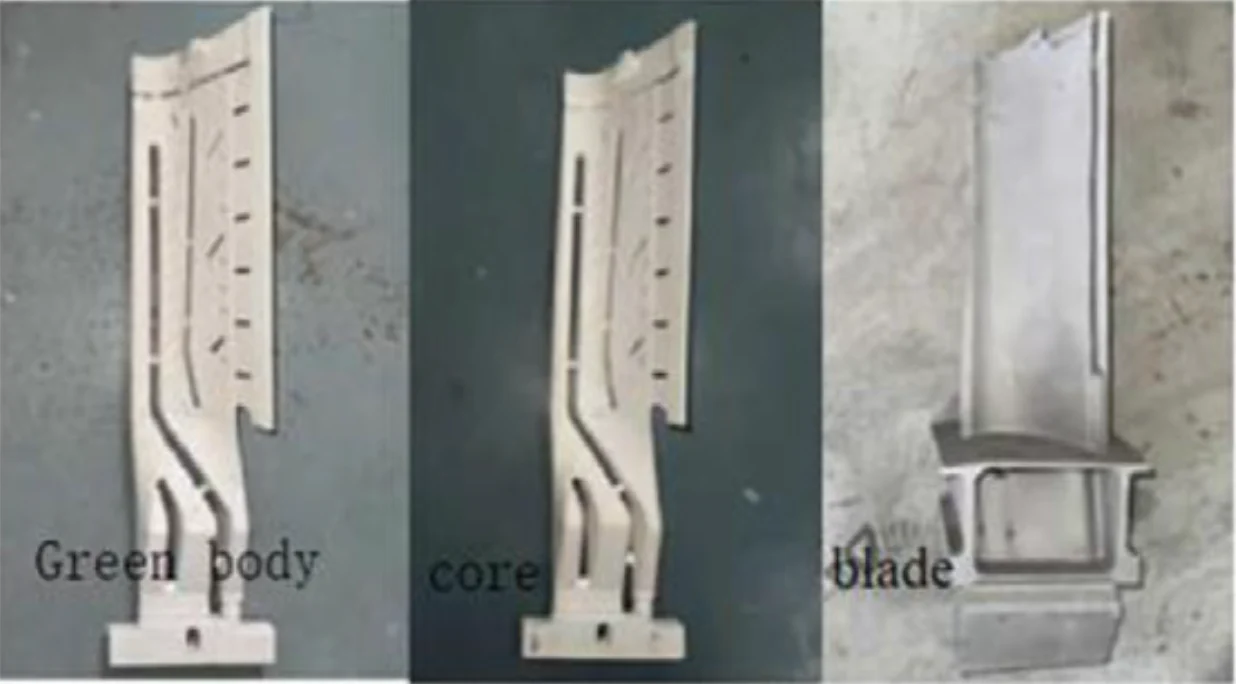
Printing follows, using one of two closely related light curing methods. Stereolithography traces each layer with an ultraviolet laser, while digital light processing exposes a whole layer at once through a projected mask, reaching a printing accuracy in the range of 20 to 30 µm. In both, the part is built one cured slice at a time, with the platform stepping by a single layer thickness between exposures. Layer thickness, exposure time, and exposure energy decide how completely each layer cures and how cleanly it bonds to the one below, and orientation matters too, since cores are stronger along surfaces parallel to the build direction than across them. This printing stage is what produces the hollow turbine core itself, the geometry that goes on to form the internal cooling passages in the finished blade.
The freshly printed part, known as the green body, is still a composite of ceramic powder held together by cured resin, and debinding removes that resin. The green body is heated slowly, typically to between 350 and 550 °C, so the organic binder burns away without tearing the fragile structure apart. Heating rate and hold time are the levers, and getting them wrong invites cracks, blistering, or distortion, so a vacuum or argon atmosphere is often used to keep the process gentle.
Sintering is the final stage, where high temperature fuses the ceramic particles into a solid, load-bearing body. Sintering temperature, hold time, and atmosphere together set the final strength, porosity, and surface finish, and they pull in opposite directions: push the temperature too high and grains grow abnormally, and the part can crack; keep it too low and the core never fully densifies. This is where the lattice ceramic core comes in. The review highlights lattice and lightweight designs as a way to ease this stage, because hollowing out solid sections reduces the shrinkage mismatch that causes defects while keeping the core stiff. The same logic carries into the core-shell mold, where a printed lattice reinforces the mold for casting, integrating the core directly into the casting process.
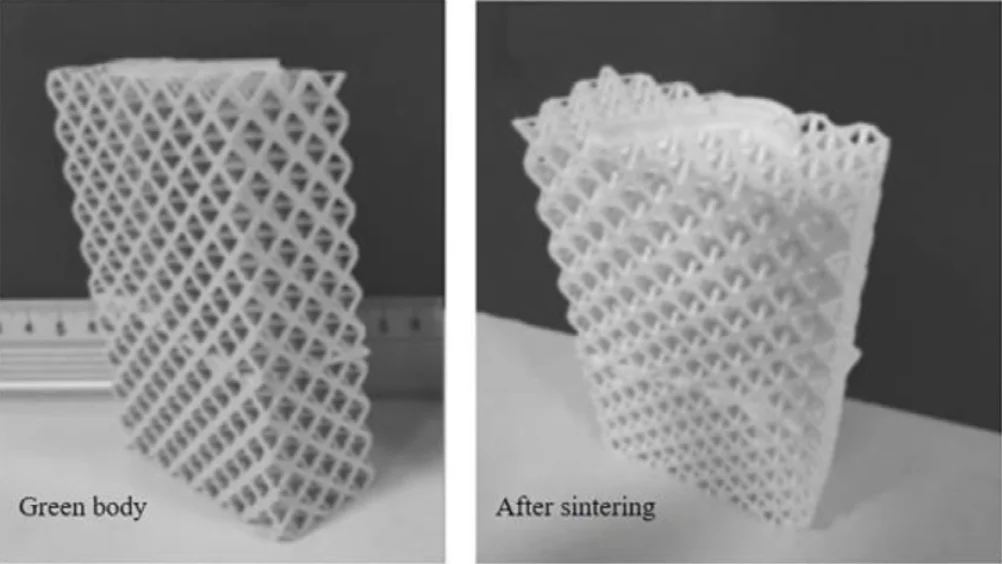
Figure 2. A printed lattice ceramic core shown as a green body and again after sintering, illustrating how an open structure survives the heat treatment while the part shrinks and densifies. Source: Yang et al. Research Progress on Additive Manufacturing Technology and Equipment for the Vat Polymerization of Ceramic Cores of Aeroengine Blades. Additive Manufacturing Frontiers. 2025.
Results
Across the studies the review collects, the printing stage sets the ceiling for everything that follows. Digital light processing reached a printing accuracy of 20 to 30 µm, fine enough to resolve the detailed internal features that blade cooling channels demand. That resolution is what makes the mold-free route competitive with traditional tooling for complex cores.
Print settings then translate that resolution into a usable part. Holding the layer thickness at 50 µm kept the size deviation between the printed green body and the original digital model under 0.2 mm, showing how tightly the build can track an intended geometry when exposure and slicing are dialed in. Orientation proved just as influential: cores printed with their surfaces parallel to the build direction were measured at roughly 2.4 times the bending strength of cores printed perpendicular, a reminder that how a part sits on the platform is itself a design decision.
The structural design work carried these gains through the heat treatment. One hollow core built with an internal lattice was sintered to a dimensional accuracy within ±0.1 mm, confirming that lightweight internal structures can hold tolerance rather than sacrifice it. The same strategy helped suppress the cracking and distortion that thick, solid cores tend to develop during debinding and sintering, because an open structure shrinks more evenly. Together the results trace a clear line from print resolution and settings, through orientation and structural design, to a finished core that arrives close to specification and ready for casting.

Figure 3. The end of the workflow in three steps: a printed ceramic core, the casting mold built around it, and the final hollow blade it produces. Source: Yang et al. Research Progress on Additive Manufacturing Technology and Equipment for the Vat Polymerization of Ceramic Cores of Aeroengine Blades. Additive Manufacturing Frontiers. 2025.
“Most importantly, ceramic additive manufacturing can flexibly adjust the model design without pre-manufacturing and assembling molds, which significantly shortens the development iteration cycle of the model from design to the finished product.“
— Yang et al., Additive Manufacturing Frontiers, 2025
Products Used In This Study

Questions on how our 3D printing system can work for your research? Connect with one of our specialists.
More Research Article Summaries
McGill University researchers build a 3D printed double-sided mold system to shape and merge brain organoids on a chip
University of Hawaiʻi researchers 3D print wearable "sweatainer" devices with true microscale internal channels
Want to read more article summaries?
We summarize the latest microfluidics and 3D printing research.
Curated from peer-reviewed publications featuring the CADworks3D system.