
Research Article Summary
5 Minute Read
McGill University Engineers 3D Print an ELISA Chip That Doses Itself
Title
3D-printed capillaric ELISA-on-a-chip with aliquoting
Authors
Azim Parandakh, Oriol Ymbern, William Jogia, et al.
Journal
Lab on a Chip, 2023, 23, 1547–1560
DOI Link
Summary
Researchers at McGill University 3D printed a capillary-powered ELISA chip that automatically measures and sequences its own reagents, delivering lab-grade diagnostic sensitivity without pumps, motors, or a trained technician. This summary is based on the peer-reviewed study by Parandakh et al., published in Lab on a Chip (2023).
Summary Author
This page was prepared by CADworks3D to summarize and highlight a peer-reviewed research article authored by independent researchers utilizing the CADworks3D system.
Title
3D-printed capillaric ELISA-on-a-chip with aliquoting
Authors
Azim Parandakh, Oriol Ymbern, William Jogia, et al.
Journal
Lab on a Chip, 2023, 23, 1547–1560
DOI Link
Key Results at a Glance
91 pg/mL
Limit of Detection in Saliva
Picked up trace amounts of SARS-CoV-2 protein at picogram-level sensitivity
93%
Aliquoting Accuracy
Automatically measured out every reagent without a lab pipette
1.5 hours
Full Assay Runtime
Eight reagent and wash steps ran in sequence with zero external equipment
< 1 hour
Print-to-Chip Time
Went from a CAD file to a sealed, ready-to-load device on a single 3D printer
Objective
The enzyme-linked immunosorbent assay, or ELISA, is the standard method for detecting and measuring proteins, antibodies, and other biomarkers in a fluid sample. It is a workhorse of clinical and research labs because of its high sensitivity and quantitative readout, but running one is slow and demanding. A typical plate-based ELISA can take two to twelve hours and depends on a trained technician to add and remove reagents at the right moments, along with a plate reader to interpret the result.
At the other end of the spectrum sit rapid tests, the same lateral flow devices used for home pregnancy and COVID-19 testing. They are fast and need no equipment, but they only return a yes or no answer and are generally far less sensitive than a lab ELISA. Microfluidic lab-on-a-chip systems have tried to close this gap by shrinking the ELISA workflow onto a small device, but most still rely on external pumps, motors, or a computer to move liquid through the chip.
Capillary-driven chips remove that bulky hardware by letting surface tension pull liquid through pre-programmed channels on its own. The research team behind this study had previously built a capillary circuit that encoded an entire ELISA structurally into a chip, but it had two practical weaknesses: it required a laboratory-precision pipette to load, and it failed at the higher detergent concentrations that real assays typically need to reduce background signal. This paper sets out to fix both problems, building a 3D-printed chip that a user can load with an ordinary squeeze pipette while the device itself measures out the exact volume of each reagent.
Methodology and Design
The chip starts as a digital model built in CAD software and is printed on a desktop DLP 3D printer that cures a liquid resin layer by layer with UV light. Once printed, it goes through a short post-processing sequence, rinsing away uncured resin, drying, UV post-curing, and a brief plasma treatment that makes the channel walls hydrophilic enough for capillary flow to work, before a thin adhesive film seals the channels closed. From digital file to sealed, ready-to-use chip takes under an hour, which let the team rapidly test and refine the channel geometry.
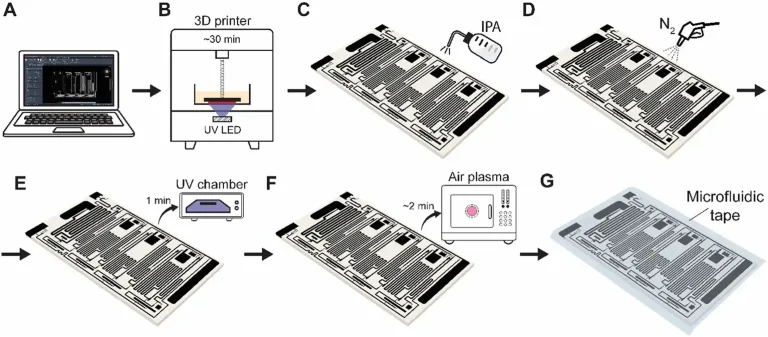
Figure 1. From CAD file to sealed chip in under an hour: design, 3D print, isopropanol rinse, nitrogen dry, UV cure, plasma treatment, and tape sealing. Source: Parandakh et al. 3D-printed capillaric ELISA-on-a-chip with aliquoting. Lab on a Chip. 2023.
That same fabrication pipeline produced a single chip design the researchers put to work in three ways:
Lab Automation
Point-of-Care Format
Diagnostic Demo
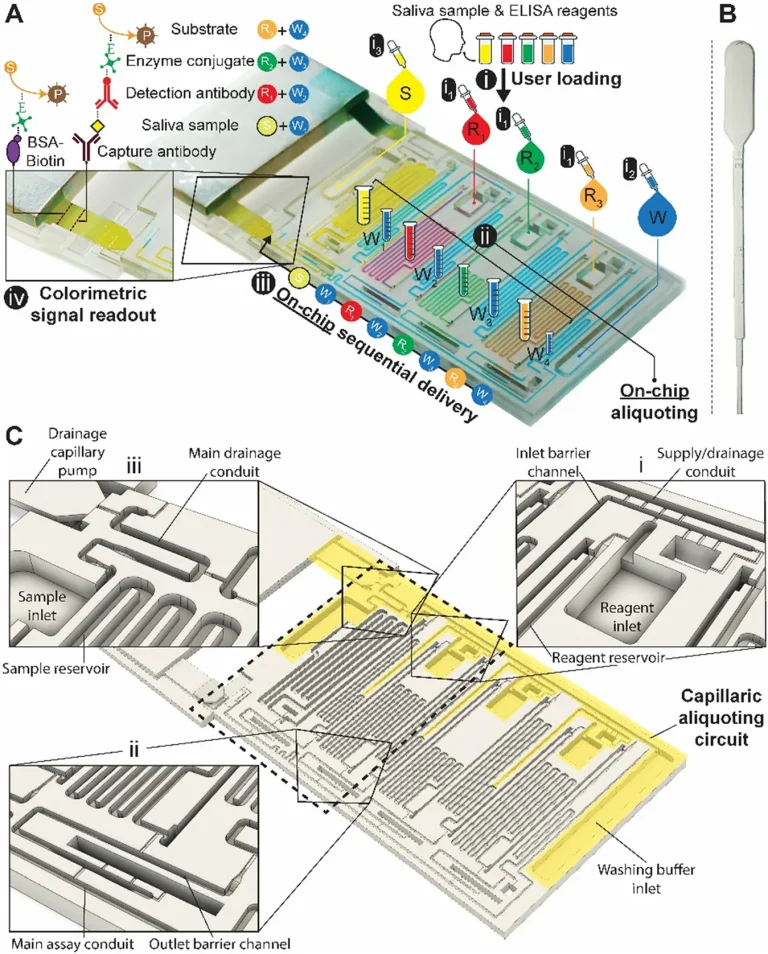
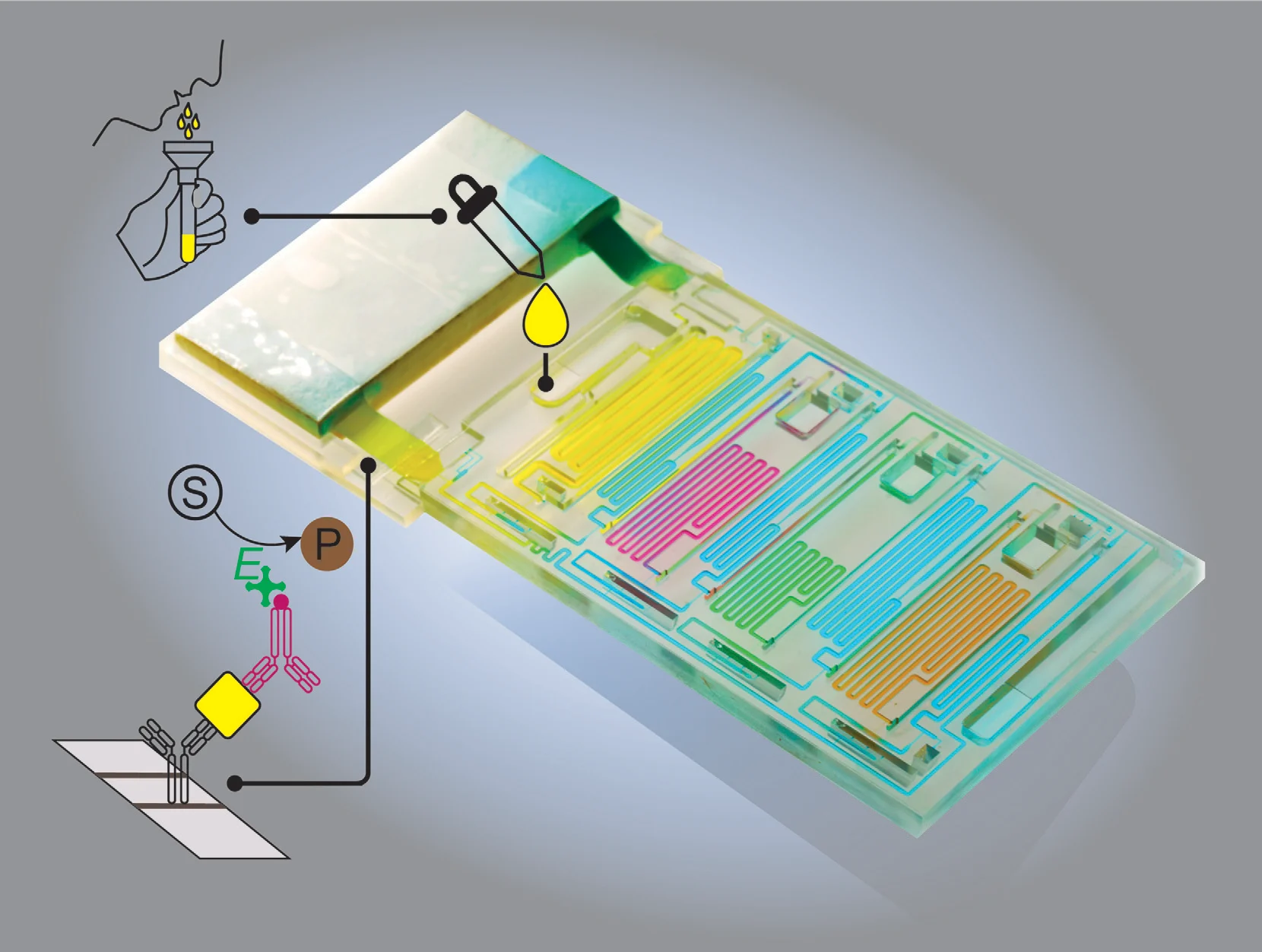
Figure 2. The printed ELISA chip alongside its CAD design, showing the reservoirs and capillary channels that measure and sequence each reagent. Source: Parandakh et al. 3D-printed capillaric ELISA-on-a-chip with aliquoting. Lab on a Chip. 2023.
To use the chip, a person loads five inlets in any order with a low-precision squeeze pipette: three reagents (a detection antibody, an enzyme conjugate, and a colour-forming substrate), a washing buffer, and the sample. Capillary flow alone pulls each liquid into a serpentine measuring channel sized to hold the exact volume the assay needs: 70 µL of detection antibody, 50 µL of enzyme conjugate, and 80 µL of substrate, while the same buffer inlet automatically splits into four separate wash volumes. Any liquid loaded beyond what a channel can hold drains away through a built-in aliquoting circuit, so the user never has to measure a volume by hand. Adding the sample triggers this drainage step and fills the last reservoir; clicking a nitrocellulose test strip onto the chip then starts the assay itself. From there, a structurally encoded sequence, called a microfluidic chain reaction, releases the sample, antibody, enzyme, substrate, and washes one after another in the correct order, each step triggering the next, with no valves, pumps, or timer needed. The same chip and workflow were used to run a diagnostic assay for the SARS-CoV-2 (diagnostic demo) nucleocapsid protein directly in diluted human saliva, showing the design also works as a point-of-care test outside a lab setting.
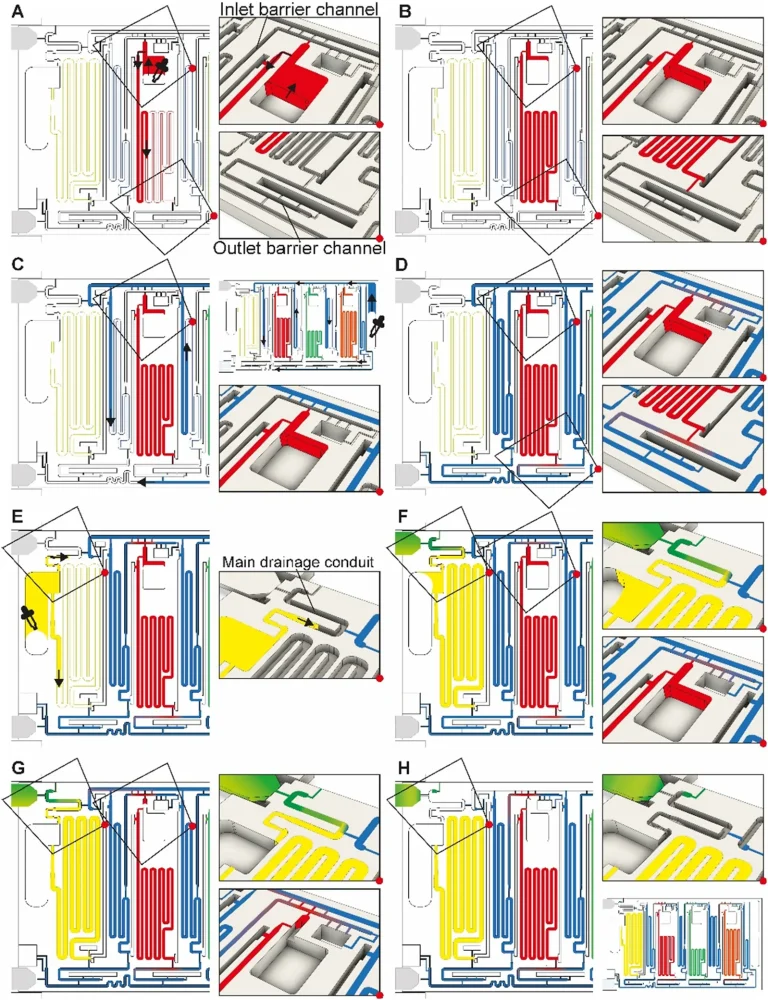
Figure 3. Close-up CAD views of the chip's inlet and outlet barrier channels, the structural features that keep reagents from mixing before their turn in the sequence. Source: Parandakh et al. 3D-printed capillaric ELISA-on-a-chip with aliquoting. Lab on a Chip. 2023.
The printer cured each resin layer for 2.5 seconds, 10 seconds for the base layer, at a layer thickness of 20 µm, fine enough to hold the barrier channels that keep reagents from touching each other before their turn in the sequence. Channel dimensions on the finished chips varied by less than 4% across production runs, which is what let the measuring reservoirs hold consistent volumes chip to chip. After printing, a 10-second air plasma treatment converted the resin surface from repelling water to drawing it in by capillary action, and the chip was sealed with a microfluidic diagnostic tape rather than glue or heat bonding, keeping the whole process compatible with a benchtop workflow. Around 1,200 chips were printed this way over the course of the study.
Results
Across the reservoirs tested, the chip’s built-in aliquoting circuit measured out each reagent, buffer split, and sample volume with an accuracy above 93%, and in most cases above 98%, using nothing more than an ordinary squeeze pipette to load it. Timing was equally consistent: each step of the eight-step sequence ran within about 3.5% of its target duration from chip to chip, matching the reliability of the pipetting robots used in standard laboratory ELISA, but without any motorized part.
Once loaded, the full assay, sample, washes, detection antibody, enzyme, substrate, and a final wash, completed in about 1.5 hours and produced a visible brown line on the test strip wherever the SARS-CoV-2 nucleocapsid protein was present. Digitizing that line gave a limit of detection of 54 pg/mL in buffer and 91 pg/mL in diluted saliva, a sensitivity in the same range as a commercial benchtop ELISA kit and roughly 25 times better than a leading rapid antigen test evaluated over the same concentration range.
The fabrication side of the results was just as central to the paper’s argument. Each chip went from a CAD file to a sealed, ready-to-load device in under an hour, and the team printed about 1,200 of them over the course of the study without changing the core design. Because the channels sit on a single open face of the chip, the authors note the same layout could later move from 3D printing to injection molding for larger production runs, without redesigning the fluidic circuit itself.
“We designed a capillaric ELISA chip without a moving part that automates aliquoting of sample, reagents, and buffer, and autonomously executes an ELISA protocol.”
— Parandakh et al., Lab on a Chip, 2023
Products Used In This Study
Questions on how our 3D printing system can work for your research? Connect with one of our specialists.
More Research Article Summaries
McGill University researchers build a 3D printed double-sided mold system to shape and merge brain organoids on a chip
University of Hawaiʻi researchers 3D print wearable "sweatainer" devices with true microscale internal channels
Want to read more article summaries?
We summarize the latest microfluidics and 3D printing research.
Curated from peer-reviewed publications featuring the CADworks3D system.