
Research Article Summary
5 Minute Read
LSU researchers print microfluidic counting chambers and test devices in under 40 minutes using 3D resin printers
Title
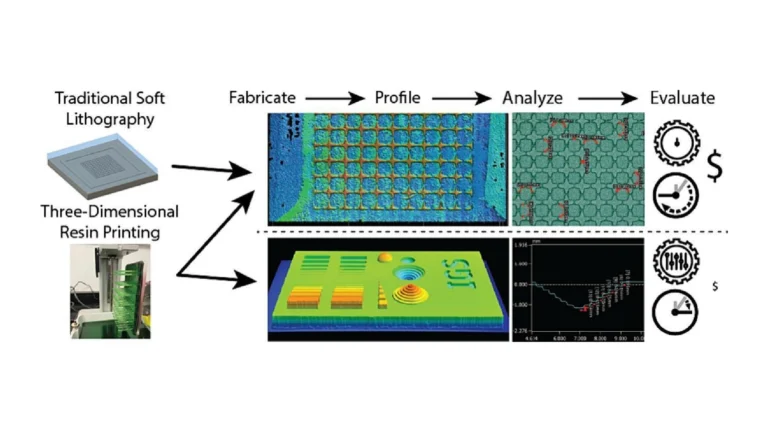
Evaluation of industrial and consumer 3-D resin printer fabrication of microdevices for quality management of genetic resources in aquatic species
Authors
Seyedmajid Hosseini, Jack C. Koch, Yue Liu, et al.
Journal
Micro and Nano Engineering, Volume 24 (2024), Article 100277
DOI Link
Summary
This summary looks at how 3D stereolithography (SLA) resin printing can replace slow, specialized cleanroom methods for making microfluidic devices used to manage genetic samples from fish and other aquatic species. Hosseini et al. designed two devices in CAD, printed them on both an industrial and a consumer resin printer, and measured how closely the printed parts matched their target dimensions down to the 0.1 mm range.
Summary Author
This page was prepared by CADworks3D to summarize and highlight a peer-reviewed research article authored by independent researchers utilizing the CADworks3D system.
Title
Evaluation of industrial and consumer 3-D resin printer fabrication of microdevices for quality management of genetic resources in aquatic species
Authors
Seyedmajid Hosseini, Jack C. Koch, Yue Liu, et al.
Journal
Micro and Nano Engineering, Volume 24 (2024), Article 100277
DOI Link
Key Results at a Glance
< 38 min
Print time per device
A full device printed start to finish, versus about 2 days for the traditional method.
< 2%
Dimensional accuracy
Printed features from 1 mm down to 0.4 mm matched the design within a couple percent.
0.1 mm
Smallest reliable feature
The industrial printer held accuracy down to features 0.1 mm tall or deep.
~$0.08
Material cost per device
Resin cost per printed chamber, compared to roughly $555 for the cleanroom version.
Objective
Aquatic species are a major source of food and a foundation for biomedical research, yet the genetic material that keeps these populations healthy is rarely preserved at scale. Freezing samples (cryopreservation) is the main way to protect them, but the process depends on small, precise tools, like chambers for counting sperm cells, to check sample quality before anything goes into long-term storage. Many of these tools are expensive, fixed in design, and hard to get outside of well-funded labs.
The standard way to make these microdevices is soft lithography: a master mould is patterned onto a silicon wafer in a cleanroom, then a flexible silicone called PDMS (polydimethylsiloxane) is poured over it, cured, and peeled off. It produces excellent, high-resolution parts, but it is slow, costly, requires specialized facilities, and is painful to iterate on. If you want to change one dimension, you often have to remake the whole mould.
This is the gap the paper addresses. 3D resin printing turns a CAD file directly into a physical part, layer by layer, with no masks, etching, or bonding steps. The authors set out to answer a practical question for biology and engineering labs that are not microfabrication specialists: can off-the-shelf resin printers, both a high-end industrial machine and an inexpensive consumer one, make functional microdevices accurately enough to replace soft lithography for everyday quality-management work?
Methodology and Design
The team designed both devices in CAD software, then exported the files to STL and sliced them for printing. Each device was printed, washed, and UV-cured, then evaluated with an optical profilometer and a scanning electron microscope (SEM) to check dimensional accuracy and surface quality.
To benchmark the printers, two devices spanning both a biological application and a print-resolution stress test were designed and built:
Single-piece Sperm Counting Chamber (SSCC)
Integrated Geometry Sampler (IGS)

Figure 1. CAD designs of the two test devices. Left: the Single-piece Sperm Counting Chamber (SSCC), a gridded chamber for counting cells. Right: the Integrated Geometry Sampler (IGS), a benchmark part covered in channels, ridges, and stepped features used to test print resolution. Scale bars are 1 mm. Source: Hosseini et al. Evaluation of industrial and consumer 3-D resin printer fabrication of microdevices for quality management of genetic resources in aquatic species. Micro and Nano Engineering. 2024.
Both devices were printed on two machines: an industrial resin printer with a 28.5 µm pixel size and a consumer printer with a 28 µm pixel size. Each was run with both opaque and clear resin, since clear resin is needed for parts you look through under a microscope, but it is harder to print and measure cleanly. Because a printer cannot use half a pixel, the team scaled every device’s X-Y dimensions to whole multiples of the 28 µm pixel, which kept the grid lines crisp and even.
After printing, parts were washed in isopropyl alcohol in an ultrasonic bath to remove leftover uncured resin, air dried, then cured under 405 nm UV light to finish hardening. To grade the results, every printed feature was scanned with an optical profilometer (a non-contact tool that measures surface height with light) to check how close each dimension was to its target and how consistent it was across repeats. A scanning electron microscope (SEM) was used to inspect surface quality and the squareness of printed walls and channels.
The SSCC is a real working device: a grid of walls that holds a known sample volume so cells can be counted accurately, with small gaps in the gridlines so the sample spreads evenly. For comparison, a soft-lithography version of the SSCC was also made the traditional way: a patterned SU-8 photoresist mold on a silicon wafer, with PDMS poured on top, degassed, oven-cured, and peeled off.
The IGS is a purpose-built test object packed with channels, raised ridges, stepped pits, and concentric circles ranging from 1 mm down to 0.02 mm, designed to stress-test how small a feature each printer can reproduce.
Results
For larger features, the industrial printer was strikingly accurate. Channels and ridges between 0.4 mm and 1 mm came out within less than 2% of their target dimensions. Accuracy stayed strong as features shrank: the printer held a reliable working limit at about 0.1 mm, with discrepancies rising to roughly 13% for the smallest 0.1 to 0.2 mm channels but still usable. The consumer printer kept up well above 0.2 mm but became unreliable below that, with raised features in particular drifting by over 30%.
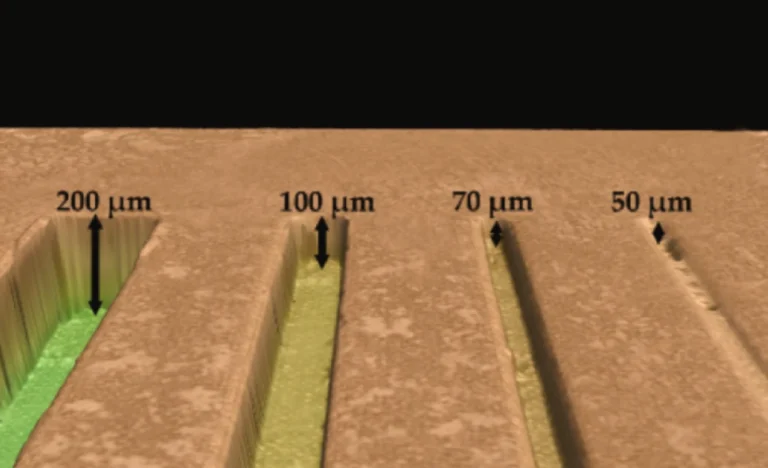
A 3D surface scan of printed microchannels at four target widths, from 200 µm down to 50 µm, showing how channel definition holds up as features shrink. Source: Hosseini et al. Evaluation of industrial and consumer 3-D resin printer fabrication of microdevices for quality management of genetic resources in aquatic species. Micro and Nano Engineering. 2024.
The working SSCC told the same story. The clear-resin chamber printed on the industrial machine landed within 2% of its target wall height, close to the soft-lithography benchmark, which itself sat under 1% of target. The consumer version was less accurate but still consistent enough for routine use with most species.
The biggest practical win was speed and cost. A single SSCC made by soft lithography took about 2 days and roughly $555 per unit. The same device printed on the industrial machine took under 38 minutes and used about $0.08 of resin. The consumer printer was slower than the industrial one but cheaper still on materials, landing around $0.01 to $0.03 per device. Even after accounting for the printers’ upfront cost, this is a dramatic drop in the time and money needed to get a usable device in hand.
SEM imaging confirmed the trade-offs. Industrial prints had smoother surfaces and sharper wall angles than consumer prints, though the cleanroom PDMS part was still the smoothest of all. A faint texture matching the printer’s LCD pixel pattern was visible on resin parts, and post-processing (washing out residual resin) was shown to be essential, as it opened up the gaps between grid cells that let samples fill evenly.
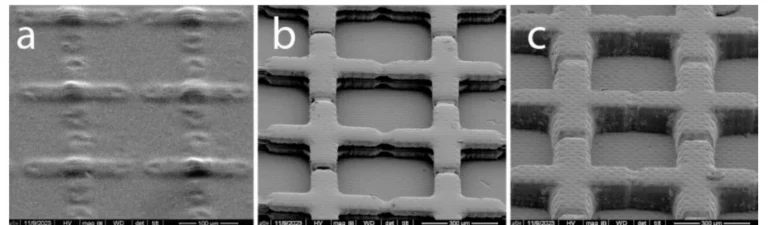
Figure 2. Electron microscope images of the SSCC grid made three ways: (a) traditional soft lithography, (b) industrial resin printing, and (c) consumer resin printing. The printed walls are taller (0.1 mm vs 0.01 mm) and show faint layer texture. Scale bars are 0.1 mm. Source: Hosseini et al. Evaluation of industrial and consumer 3-D resin printer fabrication of microdevices for quality management of genetic resources in aquatic species. Micro and Nano Engineering. 2024.
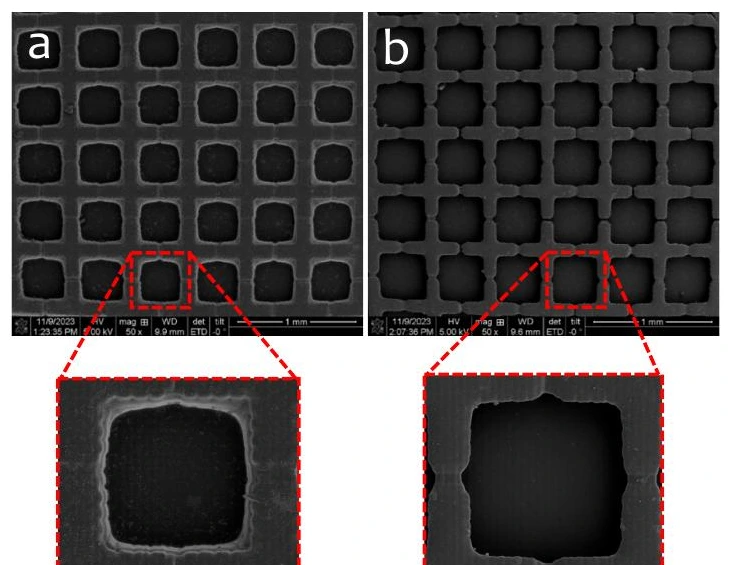
Figure 3. An industrial 3D-printed SSCC before (a) and after (b) post-processing. Washing out leftover resin opens the gaps between grid cells, which let the sample fill the chamber evenly. Insets show a single cell up close. Source: Hosseini et al. Evaluation of industrial and consumer 3-D resin printer fabrication of microdevices for quality management of genetic resources in aquatic species. Micro and Nano Engineering. 2024.
“Even with the current capabilities of resin printing, we can move seamlessly from micro- to milli- to macro-scales in the design process without changing materials or equipment.”
— Hosseini et al., Micro and Nano Engineering, 2024
Products Used In This Study


Questions on how our 3D printing system can work for your research? Connect with one of our specialists.
More Research Article Summaries
McGill University researchers build a 3D printed double-sided mold system to shape and merge brain organoids on a chip
University of Hawaiʻi researchers 3D print wearable "sweatainer" devices with true microscale internal channels
Want to read more article summaries?
We summarize the latest microfluidics and 3D printing research.
Curated from peer-reviewed publications featuring the CADworks3D system.