
Research Article Summary
5 Minute Read
KTH and UCAM Researchers Achieve Reagent-Free pH Control With a 3D Printed Microfluidic Cell
Title
Reversible electrochemical pH modulation in thin-layer compartments using poly(aniline-co-o-aminophenol)
Authors
Alexander Wiorek, Chen Chen, María Cuartero, Gastón A. Crespo
Journal
Sensors and Actuators: B. Chemical, Vol. 419, Article 136315 (2024)
DOI Link
Summary
Researchers from KTH Royal Institute of Technology and Universidad Católica San Antonio de Murcia (UCAM) developed a reagent-free electrochemical method for reversibly shifting the pH of ultra-small fluid samples inside a 3D printed microfluidic cell, offering a chemical-free alternative to traditional acid dosing for environmental sensing. (Wiorek et al.)
Summary Author
This page was prepared by CADworks3D to summarize and highlight a peer-reviewed research article authored by independent researchers utilizing the CADworks3D system.
Title
Reversible electrochemical pH modulation in thin-layer compartments using poly(aniline-co-o-aminophenol)
Authors
Alexander Wiorek, Chen Chen, María Cuartero, Gastón A. Crespo
Journal
Sensors and Actuators: B. Chemical, Vol. 419, Article 136315 (2024)
DOI Link
Key Results at a Glance
100 µm
Thin-Layer Design
The 3D printed cell traps samples in a chamber under 100 µm thick for fast, uniform pH control
0.6 µL
Sample Volume
Each pH modulation used a fluid volume of just 0.6 µL, no larger than a drop of dew
pH 2-4
Rapid Acidification
Sample pH lowered into this range in just 3 minutes, using electricity alone
Reagent-Free
Zero Added Chemicals
No acids or bases were added to shift the sample’s pH at any point
Objective
Many chemical and environmental measurements only work within a narrow pH window. Detecting phosphate in water, for example, requires the sample to first be acidified to a pH of 2 or lower so it can form a colored complex with molybdate. Measuring alkalinity calls for a similar acid addition, typically down to a pH of 3 to 4.5. In a lab, this is a routine step: a technician adds acid or base by hand or with an automated dosing system. But for continuous, decentralized, or in-situ monitoring, such as ocean buoys or field sensors, carrying reagent stocks and waste tanks is impractical.
Researchers have looked for reagent-free ways to shift pH, most commonly by using electrical current to split water at an electrode surface and generate protons or hydroxide ions directly in the sample. This works, but it requires fairly aggressive voltages and currents, which can trigger unwanted side reactions. A gentler alternative uses redox-active materials that release and reabsorb protons at much lower potentials. Polyaniline (PANI) is one such material, but its reversible proton exchange breaks down above a pH of about 4 to 5, limiting where it can be used.
This left a gap: could a related material extend reversible, low-voltage pH control up to higher, more environmentally realistic pH values? Poly(aniline-co-o-aminophenol) (PANOA), a co-polymer known to stay reversible up to a pH of 9 to 10 in biosensing applications, looked promising, but it had never been tested specifically as a pH-modulating actuator. The objective of this study was to design a microfluidic platform to characterize PANOA’s proton exchange behavior, optimize how the polymer is grown, and determine whether it could reversibly and repeatably acidify small-volume samples, including real seawater, without adding any reagents.
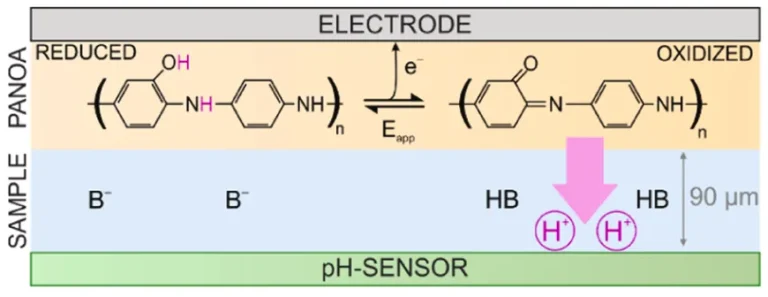
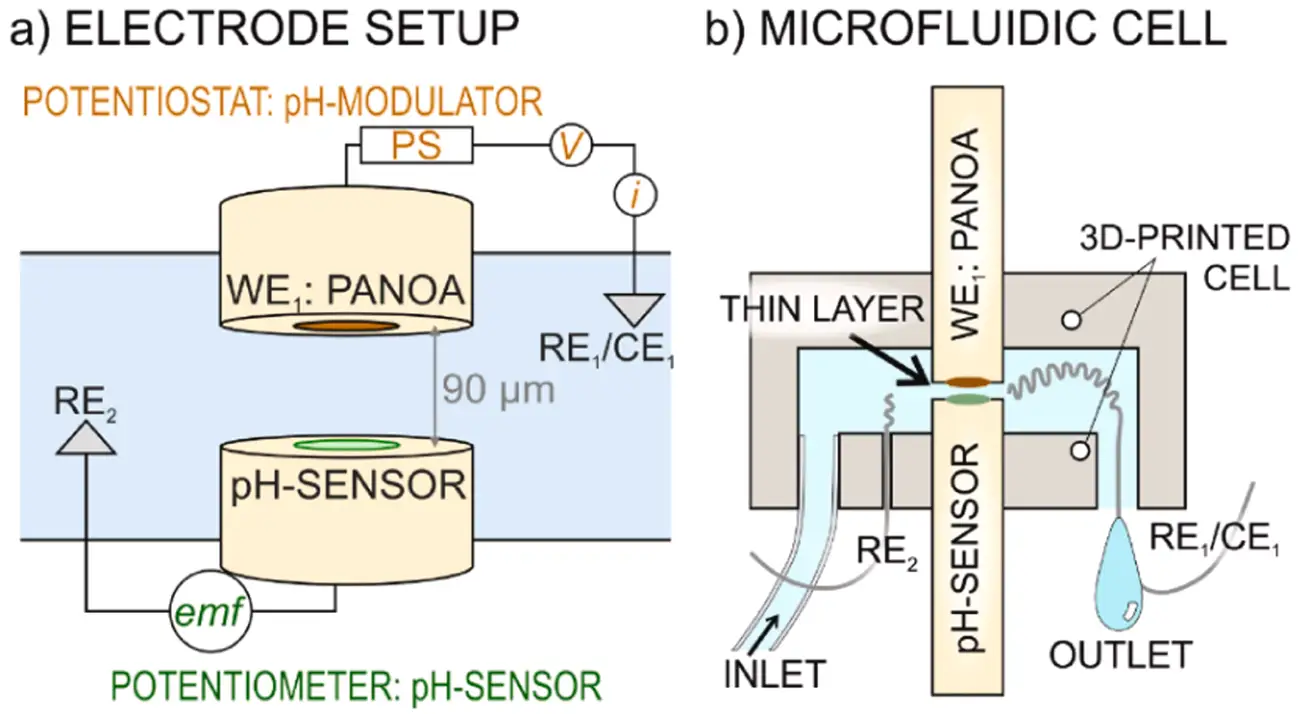
Figure 1. The working concept of the 3D printed pH-modulation cell: a sample plug flows into the thin-layer chamber between the PANOA actuator and the pH sensor (left), and applying an electrical potential to the PANOA releases protons into the trapped sample, lowering its pH without adding any reagent (right). Source: Wiorek et al. Reversible electrochemical pH modulation in thin-layer compartments using poly(aniline-co-o-aminophenol). Sensors and Actuators: B. Chemical. 2024.
Methodology and Design
To test this, the team needed a way to trap a tiny, well-defined volume of sample between two electrodes: one coated in PANOA to act as the proton source, and a second coated in PANI to act as a reference pH sensor. They designed a microfluidic cell in CAD software and produced it on a resin 3D printer, giving them a sealed chamber with inlet and outlet ports for flowing sample in and out, plus a dedicated port for a reference electrode. Because the entire chamber was 3D printed as a single part, the researchers could position the two electrode faces precisely opposite one another, creating a thin-layer sample gap under 100 µm thick where diffusion is fast and pH changes can be tracked in real time.
With the cell built, the team put it to work across a range of sample types and future sensing scenarios:
Seawater Acidification Cell
Buffered Sample Cell
Modular Sensor Cell
In its first real-world test, the cell was filled with seawater collected off the coast of Spain and repeatedly acidified and regenerated using the electrochemical protocol alone, with no acid added by hand. Because natural seawater carries its own buffering capacity and a much higher chloride concentration than the artificial test solutions, the team adjusted the applied potentials slightly to compensate, and still recovered consistent, repeatable pH drops across multiple cycles. In parallel, the same cell design was used to test bicarbonate-buffered solutions that mimic higher, more environmentally relevant starting pH values, a condition where earlier polymer formulations struggled to stay reversible. Refining the electropolymerization recipe for PANOA, in particular limiting the maximum voltage used to grow the film and capping the number of growth cycles, produced a film that stayed reversible across repeated acidification cycles even under these more demanding, buffered conditions. Looking beyond pH sensing itself, the researchers note that the pH sensor half of the cell could be swapped for a different kind of sensor altogether, such as one for dissolved inorganic carbon or phosphate, while keeping the same 3D printed cell and PANOA-based acidification actuator, opening the door to a reusable acidification platform for several environmental sensing applications.
On the fabrication side, two 3 mm gold electrode tips were positioned face to face inside the printed cell and separated by a 90 µm-thick double-sided adhesive spacer, which set the thickness of the thin-layer sample gap. A second reference electrode was inserted through its own dedicated port in the printed body; once in place, that port was sealed by curing the printer’s own resin around the wire with UV light for 30 seconds, using the same photocurable material the cell itself was printed from. This kind of in-place resin sealing let the researchers integrate multiple electrodes into a single, leak-tight 3D printed part without needing separate gaskets or adhesives at each port.
Results
Across all tests, the 3D printed thin-layer cell consistently confined samples to a chamber under 100 µm thick, holding just 0.6 µL of fluid per measurement, small enough that a single applied potential could shift the pH throughout the entire sample almost immediately, with no dead volume for reagents to mix into.
Using the optimized PANOA film, the researchers could reliably drop the sample pH into the 2 to 4 range within 3 minutes, using only an applied electrical potential and no acid or base addition. Reversibility held up over multiple back-to-back acidification and regeneration cycles, and when the researchers added an occasional acid-based regeneration step, the film could be reused for at least four consecutive cycles in seawater with repeatable results between refreshes.
Notably, this reagent-free approach worked not only in simple salt solutions but also in real seawater samples, where higher buffering capacity and chloride levels make pH control harder to achieve. The optimized PANOA films outperformed earlier film formulations tested in the same 3D printed cell, confirming that both the polymer growth conditions and the cell’s thin-layer design were essential to achieving stable, repeatable, chemical-free pH modulation.
“Overall, such materials could contribute to the development of continuous, decentralized measuring devices requiring acidification for the formal detection of environmental markers, such as nutrients, carbon species speciation and alkalinity, among others.”
— Wiorek et al., Sensors and Actuators: B. Chemical, 2024
Products Used In This Study
Questions on how our 3D printing system can work for your research? Connect with one of our specialists.
More Research Article Summaries
McGill University researchers build a 3D printed double-sided mold system to shape and merge brain organoids on a chip
University of Hawaiʻi researchers 3D print wearable "sweatainer" devices with true microscale internal channels
Want to read more article summaries?
We summarize the latest microfluidics and 3D printing research.
Curated from peer-reviewed publications featuring the CADworks3D system.