
Research Article Summary
5 Minute Read
KTH and UCAM researchers 3D print a hollow microneedle that measures temperature inside the skin
Title
Wearable 3D-Printed Microneedle Sensor for Intradermal Temperature Monitoring
Authors
Qikun Wei, Daniel Rojas, Qianyu Wang, et al.
Journal
ACS Sensors, 2025, Vol. 10, pp. 4027–4037
DOI Link
Summary
A research team used high resolution 3D printing to fabricate a robust, biocompatible hollow microneedle that, once filled with a temperature responsive conducting polymer, measures intradermal temperature continuously and accurately — the first 3D printed microneedle temperature sensor reported. Work by Wei et al.
Summary Author
This page was prepared by CADworks3D to summarize and highlight a peer-reviewed research article authored by independent researchers utilizing the CADworks3D system.
Title
Wearable 3D-Printed Microneedle Sensor for Intradermal Temperature Monitoring
Authors
Qikun Wei, Daniel Rojas, Qianyu Wang, et al.
Journal
ACS Sensors, 2025, Vol. 10, pp. 4027–4037
DOI Link
Key Results at a Glance
30 µm
With Complex Geometries
Applications ranging from particle separation, fluid mixing and distribution, and cell culture
90%
Print Layer Height
Resolution used to form the sharp, hollow tip
<45 µm
Manufacturing Success
Sharp enough for near-painless skin insertion
60 days
Cell Viability
No loss of sensitivity over the test period
Objective
Wearable health devices have moved quickly from research labs into clinical thinking because they can track what is happening inside the body continuously rather than in single snapshots. Among the fluids these devices can read, dermal interstitial fluid (the watery fluid surrounding cells just beneath the skin) is especially valuable. It carries much of the same chemical information as blood, but sits close to the surface and can be reached with far less invasiveness than a blood draw.
The standard tool for reaching this fluid is the microneedle, short enough to access the interstitial fluid while staying shallow enough to avoid nerves and major blood vessels. Microneedle sensors have been built to track glucose, lactate, pH, potassium, and several ions at once. The problem is that almost every one of these readings is temperature sensitive: enzyme activity shifts with temperature, the calibration slope of potentiometric sensors depends on it, and the diffusion of gas-based biomarkers changes with it as well. If the local temperature is unknown, the chemical reading carries a hidden error.
The fix is to measure temperature exactly where the chemistry happens, inside the skin rather than on top of it. This matters because the difference between the skin surface and one millimeter down can be 0.6 to 2 degrees Celsius, and surface readings are easily thrown off by room temperature and sweat. Existing attempts fall short: commercial glucose patches read temperature near the surface rather than at the sensing site, color-changing powders give only rough readings, thermocouple arrays were never fully characterized, and implantable probes require surgery.
This study addresses that gap. The authors set out to build a microneedle that measures temperature intradermally with real analytical rigor: robust enough to pierce skin reliably, biocompatible enough to sit safely in tissue, and precise enough to be trusted both for standalone monitoring and for correcting the temperature error in other microneedle biosensors. The route they chose was high-resolution 3D printing. It allows fine control over needle geometry and the micrometer-scale resolution a working hollow needle demands.
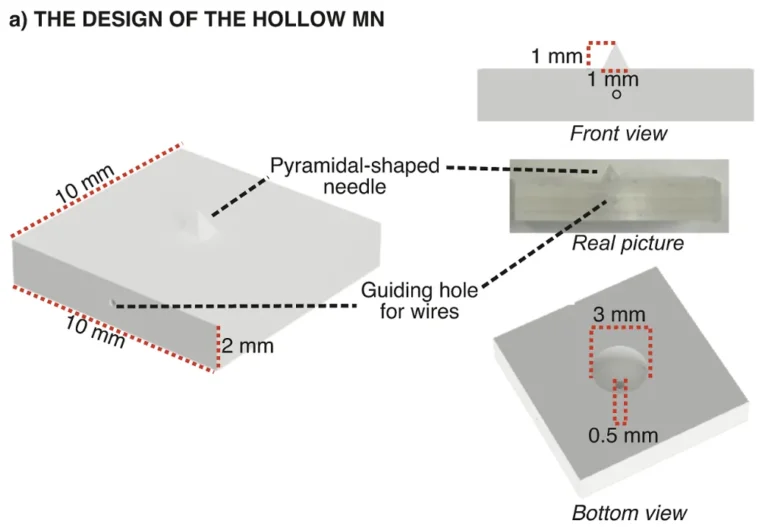
Figure 1a. The hollow microneedle designed in CAD, shown with labeled front and bottom views alongside a real image of the 3D printed part. Source: Wei et al. Wearable 3D-Printed Microneedle Sensor for Intradermal Temperature Monitoring. ACS Sensors. 2025.
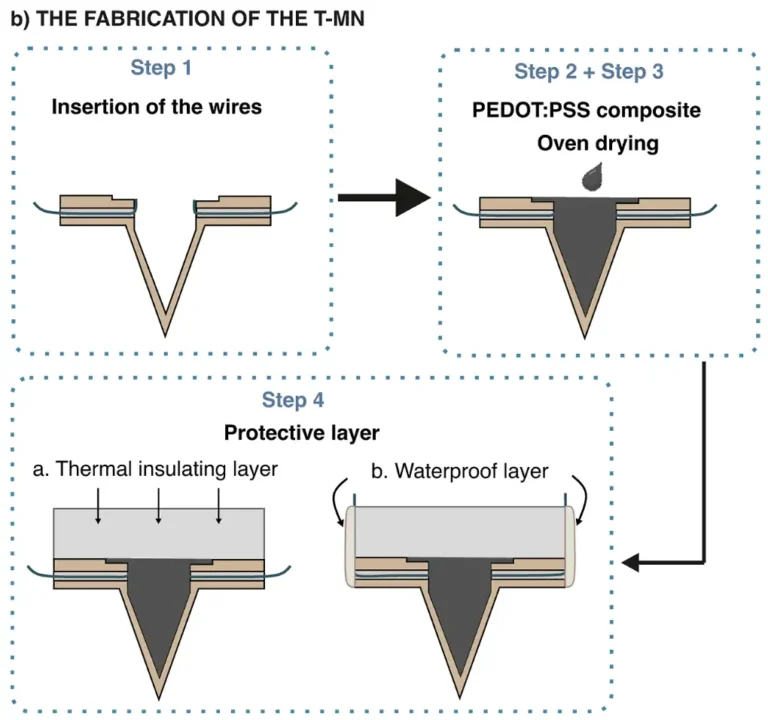
Figure 1b. The build-to-sensor workflow: stainless steel wires are threaded in, the conducting polymer is filled and oven dried, then thermal insulating and waterproof protective layers are added. Source: Wei et al. Wearable 3D-Printed Microneedle Sensor for Intradermal Temperature Monitoring. ACS Sensors. 2025.
Methodology and Design
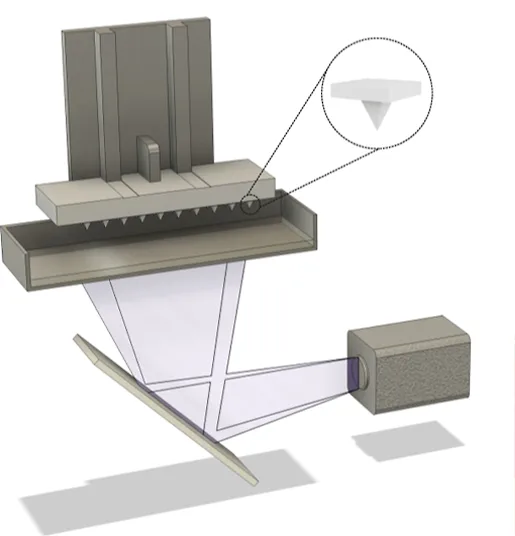
The microneedle sensor is built through digital light processing (DLP) 3D printing. The device geometry is designed in CAD software, then printed layer by layer as the printer cures liquid resin with projected light, producing a hollow, sharp tipped shell ready for further processing.
The team built two related devices: a flat reference patch to prove the sensing chemistry, and the printed microneedle that turns that chemistry into a wearable, skin piercing sensor.
Planar Temperature Patch
Hollow Microneedle Sensor
The sensing principle is the same in both. The conducting polymer PEDOT:PSS changes its electrical resistance in a predictable, linear way as temperature rises, so reading resistance becomes a way of reading temperature. To make that signal reliable, the team tuned the polymer mixture, adjusting the ratio of a cross-linking agent called GOPS to lock the film onto the substrate and sharpen sensitivity, and adding a surfactant to help the film dry evenly. They tested five ratios and kept the one with the strongest, most stable response.
The flat patch came first as a proof of concept: a simple three-layer stack of cut polyester sheets with PEDOT:PSS in the middle and copper contacts on either side, used to optimize the polymer recipe before committing it to the much smaller needle.
The needle is where the fabrication workflow becomes the heart of the project. The hollow microneedle was designed in CAD software and printed on a digital light processing printer, which cures liquid resin layer by layer using projected light. The team printed with a clear, acrylate-based resin at a layer height of 30 µm, fine enough to form a sharp, hollow tip. They tested conical and pyramidal shapes across a range of base widths, and the pyramidal design with a 1000 µm base and 1000 µm height gave both the best mechanical robustness and the highest manufacturing success rate at 90 percent.
Turning the printed shell into a working sensor followed a clear sequence. Two thin stainless steel wires were threaded through guiding channels printed into the needle base to form the electrical connections. The PEDOT:PSS solution was then filled into the hollow lumen and oven-dried, leaving a conducting film roughly 7 µm thick coating the inner wall. Finally, a two-part protective layer was added: thermal insulating tape on the upper body to shield the sensor from outside air temperature swings, and a waterproof seal along the sides to stop short circuits during use.
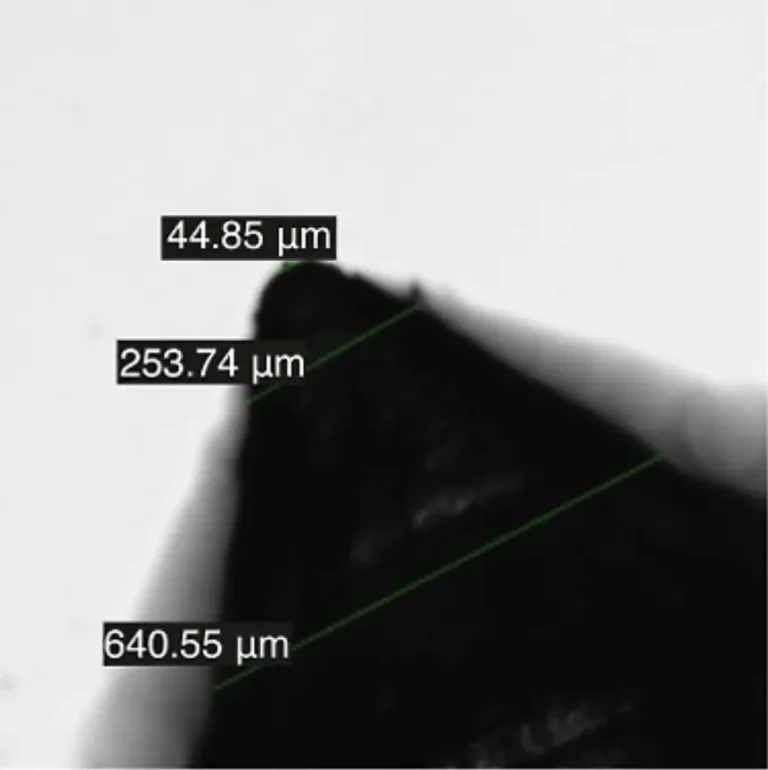
Figure 2. A microscope image of the printed needle tip, with measurements confirming a tip fine enough for low pain skin insertion. Source: Wei et al. Wearable 3D-Printed Microneedle Sensor for Intradermal Temperature Monitoring. ACS Sensors. 2025.
Results
The optimized needle performed well as a precise temperature sensor. Across a working range of 15 to 60 degrees Celsius, which comfortably brackets both hypothermia and fever, the device showed a strongly linear response with an R-squared of 0.994 and a sensitivity of negative 0.74 percent per degree Celsius, matching or beating earlier PEDOT:PSS sensors never made in needle form. Its resolution reached 0.2 degrees Celsius or better, fine enough to catch the small shifts.
The printing process proved consistent. The conducting film inside the lumen measured 7.13 µm thick with only 2.7 percent variation between needles, repeatability and reproducibility came in at 2 percent relative standard deviation, and the sensor held its calibration for at least 60 days with no loss of sensitivity.
The printed geometry held up mechanically and biologically. The pyramidal tip measured under 45 µm across, sharp enough for near painless insertion, and withstood a fracture force above 4.4 newtons, well beyond the 0.1 to 3 newtons needed to pierce skin. Biocompatibility depended heavily on post processing: needles given only a short 5 minute UV cure dropped to 57 percent cell viability by 48 hours, while needles given a longer 30 minute cure followed by an overnight soak stayed above the 70 percent safety threshold throughout, a reminder that curing strategy is part of the device design.
Finally, the device worked on the body. Across six rats monitored for 80 minutes, the printed needle tracked intradermal cooling almost perfectly against a commercial optical probe, with readings differing by only about 0.1 degrees Celsius and a correlation coefficient of 0.999. The result is a fully characterized, 3D printed intradermal temperature sensor, the first of its kind reported.
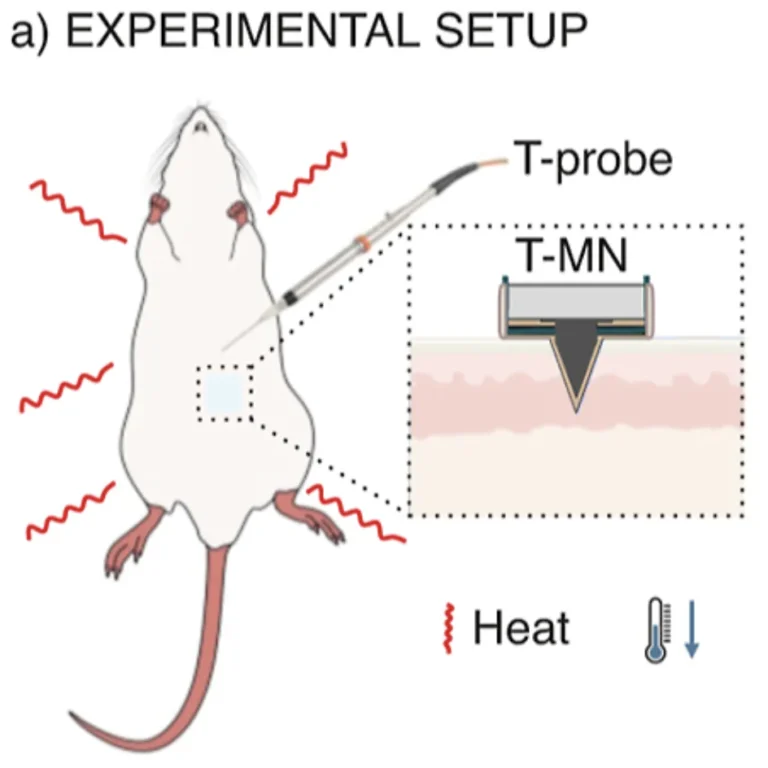
Figure 3. The finished device sits on the skin with the printed pyramidal needle reaching the interstitial fluid, where it reads temperature directly. Source: Wei et al. Wearable 3D-Printed Microneedle Sensor for Intradermal Temperature Monitoring. ACS Sensors. 2025.
“High-resolution 3D printing turned a single resin shell into a skin-piercing sensor sharp enough to insert painlessly, strong enough to survive repeated use, and precise enough to match a commercial probe inside the body.”
— Summary of findings from Wei et al., ACS Sensors (2025)
Products Used In This Study
Questions on how our 3D printing system can work for your research? Connect with one of our specialists.
More Research Article Summaries
McGill University researchers build a 3D printed double-sided mold system to shape and merge brain organoids on a chip
University of Hawaiʻi researchers 3D print wearable "sweatainer" devices with true microscale internal channels
Want to read more article summaries?
We summarize the latest microfluidics and 3D printing research.
Curated from peer-reviewed publications featuring the CADworks3D system.