
Research Article Summary
5 Minute Read
IMT Bucharest researchers use 3D printed molds to build a flexible pressure sensor
Title
On the Development of a New Flexible Pressure Sensor
Authors
Florian Pistriţu, Marin Gheorghe, Marian Ion, et al.
Journal
Micromachines, 2024, Volume 15, Article 847
DOI Link
Summary
Researchers at Romania’s National Institute for Research and Development in Microtechnologies (IMT Bucharest) built a flexible piezoresistive pressure sensor around a micro-pyramid-textured PDMS substrate cast from 3D-printed molds, then compared three mold-based assembly designs to identify the most reliable sensor structure. This summary is based on the peer-reviewed article by Pistriţu et al., published in Micromachines (2024).
Summary Author
This page was prepared by CADworks3D to summarize and highlight a peer-reviewed research article authored by independent researchers utilizing the CADworks3D system.
Title
On the Development of a New Flexible Pressure Sensor
Authors
Florian Pistriţu, Marin Gheorghe, Marian Ion, et al.
Journal
Micromachines, 2024, Volume 15, Article 847
DOI Link
Key Results at a Glance
1,500 µm
Pyramid Base Width
Each micro-pyramid on the 3D-printed mold measures 1,500 µm across the base
50 Minutes
Mold-to-Cured Part
Time needed to cure the PDMS substrate after it was cast from the 3D-printed mold
3 Designs
Mold-Based Assemblies Tested
Three pyramid orientations were cast from the same mold family and compared
70°C
Lower Bonding Temperature
An optimized process cut the wire-bonding cure step down from the original 125°C
Objective
Wearable pressure sensors are becoming a core part of how researchers monitor human health and movement outside the clinic. Devices worn on skin or clothing can track muscle activity, joint motion, pulse, and respiration, feeding that data back for rehabilitation, diagnostics, or everyday activity tracking. To do this well, a sensor needs two things at once: a soft, stretchable structure that moves comfortably with the body, and a sensitive resistive element that turns that movement into a clean electrical signal.
Most flexible pressure sensors rely on a microtextured elastomer layer, usually PDMS, to boost sensitivity. Texturing the surface with tiny raised features, such as pyramids, concentrates stress at contact points, making the sensor react more strongly to small pressure changes than a flat surface would. The challenge is manufacturing that microtexture reliably and quickly. Traditional cleanroom methods, like photolithography or deep etching, can produce these features, but they are slow, expensive, and hard to iterate on when a lab wants to test several geometries before settling on one.
The researchers set out to build a new flexible pressure sensor around a micro-pyramid textured PDMS substrate, using 3D printed molds instead of cleanroom tools to define the pyramid geometry. Their goal was to test whether a simpler, mold-based fabrication route could produce a substrate sensitive and consistent enough for a working piezoresistive sensor, while also comparing multiple pyramid orientations to see which assembly gave the cleanest, most linear pressure response.
Methodology and Design
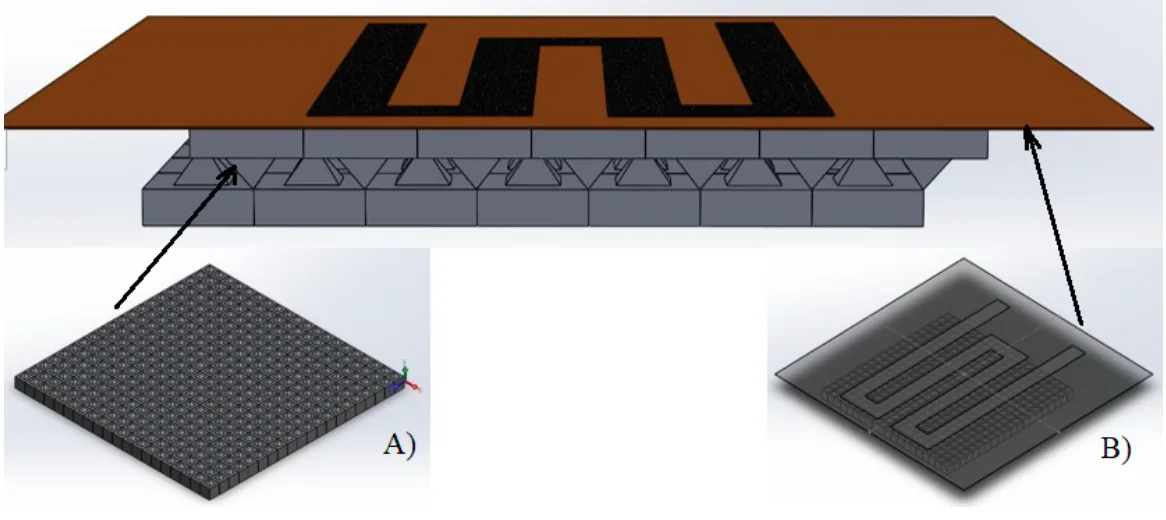
The team’s fabrication pipeline started with a CAD-designed mold containing an array of micro-pyramid cavities, produced on a 3D printer. PDMS was mixed with a small amount of aerogel powder, poured into the mold, and cured to form a flexible, micro-textured substrate. A resistive sensing layer was then screen printed onto a thin flexible foil and bonded on top of the molded substrate to complete the sensor.
Because the same mold family could be reoriented and paired with the resistive layer in different ways, the team built three distinct sensor assemblies worth comparing side by side:
Tip-Up Design
Tip-Down Design
Interlocked Pyramids
In Model I (Tip-Up Design), the printed resistive foil sat directly on top of the substrate with the pyramid tips pointing upward toward the sensing layer. Model II (Tip-Down Design) used the same mold-cast substrate flipped over, so the pyramid tips faced downward and away from the sensing layer instead. Model II (Interlocked Pyramids) relied on a modified mold that produced an interlocked, paired-pyramid structure between the substrate and the resistive layer, rather than a single row of tips. All three assemblies came from the same 3D printed mold family, changing only how the molded piece was oriented or how the mating layer was shaped, not the underlying fabrication process. Across early testing, Kapton foil consistently gave a cleaner, more repeatable resistive response than ABS or PET, so it became the standard base material for the printed resistor in every assembly tested afterward.
A few process details mattered for getting consistent parts off the mold. The PDMS was mixed with its hardening agent in a 10 to 1 ratio, blended with 10% aerogel powder, and cured in a vacuum oven at 100°C for 50 minutes to fully harden the molded substrate. The resistive layer itself was deposited using two carbon-based screen-printing inks, one with added titanium dioxide, and checked under scanning electron microscopy to confirm a smooth, uniform surface. Terminal wires were bonded to the printed resistor with silver paste, then cured to finish the connection. Switching from a paste that required 125°C to one that cures at 70°C reduced how much heat the printed ink was exposed to during assembly, which the team found helped preserve the resistor’s behavior more reliably than the original higher-temperature process.
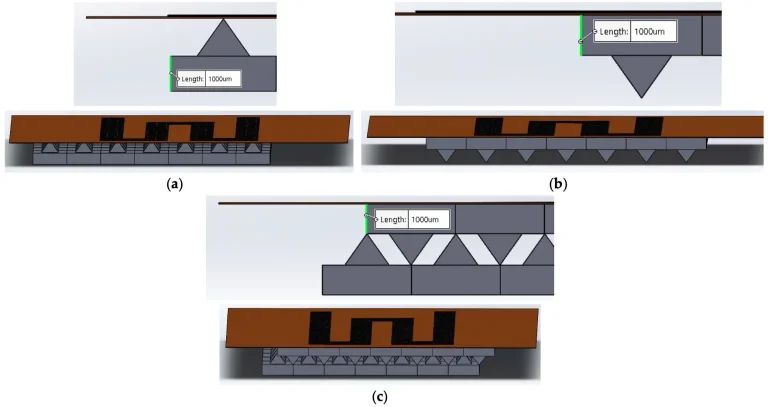
Figure 1. Three ways the team assembled the same 3D printed mold geometry into a working sensor: pyramids facing up (Model I), pyramids facing down (Model II), and an interlocked, paired-pyramid structure (Model III). Source: Pistriţu et al. On the Development of a New Flexible Pressure Sensor. Micromachines. 2024.
Results
The 3D printed molds reliably reproduced the intended micro-pyramid geometry, with each pyramid measuring 1,500 µm at the base and curing into a finished PDMS substrate in about 50 minutes. That combination of precision and turnaround meant the team could move from a mold design to a testable part the same day.
Substrate material made a clear difference in sensor quality. Kapton produced a far more linear pressure response than ABS or PET, both of which behaved erratically, likely due to how each polymer handled the heat used during processing. Kapton was carried forward as the standard resistor substrate for every assembly tested afterward.
Comparing the three mold-based assembly designs, Model II (pyramids facing down) and Model III (interlocked pyramids) produced the most consistent piezoresistive response across repeated compression cycles, both outperforming Model I (pyramids facing up). Model III’s interlocked geometry, achievable simply by changing the mold design rather than swapping materials, ultimately gave the most linear response once the fabrication process was optimized.
That optimization centered on the wire-bonding step. Switching to a silver paste that cures at 70°C instead of 125°C protected the printed resistor from unnecessary heat exposure and measurably improved response linearity. The two screen-printing ink formulations tested performed nearly identically, meaning either can be paired with the mold-cast substrate without compromising results. Together, these findings show that a single 3D printed mold can support several rounds of design iteration, orientation testing, and material comparison without new cleanroom tooling for each version.
“The optimal configuration was determined to be the meander resistor on a Kapton substrate with the Model II [Tip-Down Design] assembly model.”
— Pistriţu et al. On the Development of a New Flexible Pressure Sensor. Micromachines. 2024.
Products Used In This Study
Questions on how our 3D printing system can work for your research? Connect with one of our specialists.
More Research Article Summaries
McGill University researchers build a 3D printed double-sided mold system to shape and merge brain organoids on a chip
University of Hawaiʻi researchers 3D print wearable "sweatainer" devices with true microscale internal channels
Want to read more article summaries?
We summarize the latest microfluidics and 3D printing research.
Curated from peer-reviewed publications featuring the CADworks3D system.