
Research Article Summary
5 Minute Read
IMT Bucharest researchers explore rapid, 3D printed mold fabrication for flexible PDMS pressure sensors
Title
Rapid Manufacturing of Flexible Microstructured PDMS Substrates, Using 3D DPL Printing Technique, For Flexible Pressure Sensors
Authors
Florian Pistritu, Mihaela Carp, Violeta Dediu, et al.
Journal
U.P.B. Scientific Bulletin, Series B, Vol. 85, Iss. 4, 2023 (ISSN 1454-2331)
DOI Link
Summary
Pistritu et al. show that 3D printed molds can produce microstructured PDMS substrates for flexible pressure sensors in about four hours, from CAD design to finished part, without traditional lithography.
Summary Author
This page was prepared by CADworks3D to summarize and highlight a peer-reviewed research article authored by independent researchers utilizing the CADworks3D system.
Title
Rapid Manufacturing of Flexible Microstructured PDMS Substrates, Using 3D DPL Printing Technique, For Flexible Pressure Sensors
Authors
Florian Pistritu, Mihaela Carp, Violeta Dediu, et al.
Journal
U.P.B. Scientific Bulletin, Series B, Vol. 85, Iss. 4, 2023 (ISSN 1454-2331)
DOI Link
Key Results at a Glance
4 hours
CAD-to-Substrate Turnaround
The full workflow, from designing a mold to a finished PDMS substrate, takes about four hours.
8
Mold Geometries Tested
Seven micro-pyramid sizes plus one micro-parallelepiped mold were 3D printed for the study
1.46 mm
Peak Displacement Recorded
The highest displacement measured, from a PDMS/aerogel P2000 substrate under 120N of compression
+36%
Aerogel Displacement Boost
Adding just 5% aerogel to the PDMS mix raised displacement substantially over plain PDMS at the same geometry
Objective
Flexible pressure sensors show up anywhere a soft, bendable surface needs to sense touch or force: robotic grippers, wearable health monitors that track pulse and movement, and human machine interfaces that respond to pressure instead of buttons. Most of these sensors rely on a piezoresistive design, where a flexible material changes its electrical resistance as it is squeezed, and that change is measured as a pressure reading. How well the sensor performs- its sensitivity, response time, and working pressure range- depends heavily on the shape of the material sitting inside it.
Researchers have found that giving the sensing layer a microstructured surface, tiny repeating shapes like pyramids, domes, or cylinders rather than a flat sheet, meaningfully boosts sensitivity. Micro-pyramid and micro-dome patterns in particular have outperformed other geometries in prior studies. The challenge has always been making these microstructures. Traditional methods for patterning a sensing layer at this scale usually require cleanroom equipment and photolithography, a process that is precise but slow and expensive to iterate on. Every time a research team wants to test a new microstructure size or shape, they typically have to remake a mold from scratch, which can take days.
This paper, from a team at IMT Bucharest and the University POLITEHNICA of Bucharest, asks whether 3D printing can close that gap. Instead of using photolithography to make the mold that shapes the polydimethylsiloxane (PDMS) sensing layer, the team designed and 3D printed the molds directly, then cast PDMS, and PDMS mixed with aerogel, on top of them. The goal was to find which microstructure geometry produced the greatest displacement, meaning how far the material compresses under a given force, since more displacement generally points to a more responsive sensing element. If 3D-printed molds can match the geometries used in lithography-based methods while cutting the design-to-part timeline dramatically, it opens up much faster iteration for anyone developing a flexible pressure sensor.
Methodology and Design
The fabrication pipeline follows a straightforward six stage path. A mold is designed as a 3D CAD model, transferred to a 3D printer, and printed. The printed mold is cleaned and UV cured, then PDMS, or a PDMS and aerogel blend, is poured over it, degassed, and cured into its final microstructured shape. The finished substrate is then compression-tested to measure its response under load.
The team used this pipeline to build and compare several substrate designs, each targeting a different part of the sensitivity question:
Micro-Pyramid Substrates
Micro-Parallelepiped Substrate
PDMS/Aerogel Composite
Seven micro-pyramid molds were designed and printed, ranging from 200µm to 2000µm at the base, each paired with a proportional height. A single micro-parallelepiped mold, with a 500µm base, was also printed as a design comparison, since most published work on microstructured sensing layers focuses on pyramid, dome, and cylinder shapes rather than straight-edged geometries. All eight geometries were cast twice, once in Sylgard 184 PDMS and once in KER 4690 PDMS, two commercial elastomers that differ in stiffness and curing method, to check whether material choice alone shifted performance independent of shape.
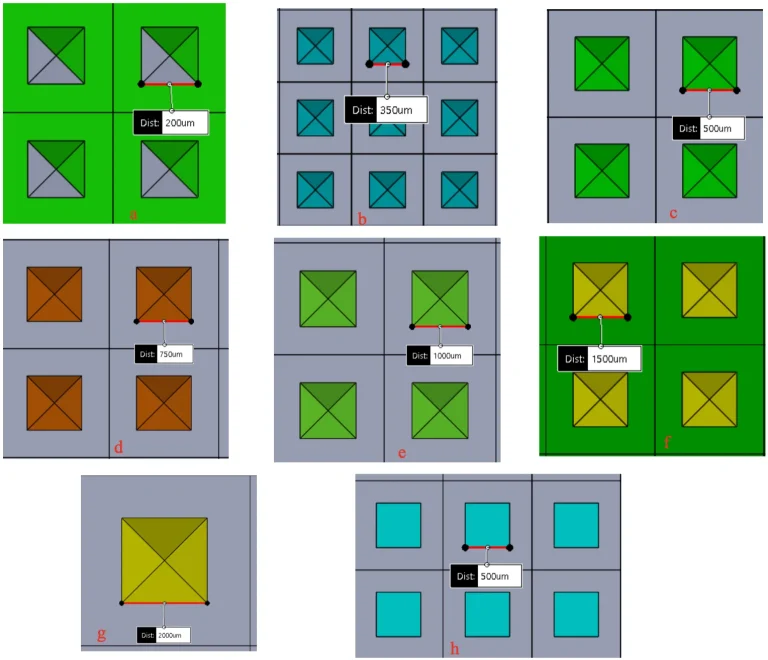
Figure 1. 3D CAD models of the eight molds 3D printed for this study. Panels a-g show the seven micro-pyramid molds, with base width and height of a) 200µm x 141µm, b) 350µm x 247µm, c) 500µm x 353µm, d) 750µm x 530µm, e) 1000µm x 707µm, f) 1500µm x 1060µm, and g) 2000µm x 1414µm. Panel h shows the micro-parallelepiped mold, with a 500µm base and 353µm height. Source: Pistritu et al. Rapid Manufacturing of Flexible Microstructured PDMS Substrates, Using 3D DPL Printing Technique, For Flexible Pressure Sensors. U.P.B. Sci. Bull., Series B. 2023
Once the team identified which pyramid sizes displaced the most under load, they moved to a composite approach: blending powdered aerogel into the Sylgard 184 mix at 5% and 10% by content before casting it onto the same molds. Aerogel is already known for being extremely lightweight and compressible, so adding it to PDMS was tested as a way to push displacement even further on the best performing geometries.
On the fabrication side, each mold took about 20 minutes to design in CAD software and roughly 15 minutes to print. After printing, molds were cleaned twice in isopropyl alcohol and UV cured for 20 minutes per side before use. PDMS mixing followed standard ratios: 10 to 1 polymer to hardening agent for Sylgard 184, and 1 to 1 for the two part KER 4690, followed by a 45 minute degassing step to remove air bubbles before casting. Sylgard 184 substrates cured at 100°C for 50 minutes, while KER 4690 cured under UV exposure. Every finished substrate was then compression tested on a Mecmesin MultiTest 2.5i device at forces of 80N, 100N, and 120N to measure displacement.
Results
Across all eight geometries, the P1500 and P2000 micro-pyramid substrates (1500µm and 2000µm at the base) produced the greatest displacement under compression, outperforming the smaller pyramid sizes and the parallelepiped design at every force level tested. Substrates made with Sylgard 184 consistently displaced more than the same geometry cast in KER 4690 under an 80N load, making Sylgard 184 the stronger baseline material for this application.
Because P1000, P1500, and P2000 stood out at 80N, the team pushed those three geometries to 100N, then narrowed further to P1500 and P2000 at 120N. The results stayed close between the two, with P2000 holding a slight edge at the highest force tested.
Adding aerogel to the mix produced the clearest gain in the entire study. Blending just 5% aerogel into the Sylgard 184 used for the P2000 substrate raised displacement from 1.07mm to 1.45mm under 100N, roughly a 36% increase over plain PDMS at the same geometry and force. The highest displacement recorded across the whole study, 1.46mm, came from a P2000 substrate with 5% aerogel under 120N. Overall, the data point to two takeaways: larger pyramid geometries in the 1500 to 2000µm range outperform smaller ones, and aerogel loading meaningfully improves compressibility without changing the mold or print process at all. Together, these results support using PDMS/aerogel micro-pyramid substrates as the sensing layer in a future flexible pressure sensor.
“Integrating this microstructured substrate into a pressure sensor, we have the possibility to measure high pressures.”
— Pistritu et al., IMT Bucharest / University POLITEHNICA of Bucharest
Products Used In This Study
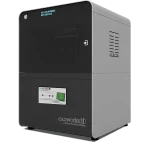
Questions on how our 3D printing system can work for your research? Connect with one of our specialists.
More Research Article Summaries
McGill University researchers build a 3D printed double-sided mold system to shape and merge brain organoids on a chip
University of Hawaiʻi researchers 3D print wearable "sweatainer" devices with true microscale internal channels
Want to read more article summaries?
We summarize the latest microfluidics and 3D printing research.
Curated from peer-reviewed publications featuring the CADworks3D system.