
Research Article Summary
5 Minute Read
Imperial College London researchers tackle bead sedimentation in 3D printed microfluidic chips
Title
Offsetting Dense Particle Sedimentation in Microfluidic Systems
Authors
Tochukwu Dubem Anyaduba, Jesus Rodriguez-Manzano
Journal
Micromachines, 2024, Volume 15, Issue 9, Article 1063
DOI Link
Summary
Imperial College London researchers 3D printed a 16-well fluidic manifold to test two low-cost fixes for a problem that plagues bead-based microfluidics: dense microparticles sinking before they can be evenly distributed. Summary based on the peer-reviewed article by Anyaduba et al.
Summary Author
This page was prepared by CADworks3D to summarize and highlight a peer-reviewed research article authored by independent researchers utilizing the CADworks3D system.
Title
Offsetting Dense Particle Sedimentation in Microfluidic Systems
Authors
Tochukwu Dubem Anyaduba, Jesus Rodriguez-Manzano
Journal
Micromachines, 2024, Volume 15, Issue 9, Article 1063
DOI Link
Key Results at a Glance
58%
Slower Bead Settling
Heating the bead buffer to trigger a surfactant phase change cut the sedimentation rate by more than half
45% → 17%
Better Well-to-Well Uniformity
Raising the flow rate from 1 to 10 mL/min sharply reduced bead concentration variation across the manifold
0.49 ± 0.02 mm
Print Accuracy
3D-printed capillary valves matched their CAD design almost exactly
16 Wells
Manifold Scale
One 3D printed chip metered beads into sixteen wells in a single run
Objective
Microparticles, or beads, are widely used as delivery vehicles in microfluidic and droplet-based biotechnology. Their high surface area makes them easy to coat with antibodies, probes, or other bio-recognition molecules, and packaging them inside droplets enables compartmentalized single-molecule assays, from digital PCR to single-cell sequencing.
For these assays to work, beads need to arrive at the right place, in the right numbers, at the right time. Most beads are denser than their buffer, so they sink. In a chip with many wells fed from one channel, this creates a concentration gradient: wells near the inlet fill with far more beads than those downstream. The same problem disrupts binary droplet encapsulation, where each droplet should receive a set number of beads.
Existing workarounds each carry a tradeoff. Density-matched fluids or humectants like glycerol help with buoyancy but, at effective concentrations, can interfere with reactions such as nucleic acid amplification. Gel beads avoid settling but bring non-Newtonian handling problems. Narrowing channels to the particle diameter keeps hard-shelled beads in a single stream but limits packing density. Mechanical fixes such as hopper systems or pneumatic trap-and-release valves work but add hours of setup or extra pumps and valves, raising cost and complexity.
What was missing was a simple, low-cost way to interrupt or slow bead settling without changing the beads, adding moving parts, or complicating the fluidic design. This study tested two such approaches: one that manipulates flow to redirect where beads settle, and one that exploits a surfactant’s physical behavior to temporarily thicken the suspension.
Methodology and Design
To test the flow-based approach, the team needed a chip that could hold beads across many parallel wells fed from a single shared channel. The device was designed in SolidWorks and 3D printed on a DLP resin printer as one monolithic part, producing the full fluidic path, chambers, channels, and valves, ready to test straight off the build plate.
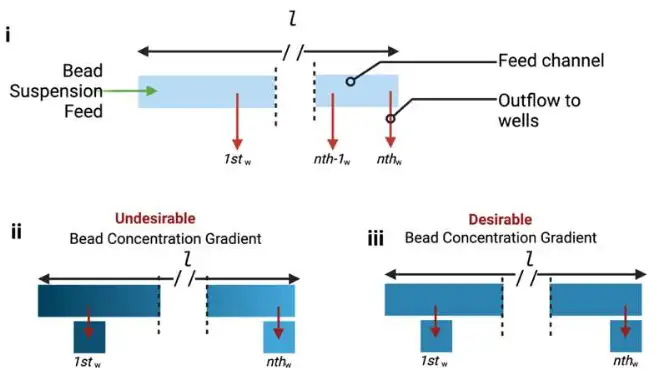
Figure 1. As beads travel down a shared feed channel, wells near the inlet fill first and end up with more beads than wells further away. The chip's design works to even this out. Source: Anyaduba et al. Offsetting Dense Particle Sedimentation in Microfluidic Systems. Micromachines. 2024.
To benchmark the resin, four devices spanning both liquid-handling and biological applications were built and tested:
Metering & Storage Chambers
Capillary Stop Valve
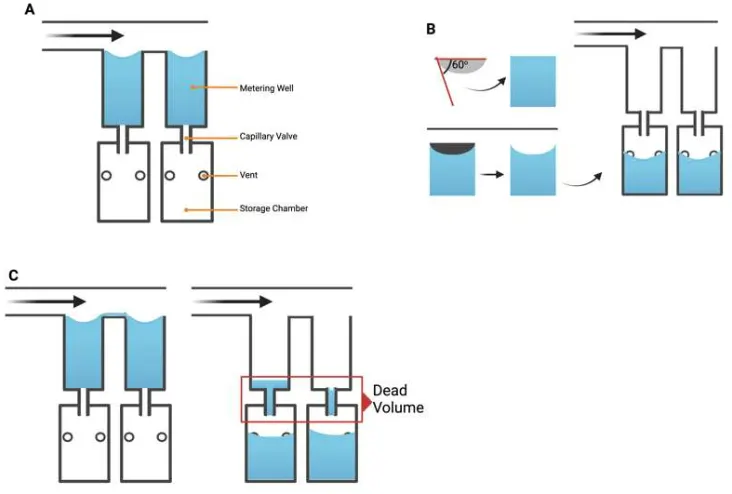
Each of the sixteen wells combined two stacked chambers, a metering chamber on top and a storage chamber below, connected by a capillary valve. Splitting the well this way avoided a common manifold failure: wells filling to the brim one after another, leaving no headspace for mixing. The storage chamber’s fill volume was set directly in the CAD model, using a 60-degree hemisphere, matching the buffer’s contact angle on the printed surface, to cut into the chamber until it reached the target volume. A small perforation at that point was plugged with a PTFE membrane during assembly; once fluid reached the membrane and began wicking through, pressure inside the chamber rose enough to stop further filling on its own.
The capillary valve linking the chambers was sized to hold flow back until a deliberate pressure change opened it. At 0.5 mm wide and 1.25 mm tall, the valve geometry was calculated to produce a Laplace pressure of 403 Pa, and optical metrology after printing confirmed the finished valves matched the CAD file closely. A syringe pump drove bead suspensions through the manifold at four flow rates, 1, 3.5, 5, and 10 mL/min, while a high-speed camera recorded each run for later image analysis. Early tests revealed a siphon effect, where wells emptying slightly out of sync pulled fluid from their neighbors. Reprogramming the pump to ramp flow up and briefly hold a higher rate at the end of each run brought all sixteen wells into sync and closed that gap.
A separate set of experiments tested the same bead suspensions in simple glass vials to see whether heat alone could slow settling. Warming the buffer toward the surfactant’s cloud point caused it to form micelles, clouding the solution in a way that mimics a higher particle concentration and, per the Richardson-Zaki relationship, slows how fast beads fall. Turbidity and settling were tracked with a spectrophotometer and a camera, then processed in Python with OpenCV to measure brightness changes over time as a stand-in for bead concentration.
Results
The 3D printed manifold matched its design closely: post-print measurements of the capillary valves averaged 0.49 ± 0.02 mm, aligning with the calculated valve geometry. That precision mattered, because reprogramming the pump’s flow ramp to close the siphon gap depended on every well behaving the same way. Once synchronized, the sixteen-well chip reliably held and released metered volumes without wells drawing fluid from their neighbors.
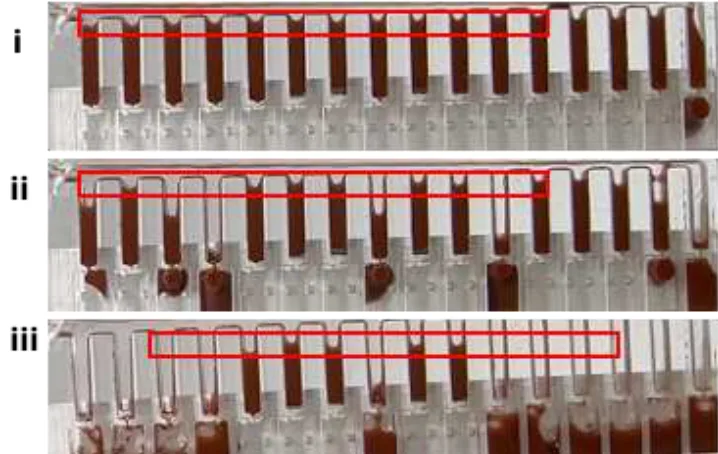
Figure 2. Photos of the printed 16-well manifold in use. Rows i–iii show wells emptying out of sync before the fix; iv plots the reprogrammed flow ramp that brought every well back into sync. Source: Anyaduba et al. Offsetting Dense Particle Sedimentation in Microfluidic Systems. Micromachines. 2024.
The flow-rate experiments showed that pushing suspensions through the manifold faster changed where beads ended up. At the slowest rate tested, 1 mL/min, beads eluted early and concentrated heavily in the first several wells, leaving later wells nearly empty. Raising the flow rate to 10 mL/min evened this out substantially, cutting well-to-well variation in bead concentration from 45% to 17%. Gains leveled off above 3.5 mL/min, suggesting a practical ceiling past which faster flow adds shear risk without much added benefit.
In the separate vial experiments, heating the bead suspension buffer toward the surfactant’s cloud point raised its turbidity by roughly 45% and, in turn, slowed the bead sedimentation rate by 58%, consistent with the Richardson-Zaki prediction that particle interactions in a more crowded suspension resist settling. Because this phase change is reversible, the same buffer can be cooled back to its original state afterward. Together, the two methods point to a way of taming bead settling using components already common on a benchtop, without resorting to gel beads or added pumps and valves.
“Both solutions exploit rudimentary components in biomedical platforms, thereby not adding to the cost.”
— Anyaduba et al., Imperial College London
Products Used In This Study

Questions on how our 3D printing system can work for your research? Connect with one of our specialists.
More Research Article Summaries
McGill University researchers build a 3D printed double-sided mold system to shape and merge brain organoids on a chip
University of Hawaiʻi researchers 3D print wearable "sweatainer" devices with true microscale internal channels
Want to read more article summaries?
We summarize the latest microfluidics and 3D printing research.
Curated from peer-reviewed publications featuring the CADworks3D system.