
Research Article Summary
5 Minute Read
ETH Zürich Researchers Use 3D Printed Molds to Build a Cell-Recirculating Hanging-Drop Chip
Title
Controlling bead and cell mobility in a recirculating hanging-drop network
Authors
Nassim Rousset, Martina de Geus, Vittoria Chimisso, et al.
Journal
Lab on a Chip, 2023, 23, 4834–4847
DOI Link
Summary
Rousset et al. built a recirculating hanging-drop network that uses adjustable drop height to switch beads and immune cells between free-flowing and stagnant states at the open air-liquid interface, with the pneumatic-layer mold produced by either standard photolithography or a 3D printed mold.

Summary Author
This page was prepared by CADworks3D to summarize and highlight a peer-reviewed research article authored by independent researchers utilizing the CADworks3D system.
Title
Controlling bead and cell mobility in a recirculating hanging-drop network
Authors
Nassim Rousset, Martina de Geus, Vittoria Chimisso, et al.
Journal
Lab on a Chip, 2023, 23, 4834–4847
DOI Link
Key Results at a Glance
300 µm
Critical Drop Height
Below this height, beads and cells flowed freely. Above it, they settled and stagnated
1 µL/min
Closed-Loop Flow Rate
The rate at which the on-chip pneumatic pump recirculated particles around the loop
3.5 mm
Drop Aperture Used
The hanging-drop diameter that gave the team fine control over flow versus stagnation
2 mold routes
Photolithography or 3D Printing
Both fabrication methods produced microfluidic layers with matching flow-control results
Objective
Multi-organ and body-on-a-chip systems are built by linking small tissue cultures together so researchers can study how healthy and diseased organs affect each other, and how compounds move through the body. For these systems to be useful, a suspension of circulating cells, such as immune cells or tumor cells, needs to move freely between the fixed tissue models, similar to how blood carries cells throughout the body.
Most microfluidic chips are closed systems, meaning the fluid channels are fully enclosed by solid walls. Physics describes this as a no-slip condition: fluid touching a wall barely moves, so cells near the channel wall slow down, settle, and stick over time. That becomes a problem if the goal is to keep cells circulating for hours or days.
Hanging-drop networks (HDNs) offer a workaround. Instead of a fully enclosed channel, part of the boundary is an open air-liquid interface (ALI), where the bottom of the drop is exposed to air rather than a solid wall. In theory, an open interface should behave like a slip boundary, where fluid right at the surface can move freely and carry cells along with it instead of letting them settle.
The gap this paper addresses is what happens when that theory meets real cell culture medium. Earlier hanging-drop platforms could recirculate fluid, but it was not confirmed whether suspended cells would keep flowing through a closed loop, or whether they would unexpectedly settle out despite the open interface. The authors set out to test that assumption directly, and to build a device where the residence time of circulating cells around a tissue model could be deliberately controlled.
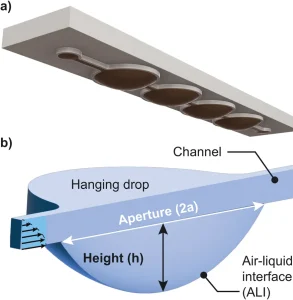
Figure 1. A hanging-drop network links open drops through microfluidic channels. Each drop's aperture is fixed by design, while its height can be adjusted during an experiment. Source: Rousset et al. Controlling bead and cell mobility in a recirculating hanging-drop network. Lab on a Chip. 2023.
Methodology and Design
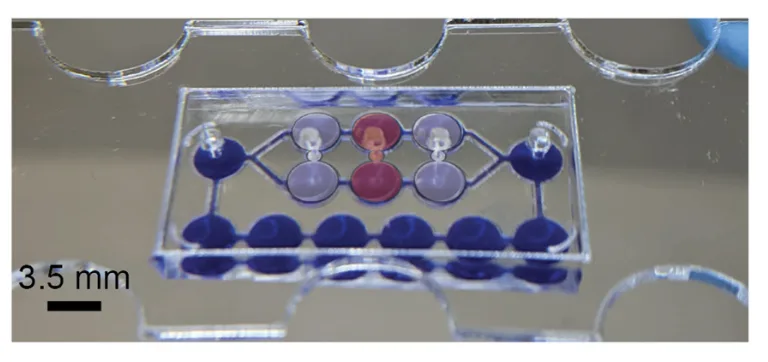
The chip is built from two bonded PDMS layers on a rigid support slide. A microfluidic layer carries the hanging drops, connecting channels, and integrated valves, while a pneumatic layer sits above it and squeezes the drops below to pump fluid forward. Each layer starts as a mold: the microfluidic layer’s mold was patterned by standard photolithography, while the pneumatic layer’s mold could be produced the same way, or by 3D printing a mold of equivalent geometry, before casting PDMS over it and plasma-bonding the two layers together.
The team validated this platform across several parts of the recirculating design, shown below:
Bead Recirculation
THP-1 Cell Recirculation
Height-Monitoring Drops
3D-Printed Mold
Bead recirculation came first. 8 µm polystyrene beads suspended in de-ionized water circulated smoothly around the closed loop, confirming the slip boundary worked as expected. When the same beads were suspended in RPMI-1640 cell culture medium with 10% fetal bovine serum, though, they slowed down and settled at the bottom of the drop within a few hours, a behavior typical of a no-slip boundary rather than the expected slip condition.
The team then repeated the test with THP-1 cells, a human monocytic leukemia cell line commonly used as an immune cell model. Cells were cultured under standard protocols and kept below 1 x 10^6 cells per mL to preserve their spherical shape. Cells in culture medium showed the same stagnation pattern as the beads, confirming the effect was tied to the medium rather than the type of particle.
Height-monitoring drops, positioned at the edge of the network and loaded with thin plastic rings, let the team track drop height at micrometre precision using open-source feedback-control software. By infusing or withdrawing de-ionized water through a dedicated inlet, they could hold the drop height steady or deliberately change it mid-experiment without disturbing the recirculating loop.
For the mold that shapes the pneumatic pump layer, the team compared two routes. The standard route etched an SU-8 master on a silicon wafer through photolithography, using a 7:1 PDMS-to-curing-agent ratio for stiff, reliable valve operation. As a faster alternative, they 3D printed a mold with an identical channel design, cured the resin under a high-intensity UV post-curing lamp, and cast PDMS directly onto it. Both routes produced a chip with 0.75 mm punched inlets, 300 µm-wide interconnecting channels, and 500 µm-tall structures, bonded to a support slide by either plasma activation onto glass or double-sided tape onto laser-cut acrylic.

Figure 2. The two-layer chip design: a microfluidic layer with on-chip pump drops (left) sits beneath a pneumatic layer (right) that squeezes the drops below to drive flow. Source: Rousset et al. Controlling bead and cell mobility in a recirculating hanging-drop network. Lab on a Chip. 2023.
Results
The central result is that drop height controls whether particles flow or stagnate. Using the existing on-chip pump design with a 3.5 mm drop aperture and a measured recirculation rate of 1 µL/min, the team confirmed that a drop height above 300 µm caused beads and cells to settle at the bottom of the drop, while a drop height below 300 µm let them flow freely around the loop. This matched a mathematical model built with the finite element method, which predicted the same threshold based on the balance of hydrodynamic, gravitational, and surface-tension forces acting on a particle at the interface.
To explain why cell culture medium behaved so differently from de-ionized water, the team imaged the air-liquid interface with transmission electron microscopy and measured particle size by dynamic light scattering. Both techniques showed that components of the culture medium, mainly from the added serum, formed increasingly large aggregates at the interface over time. This gradual build-up is what created a pseudo-no-slip boundary, turning an open, theoretically free-flowing surface into one that behaved like a solid wall.
Because the 3D-printed and photolithography-made molds produced functionally identical microfluidic layers, the study also showed that a 3D-printed mold is a viable, faster alternative to cleanroom photolithography for this class of chip, without compromising any of the flow-control results described above.
“Careful experimental design can still enable unimpeded particle flow.”
— Attribution: Rousset et al., Lab on a Chip, 2023
Products Used In This Study
Questions on how our 3D printing system can work for your research? Connect with one of our specialists.
More Research Article Summaries
McGill University researchers build a 3D printed double-sided mold system to shape and merge brain organoids on a chip
University of Hawaiʻi researchers 3D print wearable "sweatainer" devices with true microscale internal channels
Want to read more article summaries?
We summarize the latest microfluidics and 3D printing research.
Curated from peer-reviewed publications featuring the CADworks3D system.