

GUEST EPISODE 07
What happens when 3D printing meets pharmaceutical innovation?
6th October, 2025
Hemdeep Patel , Drew Wollman, John Shanley, Anne Tong
How is AbbVie’s SPaRCS team reshaping research with 3D printing?
In this three-part series of Big Ideas at Microscale, host Hemdeep speaks with Drew Wollman, Anne Tong, and John Shanley from AbbVie’s SPaRCS group, a curiosity-driven, skunkworks-style team building custom scientific tools with 3D printing that are transforming drug discovery.
In each episode, we cover:
Part 1
The origin of SPaRCS, their mission of “organized chaos,” and how diverse expertise in engineering, microfabrication, and fluid dynamics comes together to accelerate innovation inside a pharmaceutical company.
Part 2
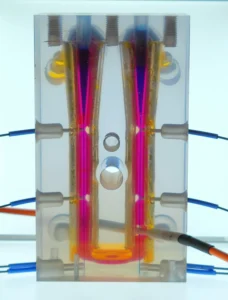
How 3D printing became a cornerstone of SPaRCS’s workflow, from early skepticism to a fleet of printers enabling rapid iteration. We dive into the creation of the iBeacon, a one-of-a-kind microfluidic device that measures protein viscosity and concentration with just two microliters of material.
Part 3
The technical breakthroughs and problem-solving mindset behind printing microfluidic devices at scale, overcoming delamination, curing challenges, microchannel cleaning, and alignment across thousands of layers, and how humility and collaboration drive SPaRCS’s success.
At the time of recording, all guests were employees of AbbVie.
Disclaimer:
John Shanley, Anne Tong, and Drew Wollman state. The opinions and views expressed in this episode of Big Ideas at Microscale are solely my own and do not reflect the views, opinions, or positions of AbbVie or any of its affiliates.
Podcast Summary
The discussion focuses on how 3D printing became central to AbbVie’s Sparks group instrumentation work in early-stage drug discovery, featuring mechanical engineers Drew Wollman and John Shanley and chemical engineer Anne Tong. The group traces its path from an early failed attempt with powder printing to today’s fleet of SLA and FFF machines, and covers the iBeacon device, a flow-channel block with microchannels and fiber optics that measures protein viscosity using tiny sample volumes.
The conversation also digs into the engineering problems solved along the way, including delamination, optical distortion, and misalignment. The episode explores how additive manufacturing complements traditional machining and photolithography, and how interdisciplinary, curiosity-driven engineering can produce instruments unavailable anywhere else in the industry.
Available on :



"We needed a creative name for our group, and whatever it was going to be called, it had to have the word chaos somewhere involved. Organized chaos is kind of one way to look at it. We make robotic systems, automation systems, software, hardware, processes, all of the above, and kind of beyond that for drug discovery research, know, things that give other scientists, biologists, chemists here within the company a competitive advantage."
Transcripts
Part 1 Transcript
Introduction to the Sparks Group Part 1
Hemdeep (00:09) Welcome to Big Ideas in Microscale, the podcast where we explore groundbreaking research happening at the microscale where micro innovations makes a big impact. We’re excited to showcase the incredible work being done by our users from around the world who are pushing the boundaries of microfluidics, lab on the chip, organ on the chip, and beyond. Through these conversations, we hope to learn from their experiences, uncover their insight, and bring their big ideas to wider audience. So whether in a lab, on the go, or just curious about the future of microtechnology, join us as we dive into big ideas at Microscale.
Hemdeep (01:01) Welcome to Big Ideas at Microscale. I am Hemdeep Patel, your host. Unfortunately, today we don’t have my co-host Robin. She’s in the process of setting up her new life in Alberta, but I’m sure she’ll be jumping on during our next episode. I’m actually very keen about this next topic and this next group of people because we’ve conversed with the researchers at schools, at universities. We’ve done some conversations with those that are in the microfluidic field in terms of 3D printing. This is the first opportunity I get to talk to with a team based out of a pharmaceutical. We’re talking to Ann Tong and Drew Wollman and John Shanley from AbbVie and they are part of the group that’s called Sparks. Welcome you guys. How are you?
John (01:51) Good, thank you.
Anne (01:52) Thank you for having us.
Hemdeep (01:54) Before we begin, why don’t we jump in and I guess I can have you introduce yourself. Why don’t we start with Andrew, I think you’re the leader of this group here, so why don’t you take the lead and charge us through.
Drew (02:06) My name is Drew. I have a PhD in mechanical engineering and I have been at AbbVie for five years. I am a member of a multidisciplinary group in AbbVie that is internal curiosity-driven research group that services our clients in drug discovery in AbbVie at the early stages of drug discovery.
Hemdeep (02:29) And how about you?
Anne (02:31) Yes, my name is Anne Tong and I have a PhD in chemical engineering. I have been working at AbbVie for two years and I’m having an amazing time with Drew, John and every member in the group.
Hemdeep (02:44) Amazing, John…
John (02:46) I’m John Shanley. I have a master’s in mechanical engineering from the University of Illinois. I’ve been in the group here for about five years, kind of switching around between traditional mechanical engineering, more towards robotics and software lately, and of course, 3D printing.
Hemdeep (03:01) Great. So I think Drew touched on this briefly and I think that would be possibly the best place to dive in. And it’s this group that you’re part of called SPARKS. I did a bit of dive into SPARKS and the mission statement, it is very interesting. If you sort of give us what the acronym SPARKS stands for and what the focus of that group is, Drew.
Drew (03:24) No. John can do that.
John (03:27) Specialized research in chaotic systems. That’s Sparks. It came from our leader, Jeff Pan, who was told by his manager years ago that we needed a creative name for our group and whatever it was going to be called, it had to have the word chaos somewhere involved. Organized chaos is kind of one way to look at it. We make robotic systems, automation systems, software, hardware, processes, all of the above and kind of beyond that for drug discovery research, things that give other scientists, biologists, chemists here within the company a competitive advantage.
Hemdeep (04:05) So if I was to put it out to the three of you, when you first joined Sparks or you were brought into Sparks, what part of that group network really inspired or at least what was the connecting point that you found very valuable to you?
Drew (04:20) So I think for me, when Jeff first reached out to me to hire me, he described an environment in which you will always have something new to work on. You will never be bored. Every project is new. Every challenge is great. There’s lots of room for improvement wherever we look. And I think that Jeff’s knowledge and excitement of the industry really got me excited about the group. That’s why I joined.
Hemdeep (04:52) Yeah. How about you, Anne?
Anne (04:54) Yes, for me, it’s like when I talk to Jeff, he inspires me about the opportunity to grow in the group. And when I come to the group for the interview, I experienced that each of the team member, the group member, they have different background. And when we talk about it, I feel I can learn a lot from them. It’s like I am specialized in microfabrication for microfluidic device. And in the group we have Dave Chang-Yan, he also specialized on that and he has more experience than me. So I feel I can learn from them and on top of that I can learn from Drew, John. I feel it’s a non-ending journey for me to learn and grow and be in the field of pharmaceutical, which is the field that I really want to work with and be helpful and devoting my specialties for the field.
Hemdeep (05:47) And you, John, how did you sort of be inspired? It’s starting to sound like your first connection with this team. There was a connecting point between what you’ve experienced before and what you’re currently experiencing right now. And it was a continuity of your, I guess, a mindset that you had.
John (06:04) Yes, the continuity and the common factor I think that you’re hearing here is curiosity driven research. Nobody here, I think would really be too satisfied in iterating on what’s already been done as much as they would be exploring what’s to come. For me, that was the idea that kind of sold me on the group. That notion that, hey, yeah, you could just optimize this a little bit more and a little bit more. But if we look at this from an interdisciplinary perspective and we say, hey, you’ve got an electrical guy over here, mechanical guy over there, a software person about, and now we’re going to throw this weird problem at you that none of you really understand more than like 10, 15% of. What can you come up with? Where does that take you? It was the freedom to kind of imagine where you could go and how you could integrate and learn along the way. That’s what got me excited.
Hemdeep (06:55) If you take the name, I guess the word sparks, you said that the word chaos had to be in there. So how does that even work? When you look at biological innovations, like how are you supposed to find chaos in systems that are fairly not rigid, but the prescribed systems that have a well-known functionality? Then you try to, where does the chaos start in this case?
Drew (07:19) Drug discovery is complicated and there’s lots of work that needs to be done and there’s no clear path on how to do it. There are rules of thumb, there are things that have worked in the past, but there’s plenty of room and there’s more room to innovate there than almost anywhere. And I think the chaos comes in as in we have a bench scientist that has a problem or would like to do something faster and better. There’s lots of different ways that that could happen. And so we are encouraged to pursue multiple solutions in parallel to help solve that problem. And that, from an outside perspective, if you’re in a traditional engineering company, that looks like chaos.
Hemdeep (08:10) And so would it be correct to say that within your system you have a series of verticals, multiple projects going at the same time, all of them attacked in parallel? I can envision that being chaotic if someone was to see it from the outside.
Drew (08:24) And all of our solutions from one project can feed into other projects. So the things that John is learning about 3D printing and his project, I use in my project, because John shares that information. And then that goes to Anne. And then Anne has a problem. And she knows that, or we talk about it, and turns out 3D printing is that solution for her problem. Let’s explore that. And then she’ll get a little bit farther along, and then she can enhance her microfabrication skills with the 3D printing.
Hemdeep (08:58) So I’m glad that you touched on skills. Can you draw it out as to exactly the skillset that you bring to the team? And then what have been the learnings that you’ve had over the last, in your case, Anne, two years, and Drew and John, the last five years? Like what is the additional skillset that you’ve built on previous to you attending or it being brought on board in this team setting?
Anne (09:21) Before I joined AbbVie, I’m specialized in microfabrication of microfluidics device using photolithography. So most of the time I use the mask and I use the photoresist so that I expose the light through the mask and cross-link the patterns and transfer the pattern on the mask to my substrate. And that’s the only way that I have been using to create microfluidics channel, tiny microfluidics channels in my device. And after joining AbbVie, I started to learn how to do 3D designing, modeling, and then also picking up 3D printing, how to apply 3D printing to make microfluidic device for my daily use. The advantages of 3D printing is it’s fast turnaround time. So for example, regular microfabrication technique that I use, it takes me a week to finish and each iteration it takes another week and another week. So for 3D printing, I can just quickly draw up a 3D model, put it in the printer and print it, and then the next day I have something to investigate and make change. I also learned from other team members to become a little bit of mechanical engineer, a little bit of how to put the wire together without electrocuting myself. So I’ve learned so many things. I learned to become better at optics, designing the microscopy from another team member. And I have learned a lot from all other team members in the group, every day, every day.
Hemdeep (11:00) Yeah. How about you, John?
John (11:02) I loved those answers a lot and I forgot the original question.
Hemdeep (11:06) The original question was, in terms of the skill set you had before you joined this team, how have you found that joining this team has broadened your capabilities in everything that you try to do?
John (11:20) Back to why I came here, that was the thing that really kind of got me interested. So before here, I spent a couple of years as a mechanical engineer designing for a consulting firm of sorts. And I’d carry a few projects at a time and I would do just the mechanical design and prototyping and hand it off. And that was that. When I was contacted here, the position was primarily a software position. My experience with software was programming Arduinos and Raspberry Pis to do what I needed to do in grad school, not professional software development. I’m not a programmer. And so I told them this in the interview process. And I was like, you guys realize you’re trying to hire a programmer who doesn’t know programming. And that didn’t seem to faze anyone. So I thought that was strange. I’m interested. Yeah, they hired me to be a programmer of all things. And now I get to do both. So I learned C sharp. I didn’t know C sharp before I started here and I can now efficiently and effectively program robotic systems in that language and navigate additional interfaces beyond there while maintaining the mechanical design work that I had kind of started with and what really got me interested in engineering in the first place. So as far as new skills go, I’d consider that a pretty good one to pick up.
Hemdeep (12:41) That sounds fantastic. So you’re saying that before you joined the team, you had no software skills at all.
John (12:48) I mean if you count undergrad MATLAB then I had that. If you count looking at Stack Overflow for Raspberry Pi how to do blink an LED type stuff, I had that. Beyond that, nothing.
Hemdeep (13:03) Nothing. Drew, before you even answer this question, I looked at your Google Scholar and the stuff that you were working on. I just sat there, what on earth? So this one that really jumped out, puddle jumping, spontaneous ejection of large liquid droplets from hydrophobic surfaces during drop power tests. I looked at that. I need to know exactly what drew you to this.
Drew (13:32) So my background is large length scale capillary fluidics, so managing propellant for orbiting spacecraft. When there’s no gravity, fluid behaves much like it does on Earth, but at a much smaller scale. So of course I’m a microfluidist, and so in my job interview, I had to confess that I’ve never made a microchannel in my life. And they’re like, yep, you’re perfect. So the common thread in our group is that no one is really an expert in what they’re working on. I have built a career out of fighting bubbles, and that is a handy skill to have, whether it’s in spacecraft or in diagnostic equipment.
Hemdeep (14:18) In terms of the skills that you had leading up to this, how have you found, or at least broadly speaking, the new skills that you’ve developed while you’ve been on this team?
Drew (14:29) There’s plenty of new skills. So microfluidics is a new skill, but also program management. There’s some software development that I’ve had to try and wrap my mind around. Electrical components and electrical selection, that’s been my latest opportunity for improvement. So I’m familiarizing myself with all of the problems with electronics communicating with one another from various sources. There is never a moment where I’m not learning in the Sparks group. And I think that that’s true for everyone.
Hemdeep (15:10) Amazing. Would you be able to give me an example of a project that sort of brought all of this together in one cohesive way? I know that we’re going to be touching on some of the projects that you’re working on right now, but have there been projects that have gone commercialized, or at least found their way to a point at some point may have failed and may have succeeded, but there was a collaborative effort, how many people would be collaborating on a specific project?
Drew (15:38) There might have been one project that was commercialized that came out of the Sparks group, but by and large, almost nothing is commercialized. We build sophisticated prototypes for our scientists. Everything is unfinished and can always be improved, but we get it to the scientists as quickly as possible to make it as useful as possible in the amount of time that we think is reasonable. And then they start working on it. And then as scientists start using the instrument, they give us feedback and start giving us feature requests. And we’re able to turn those around. Every project is collaborative. Even if there’s only one Sparks group member working on a project, they are working very closely with scientists, biologists, chemists, and external groups. I have been working with Anne very closely on our project now. I also help other people with their projects. So if John is working on his project and he needs help, we help each other. So it’s collaborative in the group, but also across the group within AbbVie. I guess, John, do you have something to add about how collaboration works? You work with, I guess, Marco. You were working with Marco, so that’s the next turn.
John (17:06) Marco messaged me about five minutes before we hopped on this call and set up a meeting for later this afternoon. So that’s an excellent guess out of seemingly nowhere. Yeah, Marco is a great example. He’s a scientist over more towards the production side of things, but he’s worked in a number of areas here. He’s a chemist by training. And when he’s got little needs like, “Hey, I need to test out this new process,” or “we’ve got a machine coming next year that is going to, for example, work on drying out a wetted powder of some sort. I’m not going to get this machine until next year, but I need some initial data to basically demonstrate that this is the right path to go on to optimize our targets, to get ourselves a head start into doing the research that we ultimately need to do. Can you help me do that?” He comes to us for the engineering side of things. And this is an extremely basic systems problem that he’s asking for. He’s saying, “Okay, I’ve got this wet powder. I need it to be a dry powder and I need to not damage it in the process. Can you help me do that?” Sure, absolutely. That’s the low, easy end of the type of project that we would work on. This is the sort of thing that might not be on my radar for more than a week or two at a time. But one of the cool things here, and trying to tie this back into collaboration somehow, everybody in this group is carrying a couple of projects like that, a couple of projects that might be on the one-year, multi-year length scale, and all in between.
Hemdeep (18:29) It sounds like as if these projects may be various in length. The sole purpose of the project isn’t for commercial applications. It’s actually pretty much to identify processes or improve processes within the network within AbbVie itself, period. And then if it turns into something commercial, fine. If it doesn’t, that’s great. There’s no issue about that because it would have had an immediate application at the scientific level, whether it’s a biologist, chemist, or any of them, their needs. That actually is a very interesting way of setting up departments where there is no overarching need to follow the bottom line, that we’ve got commercial ventures that have to be out the door in one-year, five-year increments, so on and so forth.
John (19:18) Yeah, that’s one of the nice things here is that we’re pretty separated from the commercial aspect of things. We are almost kind of like our own little bubble in a lot of ways, just framing it as a Skunk Works team would be the way to put it, I suppose. There’s no cutoff, no deadline or anything like that, that isn’t at least partially influenced by our own leadership and decision-making.
Hemdeep Nice.
Part 2 Transcript
3D Printing at Sparks and the iBeacon Instrument Part 2
Drew (03:00) We can start with John. John sort of just introduced our group to 3D printing. He brought in the first 3D printers. Anne and I have been collaborating on the CADworks printer. So overall John’s 3D printing is big picture and Anne and I are 3D printing but specific, like focused.
Hemdeep (03:26) Okay. Perfect. If you guys can just tell me what that looks like in terms of that first collaboration and then what are the mandates between the three of you for this project that you’re currently working on, and we can sort of peel away the layers of that one as well.
John (03:41) Perhaps it’s helpful to start broad and go specific. I actually brought in the second 3D printer that this group has had. The first one was brought in several years before I knew about Sparks or had ever heard of this company. And it was a pretty comprehensive failure from the stories that I have been told. It was a powder-based printer, I think it was an SLS style printer. And it made things out of cornstarch that were water soluble and was apparently a giant mess, an incredible pain. I honestly don’t know who made the printer or really anything more than I’ve shared so far, but it really soured the taste in everyone in Sparks’ mouth for the concept of 3D printing, because the mechanical engineers who were here and comprised the group at the time were all from backgrounds that were heavily reliant on machining practices, your traditional CNC-based tooling, tooling in general and CNC later. But when I mentioned 3D printing, because that was something that I’ve had at every stop along the way, internships in school and grad school and my previous job, every time there was always a 3D printer in the room or in the lab next door that I could just kind of walk over to, click play and get my little prototype, my three-dimensional scratch paper of sorts, I wanted that here. So I asked for it and they told me all these horrible stories and I said, “All right, let’s just try it anyway.” So I just bought a relatively cheap fused filament fabrication printer and over the span of a year, talked them into using it. There was more resistance from some parties than others. But eventually that turned into, “there’s enough people using this that we’re forming a decent queue, let’s get another one.” And that turned into, “well, what else can we do with these things?” And so we ventured on over and got an SLA machine, and then a bigger SLA machine. And then it kind of expanded from there to the point where I think we’ve got eight, nine machines now of different manufacturers, different capabilities, but for the most part they’re SLA and FFF. Later on, once it had become established, we started getting some of the machines that could do the finer details, which is a lot of what Drew and Anne have been working on together. I’ll let you guys kind of talk more about that.
Drew (06:17) Yeah, I’ll also just add to John’s comment. Time is really the only resource that we value. And if we can iterate on something three times in one week, that is priceless. And so whatever the cost of the printer is, the printer has paid for itself immediately. Can the printer solve all of our problems? No, of course not. But there’s use cases for the printers that the printer solves immediately, and then we can learn faster. Like Anne said, she has a prototype the next morning that she can use and that she is now getting data from. And in John’s case, John needs a whole bunch of different brackets, say. But they’re all custom brackets, and they’re all holding on to things in different ways. John can make those brackets way faster and way cheaper on a printer than it would take a machine shop to build them. So the time aspect is also really critical for us.
Hemdeep (07:25) And how about you, Drew, do you have, have a possible application of what it was old school compared to new school? Now that you have a printer, obviously your workflow has changed. But in terms of development now, what value do you find in that?
Drew (07:42) For me, the quick turnaround time is the most valuable point. And before, I also did have a strong resistance to use 3D printing to make microfluidic devices. I tried before when I was in grad school, and the technology at that time was not up to date yet. So it’s hard to make small channels, and it took a little bit of time to convince me that the new printer that we got in our group is going to be able to do what we need. And then I worked closely with Drew and then I figured it’s actually good enough for our prototyping purpose. And I’m enjoying using 3D printing so far. I got to add to that too. It is very humble, it’s not like 3D printing is replacing these traditional microfabrication techniques. It’s enhancing them. So Anne is actually combining microfabrication techniques and 3D printing techniques and combining them in single devices that have previously never been made. The conversation should never be like, “3D printing has replaced microfabrication,” “3D printing has replaced traditional machining.” Absolutely not. We use it to enhance each technique. So we’ve combined microfabrication and 3D printing, combined machining and 3D printing, to make it better than the sum of their parts. Does that make sense?
Hemdeep (09:17) And I think the stories the three of you have are the ones that we always hear where iteration cycles have increased. They’ve been able to leverage 3D printing with the existing microfabrication techniques, and that the first uptake for 3D printing is usually a story of a platform that did not work, didn’t deliver something that they had wanted, therefore they were sour. And then it required another, almost a big leap of faith to sort of say, “Okay, I think I’ll try it again.” And then you start seeing the wheels of idea-making, it just evolves very, very quickly. Once you’ve got that wheel going, it really has a momentum of its own.
Drew (10:03) Right? And it’s also about choosing the right problem. So 3D printing is a tool. So apply that tool to the problem that it’s most applicable for.
Hemdeep (10:13) I’m going to sort of touch on this more broadly. I know there are things that you’re not able to divulge because you’re currently working on it, but perhaps you guys can sort of put a thread and then connect all that together. In terms of 3D printing that you have deployed in your group, what would be the current project that you’re working on, and what other techniques or tools are you combining together in order to provide a solution for your scientist meeting? Obviously 3D printing would be one. And what other technologies are you combining together for a deliverable solution for your scientists?
Drew (10:52) So the instrument that combines everything that we’ve sort of been circling around is the iBeacon instrument. The heart of the iBeacon instrument is a flow channel that is complex to manufacture. It spans a wide variety of scales. So we have microchannels, but we also have large-length-scale features that are critical as well. And that print, after it comes out of the printer, still needs to be post-processed using a variety of different manufacturing techniques. And then even more different stuff is happening later to the block, to the instrument, to make the end product usable. Do you want to talk about that? This is the thing that comes out of your printer, and we have very…
Hemdeep (11:44) That’d be fantastic.
Drew (11:52) …tiny 300-micron-diameter downspouts, I guess. So we have microchannels in there, we have sensor holes in there. Optical clarity is critical, surface roughness is critical, and it’s all got to print. This takes up the entire build volume of a CADworks. So we need the resolution that particular instrument offers, but we’re also maximizing our volume. And so to get those two things to work takes settings that Anne sits down and painstakingly tries to figure out. We’ve had to modify our printers mechanically. Anne has modified the settings and the parameters for the prints. Everything from micro-fab all the way to milling, it’s everything. Everything goes into this instrument.
Hemdeep (12:57) I’m very curious about that. I’ve got half a million questions about that. First of all, if I was to ask just about the visual that you gave me, can you tell me how many individual devices are integrated in that? A device would be a single channel that would go across, because that is a point of interaction between two parts. If you were to say how many channels are going through there, how many different parts and features do you have within that one device?
Drew (13:25) The two main channels are vertical. They come down. Those are 300-micron-diameter channels. Those meet at the bottom. There will be a fluid channel, an open-faced fluid channel here, that has 68-micron-diameter fiber optics embedded in it. That’s separate.
Hemdeep (13:45) Okay. And that would be milled in place, correct?
Drew (13:48) Nope, that’s cast in epoxy and then machined with a femtosecond laser.
Hemdeep Wow. OK. OK.
Drew These are liquid level sensor ports here. This is threaded features for fiber protection. There’s cooling channels, there’s insulation channels, there’s alignment features, there’s mounting features. It’s complex.
Hemdeep (14:14) You’ve piqued my interest significantly. You can tell me anything and everything you’d like to about that device. What is the application for that device? Is it a biological application, chemical application, an undisclosed application? You tell me.
Drew (14:27) Okay, so this is the heart of an instrument that is used to measure the viscosity and the concentration of a protein solution. The viscosity of a drug determines how painful it is to inject. So you’re optimizing viscosity and concentration, typically effectiveness also matters. I mean, that’s the only thing that matters.
John (14:53) Yeah, that’s key detail.
Drew (14:57) But you can get to effectiveness in multiple different combinations. So do you need a large-volume injection dose at a lower viscosity, or can you get away with a high-concentration dose at a higher viscosity? Viscosity equals pain, or correlates to pain, high viscosity is more painful than low viscosity. So this device measures protein concentration and viscosity. But it does it with very small volumes, like it can go down to two-microliter volumes of your sample. So it’s truly micro scale. And that’s critical because in early drug discovery, you don’t have a lot of sample. Proteins are hard to manufacture, I’ve never made one, but I imagine they’re difficult, because in early drug discovery you have a very small amount, a very small mass. And so you have to take that precious solution and then conduct these tests, and then either keep them for further testing or you can just get rid of them. So in early drug discovery, we have a small amount of fluid that’s super precious that we need to conduct all of these measurements on. And this instrument is being developed to do that. So the 3D-printed part has a couple of different requirements. It needs to be super smooth, it needs to be super small, the fluid channels need to be small, there needs to be optical clarity, it needs to be mountable, rigid. And then we have to mount the sensor on the bottom. So when we integrate the sensor on the bottom of this block, we have tried to 3D print it in the past, so this is it all integrated all in one thing. It’s not coming through in the video, but we’ll get a picture of that. So we can integrate this sensor in 3D printing, but there’s trade-offs if we do it one way or the other. So the current way is what we’re doing.
Hemdeep (17:03) Does this block fit into an existing apparatus, or are you also building the apparatus that you are using to do the further testing or evaluation of these programs?
Drew (17:15) This block is a custom block that fits into a custom machine. There are commercially available components that are on the instrument, like a liquid handler, pumps, regulators, and things like that, so you can buy the components for the instrument. But it’s all combined in a custom way.
Hemdeep (17:37) And if we were to connect it back to a previous conversation, it’s not a commercial venture. This is to address an issue or a problem that has been identified within the team at AbbVie, and you’ve been tasked to find a solution for it.
Drew (17:54) Right, this instrument does not exist. You cannot buy it. Merck, J&J, no one else has this instrument. AbbVie has this unique capability.
Hemdeep (18:03) So let’s go back to the instrument. Now you’ve printed out that block. It sounds like it requires either additional parts that you’re going to fuse onto it to complete it. What other machining have you needed to do on the part in order to now become a fully functional device for your application?
Drew (18:25) Okay, I really want Anne to talk about all the print settings that she had to fight with. But I’ll talk a little bit about the machining post-processing that has to happen. So the first thing that has to happen is if you print vertically, if your print bed is like this and you’re printing in this orientation, the layers will diffract light, and that’s bad for optical sensing purposes. So we actually print it tilted. Once you surpass the angle of total refraction, then you get better optical quality in your prints. That’s the first thing that we had to do. The surface roughness of the print layers is insufficient for our needs, so what we had to do is develop a method to coat the microchannels with epoxy. If you fill the microchannels with epoxy and then you blow them out, the films of the liquid epoxy will collapse and occlude the channel, and then you’ve ruined your part. So then you have to have constant airflow, but if you have constant airflow, then you get rippling. We had to come up with a way to apply a body force to the liquid film so that it cures, the epoxy cures smoothly. And we are able to do that by putting the entire thing in a centrifuge, a heated centrifuge, and then we can spin it at some ridiculous speed, 200 RPM or something, and then get the epoxy to cure smoothly on the channel. So now we have smooth internal geometry, we have good optical quality. Then we take that and we send that to a machine shop, they square it up, because nothing comes out of the printer square, and they square it up so that it can be mounted and oriented in the instrument correctly. So I think that part goes through all of those things. But Anne can talk about how do you print a microchannel but also not have it peel off the bed.
Hemdeep (20:28) Yeah, sure, for sure. Can you tell me how tall that piece is? That looks to be about a hundred, probably 120 mils.
Drew (20:42) So if you take this block and you orient it in the print orientation, the maximum height from the lower raft that’s been removed to the top of the block itself is the maximum height the CADworks ProFluidics will allow, which is 120 millimeters. And we’ve maximized the width as well.
Part 3 Transcript
Print Settings, Post-Processing, and Final Reflections Part 3
Anne (03:34) I think most of the time, Drew had to deal with the problem before I joined to work with him. He spent almost a year fighting with the problem, trying to bring in the big part. Because before, if it was too heavy, while doing the printing, it just fell off the print bed. For example, delamination is a big issue. I really like the technology in the printer where you can peel the print, the vat tilting at an angle, peeling off from one side instead of pulling on the print bed straight vertically from the vat. And that is what I really like about this printer. And then I finally, slowly, tuned in for large surface coverage of the print bed. We need to peel it slowly, slowly changing the speed and peeling it slowly, but for the big part, if you peel slowly at all the steps, it’s going to take forever, and time is an important value to us. So we figured out that when we tilt the part at 30 degrees, the part that comes off the print bed first, the printing part first, from the top to bottom, the upper part, has a bigger surface, because all the support you need to add on the side so that it can hold the weight of the part we want to print. So those steps we can slowly fine-tune the time, slower at the top peeling-off speed, and then we can gradually increase the speed. So when it comes to the top, the final around 30% of the layers, you can speed it up. Fine-tuning those steps to figure out how fast you can peel off the cross-linked material from the bed is key, because delamination, sometimes it happens you spend a day printing the part and it’s good so far until it reaches about 30% of the last piece and it fails, and then you have to redo it again. So the way that Drew and I figured this out is by sectioning out the part before we print the whole block. We test out with a feature, print it, and then change the parameter. Then we section out, take another part of the block, print it, and with that, covering surface area and the sweep that we’re printing and the curing time, we can investigate: this part needs this much curing time, and it has to wait for about one, two, or three seconds before we even start to peel off the cross-linked material from the bed. And then later, when you have all the parameters, we combine them, this section needs this setting, the other section needs the other setting.
Hemdeep (06:45) So what was your print time roughly?
Anne (06:48) For that block, it takes around 28 hours. For optimization, it can take around 50 or 70 hours.
Hemdeep On it, do you have someone there pouring new material into the vat? Because I think you would have depleted the vat very quickly.
Anne (07:06) Yes. I usually set it up before I leave for the day. And the next day when I come in, I just pause the print, and the printer is smart enough to pause it and report that the next layer is about to cross-link on top of the part, and then I just top it up. But in the future, for example, for another printer that John set up, they have a big resin reservoir, and then it can pump in automatically, sensing the level and pumping in new resin. But that is not really a pain for me, topping up takes me five, ten minutes, so it’s not really a problem.
Hemdeep (07:45) Okay, so if you had 300-micron channels in the z direction and you had it angled, did you find that you had any deviation on the channels? Because UV light is going to penetrate right through on subsequent layers, so you print a channel, and even though it is now farther away from the vat, there is UV light being exposed to it. Did you just modify the profile to address that? How do you guys do that?
Anne (08:11) We modify the layer thickness, curing layer thickness, and also fine-tune the curing time. Sometimes for the smaller channel and deeper embedded channel inside the 3D printed blocks, we do a little bit of under-curing, enough to cure the layer, enough to get that layer to release from the bed, but accommodating the over-curing issue from the light penetrating through the block.
Drew (08:38) Anne is also being too modest. She’s working on all of these settings, and that impacts the cure, which impacts the cleaning of the block after it comes out of the printer. Anne also did a lot of work on developing the cleaning procedure, how do we get 300-micron microchannels cleared that have been overexposed or underexposed? There’s work there. I don’t know if she wants to talk about that.
Hemdeep (09:13) That’d be great to hear. All of these are issues that 3D printing will have, especially on the small scale. Microscale is very difficult to print. I’m amazed that you tackled so many of these all on one device. Usually most people will address only one issue per device, you’ve tackled pretty much every issue on one device.
Anne (09:33) Yes, for the cleaning, through experience, before, when we had a third party doing the printing for us, they soaked the treated printed block in solvent for so long, and then it created breakage, delamination, and deforming of the channel. So we learned that we have to reduce the washing time, it’s not like we can soak the part inside IPA for one or two days. We need to do it quickly so that the printed channel is not affected, washed away, or eaten out by the solvent. We also set up a station where I can use high air pressure to flow out the uncured resin. But sometimes for a very small channel, the resistance inside the channel is too high, if you don’t have a very tight fit on the inlet, you cannot blow air through; it’s just going to find a way to leak back out to the inlet. So we figured out we can try to flow solvent through it using high pressure, and when that doesn’t work, we apply mechanical wrapping, we have supplies of needles and small wires that we run through the channels to try to push out a little bit of the uncured resin inside the channel. Then we can use high air pressure or high-pressure solvent fluid to flow through the channel and clean it slowly. So it’s a multi-step process. Curing is also a problem, because for a thick block you don’t want any uncured resin or leakage over the time of use. We use a commercialized oven from another provider, we first do the bulk curing of the part, and then we use the oven chamber to do a directional cure, so we can concentrate curing on whichever side of the block we want to cure more.
Hemdeep (11:53) That is an amazing piece of device that you guys have created. Any other features in regards to that device in terms of the applications or anything of that sort?
Drew (12:06) Yeah, so another thing that we had to combat is when you’re dealing with a microchannel that’s vertical, that’s 300 microns in diameter, if your print bed moves 300 microns during a peel-off event, that means your next layer is misaligned with the previous layer.
Hemdeep Yes.
Drew And so the printer has a clamp that you clamp down on, and that works reasonably well for microchannels that are in small blocks where there is a small amount of surface area. But for our component, there’s a large volume, large surface area, so that peel-off force is very high and can misalign and overcome the power of that clamp. We first tried to shim it, put in some shims and clamped it down and went to town. That was insufficient. So what we ended up needing to do is take the print bed and modify it, putting in some set screws. After we mount the print bed, we clamp it down, and then we can tighten some set screws in the print bed, on the build platform. It’s more challenging to take in and out of the printer, but the benefit is far superior, every layer is aligned.
Hemdeep (13:31) In this device, how many layers did you have in your files?
Anne (13:35) Around 2,500 layers.
Hemdeep (13:39) Yeah, you could not afford any sort of sideways shifts, because that’s 27 hours down the drain at that point, right?
Drew (13:48) Right. We’ve sent this out to multiple third-party manufacturers, 3D Systems, Stratasys, also foreign companies. No one can do this. Only Anne can do this.
Hemdeep (14:02) There you go, see? There’s something to be said, you can give someone a hammer and they can just go around willy-nilly hammering everything. It just takes a skilled craftsperson to really do the right thing with it. That is amazing. When I saw that block that Drew just showed, I know what the challenges are inherently, but to be patient and overcome those, that’s where the recognition is right there. So now you take this block of yours, obviously this is not going to be a one-off every time you require a new protein to be tested; does it require a brand-new block to be printed, or is it now something that will get machined and then become part of your tool set as you develop other drugs?
Drew (14:52) The instrument is designed to be cleaned, cleaning the block is important. It’s not like there’s one block per team, but we want there to be multiple instruments. We have instruments deployed around the globe, we have customers in Germany and Austin and California who have different or subtly different needs, so their blocks might differ a little bit. So the main thrust of this was to make the blocks as easily replaceable as possible, as easily manufacturable as possible, while still maintaining the high quality. One thing that changed in my thought process about 3D printing during the development of this block was printing threads. I have always been a skeptic of thread printing, I would always prefer to cut the threads into a part. I’d print the hole, or print a pilot hole and then drill and then thread. I believed with all my heart that that was the best way to do it. And then one of our group members said, “You know, I’m just going to try it.” He tried it and it worked out great. And then I tried it, and I will never go back. So if the printer has the resolution to print threads, it saves so much time, and you can do so much more. There’s over ten threaded features on just this one block, and there are different types of threads, pipe threads, straight threads, heli-coil threads. If your software allows you to make that thread, your printer can print that thread, and it’s never let us down.
Hemdeep (16:41) That block is now forever etched. That itself is a very strong statement of the type of work that your team does at AbbVie for sure. Any last and final statements or words you’d like to share?
Drew (16:56) I talked to Maryfrances about this, but I just wanted to tell you where I thought all of us together, the story that I wanted to tell. We’re in this group, we don’t know what we’re doing. We’re all trying to come up with these cool ideas and realize these complicated machines. And John says, “there’s a better way, let’s cut down time, let’s make things faster, let’s iterate faster, let’s learn quicker,” and he brings in 3D printing. He’s so humble, but he’s stuffing it down our throats, and not just us, right, there’s other group members that are like, “no, this will never work, you can’t depend on a 3D printer, you can’t do this.” Those 3D printers that John talked about, all six of them, all eight of them, whatever, they’re always running.
Hemdeep (17:48) No, for sure. The funny thing is the way your team is made up is very similar to ours. None of our team are engineers, I graduated with a degree in physics and astronomy, my brother’s a musician and a sociology major. If you try to call him up during the summer, he’s doing street festivals throughout the city of Toronto, it’s insane. We’re very curious, hyper curious to a fault sometimes, where we get lost and go down rabbit holes. Robin was one of the first hires that we had that actually built a schedule, we did not understand schedules, we didn’t understand timeframes, there was no such thing as a deadline in our life, and then she came along and said we should be doing deadlines and schedules. So I completely appreciate where you came from. And the fact that John is an advocate of this, I really commend you, because there are people we talk to often who really look at 3D printing as either gimmicky or something that will never apply to them, and they don’t realize that you’re either one material away or a specific machine away from it actually applying to your application. The minute you find that marriage between the correct material, application, methodology, and purpose, you’re off to the races, there’s nothing that can stop you at that point. So I do commend you for pushing them along. That definitely is important.
John (19:24) I think the secret hiding in plain sight here is that we’re all experts, right, everybody’s an expert in everything all the time until you step back and say, “hey, wait, I don’t really know about this.” If you can admit that, then it’s easy, you can learn a lot. That’s the secret sauce of this group, so to speak, the whole reason that we succeed, like a microfabricator, a fluid astronomer extraordinaire bicyclist whatever, and a mechanical engineer masquerading as a software guy, the reason we can succeed in a pharmaceutical company is because we’re all comfortable admitting that we don’t know what we’re doing, talking about, or looking at, at any given time. And we’re all comfortable walking into labs full of experts who do know the chemistry, do know the biology, and just saying, “hey, what if, what if you tried this, what if you did that, how does it work when you…” and just take off the blinders. In a lot of ways, that’s kind of what we had to do to get 3D printing up and running here. I started that, but Anne and Drew, they saw it through. I think that’s probably a good way to sum up how we got ourselves into this.
Hemdeep (20:38) Amazing. So I would like to thank the three of you for taking time out today and sharing the amazing work that you and your team at AbbVie Sparks are doing. I am impressed with the type of things that people do, but this one really was very, very impressive in terms of being able to bring together a ton of skill and know-how to put that block together. And I know because we do blocks like that at the office and we know the amount of work that’s required to fine-tune a profile to get it done, it is amazing work. Thank you very much. Okay, awesome.
John (21:20) Thanks.
Anne (21:21) Thank you so much for having us today. We enjoyed the conversation.
Hemdeep (21:26) Thank you very much. Have a great day, guys. And with that, we’ve reached the end of our series with the Sparks team here at Big Ideas at Microscale. Over the past three episodes, we’ve explored how this unique group at AbbVie is reimagining what research can look like, working in an environment that values curiosity, creativity, and collaboration. We learned how diverse expertise in engineering and science come together to solve problems, how 3D printing evolved into the cornerstone of their workflow, and how breakthroughs in microfluidic microfabrication are enabling tools that no one else in the industry has. Sparks’ work is a powerful reminder that innovation doesn’t just happen at the product level, it begins with curiosity, iteration, and the courage to tackle hard problems from new angles. A huge thank you to Drew Wollman, Anne Tong, John Shanley, and the entire Sparks Group for sharing their journey with us. With that, the Big Ideas at Microscale podcast will be taking a little break for the rest of 2025, but join us next year in 2026 to see what else is in store. You can also follow us for more updates and behind-the-scenes content on LinkedIn, Instagram, Blue Sky, and X. We are Cadworks3D across the board, that’s spelled C-A-D-W-O-R-K-S. For show notes, paper references, and bonus resources on today’s topic, visit our website, cadworks3d.com, that’s spelled C-A-D-W-O-R-K-S dot C-O-M. And we will see you on the other side. Thanks for tuning in. And as always, stay curious, keep exploring, and never stop asking the big questions that are shaping our world. Whether you’re in the lab, on the go, or simply curious about the future of science and technology, join us next time on Big Ideas at Microscale.
Additional Resources
3D printed-ibeacon-block
Say Hi to our Guests
Drew Wollman @ AbbVie’s SPaRCS team
John Shanley @ AbbVie’s SPaRCS team
More Episodes
Guest Episode 06
15th September, 2025 .Season 1
Hemdeep and Robin sit down with McGill PhD student Chen Li to explore his academic journey, his research on air-liquid interfaces and epithelial cell differentiation, and the innovative process behind building custom lab setups.
Guest Episode 05
4th August, 2025 . Season 1
Can fungi solve our packaging pollution problem? Hemdeep and Robin sit down with McGill Master’s student, Alexandre Leblond to explore how his research into mycelium-based biomaterials could hold the key to sustainable packaging.
Guest Episode 04
7th July, 2025 .Season 1
What are the next innovations in 3D printing for microfluidics? Hemdeep and Robin are joined by Dr. Adam Woolley and Dr. Greg Nordin from Brigham Young University to discuss the limitations in 3D printing for microfluidics and how to overcome them.