
Research Article Summary
5 Minute Read
RIT Researchers Use a 3D Printed Microfluidic Chip to Map How Trapped Droplets Carve Preferential Flow Paths
Title
Emergence of preferential flow paths and intermittent dynamics in emulsion transport in porous media
Authors
Michael Izaguirre, Shima Parsa.
Journal
Soft Matter, 2024, 20, 3585–3592
DOI Link
Summary
Izaguirre et al. built a two-part microfluidic chip, a droplet generator paired with a 2D porous medium modeled on natural rock, to track how individual emulsion droplets move, trap, and reroute themselves as they push through a maze of pores. Their pore-by-pore imaging showed that trapped droplets reshape the medium and funnel later droplets into a handful of persistent flow paths.
Summary Author
This page was prepared by CADworks3D to summarize and highlight a peer-reviewed research article authored by independent researchers utilizing the CADworks3D system.
Title
Emergence of preferential flow paths and intermittent dynamics in emulsion transport in porous media
Authors
Michael Izaguirre, Shima Parsa.
Journal
Soft Matter, 2024, 20, 3585–3592
DOI Link
Key Results at a Glance
35%
Porosity Drop
Trapped droplets reshaped the medium, cutting porosity from 55% to 36%
65%+
Early Droplet Trapping
More than 65% of droplets became trapped behind earlier arrivals within seconds
800 s
Longest Trapped Droplet
One droplet stayed lodged in the medium for nearly the full experiment
40 × 40 µm²
Print Resolution
The XY resolution used to fabricate the porous medium’s master mold
Objective
Emulsions, tiny droplets of one liquid suspended in another, are everywhere: drug delivery formulations, food products, personal care items, and enhanced oil recovery all rely on how well an emulsion moves through a porous material. Soil, filter media, and rock formations are riddled with irregular networks of interconnected pores, and how a droplet navigates that maze determines whether it clears a filter, delivers its payload, or gets stuck underground.
Most prior research on emulsion transport focused on one end of the scale or the other: bulk measurements of how a whole porous medium behaves, or close-up physics of a single droplet squeezing through a single pore. Bulk data suggested that permeability and average flow velocity barely change as droplets pass through. At the pore level, though, the picture looks very different: droplets get trapped, squeeze through narrow throats, and locally redirect flow in ways bulk measurements never capture.
What was missing was a system that could track both scales at once, and follow individual droplets accurately even as they crowd together, deform, and touch their neighbors, conditions that trip up most droplet-tracking methods. Researchers at Rochester Institute of Technology set out to close that gap with a compact, 3D printed and PDMS-molded microfluidic chip that generates droplets on demand and pushes them through a two-dimensional porous network, while recording both pore-level trajectories and the medium’s overall pressure response.
Methodology and Design
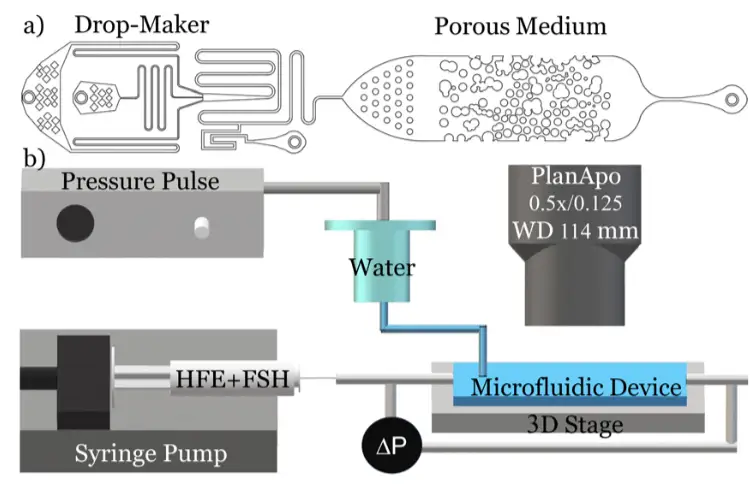
The team built their test platform with a 3D printing and soft-lithography workflow. A resin 3D printer produced a master mold containing the chip’s full channel layout, which was then cast in polydimethylsiloxane (PDMS), cured, and bonded to a glass slide to form the finished device. This single-chip approach combined two functions, droplet generation and porous-medium transport, onto one piece of glass, so droplets could be created and observed without leaving the chip.
That chip was really two connected devices working in sequence, each built to do a specific job.
Drop-Maker
2D Porous Medium
The first section of the chip is an on-chip drop-maker positioned at the device’s inlet. A central channel carries the dispersed water phase, flanked by two channels carrying fluorinated oil as the continuous phase. As the water phase pushes into the oil stream, surface tension pinches off individual droplets in a steady dripping regime, producing a narrow, well-controlled range of droplet sizes. By timing pressure pulses from an external pneumatic pump against a closed water column, the researchers could trigger single droplets on demand, giving them control over both the concentration and injection frequency of emulsions entering the downstream network.
Immediately downstream, the drop-maker feeds directly into the second section of the chip: a two-dimensional porous medium patterned after a real three-dimensional glass bead-pack. The channel layout carries a built-in porosity gradient, more open pore space near the inlet and progressively tighter pores further along, echoing the heterogeneity found in natural soils and rock. This design let the team watch a single droplet’s path evolve as it moved from a relatively open region into a crowded one, and track how earlier trapped droplets reshaped the paths taken by every droplet that followed.
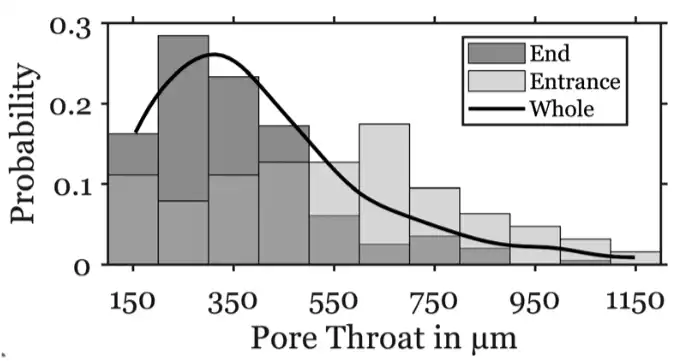
Figure 1. Pore-throat size distribution across the fabricated porous medium. The plot compares pore sizes across the whole medium against just the first third near the inlet and the final two-thirds near the outlet, confirming the built-in gradient from larger, more open pores at the entrance to smaller, more constricted pores toward the outlet. This figure has no lettered panels. Source: Izaguirre M, Parsa S. Emergence of preferential flow paths and intermittent dynamics in emulsion transport in porous media. Soft Matter. 2024.
Both sections of the chip came from the same master mold, printed on a resin-based 3D printer with an XY resolution of 40 × 40 µm² and a Z resolution of 5 µm. Because a smooth mold surface directly affects how well the finished channels perform, the printing settings, including UV exposure and curing time, were tuned for a low-light-dispersion resin to keep edges clean. The printed mold was then filled with PDMS, cured at 60°C, plasma-cleaned, and bonded to a glass slide to seal the channels. To capture what happened inside, the researchers paired a widefield optical microscope with a long-range recording camera running at 50 Hz, illuminated by a collimated RGB backlight for high-contrast footage suitable for automated droplet tracking.
Results
At low droplet concentrations, emulsions didn’t sample the pore network evenly. They preferentially followed the fastest-flowing channels, even when those channels included pores narrower than the droplets themselves. That indiscriminate routing came at a cost: within the first several seconds of injection, more than 65% of droplets became trapped, wedged behind droplets that had arrived just ahead of them.
This trapping reshaped the medium itself. As droplets accumulated, porosity fell from an initial 55% to 49%, and continued injection eventually pushed it down to 36%, a 35% total reduction from the starting value. Despite that substantial structural change, the pressure gradient driving flow barely moved, climbing from only 1400 Pa to 1450 Pa, evidence that the oil phase kept flowing around trapped droplets rather than being blocked outright.
As pore space filled in, later droplets stopped exploring the network at random and instead settled into a small number of preferential flow paths, tortuous routes that persisted for the rest of the experiment. Adding a modest size variation among the droplets opened additional pathways beyond those seen with uniformly sized droplets, since larger droplets squeezing through narrow throats nudged trailing droplets onto new routes.
Tracking each droplet’s full journey also revealed a consistent scaling law: average velocity was inversely proportional to how long a droplet spent in the medium, its residence time. Droplets that passed through quickly moved fast, while droplets that lingered moved slow. One outlier remained trapped for 800 seconds, nearly the full length of the experiment. The relationship held regardless of whether droplets were uniform or mixed in size, pointing to a fundamental feature of how emulsions interact with a porous structure.
“We design an on-chip drop-maker in series with a 2D porous medium.”
— Michael Izaguirre and Shima Parsa, Rochester Institute of Technology, 2024
Products Used In This Study
Questions on how our 3D printing system can work for your research? Connect with one of our specialists.
More Research Article Summaries
McGill University researchers build a 3D printed double-sided mold system to shape and merge brain organoids on a chip
University of Hawaiʻi researchers 3D print wearable "sweatainer" devices with true microscale internal channels
Want to read more article summaries?
We summarize the latest microfluidics and 3D printing research.
Curated from peer-reviewed publications featuring the CADworks3D system.