
Research Article Summary
5 Minute Read
University of Maryland researchers develop a 3D printed spring actuator for targeted gut drug delivery
Title
Thermomechanical Soft Actuator for Targeted Delivery of Anchoring Drug Deposits to the GI Tract
Authors
Joshua A. Levy, Michael A. Straker, Justin M. Stine, et al.
Journal
Advanced Materials Technologies, 2023, Vol. 8, Article 2201365
DOI Link
Summary
Levy et al. developed a compact, 3D printed spring actuator that fires a biomimetic, barbed microneedle drug deposit into gastrointestinal tissue on command, anchoring localized therapy for inflammatory bowel disease directly at the site of inflammation.
Summary Author
This page was prepared by CADworks3D to summarize and highlight a peer-reviewed research article authored by independent researchers utilizing the CADworks3D system.
Title
Thermomechanical Soft Actuator for Targeted Delivery of Anchoring Drug Deposits to the GI Tract
Authors
Joshua A. Levy, Michael A. Straker, Justin M. Stine, et al.
Journal
Advanced Materials Technologies, 2023, Vol. 8, Article 2201365
DOI Link
Key Results at a Glance
22x
Stronger Tissue Anchoring
The anchored microneedle deposit held onto tissue 22 times harder than a traditional molded microneedle array
14.1
On-Command Deployment
The actuator fired and delivered its payload in about 14 seconds inside a simulated intestinal environment
87%
Improved Lateral Stability
The redesigned wave-spring geometry cut sideways wobble by 87% compared to a standard conical spring
25 mm
Drug Spread Radius
The anchored deposit produced consistent, predictable drug diffusion across a 25 mm radius over 168 hours
Objective
Inflammatory bowel disease affects millions of people in the United States and is usually treated with oral or intravenous drugs that travel through the entire body before reaching the gut. Because only a small fraction of the dose ever reaches the inflamed tissue, patients are often given high systemic doses, raising the risk of side effects such as bone loss and increased infection risk.
Existing strategies to localize treatment, such as pH-sensitive coatings and mucus-binding materials, help route drugs toward general regions of the GI tract, and newer ingestible capsules can passively release drugs or microneedles once triggered by moisture or pH changes. However, none of these systems can be triggered on command in response to a sensor reading, and once released, the therapy is not physically anchored at the target site, which limits how long it stays in place.
This gap, a device that fires on command and anchors itself at a specific location for sustained release, is what this study set out to close. The researchers designed a compact spring based actuator paired with a biomimetic anchoring structure inspired by the barbed proboscis of a spiny headed worm, built to fit inside a standard ingestible capsule alongside existing GI sensing electronics.
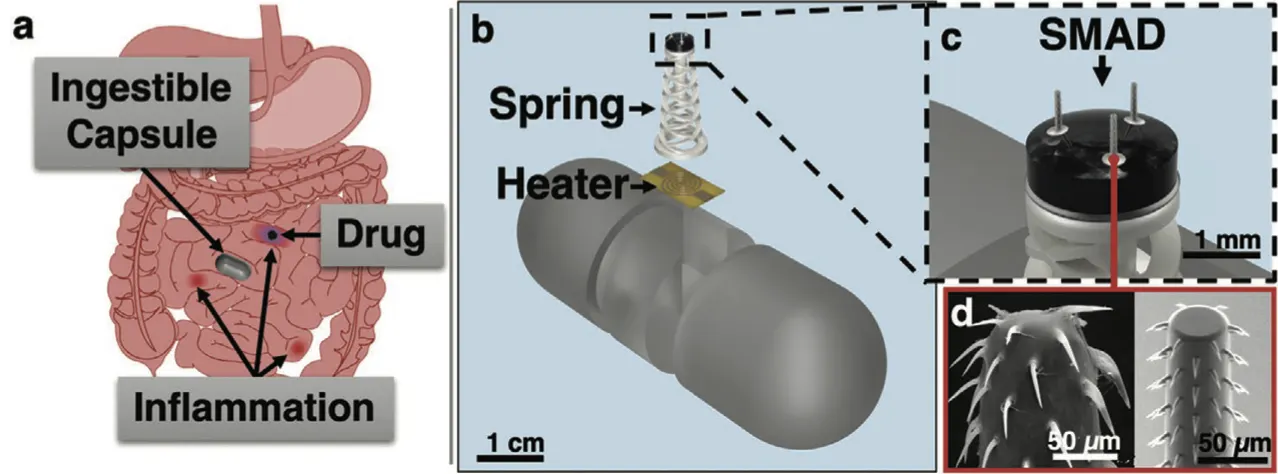
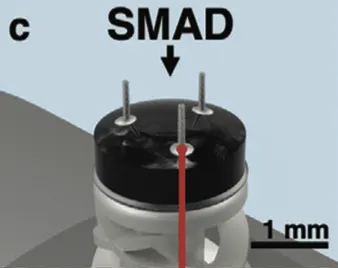
Figure 1. a) The capsule travels through the GI tract and releases its anchored drug deposit directly at an inflamed site. b) On command, a heating element fires the spring actuator, driving the deposit into the tissue. c) CAD rendering of the assembled drug deposit sitting on top of the spring actuator. d) The barbed microneedle design, adapted from the team's earlier work, mimics the anchoring proboscis of a spiny-headed worm. Source: Levy et al. Thermomechanical Soft Actuator for Targeted Delivery of Anchoring Drug Deposits to the GI Tract. Advanced Materials Technologies. 2023. Panel d adapted under CC-BY license from the authors' prior work.
Methodology and Design
The device is built by combining two 3D printing methods: a digital light processing (DLP) process to print a flexible spring, and a much finer direct laser writing process to print the anchoring microneedle tips. These parts, along with a drug loaded film and a microfabricated heater, are stacked and bonded into a single unit small enough to fit inside an ingestible capsule.
Three components work together to make this possible.
Wave Spring Actuator
SMAD Microneedle
Resistive Micro-Heater
The spring was redesigned from a standard conical coil into a wave-like shape with four overlapping coils. This layout keeps the same footprint as a typical capsule spring but resists sideways wobble far better, which matters both for reliable firing inside a narrow capsule and for consistent 3D printing, since a spring that sways during printing can misalign between layers and fail. The spring is held compressed against a wax-like polymer until it is time to fire.
Sitting on top of the spring is the SMAD, a small disk that pairs a water-soluble, dye-loaded drug layer with a cluster of barbed, hollow microneedles patterned to mimic the anchoring proboscis of a spiny-headed worm. The barbs let the deposit lock into gut tissue and stay in place after the actuator retracts, rather than being swept away by intestinal motion, giving the drug time to diffuse into surrounding tissue.
Deployment is triggered by a thin gold heater built on a flexible polyimide film. A short electrical pulse from a coin-cell-sized battery heats the wax-like polymer holding the spring compressed. Once it melts, the spring releases and drives the SMAD into tissue in roughly 14 seconds.
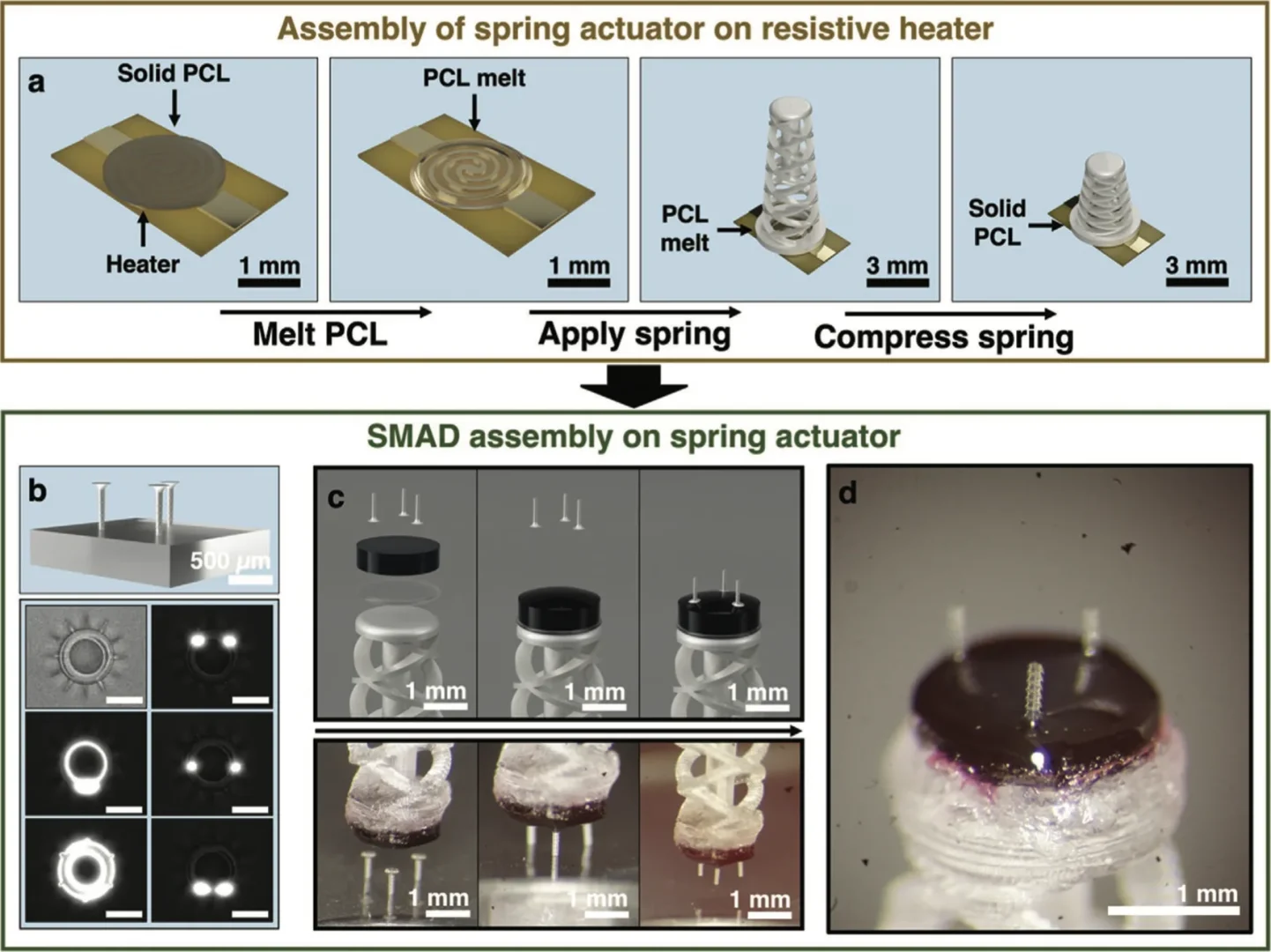
Figure 2. a) Assembly sequence: polycaprolactone is melted onto the resistive heater, then the spring is pressed down and locked in place as the polymer solidifies. b) CAD layout of the microneedle print pattern, alongside images captured during 3D printing that show the needles' hollow shaft and barb structure taking shape. c) The drug disk is attached to the actuator, then the microneedles are bonded on and mechanically freed from the print substrate. d) The finished drug deposit, fully assembled on top of the actuator. Source: Levy et al. Thermomechanical Soft Actuator for Targeted Delivery of Anchoring Drug Deposits to the GI Tract. Advanced Materials Technologies. 2023.
On the fabrication side, the springs were printed at 50 µm resolution, with each layer cured for 1.5 seconds and a 5 second base cure, then rinsed and post-cured in a UV water bath before storage in a humidity controlled chamber to preserve flexibility. A blended resin formulation was used to balance flexibility against stiffness, giving the spring enough give to compress without breaking while still storing enough force to drive the microneedles into tissue. The microneedle tips were printed upside down on a separate rigid substrate, then bonded to the drug disk with a biocompatible epoxy and mechanically released once the adhesive cured, a process similar to freeing a part from a mold. The heater itself was calibrated separately: an initial batch measured 55% off the target resistance, so the metal film thickness was adjusted and reprinted, bringing the finished heaters to within 0.4% of the intended 50 ohm design value.
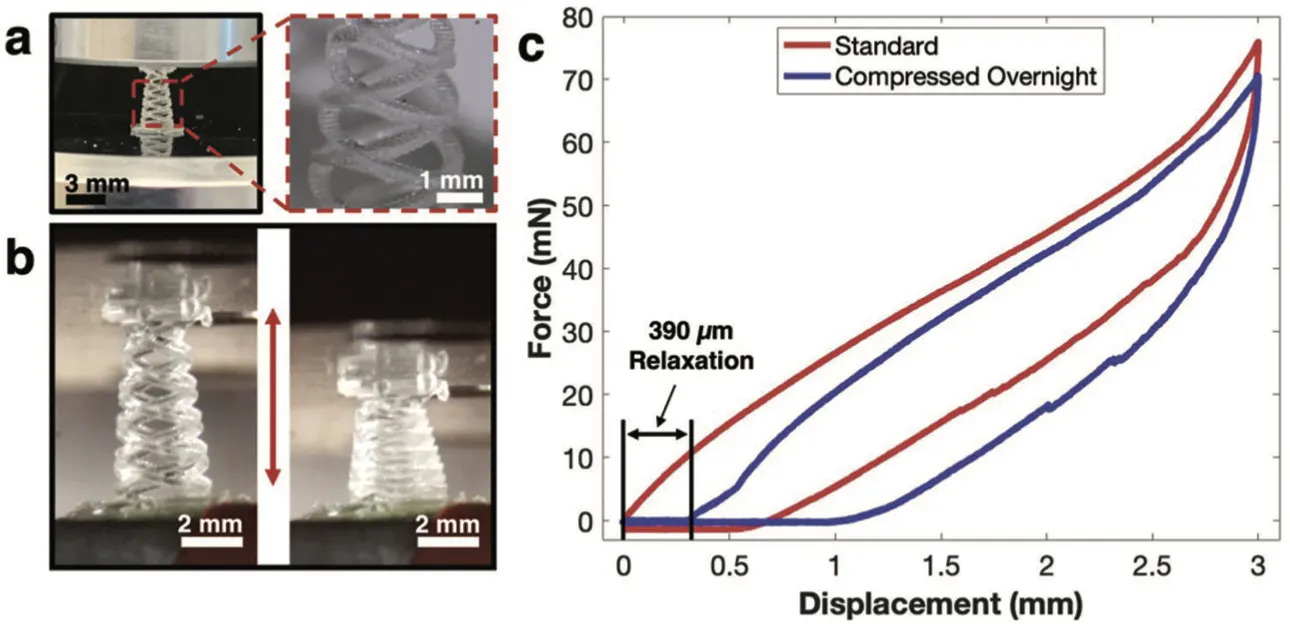
Figure 3. A close-up of the 3D printed spring during compression testing. The visible stair-step texture on the surface comes from the individual print layers laid down during the DLP printing process. Source: Levy et al. Thermomechanical Soft Actuator for Targeted Delivery of Anchoring Drug Deposits to the GI Tract. Advanced Materials Technologies. 2023.
Results
Mechanical testing confirmed the redesigned wave spring behaves as intended. Simulations showed the new geometry reduced sideways deflection by 87% compared to a standard conical spring under the same load, and physical compression testing measured a spring constant of 25.4 ± 1.4 mN/mm, reproducible to within about 5%. This is well above the roughly 0.6 mN needed to drive the barbed microneedles into tissue, leaving a comfortable safety margin.
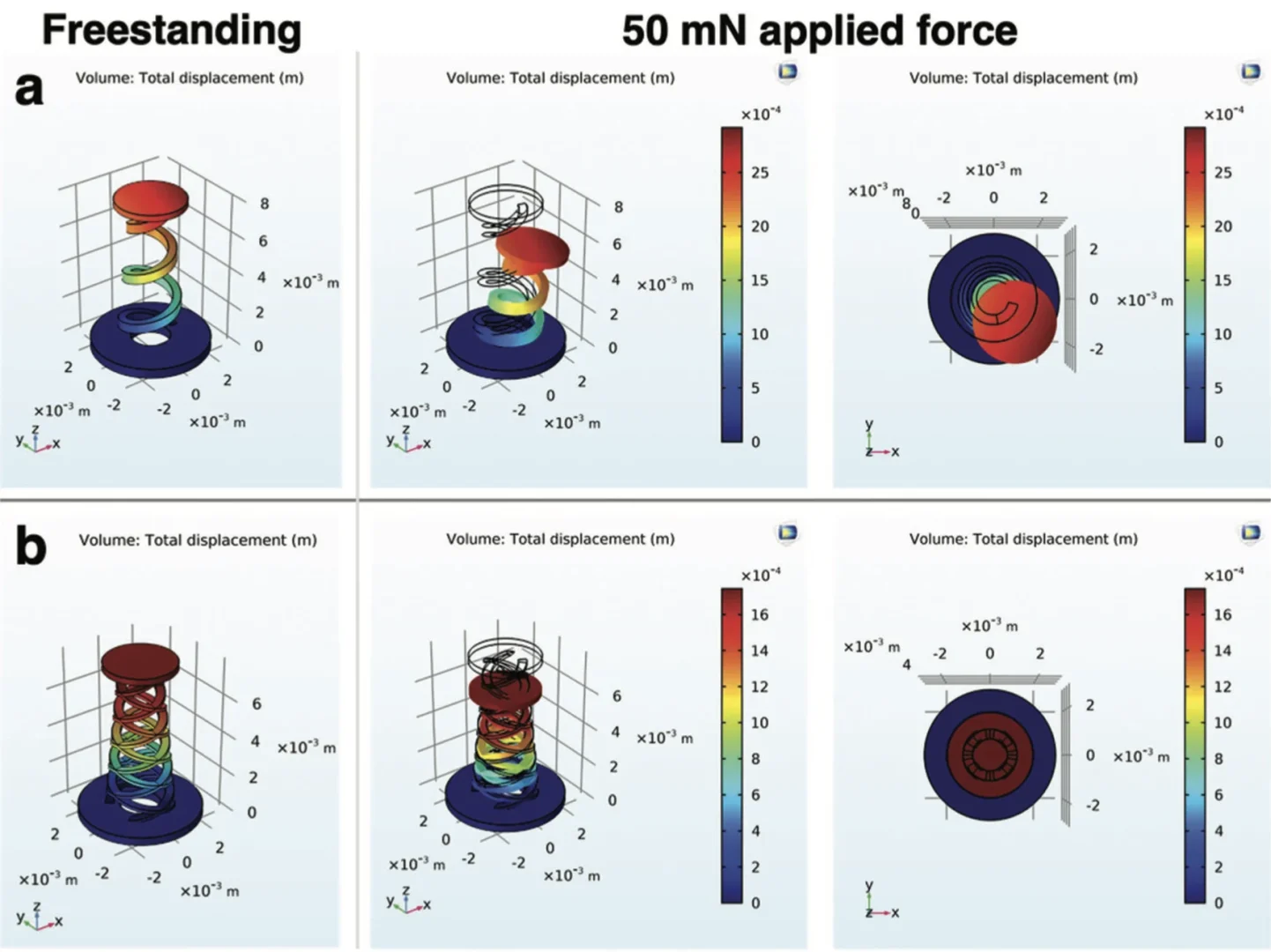
Figure 4. a) Simulation of a standard conical coil spring, which showed 1,341 µm of sideways movement under a 50 mN load. b) Simulation of the redesigned wave-like spring, which showed only 172 µm of sideways movement under the same load, an 87% improvement in lateral stability. Source: Levy et al. Thermomechanical Soft Actuator for Targeted Delivery of Anchoring Drug Deposits to the GI Tract. Advanced Materials Technologies. 2023.
When fired inside a simulated intestinal environment moving at a typical gut transit speed, the actuator released its payload in 14.1 ± 3.0 seconds, with the capsule traveling only about 3.3 mm between firing and tissue contact, well within the 22 mm size limit for an ingestible capsule. Deployment was reliable across repeated trials, with no failed firings recorded during controlled testing.
The barbed SMAD also outperformed a traditional cast microneedle array on anchoring. The SMAD held onto tissue with 22 times more force than the molded comparison structure, comfortably exceeding the pull needed to detach it from the actuator, so it reliably released and stayed anchored. In diffusion testing with a dye loaded model drug, the SMAD produced a spread radius of up to 25 mm over 168 hours in phantom tissue, tracking closely with the molded microneedle comparison group, showing the anchored deposit delivers its payload just as predictably as an established microneedle format while adding a far stronger hold.
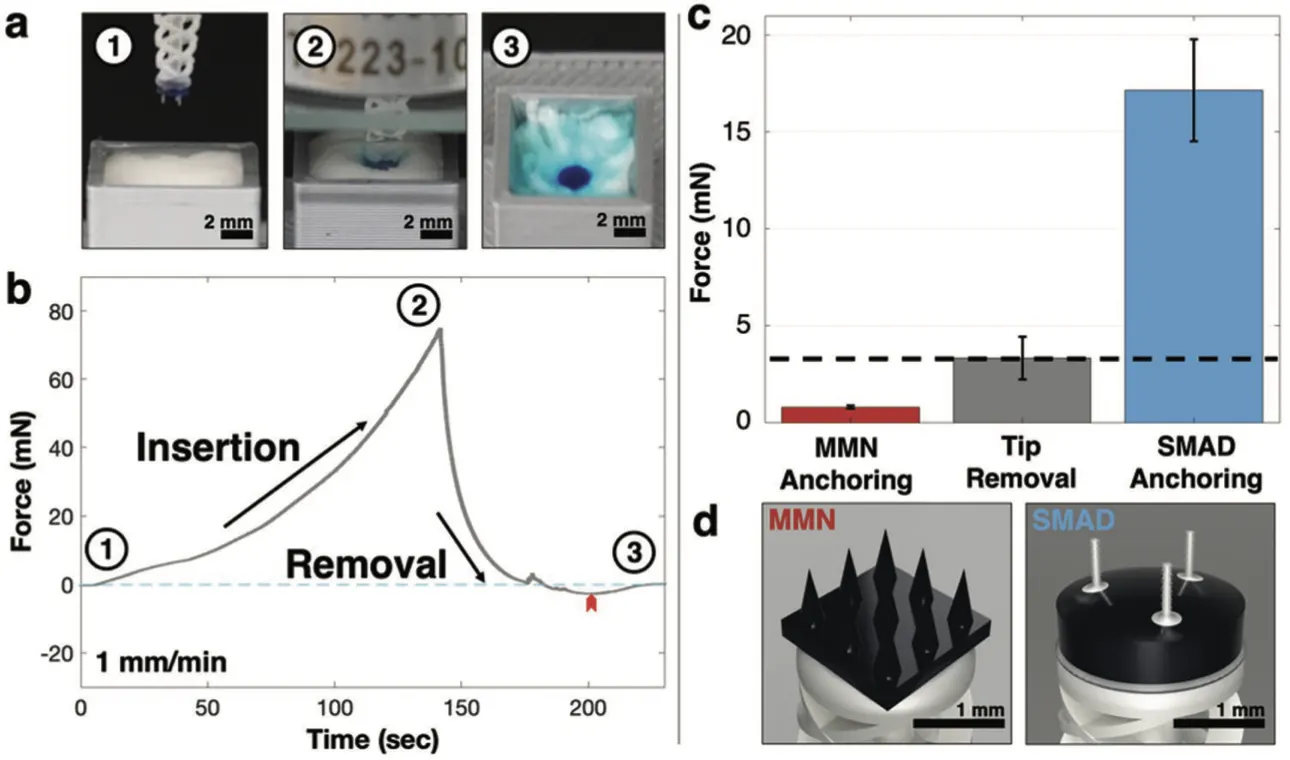
Figure 5. CAD comparison of the traditional molded microneedle structure (left) against the barbed microneedle drug deposit developed in this study (right). Source: Levy et al. Thermomechanical Soft Actuator for Targeted Delivery of Anchoring Drug Deposits to the GI Tract. Advanced Materials Technologies. 2023.
“a compact mesoscale spring actuator capable of delivering an anchoring drug deposit to point locations in the GI tract is demonstrated.”
— Levy et al., Advanced Materials Technologies (2023)
Products Used In This Study
Questions on how our 3D printing system can work for your research? Connect with one of our specialists.
More Research Article Summaries
McGill University researchers build a 3D printed double-sided mold system to shape and merge brain organoids on a chip
University of Hawaiʻi researchers 3D print wearable "sweatainer" devices with true microscale internal channels
Want to read more article summaries?
We summarize the latest microfluidics and 3D printing research.
Curated from peer-reviewed publications featuring the CADworks3D system.