
Research Article Summary
5 Minute Read
UC Santa Barbara researchers 3D print molds to build microfluidic mixers without a cleanroom

Title
Design and Characterization of a 3D-printed Staggered Herringbone Mixer
Authors
Vedika J. Shenoy, Chelsea E.R. Edwards, Matthew E. Helgeson, et al.
Journal
BioTechniques, Volume 70, Issue 5, pp. 285 to 289 (2021)
DOI Link
Summary
Shenoy et al. show that a desktop DLP 3D printer can produce accurate, reusable molds for PDMS microfluidic mixers, offering a faster alternative to cleanroom photolithography. The team mapped the printer’s resolution limits and confirmed that mixing performance holds up even when printed molds carry small defects.
Summary Author
This page was prepared by CADworks3D to summarize and highlight a peer-reviewed research article authored by independent researchers utilizing the CADworks3D system.
Title
Design and Characterization of a 3D-printed Staggered Herringbone Mixer
Authors
Vedika J. Shenoy, Chelsea E.R. Edwards, Matthew E. Helgeson, et al.
Journal
BioTechniques, Volume 70, Issue 5, pp. 285 to 289 (2021)
DOI Link
Key Results at a Glance
100 µm
Minimum Reliable Feature Size
Smallest herringbone groove width the 3D printer reproduced consistently
CV < 0.1
Fully Mixed Output
Achieved within three to five mixing cycles across the tested flow rates
41 mm
Total Mixer Channel Length
Five mixing cycles fit onto a single 3D printed chip
2x Defects, No Difference
Defect Tolerant Performance
A heavily defected mold matched a clean mold by the third mixing cycle
Objective
Microfluidic devices route and process fluids through channels smaller than a millimeter wide, and mixing those fluids efficiently is one of the field’s basic challenges. Because flow at this scale is smooth and layered, a state known as laminar flow, two liquid streams sitting side by side in a channel will not blend on their own. Left alone, they only combine through slow molecular diffusion, which would require impractically long channels to finish the job.
The staggered herringbone mixer, or SHM, solves this problem with a clever piece of geometry. Angled grooves cut into the floor or ceiling of the channel push fluid into rotating, eddy-like patterns as it flows past. Reversing the groove direction partway through each cycle keeps folding the two streams over each other, and after a few cycles they are thoroughly blended. SHMs are valued in biomedical research because they mix gently, without generating damaging shear forces, making them useful for drug delivery, chemical synthesis, sample concentration, and diagnostic tools that handle cells or biomolecules.
Traditionally, the molds used to cast these mixers out of polydimethylsiloxane, or PDMS, are made using photolithography. This is a precise process, but it requires a cleanroom, specialized equipment, and trained personnel, which limits how quickly researchers can prototype and refine new microfluidic designs. 3D printing has emerged as a faster, more accessible way to produce these molds directly from a CAD file, cutting fabrication time from days to hours. However, most 3D printers cannot resolve features as small as photolithography can, and prints can vary from one build to the next. Before labs can rely on 3D-printed molds for SHMs, researchers need to understand how a printer’s resolution, calibration, and part-to-part variability affect the finished device’s ability to mix fluids well. That gap is what this study set out to address.
Methodology and Design
The overall workflow followed a standard replica molding pipeline, adapted around the limits of the 3D printer. Each mixer geometry was drawn in CAD software, then printed as a raised channel mold using a digital light processing, or DLP, 3D printer. Liquid PDMS was poured over the printed mold, degassed to remove air bubbles, cured, and peeled away as a finished, channel patterned device.
To understand how printing quality would affect a working device, the researchers built and tested two kinds of 3D printed structures:
Calibration Test Channels
Staggered Herringbone Mixer
The calibration channels used for printer benchmarking were a simple series of raised rectangular ridges, printed with heights and widths spanning roughly 25 to 700 µm, used purely to map out what the printer could and could not reproduce. Imaging the printed parts showed that they consistently came out smaller than the programmed design, especially in height. Still, the gap between the design and the actual result was consistent enough that the team could adjust their CAD dimensions to compensate. Features designed at 120 µm and above printed reliably at close to 100 µm, while anything smaller tended to deform or disappear entirely. Applying the same logic to the herringbone grooves themselves, grooves with a spacing under 300 µm often fused together with their neighbors, so the team fixed a 100 µm minimum feature size and a 300 µm groove spacing for every SHM built afterward.
With those constraints in place, the final SHM geometry departed somewhat from the dimensions recommended in earlier photolithography-based designs, since the printer could not resolve features as fine as 50 µm. The team settled on a groove width of 100 µm, a width-to-spacing ratio of about 0.45, a herringbone-to-channel height ratio of about 0.36, and a groove angle near 95 degrees, informed by earlier computational work on optimal mixing angles. Ten herringbones made up each half cycle, and five full mixing cycles were placed on a single chip, for a total channel length of about 41 mm. PDMS was mixed at a 10 to 1 ratio with its curing agent, poured over the printed mold, degassed for about two hours, and cured at 60 to 80 degrees Celsius for four hours before being removed as the finished mixer. To test mixing performance, the researchers flowed a fluorescent dye solution through one inlet and plain water through the other at matched flow rates spanning Peclet numbers of 200 to 8000, then imaged the fluorescence pattern across the channel to measure how evenly the two streams had blended after each mixing cycle.
Results
The printer calibration work confirmed that 3D printed molds can reliably reproduce the small, precise features an SHM needs, once their limits are known. Features at or above a 100 µm minimum size printed consistently and predictably, giving the team a dependable design rule to carry into future molds.
Once built, the 3D-printed SHMs mixed fluids effectively across a wide range of flow rates. Streams reached a well-mixed state, defined as a coefficient of variation below 0.1, within three to five mixing cycles for Peclet numbers between 200 and 6000, matching a total chip length of 41 mm. Only at very high flow rates, above a Peclet number of 6000, did the channel run out of length before the streams fully blended. Compared with equivalent devices made using photolithography, the 3D-printed mixers needed slightly more cycles to reach the same mixing quality, a modest tradeoff for skipping the cleanroom entirely.
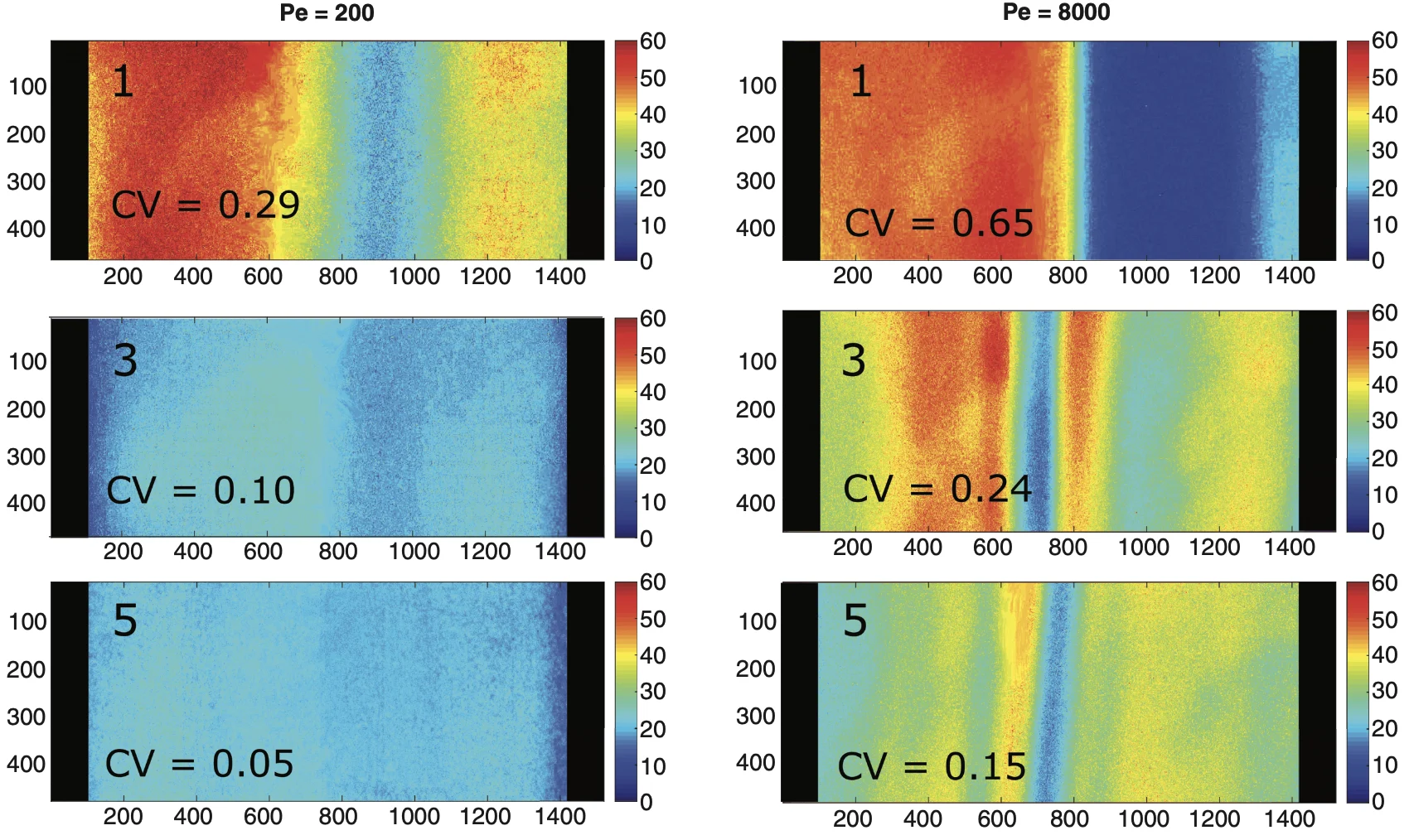
Figure 1. Fluorescence cross-sections of the mixer's output at a low and a high flow rate. Red marks unmixed dye, blue and green mark a blended stream. At the slower flow rate, the 3D-printed device produced a fully uniform output by the fifth mixing cycle. Source: Shenoy et al. Design and Characterization of a 3D-printed Staggered Herringbone Mixer. BioTechniques. 2021.
Print-to-print variation also turned out not to be a serious concern. When the researchers compared two individually printed devices, one containing twice as many defects as the other, the more defective device showed weaker mixing only in the first two cycles. By the third cycle, both devices performed the same. This result suggests that labs do not need to inspect and validate every single printed mold before use once the printer itself has been characterized, a meaningful time saving for high-throughput manufacturing of these devices.
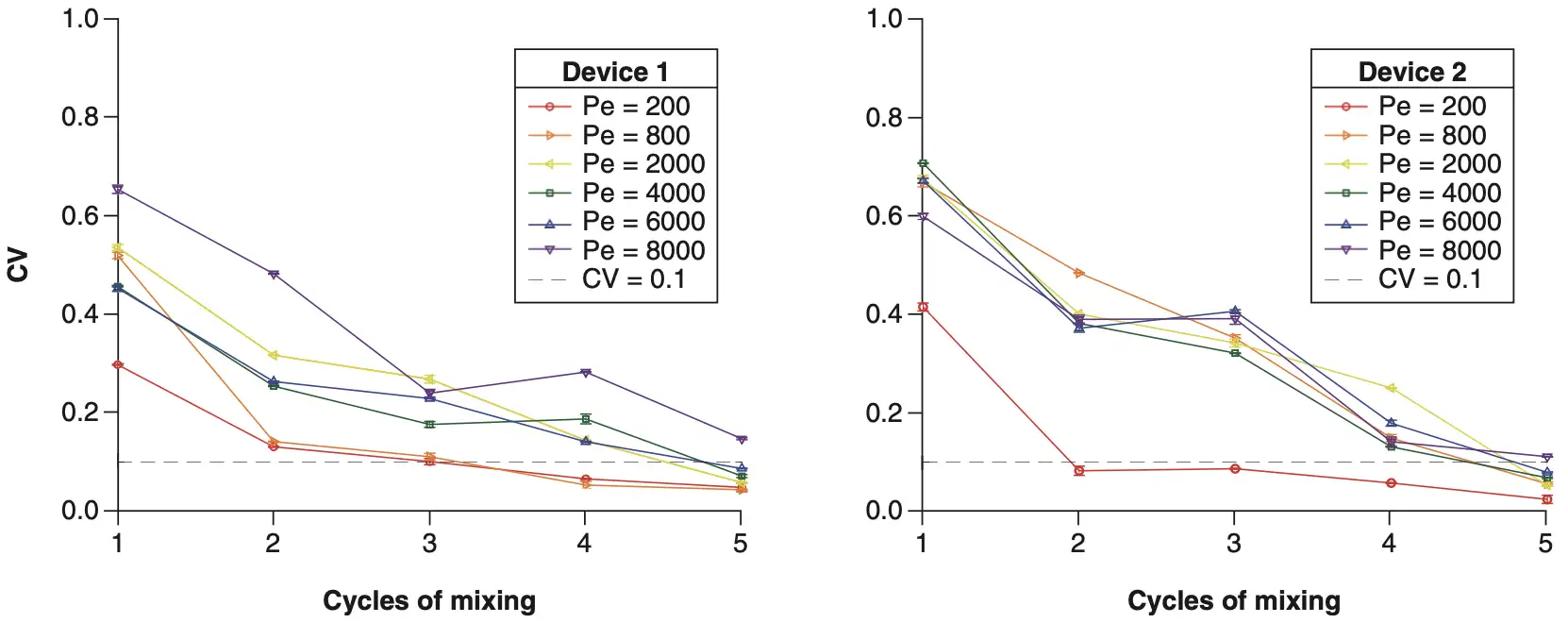
Figure 2. Mixing quality plotted against cycle count for two separately printed mixers, tested across flow rates from a Peclet number of 200 to 8000. Both printed devices, despite being individually molded, reach the mixing threshold along a nearly identical curve. Source: Shenoy et al. Design and Characterization of a 3D-printed Staggered Herringbone Mixer. BioTechniques. 2021.
“We show that SHMs produced by 3D printing generate well-mixed output streams across devices with variable heights and defects, demonstrating that 3D printing is suitable and advantageous for low-cost, high-throughput SHM manufacturing.”
— Shenoy et al., BioTechniques, 2021
Products Used In This Study
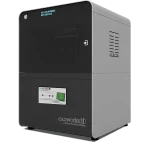
Questions on how our 3D printing system can work for your research? Connect with one of our specialists.
More Research Article Summaries
McGill University researchers build a 3D printed double-sided mold system to shape and merge brain organoids on a chip
University of Hawaiʻi researchers 3D print wearable "sweatainer" devices with true microscale internal channels
Want to read more article summaries?
We summarize the latest microfluidics and 3D printing research.
Curated from peer-reviewed publications featuring the CADworks3D system.